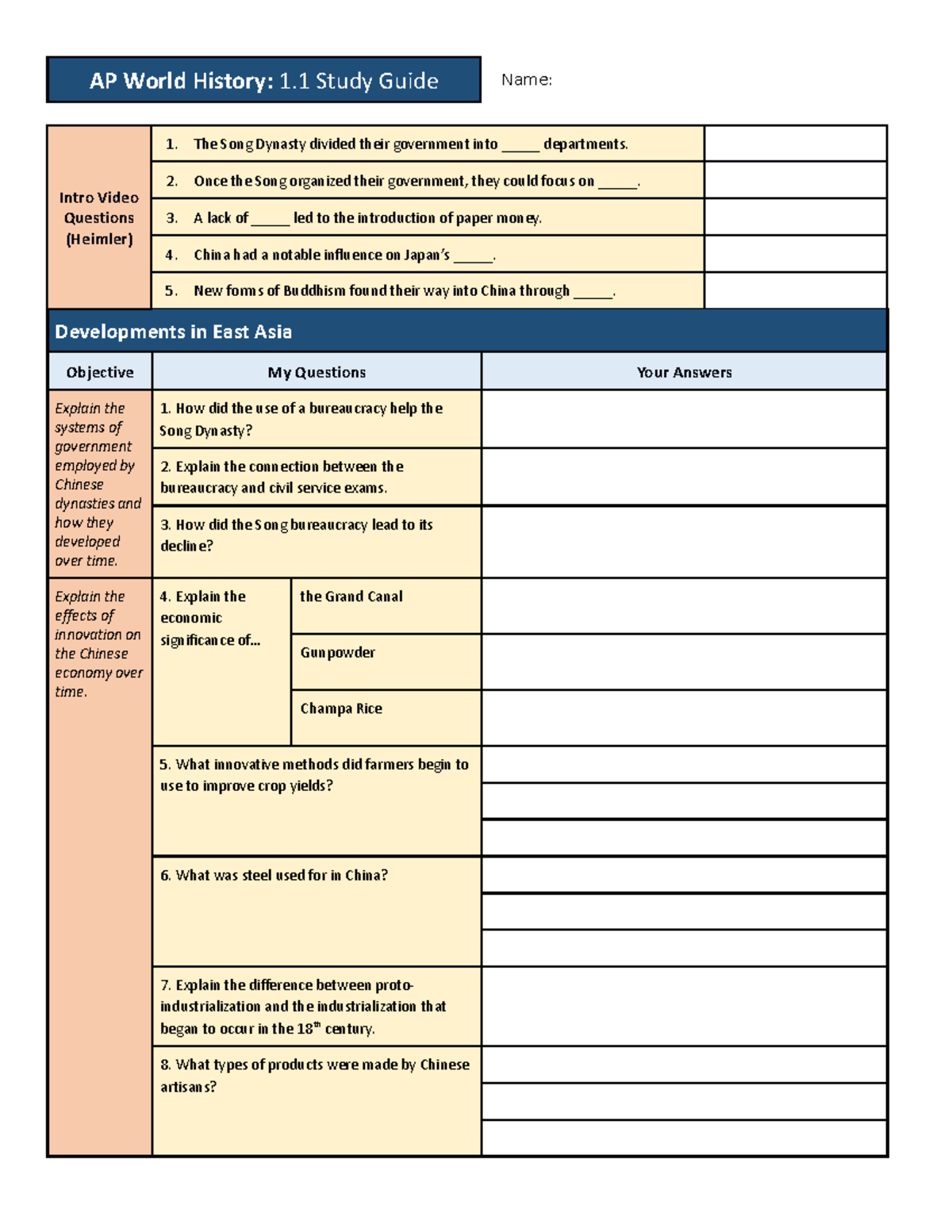
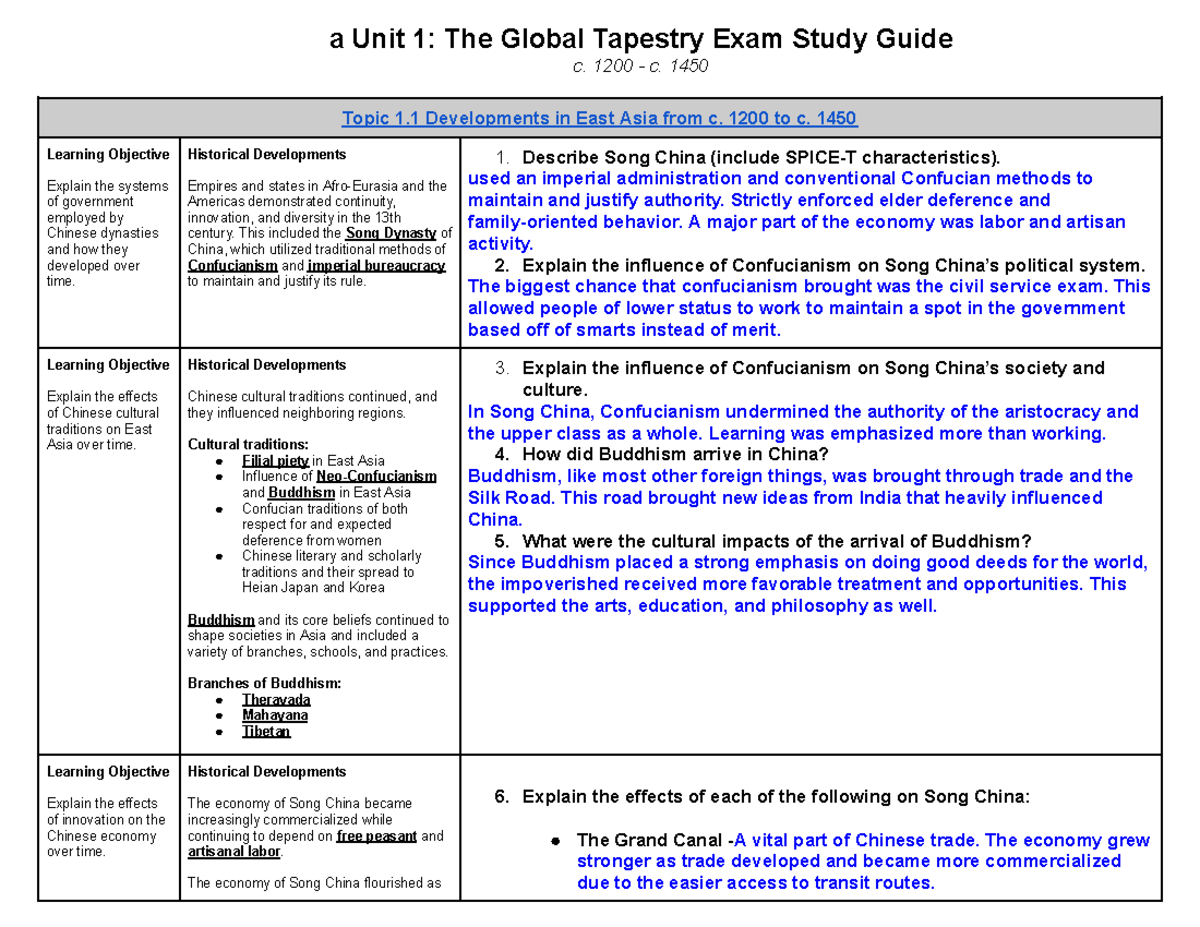
Accessing a high-quality AP World History Unit 1 multiple choice questions PDF is a fundamental step for students preparing for the AP World History: Modern exam in 2026. These resources provide targeted practice on the "Global Tapestry" (c. 1200–c. 1450), helping students master the stimulus-based question format required by the College Board to achieve a high score.
Understanding the Scope of AP World History Unit 1
Unit 1 of the AP World History: Modern curriculum, titled The Global Tapestry, covers the period from approximately 1200 to 1450. This unit is designed to set the stage for the global interactions that define the later periods of the course. Rather than focusing on a single global narrative, Unit 1 examines how different regions—East Asia, Dar al-Islam, South and Southeast Asia, the Americas, Africa, and Europe—developed internally and maintained their own unique social and political structures.
For students looking for a practice PDF, it is important to realize that the multiple-choice questions (MCQs) in this unit will not simply ask for dates or names. Instead, they are stimulus-based. This means every question or set of questions is linked to a primary or secondary source, such as an excerpt from a traveler’s journal, a map of trade routes, an image of an architectural feat, or a statistical table regarding crop yields.
Key Regions and Concepts to Study
To effectively use any practice PDF, you must first ensure you have a firm grasp of the following regional developments:
- East Asia: Focus on the Song Dynasty, the utilization of Confucianism and the Civil Service Exam to maintain imperial bureaucracy, and the impact of Chinese cultural traditions on neighboring regions like Heian Japan and Korea.
- Dar al-Islam: Understand the fragmentation of the Abbasid Caliphate and the rise of new Islamic political entities like the Seljuk Empire, the Mamluk Sultanate of Egypt, and the Delhi Sultanates. Pay close attention to the intellectual innovations coming out of the House of Wisdom in Baghdad.
- South and Southeast Asia: Study the role of Hinduism, Buddhism, and Islam in shaping societies, and the emergence of states like the Vijayanagara Empire and the Srivijaya Empire.
- The Americas: Analyze the sophisticated state-building of the Maya, the Mexica (Aztecs), and the Inca, focusing on their agricultural innovations and centralized control.
- Africa: Evaluate the growth of states such as Great Zimbabwe, Ethiopia, and the Mali Empire, particularly their role in trade networks.
- Europe: Examine the decentralized nature of West European society (Feudalism and Manorialism) and the profound influence of the Catholic Church.
The Structure of AP World History Stimulus-Based MCQs
As of the 2026 exam cycle, the AP World History MCQ section consists of 55 questions to be completed in 55 minutes. This section accounts for 40% of your total exam score. When you download an AP World History Unit 1 multiple choice questions PDF, the practice sets should mirror the specific structure used by the College Board.
The Anatomy of a Question Set
Each set typically contains three to four questions based on a single stimulus. The questions are tiered to test different historical thinking skills:
- Contextualization: Can you place the document within the broader historical events of 1200–1450?
- Comparison: How does the development described in the stimulus compare to a development in another region?
- Causation: What were the primary causes or effects of the situation described in the text or image?
- Continuity and Change: Does the stimulus represent a break from the past or a continuation of existing traditions?
Why PDF Practice is Superior to Flashcards
While flashcards are useful for learning definitions (like "Filial Piety" or "Champa Rice"), they do not prepare you for the cognitive load of the actual exam. A PDF practice exam forces you to engage in sourcing analysis. You must identify the author's point of view, the intended audience, and the historical situation to determine which answer choice is the "most" correct. In the AP exam, often two or three answers are factually true, but only one directly answers the question in the context of the provided stimulus.
Detailed Breakdown of Unit 1 Topics for MCQ Preparation
To maximize the utility of your practice questions, you should review the specific "Illustrative Examples" provided by the College Board. Examiners often pull these specific examples to create distractors or correct answers.
State Building in the Song Dynasty
The Song Dynasty (960–1279) is a frequent subject of Unit 1 MCQs. Questions often focus on the transition from the Tang to the Song and the "Economic Revolution" of the Song.
- Technological Innovations: Be prepared for questions about the Grand Canal, gunpowder, and the expansion of the Champa rice variety from Vietnam, which led to a population explosion.
- Social Structures: Understand the role of Neo-Confucianism in reinforcing patriarchy (e.g., foot-binding) while also providing a framework for the civil service examinations that allowed for limited social mobility.
The Expansion of Dar al-Islam
Between 1200 and 1450, Islamic civilization was the world's leader in scientific and philosophical thought. Practice questions often use excerpts from scholars like Nasir al-Din al-Tusi or Aishah al-Ba'uniyyah.
- Transfers: MCQs frequently test the "transfer" of knowledge, such as the preservation of Greek philosophy, the adoption of Indian numerals, and the spread of papermaking from China to Europe through Islamic intermediaries.
- Trade and Religion: Understand how Islam spread through both military conquest and the activities of merchants and Sufi missionaries.
Comparison of Regional Governance (1200–1450)
The following table summarizes the key governance styles you will encounter in Unit 1 MCQ sets. Comparing these is a high-yield study strategy.
| Region | Primary State/Empire | Governance Style | Key Source of Legitimacy |
|---|---|---|---|
| East Asia | Song Dynasty | Highly Centralized Bureaucracy | Mandate of Heaven / Confucianism |
| Middle East | Abbasid/Mamluk | Fragmented Caliphates | Islamic Law (Sharia) / Caliphate |
| South Asia | Delhi Sultanate | Muslim minority ruling Hindu majority | Religious Tolerance/Tribute |
| Americas | Inca Empire | Centralized Bureaucracy (Mit'a system) | Divine Kingship (Sun God) |
| Europe | Holy Roman Empire / Feudal States | Decentralized Feudalism | Divine Right / Catholic Church |
| West Africa | Mali Empire | Centralized Monarchy | Control of Gold-Salt Trade Routes |
Strategies for Analyzing Stimulus-Based Questions
When working through an AP World History Unit 1 multiple choice questions PDF, you should apply a systematic approach to each stimulus. This prevents "skimming" and ensures you don't fall for common traps.
1. Read the Source Citation First
Before reading the actual text or looking at the map, look at the citation at the bottom or top. It tells you the author, the date, and the location. If the date is 1324 and the location is Mali, you should immediately think of Mansa Musa’s pilgrimage to Mecca. This mental priming helps you filter out irrelevant answer choices.
2. Identify the "Big Idea"
Every stimulus is chosen because it illustrates a specific concept from the AP Course and Exam Description (CED). Ask yourself: "Is this document showing me trade, religion, state-building, or social hierarchy?" Once you identify the "Big Idea," the questions become much easier to navigate.
3. Use the Process of Elimination
In AP World History, "distractor" answers are often:
- Chronologically Incorrect: The answer describes something that happened in 1750, not 1250.
- Geographically Incorrect: The answer describes an event in China when the question is about India.
- Factually True but Irrelevant: The statement is a true fact about history, but it does not answer the specific question being asked about the stimulus.
Sample Practice Question and Explanation
To illustrate the depth required, consider a hypothetical stimulus: An excerpt from the travels of Ibn Battuta describing the wealth and piety of the Sultan of Mali.
Sample Question: The description of the Sultan of Mali in the passage best illustrates which of the following historical developments in the period c. 1200–c. 1450? A) The expansion of the Mongol Empire across Afro-Eurasia. B) The spread of Islam through merchant activity and state sponsorship. C) The decline of the silk roads due to maritime innovations. D) The rise of feudalism in Western Europe.
Correct Answer: B. Explanation: Ibn Battuta’s travels are a classic example of the "Global Tapestry" and the "Interconnections" of Dar al-Islam. The Mali Empire became a center of Islamic learning and wealth due to its control of the trans-Saharan trade routes. Option A is incorrect as the Mongols did not reach West Africa. Option C is incorrect because the Silk Roads were actually peaking under the Pax Mongolica. Option D is irrelevant to the West African context.
Where to Find Reliable AP World History Unit 1 PDFs
While many websites offer practice questions, you should prioritize those that align with the post-2019 exam redesign. The following sources are considered gold standards for practice materials in 2026:
- AP Central (College Board): The official source for past exam questions. While they rarely release full Unit 1 PDFs, their "Course and Exam Description" (CED) contains a sample set of Unit 1 questions.
- Khan Academy: As the official partner of the College Board, their questions are modeled exactly after the real exam. You can often export these or find compiled PDF versions from educational aggregators.
- High School Teacher Websites: Many veteran AP teachers (e.g., those at sites like Freeman-pedia or Heimler’s History) provide curated PDFs specifically for Unit 1.
- Major Prep Books: Publishers like Barron's, The Princeton Review, and Kaplan provide full-length practice tests that can be found in PDF format through authorized digital versions of their 2026 editions.
Common Pitfalls to Avoid in Unit 1
Students often struggle with Unit 1 because it feels "disconnected" compared to later units like the World Wars. Avoid these common mistakes:
- Ignoring the Dates: 1200 is the start date. If a question mentions the Crusades (which began in 1095), remember that for this course, you are looking at the effects and continuations of those events into the 13th century.
- Eurocentrism: Unit 1 is intentionally designed to show that Europe was not the center of the world during this time. The most powerful and innovative states were in East Asia and the Islamic world. If your answer choice suggests Europe was dominating global trade in 1300, it is likely wrong.
- Over-Memorization: Do not spend hours memorizing the names of every minor king. Focus on the systems of power—how they collected taxes, how they used religion to justify their rule, and how they treated different ethnic groups.
Frequently Asked Questions
What is the most important topic in AP World History Unit 1?
The most important topic is State Building. The College Board wants you to understand how various empires (Song, Abbasid, Inca, Mali) maintained and justified their power through different cultural, religious, and bureaucratic methods.
How many questions on the AP Exam are from Unit 1?
Unit 1 (The Global Tapestry) and Unit 2 (Networks of Exchange) combined make up approximately 16% to 20% of the multiple-choice section. Specifically, you can expect about 8 to 11 questions to focus exclusively on Unit 1 content.
Are the multiple-choice questions in the PDF the same as the real exam?
No. The College Board keeps its current exam questions secure. However, reputable practice PDFs use the same "stimulus-based" format and difficulty level, ensuring that the skills you practice are directly transferable to the actual test in May.
Can I use Unit 1 MCQs to study for the DBQ?
Yes. The content you learn for the MCQs provides the Evidence and Contextualization you need for the Document-Based Question (DBQ) and Long Essay Question (LEQ). Understanding the nuances of Song Dynasty bureaucracy, for instance, allows you to provide "outside evidence" in an essay about state-building.
Is the Song Dynasty or the Mongol Empire in Unit 1?
The Song Dynasty is the centerpiece of Unit 1. The Mongol Empire, while it began in the early 1200s, is primarily covered in Unit 2 (Networks of Exchange) because its most significant impact was on trade and connectivity across the Silk Roads.
Final Recommendation for Students
To succeed, do not just take one practice test. Download an AP World History Unit 1 multiple choice questions PDF and take it under timed conditions. Once finished, spend more time reviewing the explanations for the questions you got wrong than you did taking the test. Understanding why a distractor was tempting—and why it was ultimately incorrect—is the secret to moving from a score of 3 to a 5. Focus heavily on the "Comparison" and "Causation" skills, as these are the most frequently tested historical thinking skills in the Unit 1 MCQ section.