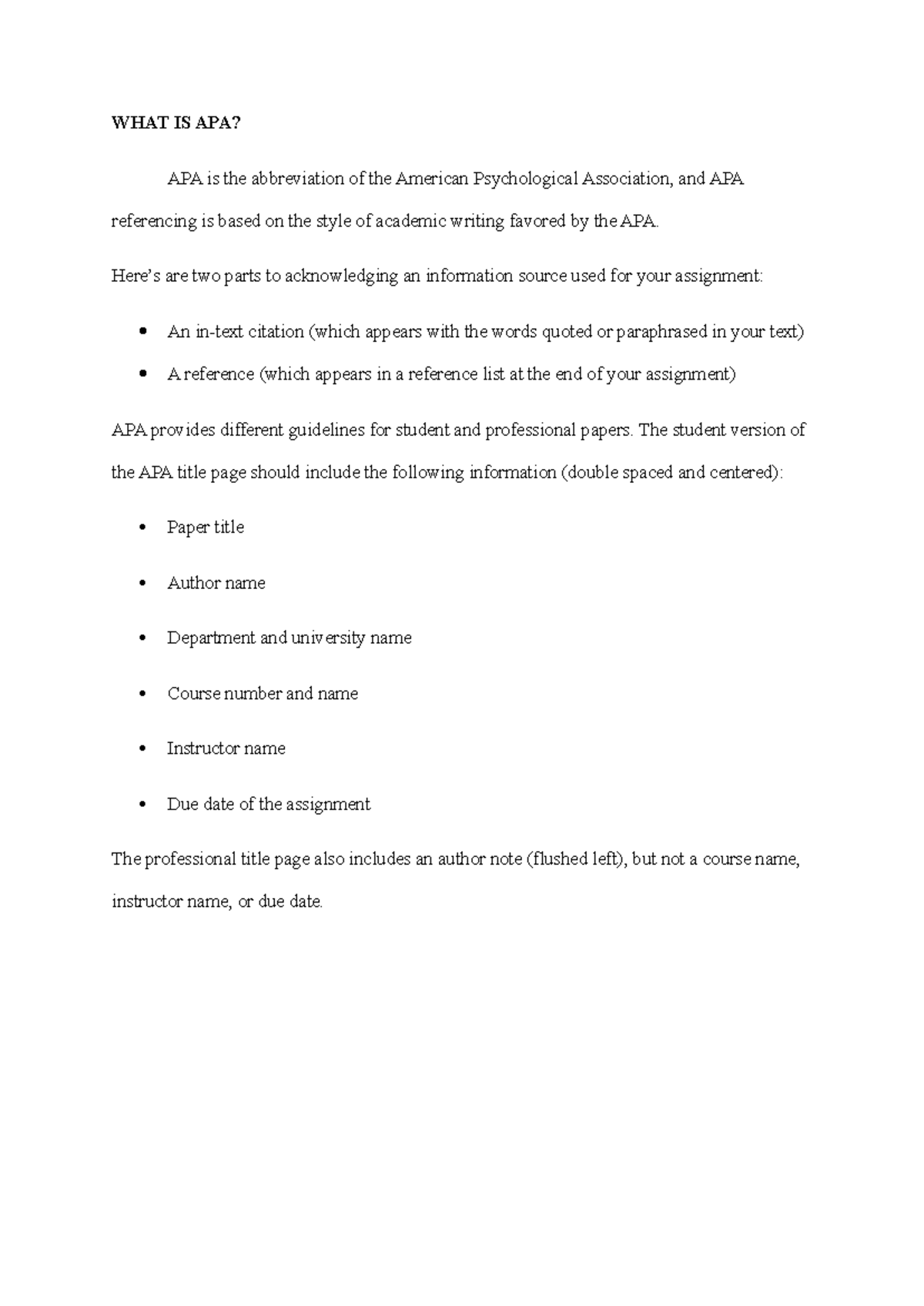
In academic and professional contexts, the abbreviation APA most commonly stands for the American Psychological Association. When referred to as a "standard," it signifies the APA Style, a specialized set of guidelines for formatting manuscripts and citing sources used primarily in the social and behavioral sciences to ensure clarity and consistency.
The term "APA" has become a ubiquitous shorthand in universities, research institutions, and publishing houses worldwide. While the acronym itself is simple, the standard it represents is a complex, evolving framework that governs how scientific knowledge is documented and shared. Understanding what these three letters represent requires more than just knowing the organization’s name; it involves understanding a century-long commitment to standardized communication, intellectual integrity, and the democratization of information.
The Identity Behind the Acronym: The American Psychological Association
To decode the letters "APA," one must first look at the organization that birthed the standard. The American Psychological Association was founded in July 1892 at Clark University in Worcester, Massachusetts. Originally consisting of just 31 members, the organization was created to advance psychology as a science, a profession, and a means of promoting human welfare.
As of 2026, the APA has grown into the largest scientific and professional organization representing psychology in the United States, with over 150,000 members including researchers, educators, clinicians, consultants, and students. However, its influence extends far beyond the borders of clinical psychology. Because the APA provided one of the first robust frameworks for scientific writing, its "standard" was adopted by disciplines as varied as nursing, education, business, engineering, and the broader social sciences.
When a student or researcher is told to "write in APA," they are not being asked to join the association. Instead, they are being directed to follow the Publication Manual of the American Psychological Association. This manual is the definitive source for APA Style, providing the "decoding" key for how these letters should manifest on the printed or digital page.
The Evolution of the Standard: Why It Was Created
The standard did not appear overnight. It began as a modest seven-page article published in the Psychological Bulletin in 1929. The authors of that initial guide sought to establish a simple set of procedures, or "style rules," that would codify the many components of scientific writing to increase the ease of reading comprehension.
Before this standardization, scientific papers were a chaotic mix of various formatting styles. Some authors used footnotes, others used endnotes, and citation formats varied wildly from one journal to another. This lack of uniformity forced readers to spend significant mental energy simply navigating the structure of a paper rather than focusing on the actual data and findings.
By decoding the letters "APA" as a standard for efficiency, we see that the primary goal was to reduce "cognitive load." When every paper follows the same structure—Title Page, Abstract, Introduction, Method, Results, Discussion, and References—the reader knows exactly where to look for specific information. This predictability is the backbone of the scientific method’s communication phase.
The Core Components of the APA Standard
To truly decode the APA standard, one must understand the three pillars upon which the guidelines are built: manuscript formatting, in-text citations, and the reference list.
1. Manuscript Formatting
The APA standard dictates the physical appearance of a document. This ensures that papers are legible and provide enough space for editor comments and peer reviews. Standard requirements include:
- Margins: One-inch margins on all sides.
- Typography: The use of accessible, widely available fonts such as 11-point Calibri, 11-point Arial, or 12-point Times New Roman.
- Line Spacing: Double-spacing throughout the entire document, including the reference list and block quotations.
- Page Headers: Professional papers require a running head (an abbreviated title in all caps), while student papers typically only require a page number.
2. In-Text Citations (The Author-Date System)
The "APA" way of citing sources is characterized by the author-date system. This allows the reader to immediately see the source's name and the timeliness of the research without having to flip to the end of the document. For example: (Smith, 2024). This emphasis on the date reflects the priority that social sciences place on current, relevant data.
3. The Reference List
The reference list provides the full bibliographic information for every source cited in the text. Unlike a general bibliography, an APA reference list only includes sources that were actually cited in the paper. The goal is to provide a clear audit trail that allows other researchers to locate the exact same sources.
Decoding the Differences: APA vs. Other Standards
Understanding the APA abbreviation often requires comparing it to other common standards. Each standard is designed for the specific needs of its discipline.
| Feature | APA Style (7th Ed.) | MLA Style (9th Ed.) | Chicago Style (17th/18th Ed.) |
|---|---|---|---|
| Full Name | American Psychological Association | Modern Language Association | Chicago Manual of Style |
| Primary Disciplines | Social Sciences, Nursing, Business, Education | Humanities, Literature, Cultural Studies | History, Arts, Fine Arts, Business |
| In-Text Format | Author-Date: (Jones, 2023) | Author-Page: (Jones 42) | Superscript Footnotes¹ or Author-Date |
| Reference Title | References | Works Cited | Bibliography or References |
| Date Placement | Immediately after the author | At the end of the entry | Varies (often near the end) |
| Emphasis | Timeliness and specific data | Authorship and textual location | Historical context and source depth |
Disambiguating "APA": Other Meaningful Standards
While the American Psychological Association is the most common referent for "APA" in a global academic context, the abbreviation serves as a standard for several other major organizations. In a professional "decoding" exercise, it is vital to distinguish these based on the industry niche.
The American Planning Association
In the realm of urban development and government, APA stands for the American Planning Association. Their "standard" refers to the ethics and professional practices of certified urban planners. If you are reading about zoning laws or sustainable city design, "APA" likely refers to this organization.
The Administrative Procedure Act
In the legal and federal sectors of the United States, APA stands for the Administrative Procedure Act. This is a federal statute that governs the way in which administrative agencies of the federal government may propose and establish regulations. This "standard" is the bedrock of U.S. administrative law.
The American Polygraph Association
In the niche of forensic psychophysiology and law enforcement, APA stands for the American Polygraph Association. They set the standards for the ethical and technical conduct of lie detector examinations.
Asset Purchase Agreement
In finance and corporate law, an APA is an Asset Purchase Agreement. This is a standard contract used when one company buys specific assets of another, rather than the entire entity.
Modern Application: APA Style in 2026
As of 2026, the APA 7th Edition remains the active gold standard, though discussions regarding future updates continue to focus on the integration of artificial intelligence (AI) and digital-first publishing. The 7th edition, released in late 2019, marked a significant shift toward inclusivity and accessibility.
One of the most important aspects of the modern APA standard is its focus on bias-free language. Decoding the "APA letters" today means adhering to guidelines that promote respect and accuracy. This includes:
- The Singular "They": APA was a pioneer in accepting "they" as a generic third-person singular pronoun to avoid gender bias.
- Specificity: The standard encourages researchers to use specific labels for groups (e.g., "people aged 65 to 75" rather than "the elderly").
- Accessibility: Guidelines for creating tables and figures that are readable by screen readers for the visually impaired.
In 2026, the standard also provides rigorous rules for citing non-traditional sources, such as AI-generated text (like ChatGPT), social media posts, podcasts, and data sets. This ensures that even as technology changes the way we create information, the APA standard maintains a clear line of credit and accountability.
Practical Steps for Implementation
If you are required to use the APA standard, follow these procedural steps to ensure compliance:
- Identify the Source Type: Is it a journal article, a book, a website, or a report? Each has a specific "formula" in the APA reference list.
- Locate the "Big Four" Elements: For every citation, you need the Author, Date, Title, and Source (where the work can be retrieved).
- Use a Digital Manager: In 2026, manual citation is prone to error. Tools like Zotero, Mendeley, or EndNote are designed to "decode" source metadata into the APA standard automatically.
- Verify the DOI: The Digital Object Identifier (DOI) is a permanent link to a piece of digital content. The APA standard prioritizes DOIs over URLs because they do not break over time.
- Check for "Sentence Case": A common mistake in APA is capitalizing every word in a title. The APA standard uses sentence case for titles in the reference list (only the first word and proper nouns are capitalized).
Common Mistakes When Decoding APA
Even experienced writers often stumble over the intricacies of the standard. Awareness of these common pitfalls can prevent significant errors in professional manuscripts:
- Over-Citing or Under-Citing: The standard requires a citation for every idea that is not your own, but it discourages "citation clusters" that make the text unreadable.
- Secondary Source Reliance: APA encourages citing the original work rather than "as cited in" another source. Decoding the standard means finding the original data whenever possible.
- Incorrect Heading Levels: APA uses five levels of headings to organize a paper. Using them out of order breaks the logical flow that the standard is designed to protect.
- Reference-Citation Mismatch: Every source in the reference list must be in the text, and every source in the text must be in the reference list.
Frequently Asked Questions
What does APA stand for in writing?
In writing, APA stands for the American Psychological Association. It refers specifically to the APA Style, which is the system of formatting and citation used to ensure consistency and clarity in scientific and academic documents.
Is APA only for psychology?
No. While it originated in psychology, APA Style is the standard for many disciplines, including nursing, social work, education, business, and sociology. It is chosen for these fields because its author-date system emphasizes the timeliness of research.
What is the current edition of the APA standard in 2026?
The 7th Edition of the Publication Manual of the American Psychological Association, released in 2019, remains the authoritative standard as of early 2026. While supplemental updates regarding AI and digital media are frequently published on the official APA Style blog, a full 8th edition has not superseded the 7th.
How do I cite a source with no author in APA?
When a source has no identified author, the APA standard dictates that the title of the work should be moved to the author position in the reference list. In-text, you would use a shortened version of the title in quotation marks.
Why is the date so important in APA citations?
In the social and behavioral sciences, knowledge evolves rapidly. A study on social media behavior from 2010 may be obsolete by 2026. By placing the date prominently in the in-text citation, the APA standard allows readers to immediately assess the relevance of the data.
Does APA require a title page?
Yes, the APA standard requires a title page for all manuscripts. For student papers, this includes the paper title, author name, affiliation (university), course name, instructor, and date. Professional papers include additional elements like a running head and author notes.
Practical Recommendation
When working with the "APA abbreviation meaning," always verify the context of your project. If you are in an academic setting, immediately secure a copy of the 7th Edition Publication Manual or use the official APA Style website as your primary resource. For those using the standard for the first time, focus on mastering the author-date citation format first, as this is the most frequently used element. To ensure your work meets the high standards of 2026, utilize a citation manager and always double-check your Reference List against the actual sources cited within your text to maintain academic integrity.