The idiom "a sight for sore eyes" is a common English expression used to describe a person, object, or situation that someone is extremely pleased to see. It implies that the viewer’s "eyes" were weary or "sore" from looking at unpleasant things or from the long absence of the subject, and seeing them provides immediate relief and joy.
While the phrase remains a staple of modern conversation in 2026, its roots stretch back centuries. Understanding its nuance requires looking at the intersection of linguistics, historical literature, and the psychology of visual relief. Whether used during a long-awaited reunion or upon discovering a necessary resource in a time of need, the phrase conveys a depth of gratitude that goes beyond a simple "hello."
Defining the Phrase: Beyond the Literal Interpretation
To understand why we say someone is a "sight for sore eyes," we must first deconstruct the metaphor. In this context, "sore eyes" does not refer to a medical condition like conjunctivitis or strain from digital screens. Instead, "soreness" represents a state of exhaustion, longing, or dissatisfaction. The "sight" is the remedy—the metaphorical eye drops that soothe the irritation of absence or hardship.
When you tell someone, "Aren't you a sight for sore eyes," you are making a declarative statement about their value in that specific moment. It is a high compliment because it suggests that your current environment was lacking until they arrived. In the year 2026, even as digital communication often replaces physical presence, the emotional weight of this phrase persists because it emphasizes the physical relief of a visual encounter.
The Nuance of "Aren't You" vs. "You Are"
The interrogative-style opening "Aren't you..." is technically a rhetorical question. It adds a layer of emphasis and shared realization. It invites the other person into the emotional state of the speaker. Using the phrase as a question functions as an exclamation of surprise and delight, whereas the statement "You are a sight for sore eyes" is a more direct, grounded observation. Both versions convey the same sentiment: the speaker's mood has been instantly improved by the other person's presence.
The Etymology and Historical Evolution
The history of this idiom is a fascinating look at how English evolves from literal descriptions to metaphorical flourishes. While the sentiment is ancient, the specific phrasing we recognize today coalesced in the 18th century.
18th-Century Origins: Jonathan Swift
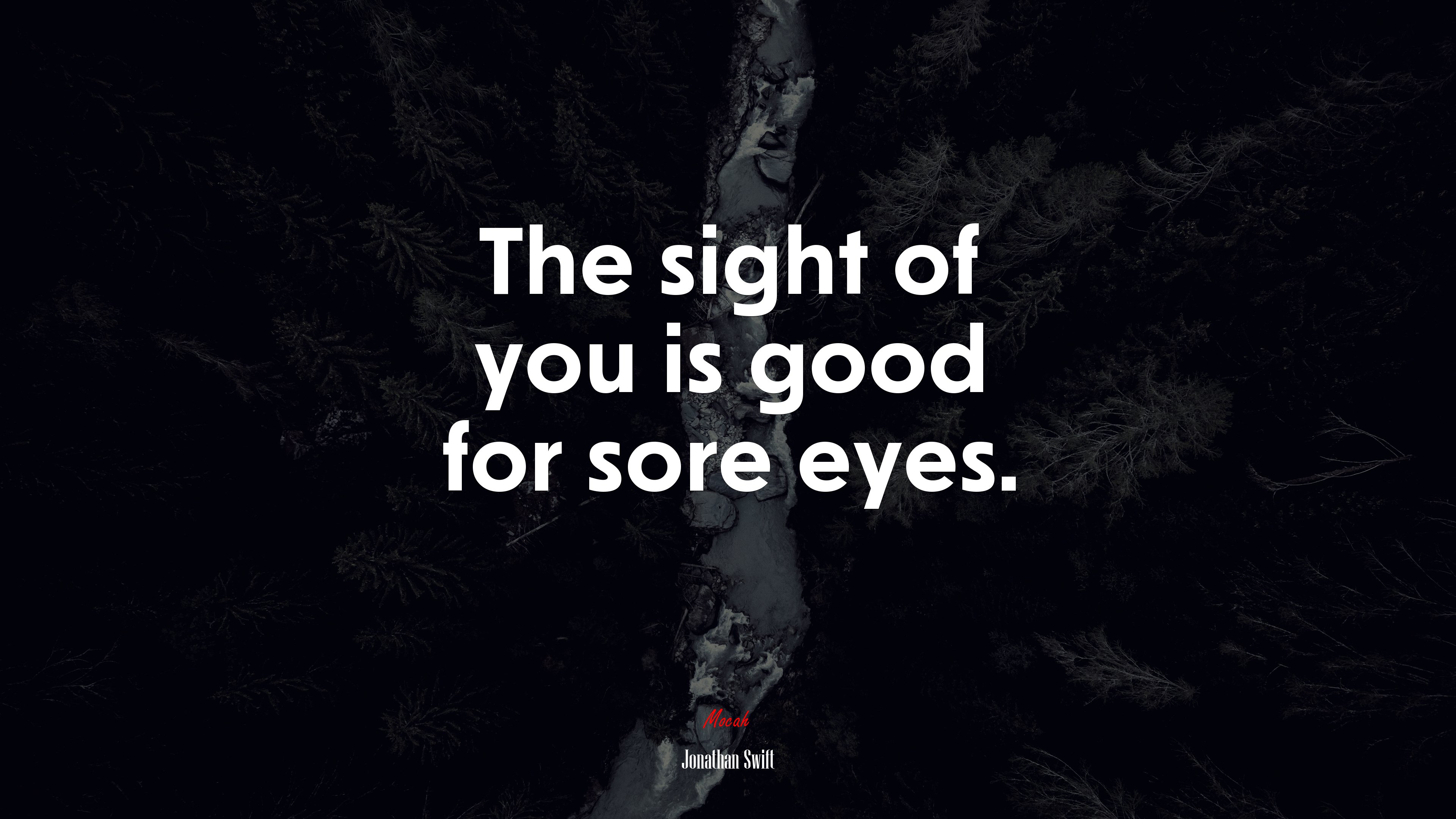
Most etymologists trace the popularized version of the phrase to Jonathan Swift, the famous satirist and author of Gulliver's Travels. In his 1738 work A Complete Collection of Genteel and Ingenious Conversation (often referred to simply as Polite Conversation), Swift captured the everyday speech of the upper classes of his time.
In the dialogue, one character remarks, "The sight of you is good for sore eyes." At that time, the phrase was already becoming a cliché in "polite" society. Swift’s goal was actually to mock the predictable, unoriginal nature of such conversational tropes, yet the phrase survived his satire and became a beloved part of the English lexicon.
Shifts in Meaning Over Time
Before the 1700s, the concept of "sore eyes" was often treated more literally. In the 1600s, there are recorded instances of writers mentioning things that would be "good for sore eyes" in a semi-medicinal or superstitious context. However, as the Enlightenment progressed and the English language became more standardized, the phrase transitioned fully into the realm of idiomatic expression.
By the 19th century, the phrase appeared frequently in British and American literature. It was used by authors to denote the relief felt by travelers returning home or soldiers seeing their loved ones. This period solidified the phrase as one of "welcome," rather than just "attractiveness."
The Psychology of Visual Relief: Why the Metaphor Works
Why do humans specifically associate "sore eyes" with the need for a pleasant sight? The answer lies in the psychological impact of visual stimuli on our emotional state.
The Role of Facial Recognition and Safety
Humans are evolutionary wired to find comfort in familiar, friendly faces. When we are in a state of stress—represented by the "soreness"—our amygdala is on high alert. Seeing a person we trust or a place we love triggers a release of dopamine and oxytocin. This biochemical shift creates a physical sensation of relaxation, particularly in the muscles around the eyes and forehead.
When we say someone is a "sight for sore eyes," we are linguistically acknowledging this biological transition from tension to ease. It is a recognition of the "safe harbor" that the person represents.
Aesthetic Preference and Environmental Psychology
The phrase isn't reserved solely for people. A hiker lost in a storm might find a small cabin to be a "sight for sore eyes." In this context, the phrase relates to Environmental Psychology. The "soreness" is the cognitive load of navigating a dangerous or monotonous environment. The "sight" is the solution to a problem. The phrase bridges the gap between aesthetic beauty and functional utility.
Modern Usage in 2026: Pop Culture and Everyday Speech
In 2026, idioms like "a sight for sore eyes" continue to thrive despite the rapid evolution of "slang" and internet-driven language. Its longevity can be attributed to its versatility.
Usage in Media and Literature
The phrase remains a favorite for screenwriters and novelists because it immediately establishes a history between two characters. If a character says this to another, the audience instantly understands that:
- They haven't seen each other in a significant amount of time.
- There is a positive, likely deep-seated affection between them.
- The speaker has been going through a difficult period.
It is a "shorthand" for complex emotional exposition.
Digital Communication and Emoji Equivalents
In the era of instant messaging and high-definition video calls, the literal "absence" required for this phrase is rarer than it was in Swift's time. However, people now use the phrase to emphasize the difference between a digital presence and a physical one. It is common to see the phrase used in social media captions when friends reunite after months of only interacting through screens.
Comparing "A Sight for Sore Eyes" to Similar Idioms
To truly master the use of this expression, it is helpful to see how it compares to other visual and emotional idioms. The following table highlights the differences in tone, intent, and context.
| Idiom | Primary Meaning | Tone | Best Use Case |
|---|---|---|---|
| A sight for sore eyes | A welcome presence that brings relief. | Warm, Emotional | Reuniting with a loved one after a hard time. |
| Easy on the eyes | Physically attractive or beautiful. | Casual, Aesthetic | Commenting on a person's appearance or a design. |
| Apple of my eye | Someone who is cherished above all others. | Affectionate, Protective | Describing a child or a significant other. |
| Eyes like a hawk | Extremely observant or watchful. | Analytical, Intense | Describing a strict supervisor or a talented scout. |
| A feast for the eyes | Something visually stunning or elaborate. | Appreciative, Grand | Describing a beautiful meal or a sunset. |
How to Use the Phrase Correctly
While "a sight for sore eyes" is generally a positive expression, there are nuances to its social application that can affect how it is received.
Social Context and Tone
- Sincerity is Key: Because the phrase is an idiom with centuries of use, it can sometimes sound like a cliché. To make it effective, it should be delivered with genuine warmth.
- Platonic vs. Romantic: This phrase is one of the few that works equally well in platonic and romantic contexts. You can say it to a spouse, a sibling, or a business partner you haven't seen since a successful project ended.
- Formal vs. Informal: It is generally considered an informal or semi-formal expression. While not inappropriate for a professional setting, it is best reserved for colleagues with whom you have an established rapport.
Common Mistakes to Avoid
- Using it for strangers: Telling a stranger they are a "sight for sore eyes" can be misinterpreted as a comment on their physical attractiveness (similar to "easy on the eyes"), which might come across as overly forward or "creepy."
- Overuse: If you say it every time you see someone, the "sore eyes" part of the metaphor loses its meaning. It implies a period of absence or hardship that makes the seeing "special."
The Linguistic Structure: Why "Aren't You" is Grammatically Unique
The phrase often appears as a tag question or a rhetorical negation. When we say "Aren't you a sight for sore eyes," we are using a negative contraction (aren't) to express a strong positive. This is a common feature in English (e.g., "Isn't it a beautiful day?").
Linguistically, this structure forces the listener to agree with the premise. It creates an immediate social bond by assuming a shared perspective. In 2026, linguistic studies continue to show that these types of "involved" speech patterns are crucial for maintaining social cohesion in an increasingly fragmented communication landscape.
Frequently Asked Questions
1. Is "a sight for sore eyes" an insult or a compliment?
It is a high compliment. While the word "sore" might sound negative, it refers to the speaker's state before they saw you. You are the "cure" for their soreness. It signifies that your presence is a relief and a joy.
2. Can I use this phrase for objects instead of people?
Yes. It is perfectly acceptable to use the phrase for objects or situations that provide relief. For example, "That cold glass of water is a sight for sore eyes," or "Seeing the 'Open' sign on the pharmacy was a sight for sore eyes."
3. What is the difference between "a sight for sore eyes" and "easy on the eyes"?
"Easy on the eyes" is a comment on someone's physical beauty or attractiveness. "A sight for sore eyes" is about the relief and happiness caused by seeing someone, regardless of their physical features. You might say a plain-looking old friend is a "sight for sore eyes" because you love them and missed them.
4. Who originally said "a sight for sore eyes"?
The phrase was popularized by Jonathan Swift in his 1738 book Polite Conversation. However, variations of the sentiment existed in English earlier than that, often used in a more literal sense regarding eye health.
5. Does the phrase imply that the person looks messy?
No. There is a common misconception that the phrase means "You look like you've had a rough time." This is incorrect. The "sore eyes" belong to the speaker, not the person being spoken to. The person being seen can look perfectly fine; the speaker is the one who was "suffering" from their absence.
Summary and Practical Recommendation
The idiom "aren't you a sight for sore eyes" remains one of the most evocative expressions of welcome in the English language. It bridges the gap between a simple greeting and a deep emotional acknowledgment of another person's value.
If you find yourself reuniting with a friend, family member, or colleague after a long or difficult period, do not be afraid to use this classic idiom. In an era where communication is often brief and transactional, using a phrase with such rich historical and psychological weight can help convey a level of sincerity that "good to see you" simply cannot match. For more information on historical idioms, you can visit the Oxford English Dictionary or explore Merriam-Webster’s idiom archives.