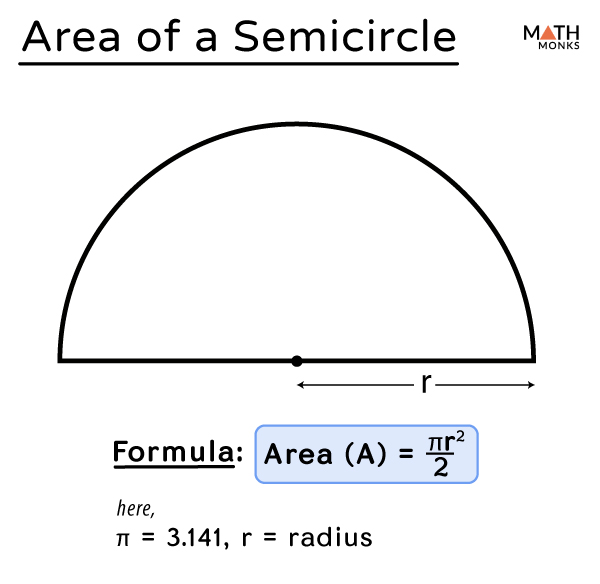
The area of a half-semicircle—which is fundamentally a quarter-circle—is calculated by taking the total area of a full circle ($\pi r^2$) and dividing it by four. Alternatively, if you are looking for the area of a standard semicircle (half of a circle), the formula is $(\pi r^2) / 2$, where $r$ represents the radius of the shape.
Understanding Geometric Definitions
To accurately calculate the area of any circular segment, one must first clearly distinguish between the terminology used. In geometry, a circle is defined as the set of all points in a plane that are at a given distance from a center point. A "semicircle" is exactly half of that circle, created by cutting it along a diameter.
When users search for the "area of a half-semicircle," there is often an ambiguity regarding whether they are referring to a standard semicircle or a quadrant (a quarter-circle). Given that a semicircle is already a "half-circle," taking half of a semicircle results in a quadrant. Mathematically, the area of a full circle is $\pi \times r^2$. Therefore, a semicircle is $(\pi \times r^2) / 2$, and a "half-semicircle" (a quarter of a full circle) is $(\pi \times r^2) / 4$. This article provides the foundational math for both shapes to ensure accuracy for your specific geometric needs.
The Mathematical Formula for a Semicircle
To find the area of a semicircle, you must determine the radius of the circle from which it originated. The radius is the distance from the center of the straight edge (the diameter) to the furthest point on the curved arc.
- Identify the Radius ($r$): If you are given the diameter ($d$), simply divide it by two ($r = d / 2$).
- Square the Radius: Multiply the radius by itself ($r \times r$ or $r^2$).
- Apply Pi ($\pi$): Multiply the squared radius by the mathematical constant $\pi$ (approximately 3.14159).
- Divide by Two: Since a semicircle is half of a full circle, divide your result by two.
The resulting formula is: $$A = \frac{\pi r^2}{2}$$
The Mathematical Formula for a "Half-Semicircle" (Quadrant)
If your intention is to calculate the area of one-half of a semicircle, you are working with a quadrant. This shape is bounded by two radii meeting at a 90-degree angle and an arc. The calculation remains consistent with the previous logic but requires an additional division.
The formula for the area of a quarter-circle is: $$A = \frac{\pi r^2}{4}$$
Because you are partitioning the total area of the circle into four equal sectors, this formula provides the most precise output. Always ensure that the radius utilized is consistent with the curvature of the arc you are measuring.
Step-by-Step Practical Application
To perform these calculations in a real-world scenario—such as in construction, design, or landscaping—follow these logical steps to ensure the units are handled correctly.
1. Unit Standardization
Before inputting numbers into the formula, ensure all measurements are in the same units. If your diameter is in centimeters but you need an area in square meters, convert the measurements before performing the squaring operation. Squaring mixed units or failing to convert early often leads to significant calculation errors.
2. Determining the Radius from the Diameter
Many technical drawings and architectural blueprints specify the diameter rather than the radius. It is a common mistake to use the diameter in the formula $(\pi d^2) / 2$. This will result in an area four times larger than the actual value. Always divide by two first.
3. Handling the Constant Pi
While 3.14 is often sufficient for casual estimation, professional engineering or precision manufacturing requires higher accuracy. Using a calculator’s internal $\pi$ function (which provides at least 10 decimal places) is recommended to prevent rounding drift, especially when the radius is a large number.
Comparison of Circular Segment Areas
The following table summarizes the relationship between circular segments, which is essential when calculating space for structural or aesthetic planning.
| Shape | Fraction of Full Circle | Area Formula |
|---|---|---|
| Full Circle | 1 | $\pi r^2$ |
| Semicircle | 1/2 | $(\pi r^2) / 2$ |
| Quadrant (Half-Semicircle) | 1/4 | $(\pi r^2) / 4$ |
| Sector (Angle $\theta$ in degrees) | $\theta / 360$ | $(\theta/360) \times \pi r^2$ |
Common Pitfalls and Troubleshooting
Even with a straightforward formula, several factors can lead to incorrect results. Awareness of these common errors will improve your accuracy.
- Confusing Radius and Diameter: This is the most frequent error. If you are provided with the straight-line width of the entire shape, recognize that this is the diameter. Using it as the radius effectively multiplies the area by four.
- Rounding Errors: Rounding your value for $\pi$ or your radius too early in the equation can cause compounding errors. Always keep the intermediate steps to as many decimal places as your final required accuracy permits.
- Squaring the Entire Fraction: In the formula $(\pi r^2) / 2$, ensure that only the $r$ is being squared. If you square the entire quantity, your result will be incorrect.
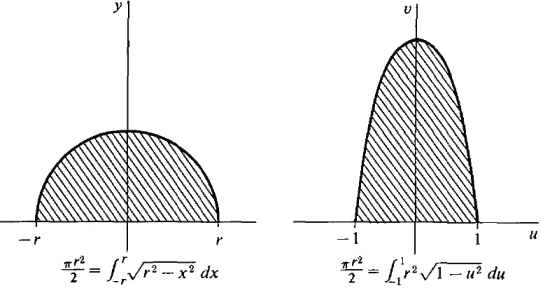
- Measurement Irregularities: If the object is not a perfect semicircle (e.g., a "flattened" arc), standard circular formulas will not apply. These require calculus-based integration or complex elliptical area formulas.
Applications in Real-World Contexts
Understanding the area of circular segments is vital for various professional fields.
- Architecture and Civil Engineering: When designing windows, thresholds, or specialized flooring, calculating the area of semicircular spaces is necessary for ordering materials. Using the wrong formula can lead to an underestimation of required flooring or glass, resulting in procurement delays.
- Landscaping and Urban Planning: Garden beds, walkways, and patio designs often feature semicircular arcs. Calculating the area correctly allows for precise estimation of gravel, sod, or concrete quantities.
- Manufacturing: In mechanical engineering, cutouts or components shaped as semicircles or quadrants must be calculated precisely to ensure they fit within larger housings or assemblies.
Frequently Asked Questions
What if I only have the circumference of the circle? If you only have the circumference, first calculate the radius using the formula $C = 2\pi r$, which rearranged is $r = C / (2\pi)$. Once you have $r$, you can plug it into the area formula for a semicircle: $(\pi r^2) / 2$.
How do I calculate the area if I have the arc length? The arc length of a semicircle is equal to $\pi r$. If you have the arc length, solve for $r$ by dividing the length by $\pi$. Use this radius in your area calculation. For a quarter-circle, the arc length is $(\pi r) / 2$.
Does the thickness of the material matter? The geometric area refers to a two-dimensional surface. If you are calculating the volume of a three-dimensional object (like a semicircular trough), you must multiply the calculated area by the depth or thickness of the object.
Can I use these formulas for an ellipse? No. These formulas are specific to circles and their segments. An ellipse has two distinct axes (major and minor). Using circular formulas on an elliptical shape will result in an incorrect calculation.
What is the most accurate way to define Pi? For most practical purposes, using the $\pi$ button on a standard scientific calculator is the gold standard. It provides sufficient precision for almost all construction, academic, and scientific applications as of 2026.
What is the "next action" if I need a highly precise area for a non-perfect arc? If the arc is not perfectly circular, you should employ coordinate geometry or digital planimetry tools. Modern CAD (Computer-Aided Design) software can calculate the area of irregular closed shapes by integrating the boundary coordinates, providing far more accuracy than manual geometric formulas.
Final Recommendation
To ensure the most accurate calculation, always verify whether the shape in question is a true semicircle (half-circle) or a quadrant (half of a semicircle). Once identified, measure the radius (not the diameter) and use the standard constant $\pi$ from your calculator. For physical projects, always add a 5–10% margin of error to your final area result to account for material waste or measurement variances in the field.