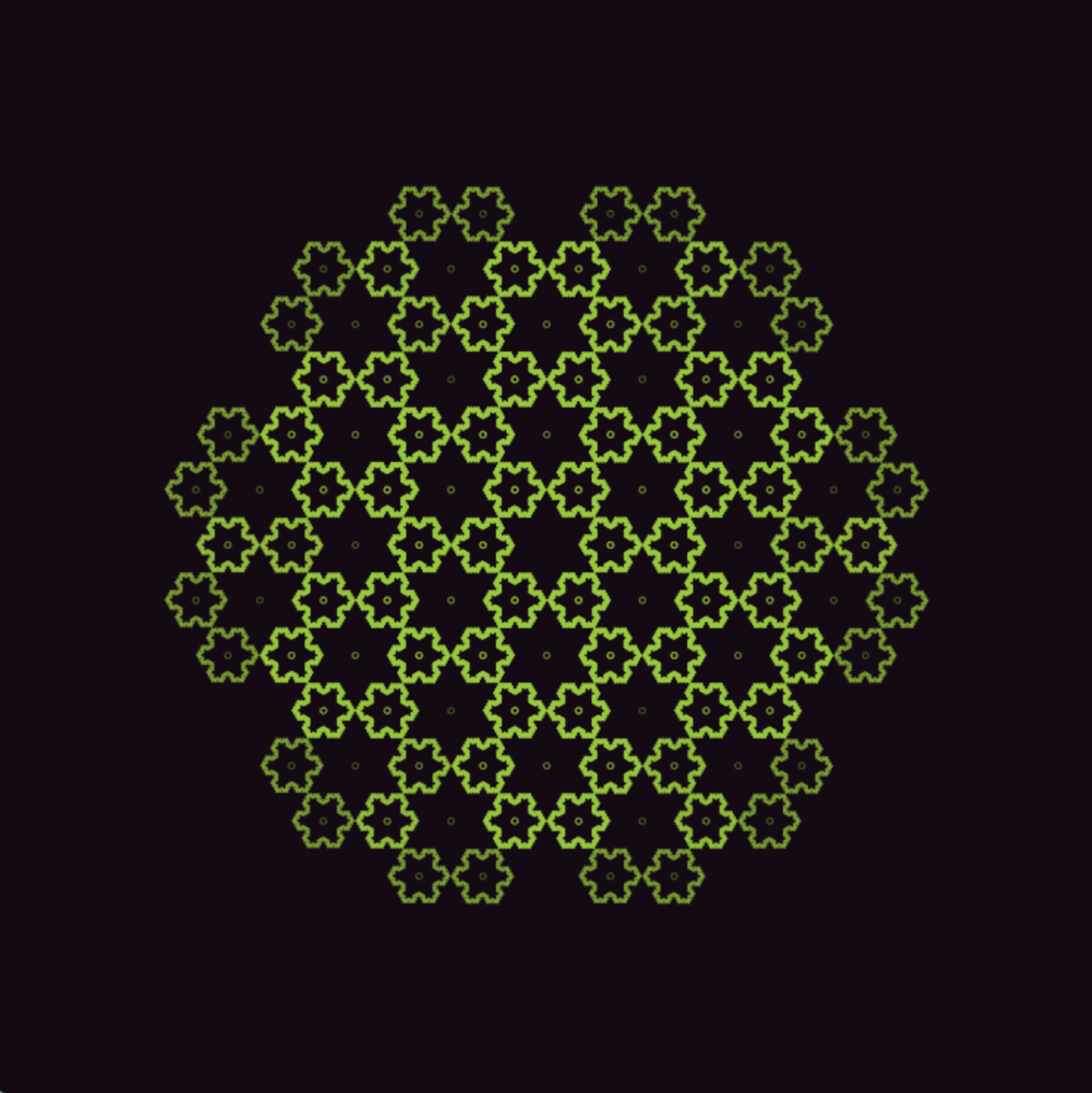
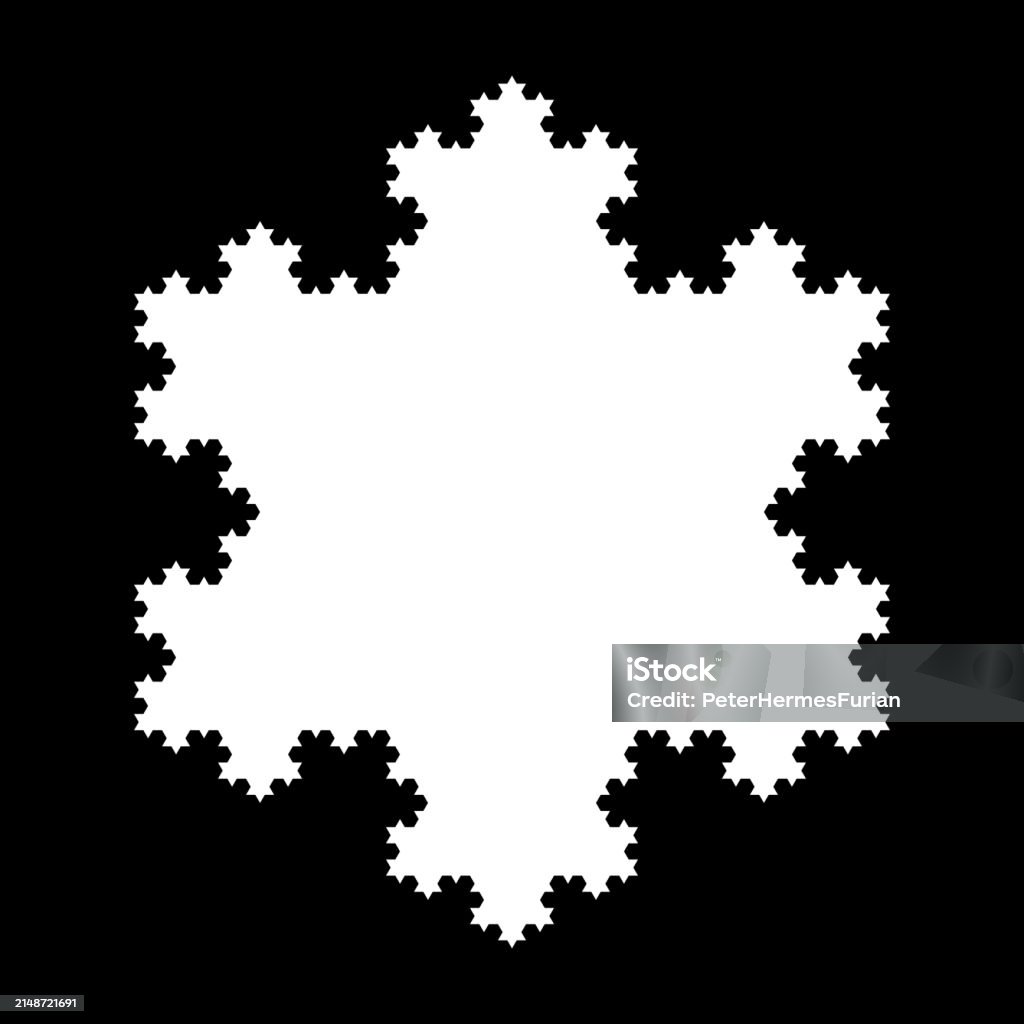
The area of a Koch snowflake is a finite value calculated by taking the area of the initial equilateral triangle and adding the infinite sum of the areas of the smaller triangles added at each iteration. Despite the snowflake having an infinite perimeter, its area converges to exactly 8/5 times the area of the original triangle, demonstrating a fascinating property of fractal geometry.
Understanding the Koch Snowflake Construction
The Koch snowflake is one of the earliest and most recognizable fractal curves. It is constructed through an iterative process that begins with a simple equilateral triangle. The term "fractal" refers to the self-similar nature of the shape, where each iteration adds complexity while maintaining the geometric properties established in the initial state.
To construct the Koch snowflake, you start with an equilateral triangle with a side length of s. In the first iteration, you take each of the three sides, divide them into three equal segments, remove the middle segment, and replace it with two sides of an equilateral triangle that points outward. This process is repeated indefinitely. With each iteration, the number of sides increases by a factor of four, and the length of each side becomes one-third of the previous length.
The Paradox of Infinite Perimeter
A critical aspect of understanding the Koch snowflake's area is distinguishing it from its perimeter. As you move from iteration to iteration, the total perimeter increases by a factor of 4/3. Since this ratio is greater than 1, the limit of the perimeter as the number of iterations approaches infinity is infinite. Paradoxically, while the boundary of the snowflake becomes infinitely long, the area it encloses remains bounded. This is a hallmark of fractal geometry: a finite, well-defined space enclosed by an infinitely complex boundary.
The Mathematical Derivation of the Area
To calculate the total area of the Koch snowflake, we denote the area of the initial equilateral triangle as A₀. Let s be the side length of this triangle. The area of an equilateral triangle is given by the formula:
A₀ = (√3 / 4) * s²
In each subsequent iteration, new, smaller triangles are added to the sides of the existing shape.
Step-by-Step Iteration Analysis
- Iteration 0: We have the original triangle with area A₀.
- Iteration 1: We add 3 smaller triangles. Each new triangle has a side length of 1/3 of the previous side, meaning its area is (1/3)² = 1/9 of the original triangle's area. Total added area = 3 * (A₀ / 9).
- Iteration 2: We add 12 smaller triangles. Each has a side length 1/3 of the previous addition (1/9 of the original side length), so the area of each is (1/9)² = 1/81 of the original triangle. Total added area = 12 * (A₀ / 81).
- Iteration n: The number of sides increases, and the area of the triangles added decreases, following a geometric series.
Summing the Geometric Series
The total area A of the Koch snowflake is the sum of the initial area plus the infinite series of additions. The series follows the pattern:
A = A₀ + 3 * (A₀/9) * [1 + 4/9 + (4/9)² + (4/9)³ + ...]
This is a geometric series with a first term a = 1 and a common ratio r = 4/9. The sum of such a series is 1 / (1 - r). Calculating this:
1 / (1 - 4/9) = 1 / (5/9) = 9/5
Plugging this back into our total area equation:
A = A₀ + (3 * A₀ / 9) * (9/5) A = A₀ + (A₀ / 3) * (9/5) A = A₀ + (3/5) * A₀ A = (8/5) * A₀
Thus, the total area of the Koch snowflake is exactly 1.6 times the area of the initial equilateral triangle.
Comparison of Fractal Properties
The unique nature of the Koch snowflake is best highlighted when compared to standard Euclidean shapes. Unlike a square or a circle, the snowflake exhibits self-similarity at every scale, yet its containment remains mathematically predictable.
| Feature | Euclidean Triangle | Koch Snowflake |
|---|---|---|
| Perimeter | Finite (3s) | Infinite (Limit approaches ∞) |
| Area | Finite (A₀) | Finite (8/5 A₀) |
| Boundary Dimension | 1 | log(4)/log(3) ≈ 1.26 |
| Iteration Growth | N/A | Exponential side multiplication |
Practical Applications and Educational Significance
While the Koch snowflake is a mathematical abstraction, its study is vital in several fields. It serves as a pedagogical tool to introduce students to the concepts of limits, convergent infinite series, and non-integer dimensions.
In physics and engineering, the principles of fractal geometry used in the Koch snowflake design are applied to antenna design. By using fractal shapes, engineers can create "fractal antennas" that are highly compact while providing multiband frequency coverage. Because the perimeter of the Koch snowflake is infinitely long within a limited area, it provides an exceptional surface-area-to-volume ratio, which is beneficial in heat dissipation designs and acoustic modeling.
Common Misconceptions
A common error when analyzing the area of a Koch snowflake is assuming that because the perimeter becomes infinite, the area must also become infinite. This intuitive trap arises because, in Euclidean geometry, increasing the perimeter of a shape usually requires increasing its area. The Koch snowflake violates this intuition because the added "spikes" become smaller at a rate that allows the total area to remain finite while the boundary length diverges.
Another point of confusion involves the number of triangles added. It is crucial to remember that with each iteration, every side of the previous iteration is replaced by four new segments, which in turn spawn new triangles. If you lose track of the count of sides, the calculation of the geometric series will fail to yield the 8/5 factor.
FAQ: Frequently Asked Questions
Why does the area converge if the perimeter is infinite?
The area converges because the sizes of the triangles being added decrease geometrically. Even though we are adding an infinite number of triangles, the total "added" area is a convergent geometric series. The boundary, however, grows by a factor of 4/3 with each iteration, which does not shrink fast enough to result in a finite limit.
Is the Koch snowflake a real physical object?
The Koch snowflake is a mathematical ideal. A truly physical version could only exist up to a certain iteration (the atomic limit), as we cannot continue to divide physical matter into smaller segments infinitely. However, it can be approximated with high precision in computer graphics and material science.
How do I calculate the area if I only know the side length?
If you have the side length s of the initial triangle, first calculate the area of that base triangle using (√3 / 4) * s². Once you have that value, multiply it by 1.6 (or 8/5) to get the final area of the snowflake.
Does the snowflake's area change based on the starting triangle size?
Yes, the area scales proportionally with the initial area A₀. If you double the side length of the starting triangle, the initial area A₀ increases by a factor of 4, and therefore the total area of the final Koch snowflake also increases by a factor of 4.
Are there variations of the Koch snowflake?
Yes, variations such as the Koch anti-snowflake can be created by pointing the triangles inward instead of outward. While the construction changes the visual result, the principle of a bounded area with an infinite perimeter remains the core focus of such studies.
Conclusion and Further Exploration
The area of a Koch snowflake serves as a definitive example of how infinite processes can produce finite, measurable outcomes. By mastering the geometric series summation involved in this shape, you gain insight into how fractals operate across various scientific disciplines. To further your understanding, consider calculating the area for different starting polygons, such as a Koch island derived from a square, to see how the geometric series constant changes based on the initial shape's geometry.