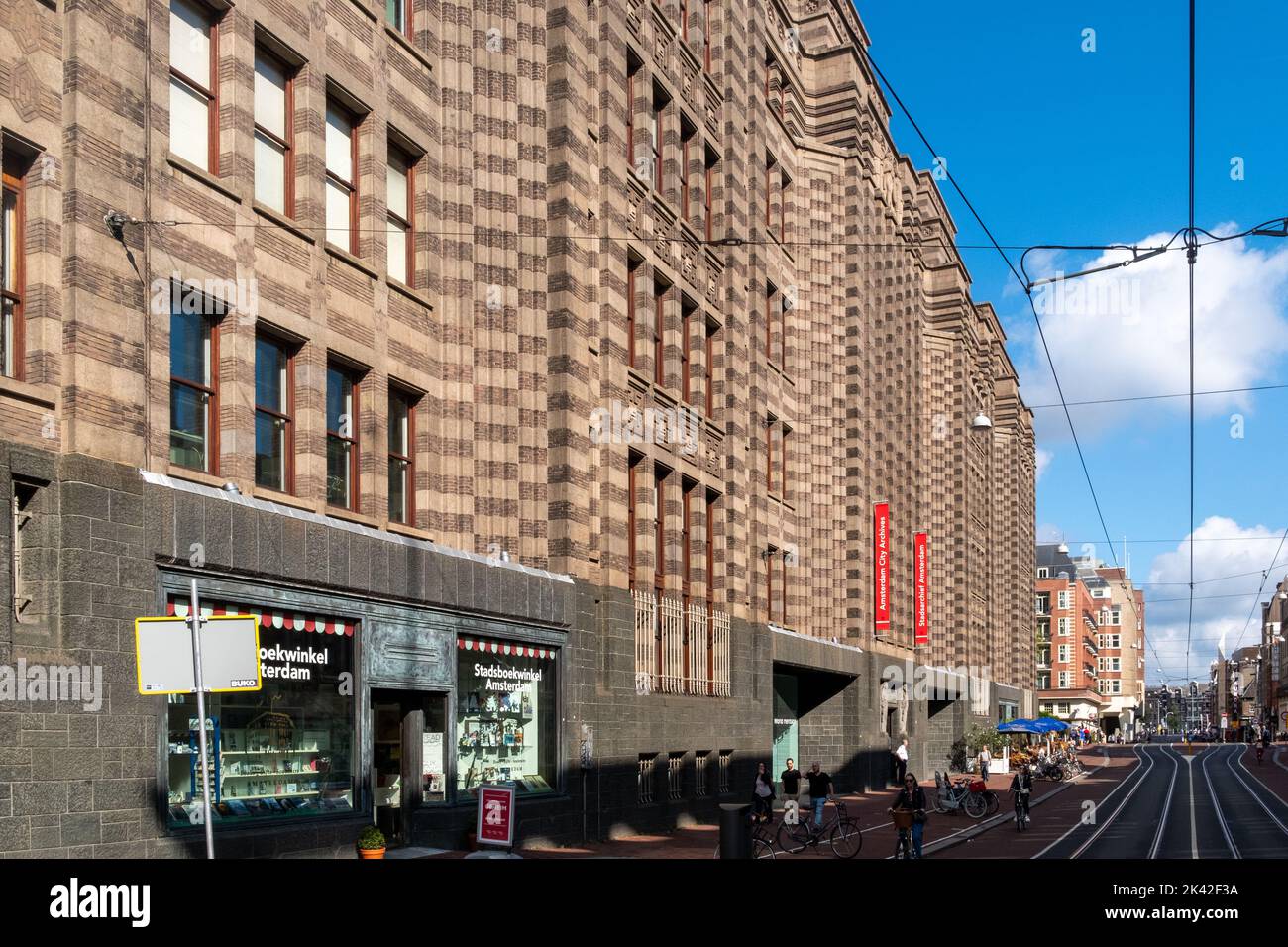
To access the Amsterdam City Archives (Stadsarchief Amsterdam), you can utilize their extensive digital database for remote research or visit the physical repository located in the historic De Bazel building at Vijzelstraat 32. Most genealogical and historical inquiries begin with the online "Indexen" (Indexes), which provide digitized scans of birth, marriage, and death records, as well as population registers and notarial acts spanning over seven centuries of the city's history.
The Amsterdam City Archives stands as the largest municipal archive in the world, preserving a staggering 50 kilometers of shelf space filled with documents, maps, drawings, and photographs. Whether you are a professional historian, a genealogical researcher tracing ancestors, or a resident investigating the history of your home, understanding the structure and accessibility of these archives is essential for a productive search.
The De Bazel Building: A Monumental Research Hub
Since 2007, the archives have been housed in the De Bazel building, a monumental brick structure that was originally designed as the headquarters for the Nederlandsche Handel-Maatschappij (Netherlands Trading Society). The building itself is an archival artifact, showcasing the transition of Amsterdam’s economy from maritime trade to international banking in the early 20th century.
In 2026, the building continues to serve as a multi-functional space. It houses the city's memory while offering public exhibition spaces, a cinema, a bookstore, and the central study room. For researchers, the "Onderzoekzaal" (Study Room) is the primary destination. It is important to note that while many records are digitized, a significant portion of the collection still requires physical consultation.
Planning a Physical Visit
Before visiting in person, researchers must identify the specific "inventarisnummer" (inventory number) of the documents they wish to view. Most physical records must be requested in advance through the online portal. In 2026, the archives maintain a strict policy regarding the handling of original documents to ensure their preservation for future generations. Lead weights and foam supports are provided for fragile volumes, and the use of ink-based pens is strictly prohibited in the study room.
Navigating the Digital Collections
The digital transformation of the Amsterdam City Archives has made it one of the most accessible historical repositories globally. The website is divided into several key sections, each serving a distinct research purpose.
The Indexes (Indexen)
The Indexes are the most frequently used tool for genealogists. This database contains millions of names extracted from primary sources. When you search for a name, the system often links directly to a high-resolution scan of the original document. Key records available in the indexes include:
- Doop-, Trouw- en Begraafboeken (DTB): Church records of baptisms, marriages, and burials prior to 1811.
- Burgerlijke Stand: Civil registry records (births, marriages, deaths) from 1811 onwards.
- Bevolkingsregisters: Population registers that track families as they moved between addresses within the city from 1850 to 1920.
- Archiefkaarten and Gezinskaarten: Individual and family registration cards used from 1920 until the late 20th century.
The Image Bank (Beeldbank)
For those researching visual history, the Beeldbank contains over 500,000 photographs, drawings, and prints. This collection is invaluable for verifying the historical appearance of specific streets or buildings. Users can search by street name, architect, or time period. Many images are available for high-resolution download, though some remain subject to copyright restrictions depending on the photographer and the date of creation.
The Archives Database (Archievenoverzicht)
This section provides the "Inventarissen" (Inventories) of the various collections. An inventory is essentially a table of contents for a specific archive, such as the records of the "Brouwerij d'Oranjeboom" or the "Diaconie van de Hervormde Gemeente." Unlike the Indexes, this database is organized by topic or organization rather than by individual names.
Primary Research Domains
Genealogical Research in Amsterdam
Tracing family roots in Amsterdam is a structured process thanks to the city's historical penchant for record-keeping. The transition in 1811 from church-based record-keeping to the Napoleonic civil registry is a critical juncture for any researcher.
Researchers should begin with the Archiefkaarten (1939–1994) or Gezinskaarten (1893–1939). These cards provide a snapshot of a household, including birth dates, occupations, and every address where the family lived in Amsterdam. If the ancestor lived in the city prior to 1850, the researcher must pivot to the Bevolkingsregisters, which are organized by neighborhood and house number.
Architectural and House History
Amsterdam’s canal houses and neighborhoods have a rich, documented history. If you are looking to uncover the story of a specific property, the archives offer:
- Bouwdossiers: Building permits and blueprints from the late 19th century onwards. These documents reveal original layouts, structural changes, and the names of the architects.
- Kwijtscheldingen: Historic property transfer records that can trace ownership back to the 16th century.
- Woningkaarten: Housing cards that list the inhabitants of a specific address during the early to mid-20th century.
The Notarial Archives: "Alle Amsterdamse Akten"
One of the most ambitious projects in the archives' recent history is the digitization and transcription of the Notarial Archives. Amsterdam’s notaries recorded everything from marriage contracts and wills to trade disputes and the sale of enslaved people.
By 2026, the "Alle Amsterdamse Akten" crowdsourcing project has made millions of these handwritten documents searchable through AI-assisted transcription (Handwritten Text Recognition). This collection provides an unparalleled look into the private lives and legal entanglements of Amsterdammers—including famous residents like Rembrandt van Rijn and Baruch Spinoza.
Key Record Types and Access Levels
| Record Category | Period Covered | Access Method | Notable Content |
|---|---|---|---|
| Church Records (DTB) | 1564–1811 | Online Index/Scans | Baptisms, banns, and burials by parish. |
| Civil Registry | 1811–Present | Online Index (within privacy limits) | Birth, marriage, and death certificates. |
| Population Registers | 1850–1920 | Online Index/Scans | Comprehensive household listings and addresses. |
| Notarial Acts | 1578–1915 | Index/Request Physical | Wills, inventories, and commercial contracts. |
| Building Permits | 1850–Present | Digital/Physical Request | Blueprints, structural plans, and applications. |
| Image Bank | 16th Century–2026 | Digital Search | Photos, maps, and historical prints. |
Privacy Restrictions and Ethics
Researching at the archives requires an understanding of Dutch privacy laws (AVG/GDPR). Not all records are immediately available for public viewing. Standard closure periods are applied to protect the privacy of living individuals:
- Birth Records: Closed for 100 years.
- Marriage Records: Closed for 75 years.
- Death Records: Closed for 50 years.
- Archiefkaarten: Only available for individuals who have been deceased for a specific period, or with proof of death.
In 2026, researchers must also navigate ethical considerations when accessing records related to sensitive topics, such as World War II police records or colonial history. The archives provide specific guidance on how to handle and cite these documents responsibly.
UNESCO Memory of the World
The Amsterdam City Archives holds several collections of international significance. The most notable is the Archive of the Portuguese-Israelite Community in Amsterdam (1610–1875), which is part of the UNESCO Memory of the World Register. This collection documents the lives of Sephardic Jews who fled the Inquisition in Spain and Portugal to settle in Amsterdam, contributing significantly to the city’s Golden Age.
Additionally, the archives contain the original documents related to the construction of the Canal Ring (Grachtengordel), which is itself a UNESCO World Heritage site. These documents include the urban planning maps and financial records that enabled the massive 17th-century expansion of the city.
Troubleshooting Common Research Obstacles
Language and Paleography
The primary language of the archives is Dutch. While the modern website offers English guidance, historical documents are written in Old Dutch, often in difficult-to-read gothic script or "oud schrift." Researchers often encounter:
- Patronymics: Before the mandatory adoption of surnames in 1811, many people used patronymics (e.g., Jan Janszoon meaning Jan, son of Jan). This can make tracing lineages difficult.
- Archaic Terms: Legal and medical terms used in the 17th and 18th centuries may not correspond to modern Dutch.
Name Variations
Spelling was not standardized until the 19th century. A surname like "Van Bakel" might appear as "Van Bacquel" or "Bakel" in different documents. When using the online indexes, it is advisable to use "wildcards" (such as an asterisk *) to capture spelling variations.
Missing Records
While the collection is vast, there are gaps caused by historical fires, floods, or administrative neglect. If a record cannot be found in the City Archives, researchers should check the Nationaal Archief (National Archives) in The Hague, especially for records related to national military service or high-level government administration.
Frequently Asked Questions
Is there a fee to use the Amsterdam City Archives?
Access to the study room and the online indexes is generally free. However, there are costs associated with "scans on demand" for records that have not yet been digitized. In 2026, fees for high-resolution reproductions for commercial use or extensive research assistance by archive staff remain in place.
Can I conduct research in English?
The search interface and much of the descriptive metadata are available in English. However, the historical documents themselves are almost exclusively in Dutch. Many researchers use translation tools or hire local genealogical researchers to assist with complex old-script documents.
How do I find records of the VOC (Dutch East India Company)?
While the Nationaal Archief in The Hague holds the central VOC archives, the Amsterdam City Archives holds the records of the Amsterdam Chamber of the VOC. This includes payrolls (soldijboeken) and ship logs that are vital for tracking individuals who traveled to Asia between 1602 and 1795.
What should I do if my ancestor lived in a village that was later annexed by Amsterdam?
Amsterdam has grown significantly by annexing surrounding municipalities like Sloten, Watergraafsmeer, and Buiksloot. The City Archives has incorporated the records of these former municipalities. When searching the indexes, ensure you select the appropriate "onderdeel" (department) or check the inventory of the annexed town.
Can I visit the archives without an appointment?
As of 2026, it is highly recommended to book a time slot for the study room if you intend to consult physical documents. For the public exhibitions or the bookstore, no appointment is necessary. Check the current schedule on the official website before traveling, as hours may vary for public holidays.
Next Steps for Your Research
To begin your journey into Amsterdam's past, start by creating an account on the Stadsarchief Amsterdam website. Use the "Indexen" to search for a specific name or "Beeldbank" for a specific location. If you find a relevant document that is not yet digitized, use the "Schatkamer" (Treasury) request system to order a scan. For complex historical queries, consider attending one of the paleography workshops or "research mornings" frequently hosted at the De Bazel building to sharpen your archival skills.