Annual information awareness training is a mandatory educational program designed to provide employees and contractors with the necessary knowledge to identify, report, and mitigate cybersecurity threats. This training ensures organizational compliance with federal regulations and industry standards while establishing a "human firewall" to protect sensitive data from social engineering, malware, and unauthorized access.
In the current landscape of 2026, information awareness has shifted from a once-a-year "checkbox" activity to a continuous strategic pillar of risk management. As cyber-attacks become more sophisticated through the use of generative AI and automated social engineering, the annual training cycle serves as the baseline for ensuring every member of an organization understands their role in the defense-in-depth strategy. Whether you are navigating Department of Defense (DoD) requirements or corporate data privacy laws, understanding the components of a robust training program is essential for operational security.
The Core Objectives of Information Awareness Training
The primary goal of annual information awareness training is to modify behavioral patterns. While technical controls like firewalls and encryption are vital, human error remains one of the leading causes of data breaches. By educating the workforce, organizations aim to reduce the attack surface that hackers exploit through psychological manipulation.
Reducing the Risk of Human Error
Human error can manifest in various ways, from misconfiguring a cloud storage bucket to clicking a malicious link in a seemingly legitimate email. Training provides the cognitive tools necessary to pause and evaluate digital interactions. In 2026, this includes recognizing the subtle signs of AI-generated "deepfake" audio or video calls, which have become common tools for business email compromise (BEC).
Maintaining Regulatory Compliance
For many sectors, training is not optional. It is a legal requirement mandated by frameworks such as the Health Insurance Portability and Accountability Act (HIPAA), the Payment Card Industry Data Security Standard (PCI DSS), and the Cybersecurity Maturity Model Certification (CMMC). Failure to provide and document this training can lead to significant fines, loss of contracts, and legal liability in the event of a breach.
Establishing an Incident Reporting Culture
Training empowers employees to act as sensors. When an employee identifies a suspicious event, they must know exactly how to report it without fear of retribution. A successful annual program clarifies the communication channels between the general workforce and the Security Operations Center (SOC) or IT department, ensuring that potential threats are neutralized before they escalate.
Major Regulatory Frameworks and Mandates
Understanding which regulations apply to your organization is the first step in designing an annual curriculum. Different industries face different levels of scrutiny and specific documentation requirements.
Department of Defense (DoD) and Federal Requirements
For federal employees and contractors, the Cyber Awareness Challenge is the standard for annual training. This curriculum is updated annually to reflect the current threat environment identified by the Defense Information Systems Agency (DISA). Under NIST Special Publication 800-53, specifically the AT (Awareness and Training) control family, federal agencies must provide basic security awareness training to all information system users.
In 2026, the CMMC 2.0 framework is fully operational, requiring defense industrial base (DIB) contractors to verify that their awareness training meets specific maturity levels. This includes not only general awareness but also specialized training for those handling Controlled Unclassified Information (CUI).
HIPAA and Healthcare Data
The HIPAA Security Rule (45 CFR § 164.308(a)(5)) requires covered entities and business associates to implement a "security awareness and training program for all members of its workforce." While the rule is "addressable," meaning it allows for some flexibility in implementation, the Department of Health and Human Services (HHS) consistently emphasizes that annual updates are a best practice for maintaining a reasonable and appropriate security posture.
Financial Services and PCI DSS
The PCI DSS v4.0 standards require that personnel be made aware of information security risks and their responsibilities. Requirement 12.6 specifically mandates that the security awareness program be updated at least annually and that all personnel attend the program upon hire and at least every 12 months thereafter. This includes training on specific threats like "skimming" and social engineering aimed at point-of-sale systems.
Essential Curriculum Components for 2026
To be effective, annual training must cover a broad spectrum of topics ranging from digital hygiene to physical security. As we move through 2026, the curriculum must address the convergence of traditional cyber threats and emerging technology.
1. Phishing and Social Engineering
Phishing remains the most prevalent threat. Training must go beyond simple "spot the typo" exercises. Modern modules focus on:
- Spear Phishing: Highly targeted attacks directed at specific individuals using gathered intelligence.
- Smishing and Vishing: Attacks occurring via SMS/text or voice calls, often utilizing AI voice cloning.
- Pretexting: Creating a fabricated scenario to steal information (e.g., posing as a help desk technician).
2. Handling Sensitive Information (PII and PHI)
Employees must understand the definitions and handling requirements for Personally Identifiable Information (PII) and Protected Health Information (PHI). This includes the "need to know" principle and the "least privilege" model, ensuring that data is only accessed when necessary for business functions and is stored in encrypted, approved environments.
3. Password Hygiene and Multi-Factor Authentication (MFA)
Even as the world moves toward passwordless authentication, the misuse of credentials remains a primary entry point for attackers. Training should emphasize:
- The use of complex, unique passphrases.
- The critical importance of Multi-Factor Authentication (MFA) and the dangers of "MFA fatigue" attacks, where users are bombarded with prompts until they accidentally approve one.
- The role of enterprise password managers in maintaining security.
4. Remote and Hybrid Work Security
With hybrid work models now permanent for many, the "office" environment often extends to home Wi-Fi and public coffee shops. Training must cover:
- Securing home routers and avoiding public, unencrypted Wi-Fi.
- Physical security of devices in public spaces (e.g., using privacy screens).
- VPN usage and secure file-sharing protocols.
5. AI Safety and Data Privacy
In 2026, a new module is essential: the safe use of generative AI. Employees must be warned against inputting proprietary company data, client secrets, or trade secrets into public AI models, as this can lead to data leaks and IP theft.
Designing and Implementing the Training Program
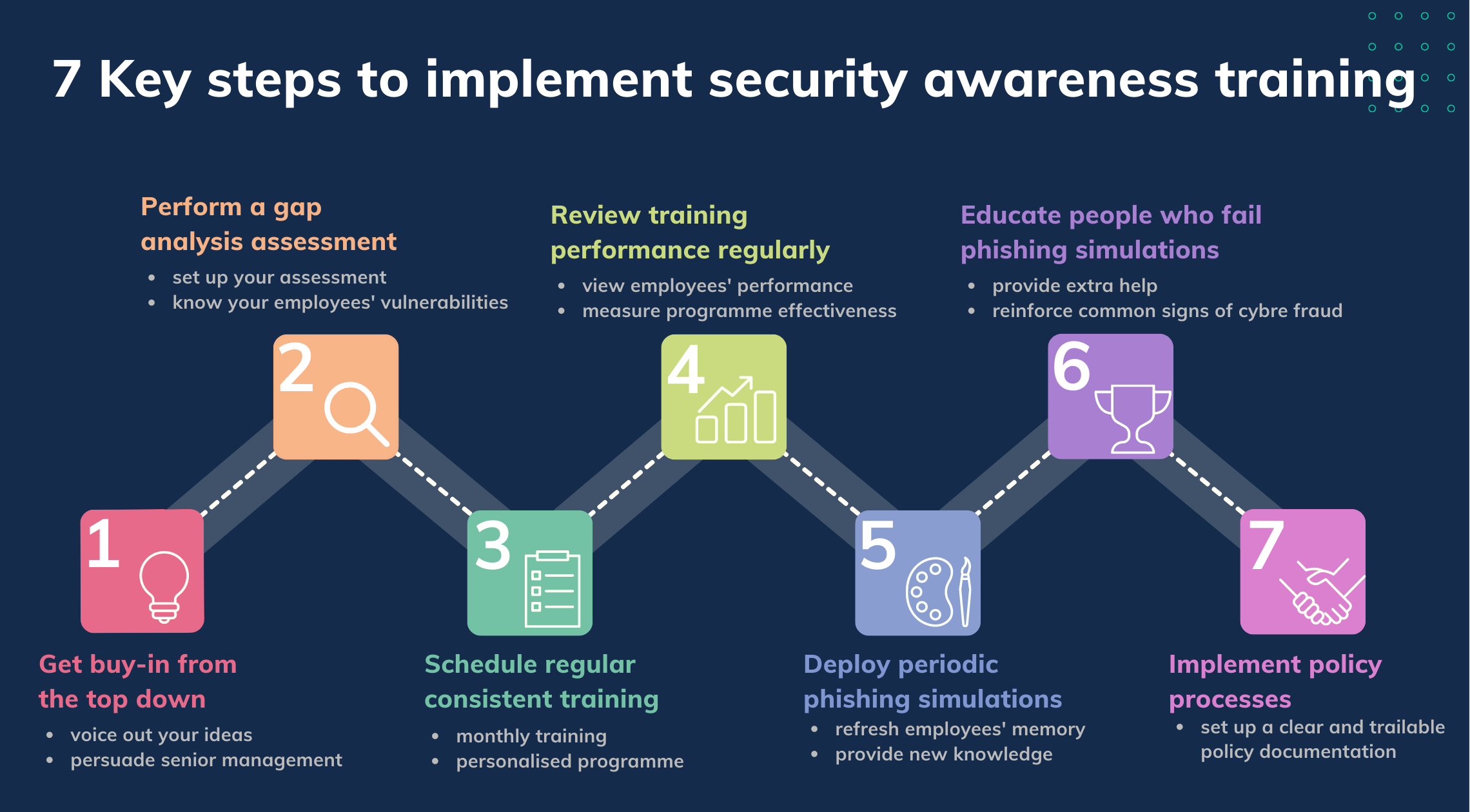
Simply purchasing a training module is not enough. The implementation strategy determines whether the information is retained or ignored.
Moving Toward Microlearning
The traditional 60-minute "death by PowerPoint" session is increasingly being replaced by microlearning. This involves breaking the training into 5-to-10-minute segments delivered throughout the month or quarter, culminating in a yearly review. This cadence prevents information overload and keeps security top-of-mind.
Gamification and Engagement
Gamified elements—such as leaderboards, digital badges, and interactive simulations—can significantly increase engagement. Interactive modules where users "choose their own adventure" and see the immediate consequences of their security choices (e.g., a simulated ransomware screen) create a more lasting impact than passive video watching.
Role-Based Training
A "one-size-fits-all" approach is rarely efficient. An executive assistant handles different risks than a software developer or a warehouse manager. Role-based training tailors the curriculum to the specific data types and software tools used by different departments.
| Training Category | Target Audience | Primary Focus Area | Frequency |
|---|---|---|---|
| General Awareness | All Employees | Phishing, Passwords, Physical Security | Annual |
| Executive Security | C-Suite / VPs | Whaling, BEC, Travel Security | Bi-Annual |
| IT/Developer | Technical Staff | Secure Coding, Cloud Config, API Security | Ongoing/Annual |
| Data Handler | HR, Finance, Legal | PII/PHI, GDPR/CCPA Compliance | Annual |
| Contractor/Third Party | Vendors | Access Controls, NDAs, Data Siloing | Before Access |
Verification, Auditing, and Measuring Effectiveness
For compliance purposes, an organization must be able to prove that training occurred. However, for security purposes, the organization must prove that the training worked.
Documentation and Certificates of Completion
Most learning management systems (LMS) automatically generate certificates. These records should be stored centrally and are often required during audits by the Federal Trade Commission (FTC) or industry-specific regulators. Documentation must include the date of training, the version of the curriculum, and the assessment score.
Phishing Simulations
The most effective way to measure awareness is through unannounced phishing simulations. By sending a safe "mock" phishing email and tracking how many users click the link or, more importantly, report the email to the security team, organizations can identify high-risk departments that may need remedial training.
Key Performance Indicators (KPIs)
To justify the budget for annual information awareness training, CISOs (Chief Information Security Officers) often track:
- Mean Time to Report (MTTR): How quickly an employee reports a suspicious event.
- Click Rate: The percentage of employees who fail a phishing simulation.
- Reporting Rate: The percentage of employees who use the "Report Phish" button.
Common Pitfalls to Avoid
Even well-intentioned programs can fail if they fall into common traps. Understanding these mistakes is crucial for the 2026 security professional.
- Treating Training as Punishment: If employees feel they are being "tested" to be caught and reprimanded, they will develop a negative association with security. Training should be framed as professional development and a collective defense effort.
- Outdated Content: Using training videos from 2020 in 2026 is a major mistake. The threats have changed. If the training doesn't mention AI-driven threats or modern MFA, employees will view it as irrelevant.
- Lack of Executive Support: If leadership ignores security protocols, the rest of the workforce will follow suit. Information awareness must be championed from the top down.
Frequently Asked Questions
Is annual information awareness training required for all employees?
Yes, in almost all regulated industries. Even if not strictly mandated by a specific law, it is considered a "standard of care" in legal proceedings. If a company is sued following a data breach, the lack of an annual training program is often cited as evidence of negligence.
How long should the annual training session be?
While federal programs like the Cyber Awareness Challenge typically take 60 to 90 minutes, many private organizations find that a 30-to-45-minute annual core session, supplemented by monthly 5-minute refreshers, provides the best balance of compliance and retention.
Can we develop our own training or must we use a certified provider?
Most frameworks (like NIST or HIPAA) do not require a specific vendor. You can develop internal training as long as it covers the required control areas and you maintain accurate records of participation and content. However, using a recognized provider ensures the content remains updated with the latest threat intelligence.
Does this training cover personal devices?
In a "Bring Your Own Device" (BYOD) world, yes. Modern training must include policies regarding the use of personal phones or laptops for work purposes, focusing on the separation of personal and professional data and the risks of shadow IT.
What happens if an employee fails the training assessment?
Most organizations require a minimum passing score (typically 80%). If an employee fails, they are usually required to retake the module. Consistent failure or a high "click rate" in simulations may lead to more intensive, one-on-one security coaching.
Recommendations for Next Actions
To ensure your organization is prepared for the 2026 threat landscape, begin by auditing your current training curriculum. Verify that it includes updated modules on AI safety, voice cloning, and remote work protocols. If you are operating under DoD or NIST guidelines, ensure your training records are readily accessible for the CMMC 2.0 assessment process.
Furthermore, consider moving away from a single annual event toward a continuous awareness model. Integrating security reminders into Slack, Teams, or company newsletters keeps the principles fresh. Finally, ensure that your reporting process is as simple as possible; a "one-click" report button in the email client is the most effective way to turn your trained workforce into an active defensive asset.
For further guidance on federal standards, consult the CISA (Cybersecurity & Infrastructure Security Agency) resources on security awareness.