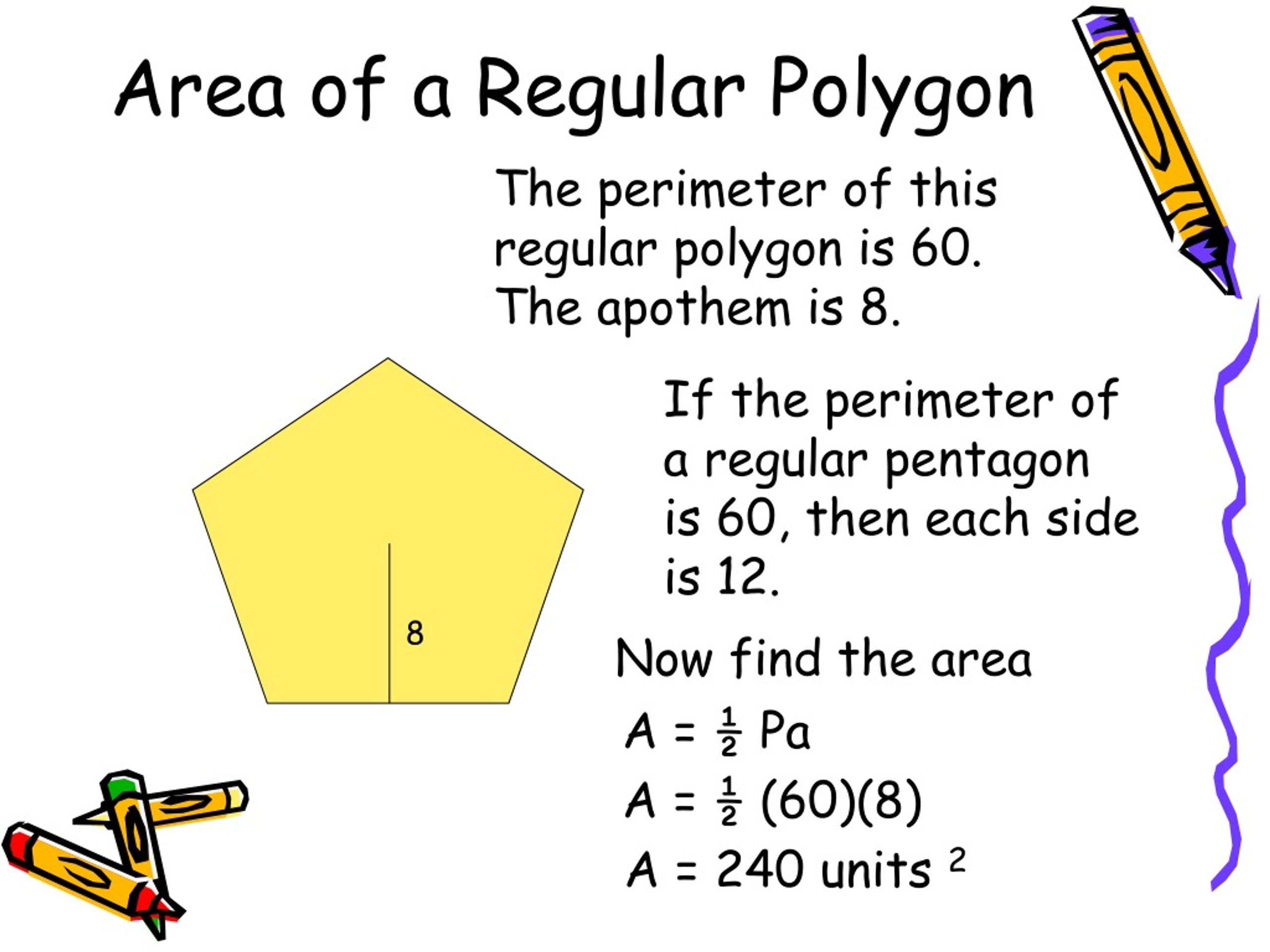
To calculate the area of a regular polygon, you multiply the perimeter by the apothem—the distance from the center to the midpoint of any side—and divide the result by two. If you do not know the apothem, you can calculate it using trigonometry based on the side length and the number of sides.
Understanding Regular Polygons
A regular polygon is a geometric figure where all sides are of equal length and all interior angles are congruent. Examples range from the equilateral triangle (three sides) and the square (four sides) to more complex shapes like the pentagon, hexagon, octagon, and beyond. Because of this symmetry, these shapes possess properties that allow for a standardized approach to finding their area, regardless of how many sides they possess.
The area represents the total two-dimensional space enclosed within the boundary of the polygon. For irregular shapes, finding this area often requires triangulation or coordinate geometry (such as the Shoelace Formula). For regular polygons, however, the regularity of the sides allows us to derive a specific formula that depends only on the number of sides ($n$) and the length of each side ($s$).
The Perimeter and Apothem Method
The most intuitive way to understand the area of a regular polygon is to imagine it broken down into a series of identical isosceles triangles. If you draw lines from the center of the polygon to each of its vertices, you create $n$ triangles.
For each of these triangles:
- The base is the side length ($s$) of the polygon.
- The height is the apothem ($a$), which is the perpendicular distance from the center of the polygon to the midpoint of a side.
Since the area of one triangle is $\frac{1}{2} \times \text{base} \times \text{height}$, the total area is $n \times (\frac{1}{2} \times s \times a)$. Because $n \times s$ is the definition of the perimeter ($P$), the formula simplifies to:
$$\text{Area} = \frac{1}{2} \times P \times a$$
Determining the Apothem
In practical scenarios, you are often given the side length ($s$) but not the apothem ($a$). To find the apothem, you must use trigonometry. A single triangle formed by the center and one side has a central angle of $\frac{360^\circ}{n}$. When you bisect this triangle to find the apothem, you create a right-angled triangle where:
- The angle at the center is $\frac{180^\circ}{n}$.
- The opposite side is $\frac{s}{2}$.
- The adjacent side is the apothem ($a$).
Using the tangent function ($\tan(\theta) = \frac{\text{opposite}}{\text{adjacent}}$), we find: $$\tan\left(\frac{180^\circ}{n}\right) = \frac{s/2}{a}$$ Solving for $a$: $$a = \frac{s}{2 \times \tan\left(\frac{180^\circ}{n}\right)}$$
The Universal Area Formula
By substituting the trigonometric expression for $a$ back into the primary area formula ($\text{Area} = \frac{n \times s \times a}{2}$), we arrive at the universal formula for any regular polygon:
$$\text{Area} = \frac{n \times s^2}{4 \times \tan\left(\frac{180^\circ}{n}\right)}$$
This formula is robust and works for any value of $n$ (where $n \geq 3$). Whether you are working with a hexagon ($n=6$) or a decagon ($n=10$), this equation provides a direct path to the solution without needing to solve for the apothem separately.
Step-by-Step Calculation Guide
To ensure accuracy, follow this sequence when performing calculations manually or in a spreadsheet:
- Identify $n$ and $s$: Determine the number of sides and the length of a single side.
- Calculate the interior angle component: Calculate $\frac{180}{n}$ in degrees. Ensure your calculator or software is set to "Degrees" mode rather than "Radians."
- Find the tangent: Calculate the tangent of the resulting value.
- Square the side length: Calculate $s^2$.
- Multiply and Divide: Multiply $n$ by $s^2$, then divide by the product of $4$ and the tangent value found in step 3.
Comparison of Polygon Calculations
The following table illustrates how the complexity of calculating area evolves as the number of sides increases, showing the relationship between side length ($s$) and the resulting area.
| Polygon Type | Sides ($n$) | Standard Area Formula | Approximation (for $s=1$) |
|---|---|---|---|
| Equilateral Triangle | 3 | $\frac{\sqrt{3}}{4}s^2$ | ~0.433 |
| Square | 4 | $s^2$ | 1.000 |
| Pentagon | 5 | $\frac{1}{4}\sqrt{5(5+2\sqrt{5})}s^2$ | ~1.720 |
| Hexagon | 6 | $\frac{3\sqrt{3}}{2}s^2$ | ~2.598 |
| Octagon | 8 | $2(1+\sqrt{2})s^2$ | ~4.828 |
| Decagon | 10 | $\frac{5}{2}\sqrt{5+2\sqrt{5}}s^2$ | ~7.694 |
Common Mistakes and Troubleshooting
Calculations involving trigonometric functions are prone to specific types of errors. Understanding these can save significant time during project planning or academic work.
- Mode Settings: The most frequent error in geometry is performing calculations using radians when the formula expects degrees. If your result seems significantly smaller or larger than expected, verify that your calculator is toggled to DEG.
- Rounding Errors: Because the tangent of an angle can result in a long decimal, avoid rounding intermediate steps. Keep as many decimal places as your tool allows until the final step.
- Units of Measurement: Ensure that the perimeter and the apothem are in the same unit. If the side is in centimeters and the apothem is in millimeters, you must convert them to a uniform unit before calculating.
- Precision Limits: For polygons with a very large number of sides, the shape approaches a circle. If your calculation involves a polygon with $n > 1000$, verify if the formula remains stable, or consider using the circle area formula ($\pi \times r^2$) if the apothem is effectively the radius.
Applications in Real-World Scenarios
Knowing the area of a regular polygon is essential in various fields:
- Architecture and Engineering: Designing floor plans for buildings with non-rectangular footprints, such as gazebos or clock towers, requires precise area calculations to estimate material costs (e.g., flooring, concrete, or roof tiling).
- Manufacturing and Packaging: Many industrial containers or components are designed with hexagonal or octagonal cross-sections to maximize structural integrity or space efficiency.
- Computer Graphics: In 2026, rendering engines often decompose complex curved surfaces into a high volume of small, flat regular polygons. Calculating the area of these individual polygons is a fundamental part of determining lighting, texture mapping, and collision detection volumes.
Frequently Asked Questions
Does the formula work if I only have the radius instead of the side length? Yes. If you have the radius ($R$)—the distance from the center to a vertex—you can find the area using the formula $\text{Area} = \frac{n \times R^2 \times \sin(\frac{360^\circ}{n})}{2}$.
Is there a way to calculate this without trigonometry? Only for specific shapes. Squares, rectangles, and triangles have specialized formulas that do not require trigonometry. However, for any regular polygon with five or more sides, trigonometry is the most efficient and accurate method.
How do I convert degrees to radians if my software requires it? Most modern engineering software uses radians as the default. To convert degrees to radians, multiply your degree value by $\frac{\pi}{180}$.
Why does the area formula for a regular polygon include a tangent function? The tangent function relates the base of a triangle to its height within a right-angled triangle. Since a regular polygon is composed of these triangles, the tangent function naturally emerges as the ratio between the side length and the apothem.
Can this formula be used for irregular polygons? No. This formula relies entirely on the fact that all sides and all interior angles are equal. For irregular polygons, you must divide the shape into smaller triangles and calculate their areas individually using the base-height formula or Heron’s formula.
Final Recommendation
For most users, the simplest way to calculate the area is to identify the side length and the number of sides, then input these into the universal formula: $\frac{n \times s^2}{4 \times \tan(180/n)}$. If you are performing this for professional engineering or construction work, always verify the result using a secondary method—such as calculating the area of one segment and multiplying by $n$—to ensure there are no errors in your input values.