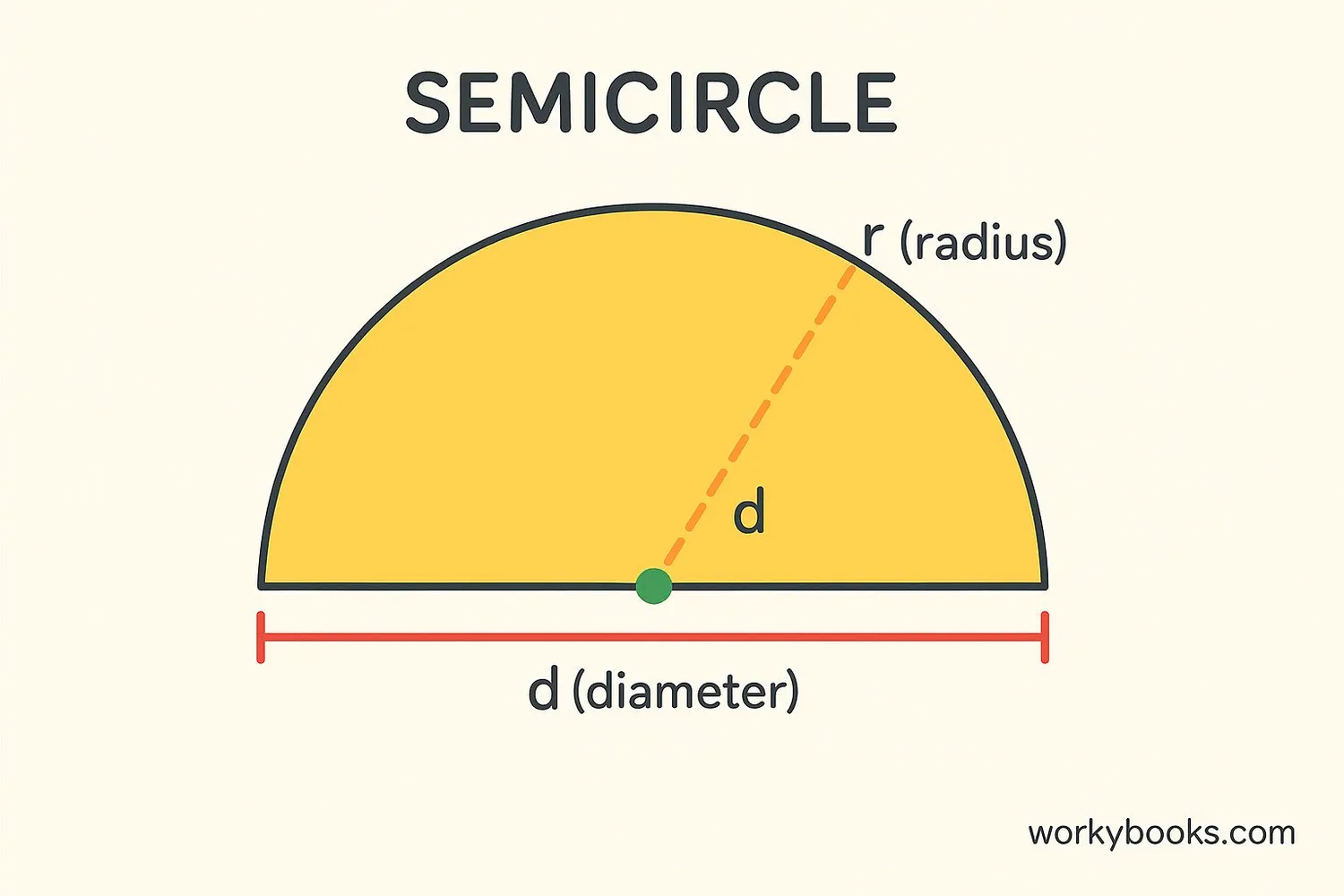
To calculate the area of a semicircle when you only have the diameter, divide the diameter by two to find the radius, square that value, multiply by pi (approximately 3.14159), and then divide the result by two. The formula is expressed as A = (π × (d/2)²) / 2, or more simply, A = (π × d²) / 8.
Understanding the Geometric Properties of a Semicircle
A semicircle is defined as a one-dimensional locus of points that forms half of a circle. When you cut a full circle along its diameter, the resulting shape consists of a curved arc and a straight edge. In geometry, understanding the area of this shape requires first grasping the relationship between the radius and the diameter.
The diameter is the longest chord of a circle, passing through the center and connecting two points on the perimeter. The radius, by definition, is exactly half the length of the diameter. Because the area of a full circle is calculated using the radius squared multiplied by π, the area of a semicircle is inherently half of that value. When you are provided with the diameter rather than the radius, the calculation is essentially an exercise in converting a linear measurement into a squared area measurement while accounting for the fractional nature of the semicircle.
The Mathematical Formula Explained
The standard formula for the area of a full circle is: A = πr²
Since a semicircle is exactly half of a circle, its area is: A = (πr²) / 2
However, if your data point is the diameter (d), you must first perform the conversion r = d / 2. Substituting this into the equation yields: A = π(d/2)² / 2
When you simplify this expression algebraically: A = π(d²/4) / 2 A = πd² / 8
This simplified formula, A = (π × d²) / 8, is the most efficient way to compute the area when working directly with the diameter. It eliminates the intermediate step of dividing by two before squaring, which reduces the potential for rounding errors during complex calculations.
Step-by-Step Calculation Procedure
To ensure accuracy, follow these systematic steps whenever you are tasked with finding the area of a semicircle from a diameter measurement:
- Verify the Unit of Measurement: Ensure that the diameter is provided in the desired units (e.g., centimeters, inches, meters). If the final area needs to be in square units, the diameter must be in linear units of that same system.
- Determine the Diameter Value: Identify the diameter (d). For example, if the diameter is 10 cm, use this value for the calculation.
- Square the Diameter: Multiply the diameter by itself. Using the example of 10 cm: 10 × 10 = 100.
- Apply Pi: Multiply the squared diameter by π (approx. 3.14159265). 100 × 3.14159265 = 314.159265.
- Divide by Eight: Because the formula for a semicircle using the diameter is πd²/8, divide your result by 8. 314.159265 / 8 = 39.2699.
- Assign Units: Always report the final answer in square units, such as square centimeters (cm²).
Practical Comparison Table
The following table demonstrates how different diameters affect the final area of a semicircle, illustrating the relationship between linear increases in diameter and the resulting growth in surface area.
| Diameter (d) | Radius (r = d/2) | Area Formula: (π × d²) / 8 | Total Area (Approx.) |
|---|---|---|---|
| 2 cm | 1 cm | (3.1416 × 4) / 8 | 1.57 cm² |
| 4 cm | 2 cm | (3.1416 × 16) / 8 | 6.28 cm² |
| 6 cm | 3 cm | (3.1416 × 36) / 8 | 14.14 cm² |
| 8 cm | 4 cm | (3.1416 × 64) / 8 | 25.13 cm² |
| 10 cm | 5 cm | (3.1416 × 100) / 8 | 39.27 cm² |
Why Precision in Pi Matters
In many real-world applications, such as construction or drafting, using a truncated value of pi can lead to significant discrepancies. While 3.14 is often taught in introductory mathematics, it may not be sufficient for projects requiring high tolerances.
Using 3.14159 or the π button on a scientific calculator is recommended for most engineering and architectural tasks. For instance, if you are calculating the area of a large semicircular window or a garden bed with a diameter of 10 meters, the difference between using 3.14 and 3.14159 over a large squared value can result in an error of several centimeters or more. Always consider the level of precision required by your specific project context before rounding your final answer.
Common Pitfalls and Troubleshooting
Calculators often generate errors when users confuse diameter with circumference or forget the squaring operation. Here are the most frequent mistakes made during this calculation:
- Forgetting to Square the Diameter: A common error is calculating (π × d) / 8 instead of (π × d²) / 8. This leads to a linear result rather than an area. Remember that area is always represented in square units.
- Incorrect Division: Some users mistakenly divide by 2 (the semicircle factor) but forget that the diameter is also being squared. If you use the radius (d/2), you divide by 2 only after squaring the radius. If you use the diameter, you must divide by 8 because (d/2)² = d²/4, and dividing that by 2 results in d²/8.
- Unit Mismatch: Ensure that your diameter is not in inches while you are attempting to calculate an area in square centimeters. Always convert all linear dimensions to the same unit before starting the calculation.
- Calculator Order of Operations: If you are inputting the equation into a basic calculator, ensure you press the "=" key after the diameter squared calculation before proceeding to multiply by π and divide by 8, or use parentheses to group the operations correctly.
Applications in Geometry and Beyond
The ability to calculate the area of a semicircle using a diameter is a foundational skill used in various professional fields. In landscaping, it is used to determine the amount of sod or mulch needed for semi-circular pathways or flower beds. In manufacturing, it is used to calculate the surface area of semi-cylindrical components or panels.
Understanding this calculation also serves as a gateway to more complex geometric problems, such as finding the surface area of 3D shapes like domes (hemispheres) or the volume of vaulted ceilings. By mastering the 2D area calculation, you create a stronger conceptual foundation for approaching 3D spatial geometry, where identifying the cross-sectional area is the primary prerequisite for finding the total volume of an object.
Frequently Asked Questions
Does the order of operations matter when calculating the area? Yes, it is crucial. You must square the diameter first. If you multiply the diameter by π before squaring it, you will arrive at an incorrect value. Always follow the PEMDAS/BODMAS rules: perform the exponentiation (squaring) before multiplication and division.
What should I do if my measurement is not a perfect whole number? The formula works the same for decimals and fractions. Simply treat the measurement as a standard numerical value. If you are dealing with fractions, it is often easier to convert them to decimals before squaring to ensure accuracy.
Is the area of a semicircle the same as the perimeter? No. The area measures the two-dimensional space inside the semicircle, while the perimeter (or circumference) measures the length of the boundary. The perimeter of a semicircle is calculated as (π × r) + d, which is a fundamentally different operation than the area calculation.
Why is the divisor 8 in the diameter-based formula? The divisor is 8 because the area formula for a circle is πr². Substituting r = d/2 into this results in π(d/2)², which is π(d²/4). Because a semicircle is half a circle, you divide that by 2, resulting in π(d²/8).
Can this formula be used for shapes that aren't perfect semicircles? No, this formula applies strictly to a perfect semicircle—a shape formed by a diameter cutting a circle exactly in half. If the arc is not perfectly circular or the cut is not through the center (resulting in a circular segment rather than a semicircle), the formula will not provide an accurate area.
Final Recommendation
When calculating the area of a semicircle from a diameter, the most reliable method is to first convert the diameter to the radius by dividing by two, then apply the standard A = πr² / 2 formula. This approach is conceptually intuitive and less prone to the "forgotten division" errors that can occur when using the πd²/8 shortcut. Always maintain precision until the final step, and double-check your units to ensure the output matches your requirements.