Coast redwoods (Sequoia sempervirens) and giant sequoias (Sequoiadendron giganteum) possess exceptional evolutionary adaptations that make them highly fire resistant. Their thick, fibrous, tannin-rich bark lacks flammable resins, allowing them to withstand intense surface fires that would destroy less resilient tree species, though they remain vulnerable to extreme, high-severity crown fires.
The Evolutionary Strategy of Fire Resilience
Redwoods have existed for millions of years, a longevity attributed in large part to their co-evolution with fire. In the forests of California, fire is not merely an external threat; it is an ecological driver that keeps the ecosystem healthy. To survive in an environment where wildfire is a recurring event, redwoods have developed several specialized anatomical and chemical defenses.
The most prominent feature is their bark. Unlike many conifers that possess thin, pitch-heavy bark that acts as fuel, redwoods have bark that is remarkably thick—sometimes reaching two feet in depth on mature specimens. This bark is fibrous, spongy, and notably devoid of flammable resins or pitch. When a surface fire sweeps through the understory, the bark acts as a formidable thermal insulator, shielding the tree’s vital cambium layer—the living tissue responsible for growth—from the extreme heat.
Beyond the physical thickness of the bark, the chemical composition plays a secondary but vital role. Redwoods contain high concentrations of tannins. Tannins are complex organic compounds that act as natural fire retardants. Furthermore, these chemicals provide resistance to rot, fungi, and insect infestations, which is crucial because a fire-weakened tree might otherwise be susceptible to secondary mortality from pests.
Comparing Species: Coast Redwoods vs. Giant Sequoias
While both species are often grouped together under the umbrella of "redwoods," they are distinct biological entities with slightly different relationships to fire.
Coast Redwoods (Sequoia sempervirens)
Found primarily along the fog-drenched coastal belt of Northern California, coast redwoods thrive in a humid environment. Because of this moisture, their primary fire threat comes from low-to-mid intensity surface fires. Their ability to resprout from the root crown or along the trunk (epicormic sprouting) gives them a massive advantage. If a fire does manage to scorch the canopy, a coast redwood can often regenerate its foliage, provided the root system remains intact.
Giant Sequoias (Sequoiadendron giganteum)
Inhabiting the western slopes of the Sierra Nevada, giant sequoias live in a more fire-prone, drier climate. Their evolutionary response to fire is specifically tied to reproduction. Giant sequoias require fire to clear the forest floor of competing vegetation and, critically, to open their serotinous cones. The heat from a fire dries out the cones, causing them to release seeds onto the newly cleared, nutrient-rich ash bed. Without the periodic "reset" of a fire, giant sequoia recruitment in the wild would be significantly hampered.
Factors Influencing Fire Susceptibility
Despite their impressive defenses, no tree is truly "fireproof." The degree to which a redwood survives a wildfire depends on several variable environmental and biological factors.
The Role of Bark Thickness and Maturity
A seedling or a sapling has not yet developed the thick bark necessary to survive a fire. In young trees, the bark is relatively thin, and the crown is closer to the ground, making them highly susceptible to damage. As the tree ages, it accumulates more bark, which correlates directly with its probability of survival during a wildfire event.
Surface Fires vs. Crown Fires
Redwoods are masters of surviving surface fires—those that burn through grasses, shrubs, and leaf litter. However, they are vulnerable to crown fires. A crown fire occurs when heat or flames climb into the canopy, often facilitated by "ladder fuels"—shrubs, smaller trees, or vines that act as a bridge for flames to move from the forest floor up into the crown. In 2026, forest management practices in protected redwood groves focus heavily on reducing these ladder fuels through controlled burns and mechanical thinning to ensure that fires remain at the surface level where the trees are best adapted to survive.
Cumulative Damage and Structural Integrity
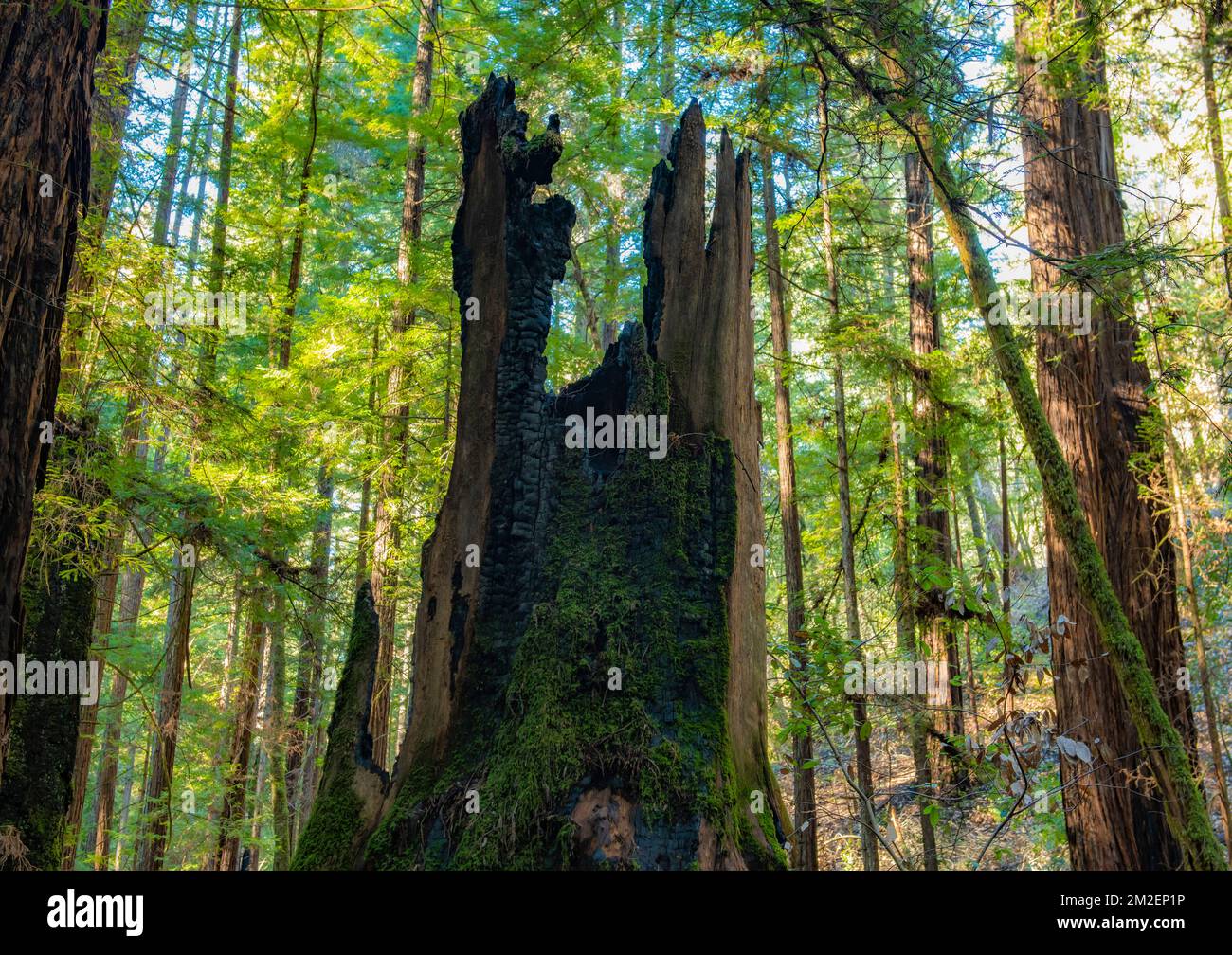
When a tree survives a fire, it often bears a "cat-face"—a localized scar where the fire burned through the bark to the sapwood. While a single cat-face rarely kills a mature redwood, repeated high-intensity fires can weaken the structural integrity of the base. If a fire hollows out the base of a tree enough to compromise its stability, it may fall—a process known as fire-induced windthrow.
Table 1: Comparison of Fire Survival Mechanisms
| Feature | Coast Redwood Adaptation | Giant Sequoia Adaptation |
|---|---|---|
| Bark Thickness | Very thick; up to 12 inches | Exceptionally thick; up to 24 inches |
| Resin Content | Extremely low | Very low |
| Regeneration | Epicormic and root sprouting | Fire-triggered seed dispersal |
| Primary Fire Role | Resilience to recurring heat | Clears competition for seedlings |
| Vulnerability | High-intensity canopy fire | High-intensity canopy fire |
Historical and Contemporary Management
In the early 20th century, the prevailing philosophy in forestry was complete fire suppression. However, by the early 21st century and continuing into 2026, researchers and land managers have shifted toward a "managed fire" approach. Complete suppression led to a massive buildup of biomass on the forest floor, creating fuels that allow modern fires to burn hotter and longer than they would under historical conditions.
Today, federal and state agencies utilize prescribed burns to mimic the natural fire cycle. By intentionally lighting low-intensity fires during periods of high humidity and lower temperatures, managers can consume the accumulated duff and debris. This strategy reinforces the fire-resistant nature of the redwood groves by preventing the high-intensity fires that currently pose the greatest threat to these ancient giants.
Addressing Common Misconceptions
It is a common error to believe that redwoods are immune to heat. While they are among the most fire-adapted organisms on Earth, they operate within specific biological limits.
- "Redwoods don't burn." This is false. The wood itself, if dried or exposed to sufficient heat, will combust. However, the protective bark and low resin content make ignition much harder compared to species like pine or fir.
- "All fire is good for redwoods." While fire is an integral part of their life cycle, an extreme wildfire fueled by drought-stressed undergrowth and climate-worsened conditions can bypass the defenses of even the most massive, ancient trees.
- "Bark is the only defense." While bark is the most visible defense, the internal physiology, including the tree's water-transport efficiency and the ability to compartmentalize damage, is equally vital for long-term survival.
Frequently Asked Questions
Can a redwood tree survive if its bark is completely charred?
Yes, provided the cambium layer remains alive beneath the char. If the fire is intense enough to kill the cambium all the way around the circumference of the trunk, the tree will be "girdled," cutting off the flow of nutrients and water from the roots to the leaves, which will eventually lead to the tree’s death.
Why do some redwoods look hollow inside?
These hollows are typically the result of repeated fire events over centuries. Fire burns out the heartwood, which is the non-living structural center of the tree. Because the outer ring of the tree (the sapwood and cambium) remains functional, the tree can continue to live and grow even when it is essentially a hollow chimney.
Are redwoods at risk from climate-driven wildfires?
Yes. As of 2026, changing weather patterns, including longer droughts and higher ambient temperatures, have created conditions where fires burn with greater intensity than the historical norm. While redwoods are resilient, the "new normal" of fire frequency and severity challenges their evolutionary adaptations.
Does the age of a redwood affect its fire resistance?
Absolutely. Younger trees with thinner bark are significantly more likely to perish in a fire. The development of fire resistance is an age-dependent process, which is why protecting saplings from encroachment by other plant species is vital for the forest's future.
Can redwoods grow back after a forest fire?
Coast redwoods are masters of regeneration. They can sprout new branches from the trunk or send up new stems from the root system after a fire. Giant sequoias rely on seed germination in the mineral soil exposed by fire. In both cases, they are remarkably effective at recolonizing a landscape after a disturbance.
Next Steps for Forest Stewardship
If you own property with redwoods or are interested in the preservation of these forests, the focus must be on defensible space and fuel management. For private landowners, this means maintaining a zone around trees free of dead "ladder fuels." Clearing brush, trimming low-hanging dead branches, and ensuring that invasive, flammable species do not encroach upon the redwood groves are the most effective actions to support the tree’s natural defenses. Support local conservation organizations and state forestry programs that prioritize controlled burning and forest thinning, as these evidence-based practices are the most effective tools currently available to preserve these ecosystems for future generations.