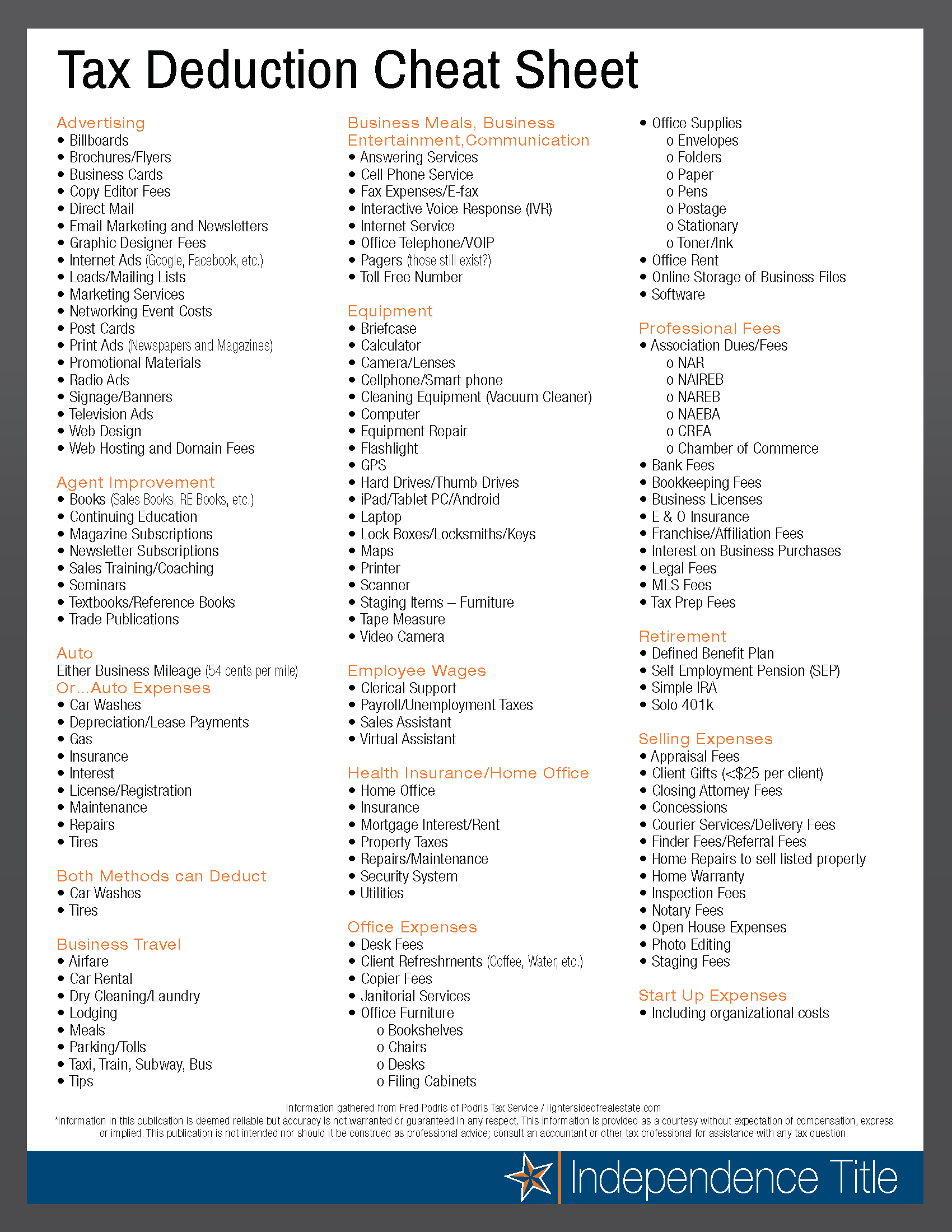
Realtor commissions and related closing costs are generally not considered tax-deductible expenses for residential homeowners in the same way that mortgage interest or property taxes are. However, these fees are treated as selling expenses that reduce the total capital gain realized from the sale of your home, effectively lowering your taxable profit when calculating your tax liability.
Understanding the Tax Treatment of Real Estate Commissions
When you sell a home, the financial landscape often involves significant transaction costs. Among the most substantial of these are realtor fees, which typically range from 5% to 6% of the home's final sale price. Many homeowners assume that because these fees are a direct cost of selling, they can be written off as a standard deduction on their annual federal income tax return. Under current Internal Revenue Service (IRS) guidelines, this is not the case for most residential sellers.
To understand why, you must distinguish between "deductions" and "adjustments to the basis." A tax deduction, such as those found on Schedule A, reduces your taxable income directly. Selling expenses—including realtor commissions, title insurance, transfer taxes, and escrow fees—are categorized as capital expenditures that affect your "adjusted basis."
In essence, the IRS views these costs as part of the price of liquidating an asset. By subtracting these costs from the gross sale price, you arrive at the "net proceeds." Because your capital gain is calculated as the difference between your net proceeds and your original cost basis, realtor fees play a critical role in minimizing the total profit subject to capital gains tax.
The Mechanics of Capital Gains and Selling Costs
To determine if you owe taxes on the sale of a home, you must first determine if you have a reportable gain. The formula generally follows this structure:
- Gross Selling Price: The total amount you receive for the property.
- Minus Selling Expenses: Realtor commissions, advertising costs, legal fees, title search fees, and transfer taxes.
- Net Proceeds: The amount remaining after expenses.
- Minus Adjusted Basis: Your original purchase price plus the cost of major capital improvements made during your ownership.
- Capital Gain/Loss: The final figure indicating profit or loss.
If your net proceeds (after subtracting realtor fees) are lower than your adjusted basis, you have a capital loss. Conversely, if the figure is higher, you have a capital gain. For most primary residence sellers, this calculation is largely academic due to the federal exclusion rules that allow individuals to exclude up to $250,000 (or $500,000 for married couples filing jointly) of capital gains, provided they meet ownership and residency requirements. If your total gain remains under these thresholds, your realtor fees effectively have no impact on your tax bill because you owe no tax on the sale regardless.
Capital Improvements vs. Selling Expenses
It is a common mistake to conflate selling expenses with capital improvements. While realtor fees are subtracted at the point of sale, capital improvements are added to your original cost basis over the time you own the home.
Capital improvements are defined as upgrades that add value to your home, prolong its useful life, or adapt it to new uses. Examples include installing a new roof, adding a deck, finishing a basement, or installing a high-efficiency HVAC system. These costs increase your basis, which in turn reduces your total capital gain when you eventually sell.
While you do not "deduct" these as an annual tax write-off, maintaining detailed records of these expenses throughout your tenure as a homeowner is vital. When the time comes to sell, the combination of your original purchase price, your documented capital improvements, and your final selling expenses (including commissions) will provide the most accurate picture of your taxable position.
Summary of Transaction Costs and Tax Impact
The following table provides a breakdown of common costs associated with a residential real estate transaction and how they are typically handled for tax purposes.
| Cost Category | Tax Handling | Description |
|---|---|---|
| Realtor Commissions | Selling Expense | Deducted from gross sale price to determine net proceeds. |
| Transfer Taxes | Selling Expense | State/local taxes paid at closing; reduces taxable gain. |
| Title Insurance | Selling Expense | Fees associated with clearing the title; reduces taxable gain. |
| Mortgage Interest | Itemized Deduction | Deductible on Schedule A for primary/secondary homes. |
| Property Taxes | Itemized Deduction | Deductible on Schedule A (subject to SALT caps). |
| Capital Improvements | Basis Adjustment | Increases cost basis; lowers the final capital gain. |
| Routine Repairs | None | Painting or fixing leaks; generally not deductible or additive to basis. |
Documentation Requirements for the IRS
Even if you qualify for the capital gains exclusion, it is prudent to retain documentation for all selling expenses. In 2026, the IRS remains highly focused on accurate reporting of real estate transactions. If you are ever audited, you must be able to prove both the gross proceeds of the sale and the specific costs that justify your net gain calculation.
Ensure you keep copies of the following documents in a secure location:
- The Final Closing Disclosure (CD): This document explicitly lists the realtor commissions, title fees, and transfer taxes paid at closing.
- Settlement Statements: Any supplemental documents provided by the title company or escrow agent.
- Proof of Improvements: Invoices, receipts, and contracts for any major renovations or capital improvements made during your ownership period.
Relying on memory or informal estimates is insufficient for tax purposes. If the IRS challenges your gain calculation, the burden of proof rests entirely on you to provide the necessary paper trail.
Exceptions for Rental or Investment Properties
The rules differ significantly if the home you are selling was used as a rental or investment property rather than a primary residence. For investment properties, depreciation becomes a major factor.
When you own a rental property, you are required to take an annual depreciation deduction. When you sell that property, the IRS requires you to "recapture" that depreciation, which is taxed as income. In this scenario, selling expenses like realtor commissions are still used to reduce your total capital gain, but the tax implications are far more complex because of the interplay between capital gains rates and depreciation recapture rates.
If you are selling an investment property, it is highly recommended that you consult with a certified public accountant (CPA) who specializes in real estate taxation. The nuances of 1031 exchanges, which allow for the deferral of capital gains tax by reinvesting proceeds into a new "like-kind" property, also make the accurate accounting of commission fees and other selling costs essential to the process.
Frequently Asked Questions
Can I deduct realtor fees if I sell my home at a loss?
No. If you sell your personal residence at a loss, that loss is generally considered a personal loss and is not tax-deductible. While your realtor fees reduce your "gain," if there is no gain to begin with, the fees do not provide any tax benefit or refund.
Do I report realtor fees on my tax return if the sale is reported on a 1099-S?
Yes. You should receive a Form 1099-S from the closing agent, which reports the gross proceeds of the sale to the IRS. When you prepare your return, you will use Form 8949 and Schedule D to report the sale. On these forms, you will show the gross proceeds and then subtract your adjusted basis and selling expenses (including commissions) to arrive at the final gain or loss.
Are staging costs considered selling expenses?
Generally, yes. Costs incurred to prepare your home for sale, including professional staging, cleaning, and sometimes minor cosmetic repairs intended specifically to facilitate the sale, can often be included in your selling expenses. Ensure these are documented with clear invoices that show they were part of the marketing and sale preparation phase.
Is there a limit to how many closing costs I can include?
There is no "cap" on the amount of legitimate selling expenses you can include to offset your gains. However, you must be able to prove that these were actual costs incurred to complete the sale. Personal expenses or costs that do not directly facilitate the transaction are not eligible for inclusion.
If I paid a buyer’s agent commission, is that deductible?
Yes. Both the listing agent’s commission and any commission paid to the buyer’s agent are considered selling expenses. These are paid out of the proceeds of the sale and serve to reduce the net profit, which is the figure used to determine your tax liability.
How does the SALT cap affect my ability to deduct these costs?
The state and local tax (SALT) deduction limit of $10,000 applies to property taxes and income taxes paid annually. It does not apply to the "selling expenses" involved in the sale of a home. Selling expenses function entirely outside of the itemized deduction limitations, as they are used to adjust the capital gain calculation rather than to lower your itemized income deductions.
Professional Advice Disclaimer
Tax laws are subject to change and can vary based on individual circumstances, property usage, and state-specific regulations. This article is for informational purposes only and does not constitute professional tax, financial, or legal advice. Because every real estate transaction involves unique financial variables, you should consult with a qualified tax professional or CPA regarding your specific situation before filing your returns.
Final Recommendations for Sellers
When preparing to sell your home, your primary focus regarding taxes should be accurate record-keeping. Start a physical or digital folder for your property the moment you decide to list. Collect your original purchase paperwork, a list of all capital improvements made during your residency, and be prepared to save the final closing statement from the sale. By tracking these figures meticulously, you ensure that you are only paying tax on the true, net profit of your property sale, rather than the gross amount. If you are in a high-tax bracket or have a complex investment property sale, prioritize a consultation with a tax professional at least 60 days before your scheduled closing date to ensure all tax-optimization strategies are appropriately planned.