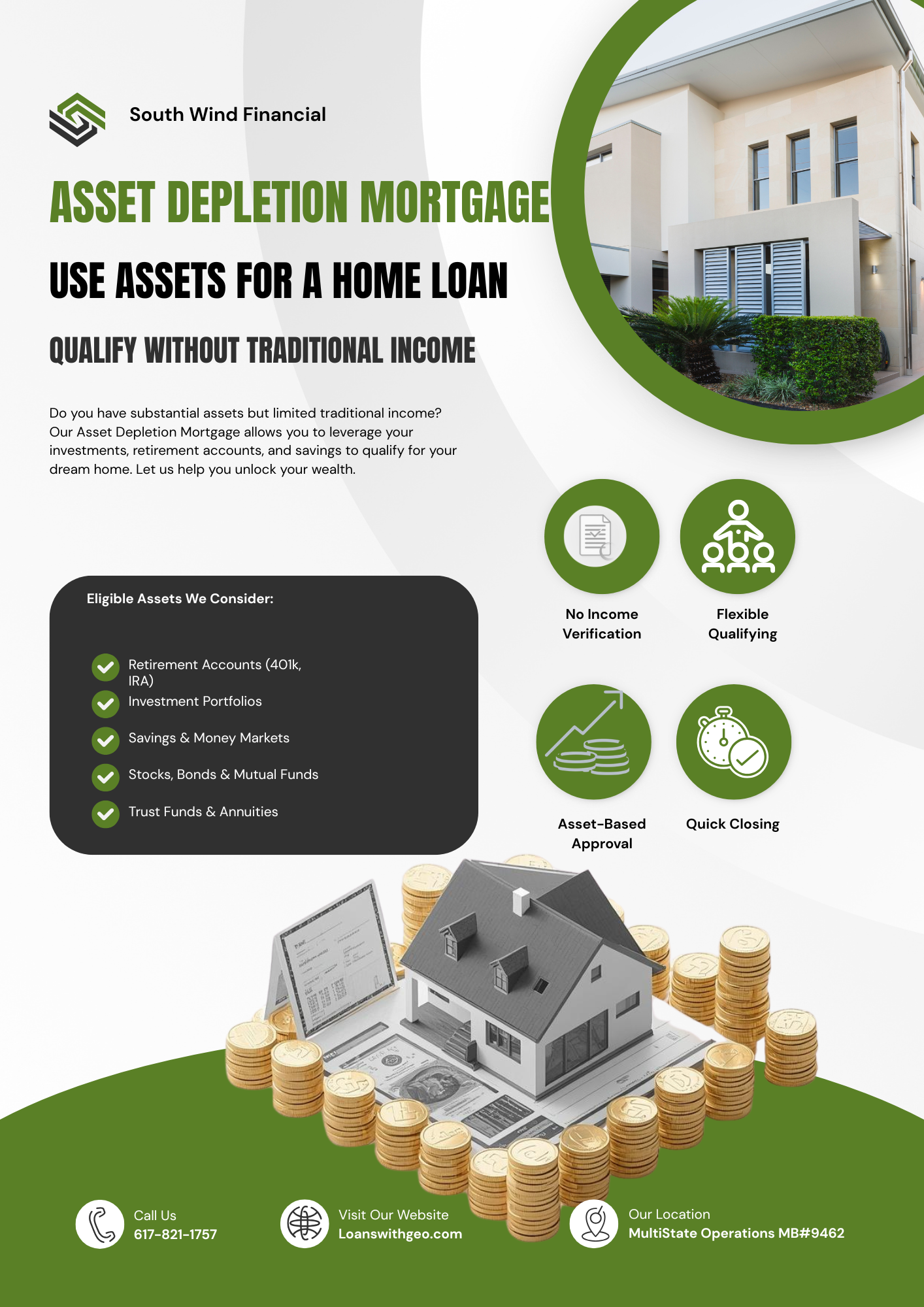
An asset depletion mortgage is a specialized financing program that allows high-net-worth borrowers to qualify for a home loan by utilizing their liquid assets—such as stocks, bonds, retirement accounts, and bank balances—rather than relying strictly on traditional W-2 income or tax-reported earnings.
Introduction to Asset Depletion Mortgages
Securing a conventional mortgage typically relies on a straightforward calculation: a borrower's gross monthly income, verified through pay stubs, W-2 forms, and tax returns, must comfortably cover their proposed monthly debt obligations. However, this traditional underwriting model often fails high-net-worth individuals whose wealth is tied up in substantial investment portfolios, retirement accounts, or business equities rather than standard payroll salaries.
Enter the asset depletion mortgage loan—frequently referred to as an asset-qualifying or asset-dissipation loan. This specialized financing mechanism is designed for individuals who possess significant wealth but lack the conventional paper income required by standard underwriting guidelines. By translating a borrower’s liquid or semi-liquid net worth into a calculated monthly income stream, lenders can evaluate creditworthiness and debt-to-income ratios without traditional employment verification.
Understanding how these programs operate, who they serve, and what lenders require is essential for self-employed professionals, retirees, startup founders, and high-net-worth buyers looking to navigate the modern real estate market.
How Asset Depletion Loans Work
At its core, an asset depletion loan bypasses traditional income verification by evaluating the longevity and volume of a borrower’s liquid assets. Instead of asking how much money a borrower earns each month, the lender asks: How long can these assets sustain the proposed monthly mortgage payments, property taxes, insurance, and overall living expenses if no new income is generated?
Lenders use specific formulas to convert a total pool of eligible assets into a hypothetical monthly income figure. While the exact mathematical models vary by financial institution, the process generally follows a standardized underwriting framework:
- Asset Aggregation and Discounting: The lender reviews all qualifying accounts and applies a "discount factor" or "haircut" to account for market volatility. For example, stocks and mutual funds may be discounted by 30% to 50% to protect against a market downturn, while cash and cash equivalents are typically valued closer to 100%.
- Amortization Over Time: The discounted asset total is then divided over a designated time horizon. This period often mirrors the term of the mortgage (such as 30 years or 360 months) or a shorter, set duration established by the lender's internal guidelines (such as 10, 15, or 20 years).
- Income Generation Calculation: The resulting figure establishes the borrower's "calculated monthly income." This amount is then plugged into standard debt-to-income (DTI) formulas to determine the maximum loan amount the borrower can comfortably service.
An Illustrative Example
Suppose a borrower has $2,000,000 in a diversified post-tax brokerage account. A private bank applies a 50% discount factor, reducing the eligible asset value to $1,000,000. If the lender divides that $1,000,000 over a 240-month (20-year) horizon, the resulting monthly income credited to the borrower is $4,166.33. This calculated income is then used by the underwriter to qualify the applicant for the mortgage.
Qualifying Assets and Discounting Factors
Not all wealth is treated equally by mortgage underwriters. Lenders categorize assets based on liquidity, accessibility, stability, and potential early-withdrawal penalties. To successfully secure an asset depletion mortgage, borrowers must understand which assets qualify and how heavily lenders will discount them.
Fully Eligible and Liquid Assets
- Checking and Savings Accounts: Cash held in traditional bank accounts is typically valued at 100%.
- Certificates of Deposit (CDs) and Money Market Funds: Highly liquid and stable, these are usually counted at or near full face value.
- Publicly Traded Stocks and Bonds: Equities and fixed-income securities held in brokerage accounts are widely accepted, though subject to conservative discounting due to market fluctuation.
Retirement and Semi-Liquid Assets
- IRAs and 401(k) Accounts: Retirement accounts can be used, but lenders often apply deeper discounts (sometimes valuing them at 60% to 70%) to account for potential early withdrawal penalties if the borrower is under the age of 59½.
- Mutual Funds and Exchange-Traded Funds (ETFs): Treated similarly to individual stocks within brokerage accounts.
Ineligible or Restricted Assets
- Closely Held Business Equity: Ownership shares in a private company are rarely accepted as liquid assets for depletion calculations because they cannot be readily converted to cash without a corporate liquidity event.
- Real Estate Equity: Equity tied up in other properties cannot typically be used for asset depletion, though it may be evaluated under separate cross-collateralization or portfolio lending guidelines.
- Cryptocurrency: While digital assets have gained mainstream visibility, most traditional mortgage lenders and portfolio institutions do not accept cryptocurrency for asset depletion programs due to extreme price volatility.
| Asset Type | Typical Valuation / Discount Rate | Liquidity Level | Accessibility Restrictions |
|---|---|---|---|
| Cash & Savings | 100% | Immediate | None |
| Certificates of Deposit | 95% – 100% | High (subject to minor term penalties) | Low |
| Public Equities & Bonds | 50% – 70% | High (settlement in 1–3 business days) | Market-dependent |
| Retirement Accounts (IRA/401k) | 60% – 70% | Moderate | Potential age-based withdrawal penalties |
| Private Business Equity | Generally Ineligible | Low | High |
Target Audience: Who Benefits Most from Asset Depletion Mortgages?
Asset depletion loans are niche financial products tailored to specific borrower profiles who find themselves "asset-rich and income-poor" on paper. Recognizing these archetypes helps clarify why traditional lending standards fall short for certain segments of the population.
1. Retirees and Pre-Retirees
Many retirees possess substantial retirement savings, investment portfolios, and home equity, but they no longer draw a traditional W-2 salary. While they could theoretically pay cash for a home, doing so would liquidate their income-generating investments and trigger massive capital gains or tax events. An asset depletion mortgage allows them to preserve their investment portfolios while securing long-term real estate financing.
2. High-Net-Worth Self-Employed Individuals and Entrepreneurs
Business owners and founders often minimize their adjusted gross income on personal tax returns to optimize tax liability legally. While effective for tax purposes, this practice often results in a low DTI ratio that causes automated underwriting systems to reject conventional mortgages. Asset depletion programs look past tax deductions to evaluate the true underlying wealth of the entrepreneur.
3. Independent Contractors, Freelancers, and Creators
High-earning consultants, artists, actors, and digital creators often experience irregular cash flows. In years where major contracts land, their income spikes; in other years, it drops. Asset depletion smooths out these financial fluctuations by focusing on accumulated capital reserves rather than volatile annual earnings.
Advantages and Disadvantages
Like any sophisticated financial tool, asset depletion mortgages come with distinct benefits and trade-offs that must be weighed carefully against the borrower's broader financial strategy.
The Benefits
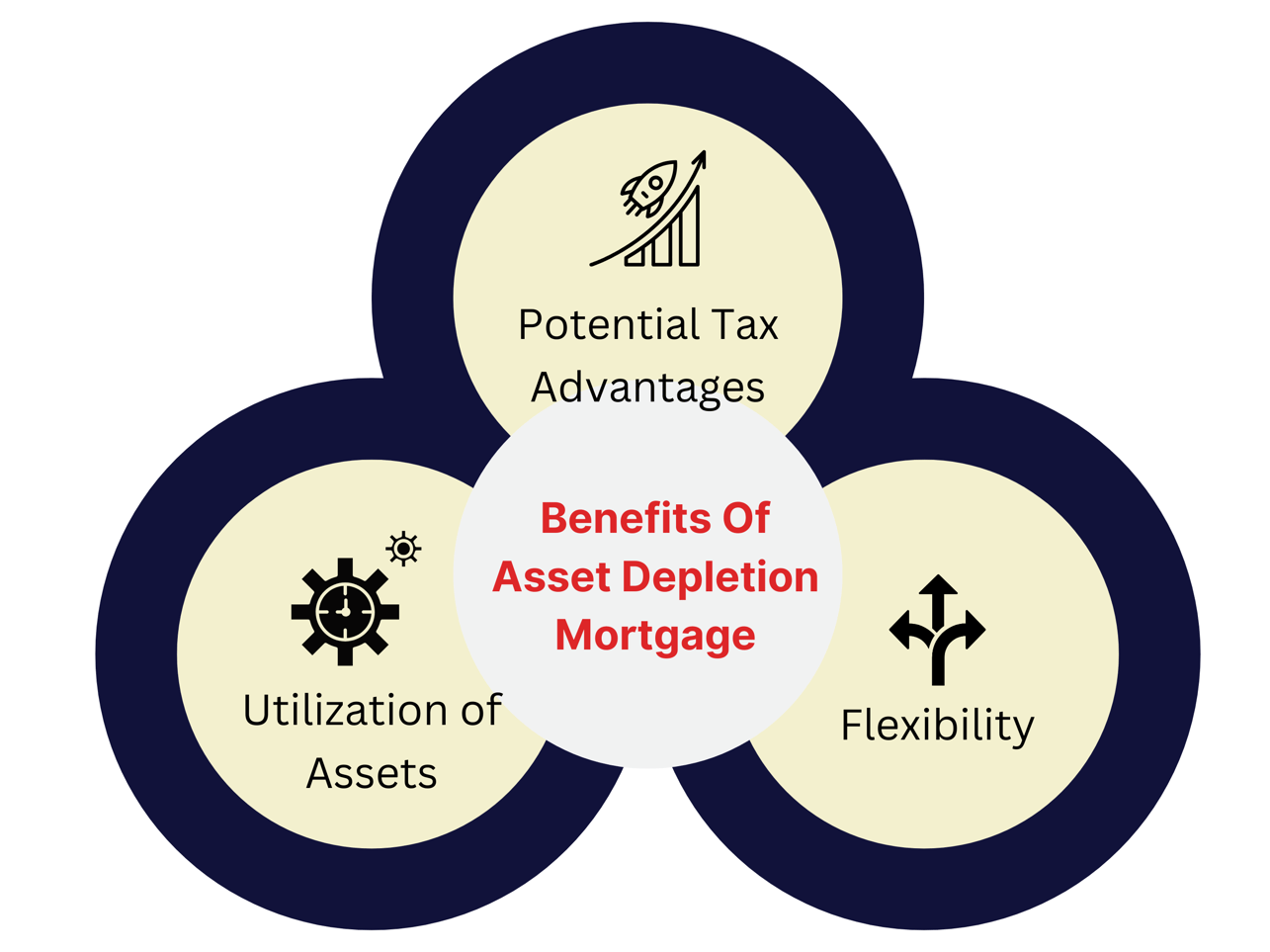
- Wealth Preservation: Borrowers can acquire real estate without liquidating valuable investment portfolios, allowing their capital to remain in the market and potentially outpace the mortgage interest rate.
- Tax Optimization: Self-employed individuals do not need to alter their tax strategies or artificially inflate their reported taxable income just to qualify for a home loan.
- Flexibility for Retirees: Provides a viable pathway for older buyers with zero traditional earned income to purchase primary residences or second homes.
- Favorable Purchasing Power: Enables high-net-worth buyers to compete in desirable housing markets without resorting to all-cash offers.
The Drawbacks and Risks
- Higher Interest Rates: Because these are typically classified as Non-QM (Non-Qualified Mortgage) loans or held in bank portfolios rather than sold to Fannie Mae or Freddie Mac, lenders often charge higher interest rates than conventional loans.
- Stricter Reserve Requirements: Lenders frequently require substantial cash reserves to remain untouched after closing, meaning a borrower cannot exhaust all their liquid funds for the down payment.
- Higher Down Payments: While conventional loans may allow down payments as low as 3% to 5%, asset depletion loans often require 20% to 30% down.
- Origination and Closing Costs: Portfolio and Non-QM loans often carry higher lender fees, specialized appraisal costs, and mandatory legal reviews.
Step-by-Step Application and Verification Process
Applying for an asset depletion mortgage requires meticulous documentation and preparation. Because these loans fall outside standard automated underwriting guidelines, human underwriters manually review every facet of the borrower’s financial life.
- Self-Assessment and Portfolio Review: Before approaching a lender, audit your liquid assets. Ensure your accounts are properly consolidated and free of encumbrances or margin loans that could reduce their net value.
- Select a Specialized Lender: Avoid standard retail banks that focus strictly on conforming agency loans. Instead, seek out private banks, credit unions, and wholesale mortgage brokers specializing in Non-QM and portfolio lending.
- Assemble Comprehensive Documentation: Gather comprehensive statements (typically spanning the last two to six months) for all qualifying accounts. Be prepared to provide brokerage agreements, corporate resolution documents (if applicable), and tax returns to verify the legitimacy of the wealth source.
- Underwriting and Manual Calculation: The lender’s underwriting team evaluates your asset mix, applies their proprietary discount formulas, calculates your synthetic monthly income, and reviews your credit score (typically requiring a minimum score of 700 to 720 or higher).
- Closing and Post-Closing Monitoring: Once approved, the loan proceeds through standard title and escrow phases. Note that some lenders may require ongoing asset verification or place restrictions on asset movement for a specified period post-closing.
Frequently Asked Questions
Can retirement accounts be used without triggering early withdrawal penalties?
Yes. Using retirement accounts for an asset depletion mortgage does not require you to actually withdraw the funds. Lenders simply evaluate the balance of the IRA or 401(k) to calculate your monthly income stream. The funds remain safely invested in your retirement account.
What credit score is required for an asset depletion loan?
Because these are non-conforming portfolio products carrying higher risk for lenders, credit score requirements are generally stricter than conventional loans. Most lenders look for a FICO score of 700 or higher, with better rates and terms available to borrowers exceeding 740.
Are asset depletion mortgages considered Non-QM loans?
In many cases, yes. Because they do not meet the Consumer Financial Protection Bureau’s (CFPB) strict Qualified Mortgage standards regarding traditional income verification, they are often originated as Non-QM or portfolio loans retained directly on the lender's balance sheet.
Can I use asset depletion for investment properties, or only primary residences?
While primary residences are the most common use case, some private portfolio lenders allow asset depletion for secondary homes or investment properties. However, expect stricter down payment requirements and higher interest rates when financing investment properties through this method.
How do lenders handle market downturns while I hold the mortgage?
Once the mortgage is closed and funded, subsequent market fluctuations do not affect your existing loan terms or monthly payments. Lenders evaluate asset value strictly at the time of underwriting to establish initial qualification.
Practical Next Steps
If you are a high-net-worth individual, retiree, or entrepreneur whose income does not fit traditional lending boxes, an asset depletion mortgage can be the key to unlocking your next real estate acquisition. To move forward effectively, begin by consulting with a specialized mortgage broker or a private wealth advisor who has direct access to portfolio lenders and Non-QM institutions. Prepare clean, organized statements of all liquid assets and review your credit profile to ensure you meet the robust qualification standards required by modern portfolio underwriters.