Yes, Saudi Arabia does levy taxes, though the tax framework differs significantly for citizens, residents, and foreign corporate entities. While there is no personal income tax on salaries earned by individuals working in the Kingdom, the government implements a comprehensive system of indirect taxes, corporate income taxes on foreign investors, and specialized levies like Zakat for local businesses.
The Evolution of Taxation in the Kingdom
Historically, Saudi Arabia was widely recognized as a tax-free haven, relying almost entirely on hydrocarbon revenues to fund public infrastructure, healthcare, education, and defense. Under traditional Islamic law and modern regulatory frameworks, the primary financial obligation for Muslim citizens and majority-owned GCC companies was Zakat, a religious wealth tax. However, the global economic shift of the mid-2010s prompted the Kingdom to diversify its revenue streams significantly.
Driven by the strategic initiatives of Vision 2030, Saudi Arabia introduced broad-based fiscal measures to modernize its economy, reduce oil dependence, and build a sustainable financial future. This transition included the implementation of Value-Added Tax (VAT), excise taxes on harmful goods, and a restructured corporate tax environment. Consequently, while individual employees still do not pay personal income tax on wages, the modern Saudi economic landscape features a sophisticated and actively enforced tax administration overseen by the Zakat, Tax and Customs Authority (ZATCA).
Personal Taxation: What Individuals Need to Know
For individual expatriates and Saudi nationals residing in the Kingdom, the question of taxation often centers on wages and personal income. Understanding how individual finances are treated under Saudi law requires looking at earned income, capital gains, and social security contributions.
Personal Income Tax on Wages
Saudi Arabia does not levy personal income tax on salaries, wages, or allowances earned by individuals working within the country, regardless of whether they are local citizens or foreign nationals. This policy has long made the Kingdom an attractive destination for global talent. Your gross monthly salary is your net take-home pay, insofar as direct income taxation is concerned.
Capital Gains and Wealth Taxes for Individuals
While salaries are exempt from income tax, certain economic activities carried out by individuals may encounter specific regulatory fees or municipal charges. For example, real estate transactions are subject to a specialized Real Estate Transaction Tax (RETT), which applies when property ownership is transferred. However, typical capital gains from the sale of personal movable property or standard stock market investments by individuals are generally not taxed in the same manner as corporate income.
Social Insurance Contributions (GOSI)
Although there is no personal income tax, employed individuals are subject to social insurance contributions managed by the General Organization for Social Insurance (GOSI).
- For Saudi Nationals: Employees contribute a percentage of their wages (typically 10% for annuities and occupational hazards) toward social security, with the employer contributing an additional share.
- For Expatriates: Non-Saudi employees generally contribute a smaller percentage (typically 2%) strictly for occupational hazards, paid entirely by the employer or split according to specific regulatory guidelines, while the annuity branch is reserved for nationals.
Corporate Taxation and Zakat
While individuals enjoy a tax-free status on earned income, businesses operating within Saudi Arabia face a distinct and rigorous tax landscape. The obligations of a company depend heavily on its ownership structure and the nationality of its shareholders.
Corporate Income Tax
Corporate income tax is levied on the share of profits belonging to foreign investors. The standard corporate income tax rate in Saudi Arabia is 20% on net adjusted profits for standard commercial activities. For companies operating in the oil, hydrocarbon, and natural gas production sectors, tax rates can be significantly higher, often scaling up to 50% or more depending on specific concession agreements and government regulations.
Zakat on GCC and Saudi-Owned Businesses
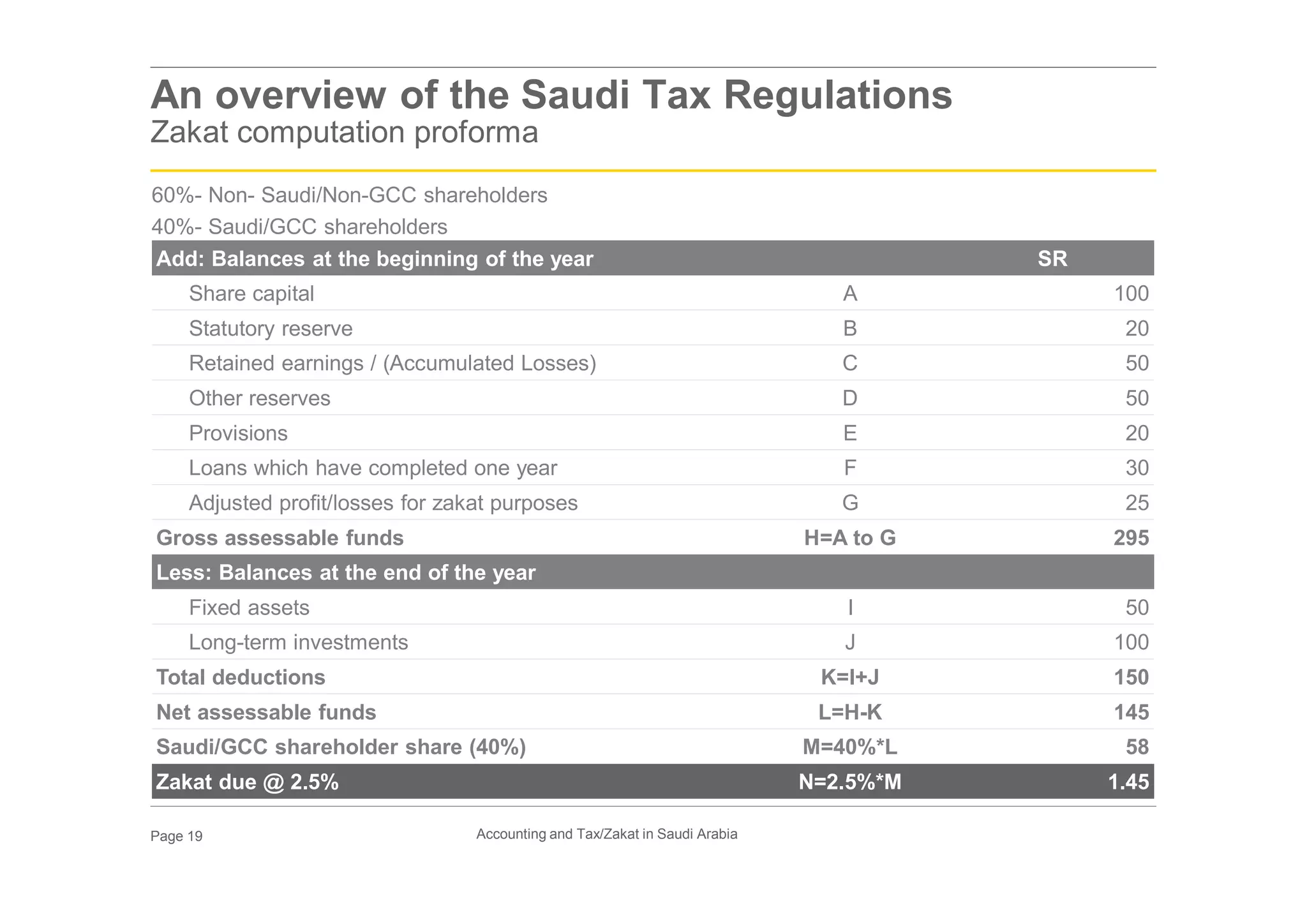
Local companies wholly owned by citizens of Saudi Arabia or other Gulf Cooperation Council (GCC) member states are subject to Zakat rather than corporate income tax. Zakat is calculated annually at a flat rate of 2.5% based on the company's Zakat base, which generally encompasses capital, retained earnings, and reserves, adjusted for certain assets and liabilities. For mixed companies with both Saudi/GCC and foreign ownership, the corporate tax applies strictly to the foreign shareholder's portion of the profit, while the local share is subject to Zakat.
| Entity Type / Shareholder Makeup | Applicable Levy | Standard Rate | Governing Authority |
|---|---|---|---|
| Foreign-Owned Companies | Corporate Income Tax | 20% (Higher for Hydrocarbons) | ZATCA |
| Saudi / GCC-Owned Companies | Zakat (Religious Wealth Tax) | 2.5% of the Zakat Base | ZATCA |
| Mixed-Ownership Companies | Pro-rated Zakat & Corporate Tax | 2.5% (Local share) / 20% (Foreign share) | ZATCA |
| Individual Employees (All Nationalities) | Personal Income Tax | 0% | N/A |
Indirect Taxes: VAT and Excise Duties
Indirect taxation forms a major pillar of Saudi Arabia's modern fiscal policy, applying uniformly to consumers regardless of their residency status.
Value-Added Tax (VAT)
Introduced in January 2018 at a rate of 5%, the standard VAT rate in Saudi Arabia was increased to 15% in July 2020 to strengthen the state's financial position amid economic shifts. VAT applies to the supply of most goods and services bought and sold in the Kingdom, with specific exceptions:
- Zero-Rated Supplies: Certain exports, international transportation, and qualifying medical equipment or medicines may be zero-rated.
- Exempt Supplies: Certain financial services and residential real estate rentals are exempt from VAT.
Excise Tax
To promote public health and discourage the consumption of specific goods deemed harmful to human health or the environment, Saudi Arabia enforces an excise tax. Common goods subject to excise duties include:
- Tobacco products and derivatives: 100%
- Energy drinks: 100%
- Carbonated drinks (sodas): 50%
- Sweetened drinks: 50% (introduced subsequently to target beverages with added sugars)
Compliance, Administration, and Enforcement
Tax administration and collection in Saudi Arabia are centralized under the Zakat, Tax and Customs Authority (ZATCA). ZATCA utilizes advanced digital infrastructure to monitor economic transactions, enforce compliance, and audit corporate financial statements.
Registration Requirements
- Businesses: Any corporate entity or establishment exceeding the mandatory VAT registration threshold must register with ZATCA and obtain a tax identification number. Businesses with taxable supplies below the mandatory threshold may apply for voluntary registration under specific conditions.
- Invoicing: ZATCA requires businesses to implement electronic invoicing (E-invoicing / Fatoorah) phases, ensuring that all tax invoices and credit/debit notes are generated and stored in a secure, digital format integrated with ZATCA's systems.
Filing and Penalties
Corporate taxpayers must file their annual tax returns and pay any due corporate income tax or Zakat within 120 days following the end of their financial year. For VAT-registered entities, returns must be filed on either a monthly or quarterly basis, depending on the annual turnover of the business. Failure to file on time, underreporting income, or late payments can result in severe financial penalties and administrative scrutiny by ZATCA inspectors.
Frequently Asked Questions
Do expatriates working in Saudi Arabia have to pay income tax?
No, individual expatriates do not pay personal income tax on their salaries, wages, or allowances earned within Saudi Arabia. Your employer does not deduct income tax from your monthly paycheck. However, you are still responsible for indirect taxes such as VAT on consumer purchases and social insurance contributions (GOSI) if applicable to your employment category.
What is the current Value-Added Tax (VAT) rate in Saudi Arabia?
The standard VAT rate in Saudi Arabia is 15%. This rate applies to the vast majority of goods and services purchased within the retail, hospitality, and commercial sectors, though specific financial transactions and residential rentals may be exempt.
How is Zakat different from corporate income tax?
Zakat is an Islamic religious obligation levied on the wealth of Saudi and GCC-owned businesses at a rate of 2.5% of the Zakat base. Corporate income tax, on the other hand, is a standard state tax levied at 20% on the net adjusted profits attributable to foreign investors. Mixed-ownership companies calculate and pay both proportional to their shareholder demographics.
Are there property taxes in Saudi Arabia?
Saudi Arabia does not have an annual recurring property tax equivalent to Western municipal property taxes on standard residential homes. However, the government enforces a White Land Tax on undeveloped urban plots to encourage real estate development, alongside a 5% Real Estate Transaction Tax (RETT) applied when property ownership is transferred.
How do businesses register for taxes in Saudi Arabia?
Businesses must register online through the official ZATCA portal. Once approved, the company receives a tax identification number and must integrate its accounting systems with ZATCA's electronic invoicing framework to ensure full regulatory compliance.
Conclusion and Next Steps
While Saudi Arabia remains free of personal income tax for individual workers, navigating its financial landscape requires a clear understanding of its indirect taxes, corporate obligations, and strict compliance standards. If you are an individual relocating to the Kingdom, budget primarily for indirect costs like the 15% VAT on consumer goods. If you are launching a business or investing locally, consult with a licensed tax professional or legal advisor certified in Saudi regulations to ensure your corporate structures, Zakat calculations, and ZATCA registrations comply fully with current statutory requirements.