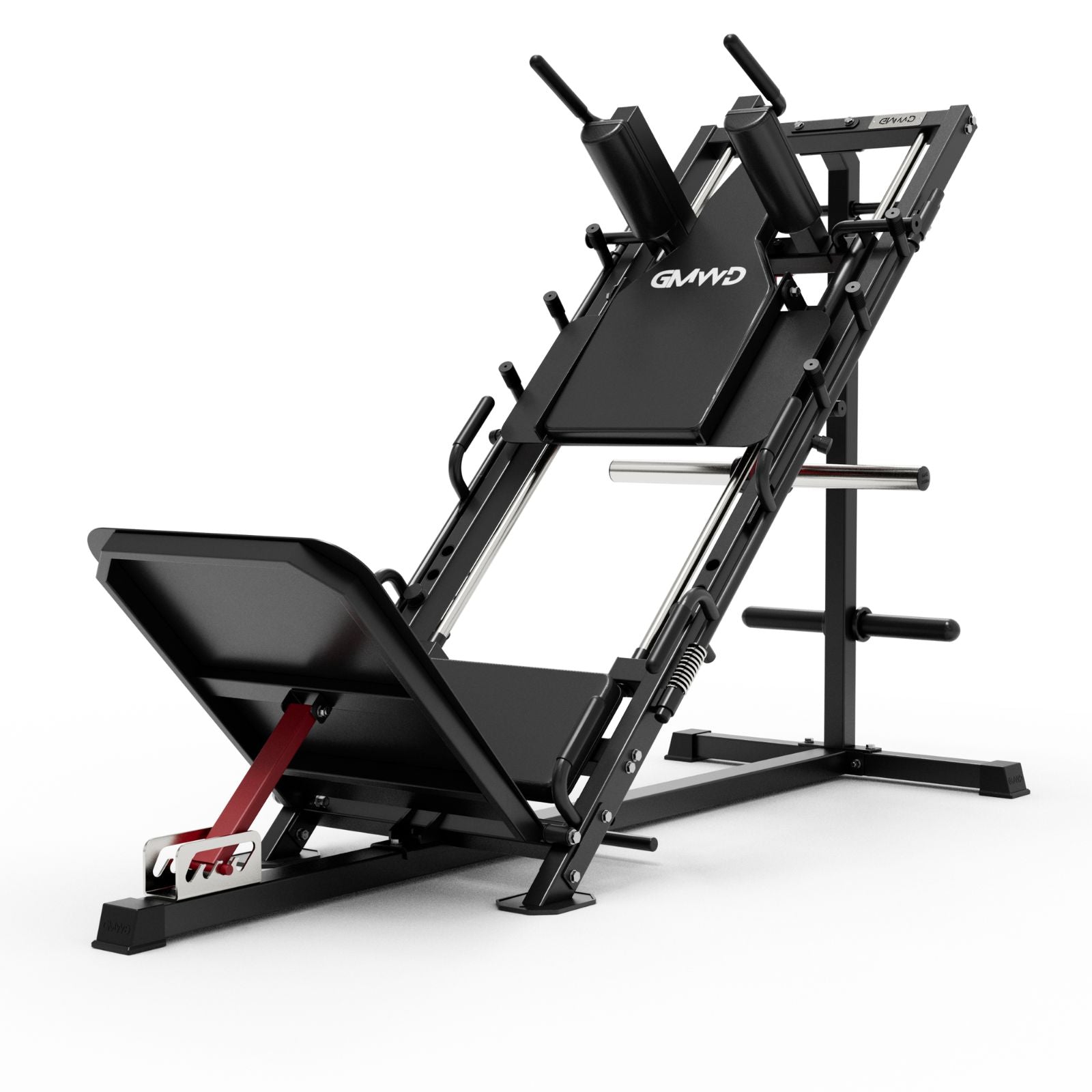
The weight defined on an angled leg press refers to the effective mechanical load moved by the user, which differs significantly from the total weight of the iron plates loaded onto the machine posts. On a standard 45-degree angled leg press, the actual force required to push the carriage equals approximately 70.7% of the combined weight of the plates and the empty sled, minus minor friction losses along the guide rails.
Defining Angled Leg Press Weight: Plate Load vs. Effective Resistance
Understanding weight on an inclined fitness machine requires distinguishing between three distinct values: plate load, sled weight, and effective resistance. When a lifter loads four 45-pound plates onto each side of a standard 45-degree leg press, the total plate load is 360 pounds (163.3 kg). However, claiming that the lifter is pressing 360 pounds against gravity is physically inaccurate.
Total Mass = Weight of Plates + Unloaded Sled Mass Effective Force = Total Mass × sin(Incline Angle) + Friction
The primary source of confusion stems from how gravitational force acts on an inclined plane. In a free-weight movement such as a barbell back squat or a vertical leg press ($90^\circ$ relative to the horizontal floor), gravity acts downward along the exact path of movement. Every pound of weight added to the bar or vertical carriage requires an equal pound of upward force to overcome gravitational attraction.
On an angled leg press, the guide rails support a portion of the load's mass. Gravity pulls the loaded sled straight down toward the floor, but the machine tracks restrict the sled to moving along a diagonal pathway. As a result, the gravitational force vector is divided into two distinct components:
- Perpendicular Force ($F_\perp$): The portion of weight pressing directly down into the linear bearings and guide rods. The steel frame of the machine completely supports this force component.
- Parallel Force ($F_\parallel$): The portion of weight pulling the sled down along the angle of the track. This is the exact force vector that your quadriceps, glutes, and adductors must overcome to extend your knees and hips.
Because the machine frame absorbs the perpendicular force, your muscles only work against the parallel force vector. Consequently, the resistance felt on an angled leg press is always lower than the nominal weight of the plates mounted on the carriage.
The Physics of the 45-Degree Leg Press
To calculate the exact force needed to move an angled leg press, you must apply basic Newtonian mechanics and vector trigonometry.
- Incline Path (Sled moves along incline)
- Vertical Component = Total Weight × sin(θ)
- Incline angle θ relative to Horizontal Axis
The Incline Formula
The baseline mathematical formula for force parallel to an inclined plane is:
$$F_\parallel = m \cdot g \cdot \sin(\theta)$$
Where:
- $m$ = total mass loaded on the machine plus the mass of the carriage sled.
- $g$ = acceleration due to gravity ($9.81\text{ m/s}^2$ or standard weight units).
- $\theta$ = angle of the guide rails relative to the horizontal plane (typically $45^\circ$).
- $\sin(\theta)$ = the sine of the angle of incline.
For a standard commercial 45-degree leg press machine, the sine of 45 degrees is approximately 0.7071.
This means that on a frictionless 45-degree slope, the effective resistance is exactly 70.71% of the total mass resting on the track.
Factoring in Carriage (Sled) Weight
Many lifters ignore the weight of the empty carriage when logging their training loads, assuming it is negligible. However, commercial leg press sleds are constructed from high-gauge tubular steel, plate-loading posts, footplates, and heavy bearing housings.
Unloaded sled weights across popular commercial gym brands generally range from 50 to 110 pounds (22.7 to 49.9 kg):
- Standard Light-Commercial Models: ~45–60 lbs (20.4–27.2 kg)
- Heavy Commercial Models (e.g., Hammer Strength, Cybex): ~75–115 lbs (34.0–52.2 kg)
- Articulating / Dual-System Leg Presses: ~100–135 lbs (45.4–61.2 kg)
To calculate true resistance, the unladen carriage weight must always be added to the plate weight before applying the sine multiplier:
$$\text{Effective Load} = (\text{Plate Weight} + \text{Sled Weight}) \times 0.7071$$
Accounting for Mechanical Friction
In real-world gym settings, friction between the sled mechanisms and the guide rails alters the effective load. Leg presses utilize either linear roller bearings running on solid steel rods or nylon/polyurethane wheels rolling over square steel tubing.
- Linear Bearings: Offer very low coefficients of friction ($\mu \approx 0.001 - 0.005$). Friction on well-maintained linear bearing machines is virtually negligible, altering the overall load by less than 2%.
- Bushings or Nylon Rollers: Generate higher frictional resistance ($\mu \approx 0.02 - 0.05$), especially if the guide rails are unlubricated, dirty, or worn.
During the concentric (pushing) phase, mechanical friction acts against your direction of travel, slightly increasing the force required to move the sled. During the eccentric (lowering) phase, friction acts against gravity, slightly reducing the load pushing back down against your feet. This explains why lowering a heavy leg press carriage often feels noticeably smoother or lighter than initiating the upward press.
Step-by-Step Weight Calculation Examples
The following table demonstrates effective load calculations across different plate configurations on a standard $45^\circ$ leg press machine with an unladen sled mass of 75 lbs (34 kg).
| Number of 45 lb Plates | Total Plate Weight (lbs) | Sled Weight (lbs) | Combined System Weight (lbs) | Effective Parallel Force at 45° (lbs) | Effective Load Percentage of Plates Only |
|---|---|---|---|---|---|
| 0 (Unloaded Sled) | 0 | 75 | 75 | 53.0 | N/A |
| 2 Plates (1 per side) | 90 | 75 | 165 | 116.7 | 129.6% |
| 4 Plates (2 per side) | 180 | 75 | 255 | 180.3 | 100.2% |
| 6 Plates (3 per side) | 270 | 75 | 345 | 244.0 | 90.4% |
| 8 Plates (4 per side) | 360 | 75 | 435 | 307.6 | 85.4% |
| 10 Plates (5 per side) | 450 | 75 | 525 | 371.2 | 82.5% |
| 12 Plates (6 per side) | 540 | 75 | 615 | 434.9 | 80.5% |
Key Takeaways from the Math
- Light Loads: When total plate weight is low, the sled weight makes up a substantial portion of the total resistance. At two 45-lb plates, the effective resistance (116.7 lbs) actually exceeds the plate weight alone (90 lbs).
- Cross-Over Point: At approximately 180 lbs of loaded plates (with a 75-lb sled), the effective resistance (180.3 lbs) matches the plate weight almost identically.
- Heavy Loads: As plate load increases significantly, the impact of the sled weight diminishes proportionally. At 12 plates (540 lbs), the effective load is roughly 435 lbs—representing ~80.5% of the nominal plate weight loaded on the machine.
Comparing the Angled Leg Press to Other Lower-Body Exercises
Comparing performance metrics across different lower-body movements requires analyzing postural stabilization, mechanical advantage, and movement geometry.
| Movement Type | Movement Angle | Effective Load % | Axial Spinal Loading |
|---|---|---|---|
| Barbell Back Squat | Vertical (90°) | 100% (+ Body mass) | High (Direct vertical) |
| Vertical Leg Press | Vertical (90°) | 100% (+ Sled mass) | Low (Supported back) |
| 45° Angled Leg Press | Diagonal (45°) | ~70.7% (+ Sled) | Low to Moderate |
| Hack Squat Machine | Diagonal (45-60°) | ~70.7% - 86.6% | Moderate to High |
1. Barbell Back Squat vs. Angled Leg Press
A lifter who squats 300 pounds can typically leg press 600 pounds or more on an angled machine. This vast discrepancy is driven by three main factors:
- Vector Incline: As demonstrated, a 45-degree angle reduces gravitational resistance by nearly 30%.
- Spinal and Core Stabilization Requirements: In a barbell squat, your trunk musculature, erector spinae, and rectus abdominis must contract isometricly to keep the upper body upright and balance the load over your center of mass. Research archived on the National Center for Biotechnology Information (NCBI) highlights how core muscle engagement and spinal shear forces limit maximum strength expression in free squats compared to fixed machine presses. On a leg press, the padded backrest supports your torso, removing core stabilization as a limiting factor.
- Balance and Center of Gravity: Free squats require continuous micro-adjustments from foot and ankle stabilizers. A machine constrained to fixed tracks eliminates balancing requirements entirely, allowing maximum motor unit recruitment dedicated purely to knee extension and hip extension.
2. Vertical Leg Press vs. 45-Degree Leg Press
Vertical leg presses position the user lying flat on their back, pushing the carriage straight up toward the ceiling at a $90^\circ$ angle.
- $\sin(90^\circ) = 1.0$, meaning 100% of the plate weight and carriage weight directly acts as downward force.
- A vertical leg press loaded with 300 lbs provides roughly 375 lbs of true resistance (assuming a 75 lb sled).
- A 45-degree leg press loaded with 300 lbs provides only 265 lbs of true resistance under identical sled weight conditions.
3. Hack Squat vs. Angled Leg Press
While many hack squat machines also operate on a 45-degree or 60-degree track, the user stands upright against a moving back pad with shoulders loaded under pads.
Although the track angle math ($\sin \theta$) remains identical, the hack squat forces the user to move a large portion of their own body weight along with the machine carriage. Conversely, on a leg press, your body mass remains stationary on the seat while only your legs press the external load.
Practical Considerations for Programming and Training
Understanding machine physics is valuable, but applying this knowledge to your strength training program ensures long-term progress, accurate record-keeping, and injury prevention.
- Training Program Considerations
- Log Consistency
- Keep method identical
- Document plate count vs total
- Note machine brand & model
- Machine Differences
- Sled mass varies (45-115 lbs)
- Track angles range (35°-50°)
- Mechanical friction differs
- Log Consistency
1. How to Log Your Leg Press Workouts
Consistency in your training log is far more critical than absolute numerical accuracy. Choose one logging method and stick to it strictly:
- Method A (Plate Weight Only): The most common gym convention. You record only the total weight of the iron plates placed on the machine (e.g., "360 lbs"). This is fast, simple, and convenient for daily tracking.
- Method B (Plates + Estimated Sled Weight): You add the rated weight of the machine carriage to your plate total (e.g., "360 lbs plates + 75 lb sled = 435 lbs"). This provides a truer reflection of total moved mass.
- Method C (Calculated Effective Force): You apply the sine multiplier to the total mass (e.g., "$435 \text{ lbs} \times 0.707 = 307.5 \text{ lbs}$"). While mathematically precise, it requires unnecessary math after every workout.
Recommendation: Use Method A for daily convenience, but acknowledge that your log numbers are machine-specific relative values rather than absolute strength figures.
2. Cross-Machine Variance Between Gyms
Never assume that pressing 400 pounds at one facility automatically translates to 400 pounds at another gym. Leg press resistance varies dramatically across equipment manufacturers due to several hardware design variables:
- Incline Angle Variations: Not all angled presses are set to exactly 45 degrees. Some commercial equipment features tracks angled at $35^\circ$ ($\sin 35^\circ \approx 0.573$), $40^\circ$ ($\sin 40^\circ \approx 0.643$), or $50^\circ$ ($\sin 50^\circ \approx 0.766$). A machine with a 35-degree track will feel significantly lighter than a 50-degree machine loaded with identical weight plates.
- Carriage Weight Differences: Plate-loaded sleds range from light residential models (30–45 lbs) to massive heavy-duty commercial rigs with dual footplates and thick frame plating (110+ lbs).
- Cam and Articulation Systems: Advanced modern leg presses feature articulating footplates or leverage arms that alter the force curve dynamically throughout the movement, changing the effective mechanical advantage as your knees flex and extend.
3. Foot Placement and Joint Biomechanics
Adjusting your foot position on the footplate changes muscle group recruitment patterns and joint torque distribution, even while the total physical force moving the sled remains constant.
Footplate Placement Biomechanics
- High Placement
- Greater Hip Flexion
- Glute/Hamstring Bias
- Reduced Knee Shear
- Low Placement
- Greater Knee Flexion
- Quadriceps Bias
- Increased Patellar Stress
- High Placement
High Placement (Near Top Edge): Increases hip flexion relative to knee flexion. This movement pattern biases the posterior chain (gluteus maximus and hamstrings) and reduces peak flexor forces at the patellofemoral joint.
Low Placement (Near Bottom Edge): Maximizes knee flexion and forward knees-over-toes translation. This creates high quad recruitment but increases compressive forces behind the patella.
Wide Stance: Increases adductor longus and magnus involvement while accommodating lifters with hip impingement limitations.
Narrow Stance: Shifts focus predominantly to the vastus lateralis and rectus femoris on the outer quad sweep.
Biomechanical Safety and Common Execution Errors
The leg press allows lifters to safely overload the lower body without demanding high motor control or balance. However, the ability to load extreme amounts of weight introduces unique injury vectors if technique degrades.
1. Pelvic Tilt and Lumbar Flexion ("Butt Wink")
The single most dangerous error on an angled leg press is allowing the lower back to round off the seat pad at the bottom of the movement.
When you lower the carriage too deep for your active hip mobility, your pelvis rotates posteriorly (butt wink). This places your lumbar spine into flexion under hundreds of pounds of compressive force, creating high shear stress on intervertebral discs.
- Correction: Only lower the carriage as far as your hip anatomy allows without your sacrum lifting off the back pad. Adjust the backrest incline angle to a more reclined setting if available.
2. Knee Hyper-Extension at Terminal Lockout
Vigorously locking out the knees at the top of the stroke transfers the mechanical load off your quadriceps muscles and directly onto the passive soft tissues of the knee joint—specifically the posterior capsule and anterior cruciate ligament (ACL).
- Correction: Maintain a slight, soft micro-bend in the knees at the top of every repetition. Keep continuous muscular tension on the quadriceps throughout the entire set.
3. Valgus Knee Collapse
Allowing the knees to cave inward toward the midline during the concentric phase places harmful lateral shear stress on the medial collateral ligament (MCL) and alters patellar tracking along the femoral groove.
- Correction: Select a weight load that permits your knees to track precisely inline with your second and third toes throughout the full concentric and eccentric movement arcs.
Comparative Overview of Machine Mechanics
The reference table below summarizes the physical, biomechanical, and operational differences across common lower-body press systems found in strength training facilities.
| Equipment Type | Typical Incline Angle | Mechanical Advantage Formula | Effective Resistance % of System Weight | Spinal Compression Level | Primary Limiting Factor |
|---|---|---|---|---|---|
| Vertical Leg Press | $90^\circ$ | $F = m \cdot g \cdot \sin(90^\circ)$ | 100% | Very Low | Pure Quadriceps / Glute Force |
| Standard Angled Leg Press | $45^\circ$ | $F = m \cdot g \cdot \sin(45^\circ)$ | ~70.7% | Low to Moderate | Quadriceps / Glute Max Extension |
| Low-Incline Leg Press | $35^\circ$ | $F = m \cdot g \cdot \sin(35^\circ)$ | ~57.4% | Very Low | Carriage Capacity / Plate Posts |
| Hack Squat Machine | $45^\circ - 60^\circ$ | $F = m \cdot g \cdot \sin(\theta)$ | ~70.7% - 86.6% | High (Shoulder Loaded) | Quadriceps / Spinal Erectors |
| Barbell Back Squat | N/A (Free Weight) | Direct Vertical Displacement | 100% (+ Body Weight) | Extremely High | Core Stability / Lumbar Extension |
Frequently Asked Questions
How much does a standard leg press sled weigh?
On commercial-grade 45-degree leg presses (such as those manufactured by Hammer Strength, Cybex, Matrix, or Life Fitness), the empty sled typically weighs between 75 and 115 pounds (34 to 52 kg). Smaller residential or light-commercial units usually feature lighter sleds weighing between 45 and 60 pounds (20 to 27 kg). Equipment manufacturers often print the unladen sled mass directly on the machine frame or serial sticker near the floor base.
Does a 45-degree leg press cut the total load in half?
No. A 45-degree angle does not cut the load by 50%. Based on trigonometric calculations, the sine of a 45-degree angle is approximately 0.7071. This means a 45-degree leg press reduces the effective gravitational resistance to roughly 70.7% of the total system mass (plates plus sled), assuming negligible track friction. A 50% load reduction would only occur on a machine angled at 30 degrees ($\sin 30^\circ = 0.50$).
Should I count the sled weight in my training log?
Adding the sled weight to your training log is optional, but staying consistent is key. If your main goal is tracking personal relative strength over time on one specific machine, logging plate weight alone is simple and completely fine. However, if you want an accurate mathematical record of your mechanical work, or if you frequently switch between different machines at different gyms, you should add the manufacturer's rated sled mass to your total loaded plate weight.
Why can I leg press significantly more weight than I can squat?
You can leg press much more than you squat due to three physical and mechanical advantages:
- The 45-degree incline track reduces the gravitational resistance of the plates to 70.7%.
- The backrest supports your upper body, removing core stabilizer strength and lumbar spine balance as performance bottlenecks.
- Your body weight remains seated on the machine frame rather than being lifted against gravity alongside the external load.
How do I calculate the exact effective force I am pushing on my leg press?
To find the exact effective push force:
- Add your total weight plates to the unladen sled weight to get the total system mass.
- Determine the track angle relative to the floor (usually $45^\circ$).
- Multiply the total system mass by the sine of that angle ($\sin 45^\circ \approx 0.7071$).
Example: If you load 400 lbs of plates onto a 75 lb sled on a 45-degree track:$$\text{Total System Mass} = 400 + 75 = 475\text{ lbs}$$$$\text{Effective Resistance} = 475 \times 0.7071 = 335.87\text{ lbs of force}$$
Practical Recommendation for Program Optimization
To maximize your leg press training performance safely while keeping track of true progressive overload:
- Inspect Your Machine: Look for a label near the carriage or frame base indicating the manufacturer's unladen sled weight and track angle. If no label exists, assume a standard 75 lb sled at a $45^\circ$ angle for commercial machines.
- Prioritize Range of Motion Over Ego Loading: Because the 45-degree incline reduces effective resistance, loading massive plate weight is easy. However, sacrificing range of motion to push heavier loads increases risk of injury without improving muscle hypertrophy. Select a load that allows a full range of motion (knee bend to at least 90 degrees) while keeping your sacrum firmly glued to the back pad.
- Log Consistently: Record your workouts using one fixed system (preferably listing plate weight and machine model). When transitioning to a new machine at a different facility, reduce the total loaded weight by 20% for your first set to gauge differences in track friction, angle slope, and carriage mass safely.