The Anglican Church in the United States encompasses several distinct ecclesiastical bodies sharing a heritage rooted in the Church of England and the historic Book of Common Prayer. Its primary expressions include The Episcopal Church (TEC)—the official member province of the global Anglican Communion—alongside independent orthodox bodies such as the Anglican Church in North America (ACNA) and various Continuing Anglican jurisdictions.
The Historical Foundations of American Anglicanism
Anglicanism in North America began with English colonization in the early seventeenth century. The first recorded Church of England service took place at Jamestown, Virginia, in 1607. Throughout the colonial era, Anglican parishes functioned under the formal oversight of the Bishop of London. Because no Anglican bishop resided in the American colonies, colonial ordinands were required to cross the Atlantic Ocean for ordination in England, and local churches operated without resident episcopal confirmation or leadership.
The American Revolutionary War (1775–1783) created a major structural and political crisis for the church. Colonial clergy had sworn oaths of allegiance to the British Sovereign as Supreme Governor of the Church of England. Following American independence, continuing to pledge loyalty to the Crown was politically untenable and legally impossible for citizens of the newly formed United States. Many loyalist clergy fled to Canada or Great Britain, leaving dozens of American parishes vacant.
To resolve the crisis of episcopal succession and governance, American Anglicans organized an independent national church structure:
- Securing the Episcopate (1784–1787): Samuel Seabury of Connecticut traveled to Europe to seek episcopal consecration. When British parliament refused to alter the oath of allegiance required for consecration, Seabury traveled to Scotland, where he was consecrated in Aberdeen in 1784 by non-juring bishops of the Scottish Episcopal Church. Subsequently, British law was amended, allowing the Archbishop of Canterbury to consecrate William White of Pennsylvania and Samuel Provoost of New York in 1787 without requiring oaths to the British Crown.
- Establishing the General Convention (1789): In 1789, clergy and lay representatives gathered in Philadelphia to form the Protestant Episcopal Church in the United States of America (PECUSA), now commonly known as The Episcopal Church (TEC). They adopted a constitution establishing a bicameral governing body (the General Convention) and authorized the first American Book of Common Prayer, which integrated Scottish and English liturgical traditions.
This newly established church preserved traditional catholic order—including the historic episcopate, creedal orthodoxy, and liturgical prayer—while establishing a representative, democratic governance structure incorporating lay representatives into church decision-making alongside bishops and clergy.
The Modern Realignment and Key Jurisdictions
During the late twentieth and early twenty-first centuries, theological controversies over biblical interpretation, human sexuality, liturgical revision, and the nature of church authority led to significant fragmentations within American Anglicanism. Today, the landscape is divided into three primary jurisdictional groupings.
- Historic Church of England
- American Revolution (1775–1783)
- Protestant Episcopal Church (PECUSA/TEC)
- Continuing Anglican Movement (ACC, APA, ACA) (1977)
- The Episcopal Church (TEC) (Anglican Communion)
- Anglican Church in North America (ACNA) (GAFCON / Global South) (2003–2009)
- Protestant Episcopal Church (PECUSA/TEC)
- American Revolution (1775–1783)
1. The Episcopal Church (TEC)
The Episcopal Church remains the largest and historically dominant Anglican organization in the United States. Headquartered in New York City, TEC consists of 99 dioceses in the U.S. and several international dioceses. It is the sole official U.S. member province of the international Anglican Communion, maintaining full communion with the See of Canterbury.
Over the past half-century, TEC adopted a progressive theological stance:
- It approved the ordination of women to the diaconate, priesthood, and episcopate (1976 General Convention).
- It revised its liturgy via the 1979 Book of Common Prayer.
- It consecrated Gene Robinson, an openly gay partnered man, as Bishop of New Hampshire in 2003.
- It authorized gender-neutral marriage rites at the 2015 General Convention.
TEC emphasizes social justice, ecological stewardship, inclusive ministry, and broad-church liturgical flexibility.
2. The Anglican Church in North America (ACNA)
Formed in 2009, the Anglican Church in North America consolidated traditionalist dioceses, parishes, and networks that departed from TEC and the Anglican Church of Canada. ACNA was established under the leadership of international Anglican archbishops associated with GAFCON (Global Anglican Future Conference) and the Global South Fellowship of Anglican Churches (GSFA).
Key theological and structural features of ACNA include:
- Theological Stance: Adherence to traditional orthodox views on biblical authority, classical creedal statements, and historic Christian teachings on marriage and human sexuality.
- Global Alignment: While not officially recognized by the Archbishop of Canterbury as a formal member province of the Anglican Communion, ACNA is recognized as fully Anglican by global provinces representing a majority of the world's practicing Anglicans (primarily across Africa, Asia, and Latin America).
- Internal Diversity: ACNA encompasses diverse liturgical traditions, ranging from Anglo-Catholic to Low Church Evangelical. It includes founding sub-bodies such as the Reformed Episcopal Church (REC), founded originally in 1873.
- Ordination Policies: ACNA permits individual dioceses to decide whether to ordain women to the priesthood, though its constitution restricts the episcopate (bishops) strictly to men.
3. The Continuing Anglican Movement
The Continuing Anglican movement emerged following the 1977 Congress of St. Louis, where concerned church leaders issued the Affirmation of St. Louis. This movement formed in direct response to TEC’s 1976 decisions to ordain women to the priesthood and revise the traditional 1928 Book of Common Prayer.
Continuing Anglican churches operate independently of both the Archbishop of Canterbury and ACNA. Major Continuing jurisdictions include:
- The Anglican Catholic Church (ACC)
- The Anglican Province of America (APA)
- The Anglican Church in America (ACA)
- The Diocese of the Holy Cross
These bodies maintain a traditional Anglo-Catholic theology, strict adherence to the 1928 (or historic English 1662) Book of Common Prayer, male-only holy orders, and traditional sacramental practices. In recent years, several of these jurisdictions have entered into formal concordats of intercommunion to foster greater unity.
Comparative Overview of Major US Anglican Bodies
The following table outlines the foundational, structural, and theological distinctions among the major Anglican entities operating in the United States:
| Feature / Dimension | The Episcopal Church (TEC) | Anglican Church in North America (ACNA) | Continuing Anglican Bodies (ACC, APA, ACA) |
|---|---|---|---|
| Founding Year | 1789 | 2009 | 1977 |
| Global Communion Status | Official member, Anglican Communion (Canterbury) | Recognized by GAFCON & GSFA; out of communion with Canterbury | Independent traditionalist; no formal ties to Canterbury |
| Primary Prayer Book(s) | 1979 Book of Common Prayer | 2019 Book of Common Prayer | 1928 Book of Common Prayer (or 1662 English BCP) |
| Ordination of Women | Deacons, Priests, and Bishops | Deacons (all dioceses); Priests (diocesan choice); Bishops (male only) | Male only (Deacons, Priests, and Bishops) |
| Marriage Doctrine | Inclusion of same-sex and opposite-sex couples | Strictly opposite-sex traditional marriage | Strictly opposite-sex traditional marriage |
| Theological Spectrum | Progressive to Broad Church | Evangelical, Anglo-Catholic, and Charismatic (Orthodox) | Traditional Anglo-Catholic / Prayer Book Catholic |
| Governing Structure | General Convention (Bishops, Clergy, Lay Deputies) | Provincial Assembly and College of Bishops | Provincial Synod and Council of Bishops |
Liturgy, Worship, and Prayer Books
Central to Anglican identity is the concept of lex orandi, lex credendi—the law of prayer is the law of belief. Anglican theology is expressed primarily through its corporate worship rather than rigid systematic dogmas.
The Evolution of the Book of Common Prayer
The Book of Common Prayer (BCP), original author Archbishop Thomas Cranmer (1549), provides structured liturgies, biblical readings (lections), psalms, and devotions. In the United States, several editions are actively used across different jurisdictions:
The 1928 BCP: Long considered the benchmark of traditional American Anglican liturgy. It preserves classic Elizabethan liturgical language ("thee," "thou," "vouchsafe") and traditional Eucharistic theology. It remains the standard liturgy for Continuing Anglican churches and some traditional ACNA and TEC parishes.
The 1979 BCP: Introduced major liturgical revisions within TEC, aligning American worship with modern ecumenical liturgical movements. It features contemporary English options (Rite II) alongside traditional language (Rite I), emphasizes Holy Baptism as the primary initiation rite, and restores the weekly Eucharist as the primary Sunday service.
The 2019 BCP: Developed by ACNA to provide a unified prayer book for orthodox Anglicans. It provides contemporary language alongside classic forms, emphasizes catechism, and seeks to bridge historic Reformation theology with ancient Catholic liturgical patterns.
1549/1552/1662 Church of England BCP
- 1789 First American BCP
- 1892 American BCP
- 1928 American BCP
- 1979 TEC BCP (Modern Rite II / Rite I options)
- 2019 ACNA BCP (Classic Alignment)
- Continuing Anglicans (Retain 1928 BCP)
- 1928 American BCP
- 1892 American BCP
- 1789 First American BCP
The Liturgical Spectrum within Parishes
Anglican churches display varied styles of worship, categorized across four main traditions:
- Anglo-Catholic (High Church): Emphasizes the Catholic continuity of Anglicanism. Services feature formal ceremonial vestments, incense ("smells and bells"), Eucharistic adoration, chanting, sanctus bells, and explicit sacramental emphasis.
- Evangelical (Low Church): Emphasizes Reformation heritage, the supreme authority of Holy Scripture, and expository preaching. Services feature simpler vestments (such as cassock and surplice or plain clerical attire), simplified liturgical ritual, and prominent sermon focus.
- Broad Church: Represents a middle-ground practice, balancing liturgical decorum with practical accessibility. It utilizes standard prayer book forms without extensive High Church ceremonial or Low Church informal modifications.
- Charismatic Anglicanism: Blends historical liturgical structures with contemporary praise music, extemporaneous prayer, and an emphasis on spiritual gifts. This style is frequently found within specific ACNA networks and modern plant churches.
Anglican Governance and Sacramental Theology
Episcopal Structure and Apostolic Succession
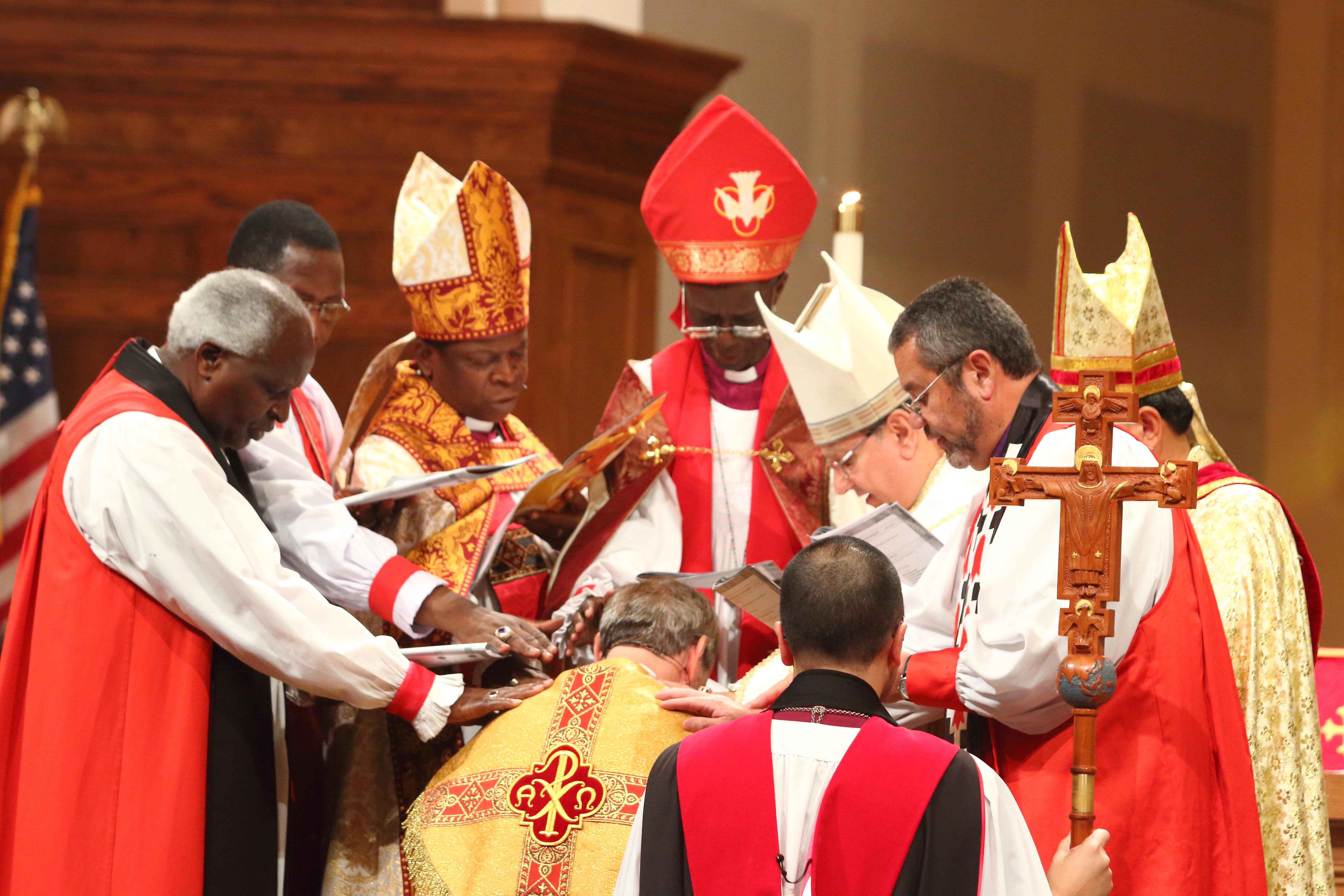
Anglicanism relies on an episcopal form of church government. Parishes are grouped geographic regions into dioceses, overseen by a Bishop. Bishops are understood to maintain Apostolic Succession—an unbroken line of episcopal consecrations linking modern bishops back to the early Christian Apostles.
The ordained ministry consists of three historic orders:
- Bishops: Chief pastors responsible for guarding the faith, ordaining clergy, confirming believers, and administering dioceses.
- Priests (Presbyters): Clergy ordained to preach the Word, administer Holy Baptism and Holy Communion, pronounce absolution, and shepherd local parish congregations.
- Deacons: Ordained ministers focused on servant leadership, charitable ministry, assisting at the altar, and reading the Gospel.
Sacramental Theology
Anglican doctrine, historically framed by the Thirty-Nine Articles of Religion, recognizes two main sacraments instituted by Christ in the Gospels:
- Holy Baptism: Administered with water in the name of the Father, Son, and Holy Spirit, marking full initiation into Christ's Body. Infant baptism is standard practice.
- Holy Eucharist (Holy Communion/The Mass): The central act of corporate worship. Anglicans affirm the Real Presence of Christ in the Eucharist—believing Christ is truly present in the consecrated bread and wine—while generally rejecting precise philosophical definitions such as Roman Catholic transubstantiation or strictly memorialist interpretations.
Additionally, five other sacramental rites are affirmed and practiced throughout Anglicanism: Confirmation, Holy Matrimony, Holy Orders (Ordination), Reconciliation of a Penitent (Confession), and Unction (Anointing of the Sick).
Navigating an Anglican Service: Guidance for Visitors
For individuals visiting an American Anglican parish for the first time, understanding service structures and liturgical customs ensures a comfortable worship experience.
Standard Worship Structure
A typical Sunday service (Holy Eucharist or Holy Communion) consists of two main divisions:
The Liturgy of the Word:
- Processional Hymn and Acclamation
- The Collect for the Day (appointed prayer)
- Scripture Lessons (typically Old Testament, Psalm, New Testament Epistle)
- The Holy Gospel Reading (congregation stands)
- The Sermon
- The Nicene Creed
- Prayers of the People and Corporate Confession of Sin
- The Peace (greeting one another)
The Liturgy of the Sacrament (Holy Eucharist):
- The Offertory (presentation of bread, wine, and financial gifts)
- The Great Thanksgiving (Eucharistic Prayer)
- Lord’s Prayer
- Breaking of the Bread (Fraction)
- Distribution of Holy Communion
- Post-Communion Prayer and Final Blessing
Holy Communion Etiquette and Participation
Communion guidelines vary depending on the jurisdiction of the parish:
- In The Episcopal Church (TEC): Open communion is standard. All baptized Christians of any denomination are invited to receive Holy Communion.
- In the Anglican Church in North America (ACNA): Generally open to all baptized Christians who are in good standing with their home churches, repentant of sin, and affirm faith in Jesus Christ.
- In Continuing Anglican Parishes: Admission to Holy Communion is typically reserved for baptized, confirmed Christians who hold traditional creedal faith.
Note for non-communicants: Any visitor, regardless of baptismal status, may approach the communion rail to receive a blessing from the priest by crossing their arms over their chest (forming an 'X').
Physical Postures in Liturgical Worship
Anglican worship involves physical engagement. A standard rule of thumb followed by worshippers includes:
- Stand for praise, singing, reading the Gospel, and reciting the Creed.
- Sit for instruction, listening to Old/New Testament readings, psalms, and the sermon.
- Kneel (or stand, if kneeling is unfeasible) for prayer, confession of sin, and receiving Holy Communion.
Frequently Asked Questions
Is The Episcopal Church the same as the Anglican Church in North America?
No. While both share common historical roots in the Church of England, they are separate ecclesiastical bodies. The Episcopal Church (TEC) is the official member province of the global Anglican Communion and holds progressive theological stances. The Anglican Church in North America (ACNA) was formed in 2009 by orthodox, traditionalist Anglicans who separated from TEC over theological disputes regarding scripture, human sexuality, and church authority.
Is ACNA recognized by the Archbishop of Canterbury?
ACNA is not formally recognized by the Archbishop of Canterbury as an official member province of the Anglican Communion. However, ACNA is officially recognized as fully Anglican by the Global Anglican Future Conference (GAFCON) and the Global South Fellowship of Anglican Churches (GSFA), which represent a significant majority of practicing Anglicans worldwide.
Which Book of Common Prayer is used in American Anglican churches?
Prayer book usage varies by jurisdiction. The Episcopal Church primarily uses the 1979 Book of Common Prayer. The Anglican Church in North America (ACNA) officially uses its authorized 2019 Book of Common Prayer. Continuing Anglican bodies (such as the ACC, APA, and ACA) primarily retain the historic 1928 Book of Common Prayer.
Can visitors take communion at an Anglican church?
In most TEC and ACNA churches, all baptized Christians who profess faith in Jesus Christ are welcome to receive Holy Communion. Continuing Anglican parishes may restrict communion to confirmed members or those who share their specific sacramental understanding. Visitors who are unbaptized or prefer not to receive bread and wine may approach the altar rail with arms crossed over their chest to receive a prayer of blessing.
What is the difference between High Church and Low Church Anglicanism?
High Church (Anglo-Catholic) parishes place strong emphasis on sacraments, formal liturgical rituals, high ceremonial practices (vestments, candles, incense), and Catholic heritage. Low Church (Evangelical) parishes focus more on expository preaching, scriptural authority, simplified liturgical ceremonial, and Protestant Reformation principles.
Practical Next Steps for Exploring American Anglicanism
If you are exploring Anglicanism or seeking a local parish in the United States, consider taking the following action steps:
- Identify Your Theological Preferences: Determine whether you align more closely with progressive, broad-church Anglicanism (The Episcopal Church), orthodox classical Anglicanism (Anglican Church in North America), or traditional Anglo-Catholic practice (Continuing Movement).
- Locate Parishes via Official Directories:
- Search for Episcopal congregations using The Episcopal Church Parish Finder.
- Search for orthodox Anglican congregations using the ACNA Parish Locator.
- Review Parish Bulletins and Live Streams: Prior to attending in person, watch a parish stream or review recent Sunday bulletins online to identify the congregation's liturgical style (Anglo-Catholic, Low Church, or Broad Church).
- Connect with Local Clergy: Contact the parish rector or vicar to discuss baptism, confirmation, or reception into the Anglican church, or to register for introductory adult education classes (such as Anglicanism 101 or catechism studies).