In a right triangle, the angle measurements always sum to $180^\circ$ ($180$ degrees or $\pi$ radians), with exactly one right angle measuring $90^\circ$. The remaining two acute angles are complementary, meaning their measurements sum to $90^\circ$. You can determine unknown angles using inverse trigonometric functions ($\arcsin$, $\arccos$, $\arctan$) or standardized special triangle ratios.
Fundamental Geometric Properties of Right Triangle Angles
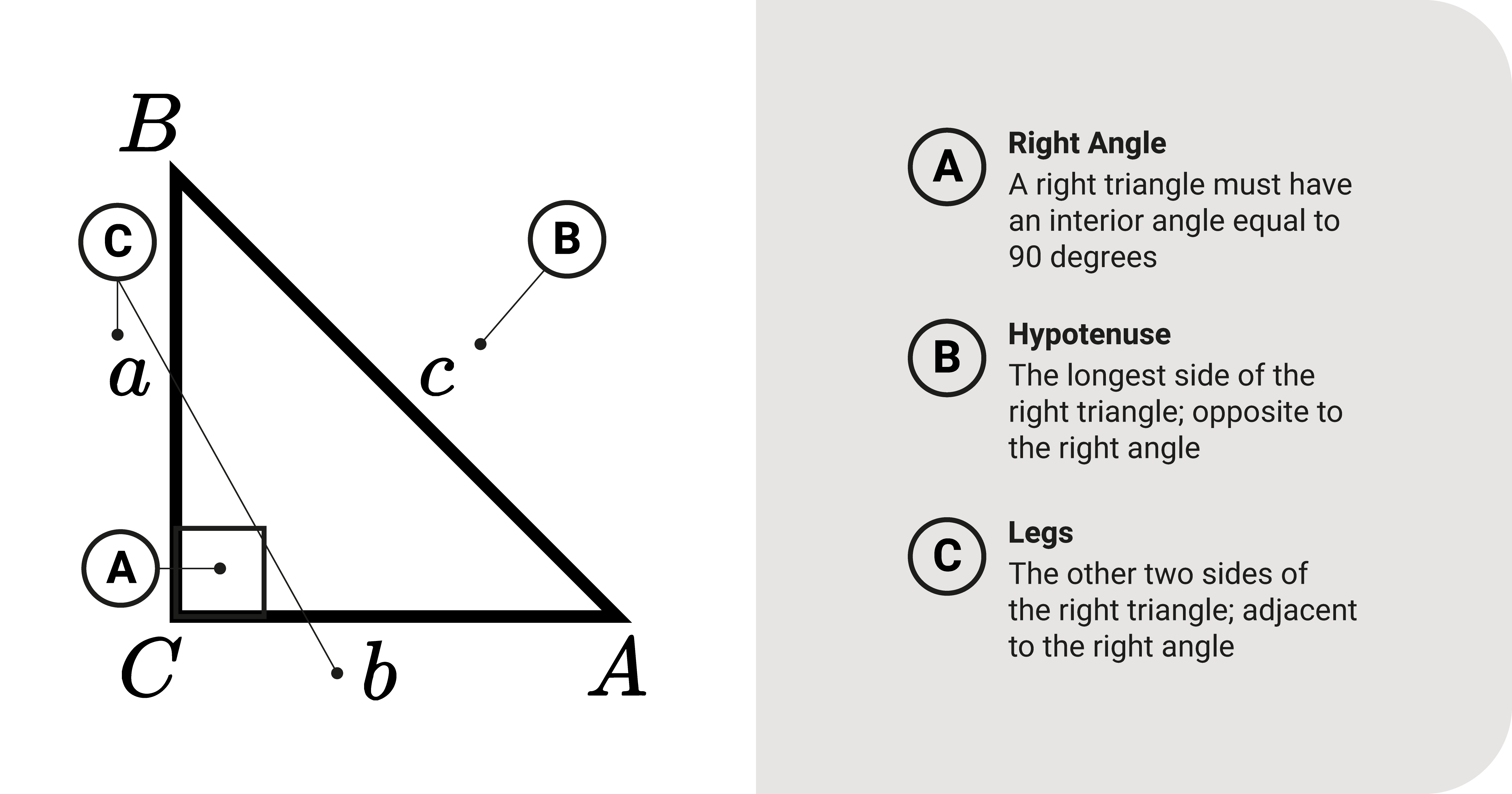
Understanding the angle measurements of a right triangle requires a firm grasp of Euclidean plane geometry. By definition, a right triangle (also referred to as a right-angled triangle) is any three-sided polygon containing one interior angle that measures exactly $90^\circ$. This right angle is denoted visually by a small square symbol at the intersection of the two perpendicular line segments, known as the legs.
The presence of the $90^\circ$ angle dictates the mathematical rules governing the remaining components of the triangle. The sum of all interior angles in any planar triangle is universally constant:
$$\theta_1 + \theta_2 + \theta_3 = 180^\circ \quad \text{(or } \pi \text{ radians)}$$
Because one angle is permanently fixed at $90^\circ$, the basic formula for a right triangle simplifies directly:
$$90^\circ + \alpha + \beta = 180^\circ \implies \alpha + \beta = 90^\circ$$
Here, $\alpha$ (alpha) and $\beta$ (beta) represent the two remaining acute angles.
/| / | / | c / | a / | / | /β____α| b
The Right Angle ($90^\circ$) and the Hypotenuse
The $90^\circ$ angle is always the largest interior angle in a right triangle. Under the basic theorems of geometry, the longest side of any triangle lies directly opposite its largest angle. Therefore, the side lying opposite the $90^\circ$ right angle is always the longest side, called the hypotenuse (labeled $c$).
The remaining two sides, referred to as legs (labeled $a$ and $b$), meet at a perpendicular angle ($90^\circ$). The legs are directly opposite the two acute angles ($\alpha$ and $\beta$).
Complementary Acute Angles
Because the two non-right angles in a right triangle must sum to $90^\circ$, they are defined as complementary angles. Neither acute angle can equal or exceed $90^\circ$, nor can either angle be less than or equal to $0^\circ$. This complimentary relationship yields several distinct properties:
- Mutual Dependence: If you calculate or measure one acute angle, the other acute angle is immediately determined by subtraction: $\beta = 90^\circ - \alpha$.
- Cofunction Identity: The sine of one acute angle is strictly equal to the cosine of its complement. For example, $\sin(\alpha) = \cos(\beta)$ and $\cos(\alpha) = \sin(\beta)$.
- Strict Bounds: Both acute angles must satisfy the domain constraint $0^\circ < \alpha, \beta < 90^\circ$ (or $0 < \alpha, \beta < \frac{\pi}{2}$ in radians).
Angle-Side Proportionality and Inequalities
The sizes of the acute angles directly mirror the relative lengths of the opposite legs. The fundamental side-angle inequality theorem states that in any triangle, a larger angle faces a longer side.
- If leg $a > b$, then acute angle $\alpha > \beta$.
- If leg $a < b$, then acute angle $\alpha < \beta$.
- If leg $a = b$, then acute angle $\alpha = \beta = 45^\circ$.
This linear relationship between side ratios and interior angles forms the foundation of classical trigonometry and allows precise angle determination even when direct protractor measurements are unavailable.
Special Right Triangles and Their Exact Angle Measurements
In geometry, two specific geometric configurations are classified as special right triangles. These triangles possess fixed angle measurements and predictable side-length ratios, allowing you to solve for angles and side lengths without relying on complex inverse trigonometric calculations.
45°-45°-90° Isosceles Right Triangle 30°-60°-90° Scalene Right Triangle /| /| / | / | / | / | c / | a = x c / | a = x√3 / | / | /45° _| /30° _| /_____|| /_____|| b = x b = x
The $45^\circ-45^\circ-90^\circ$ Isosceles Right Triangle
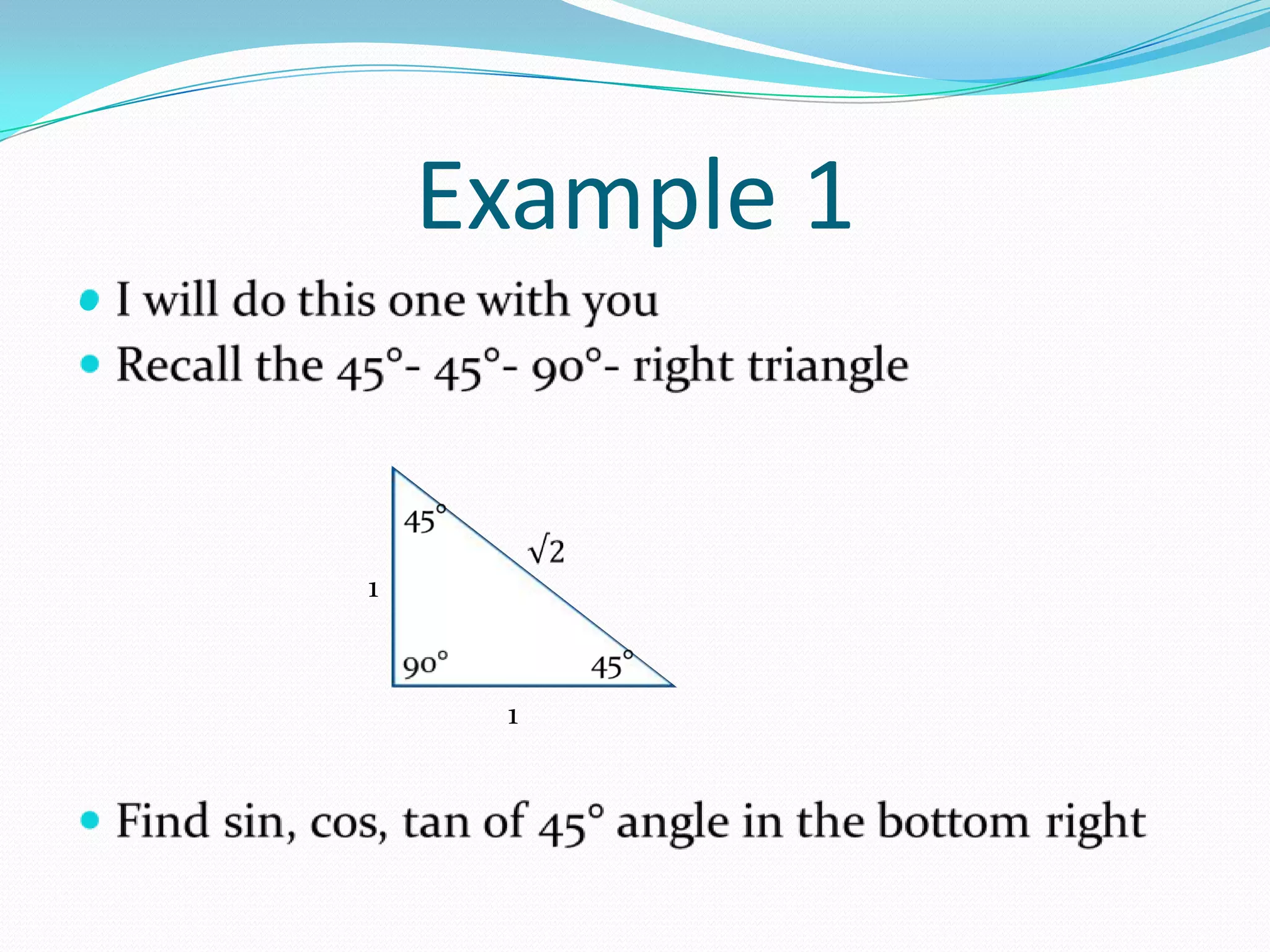
The $45^\circ-45^\circ-90^\circ$ triangle is formed by cutting a square in half along its diagonal. Because the two legs are of equal length ($a = b$), the angles opposite those legs must also be equal ($\alpha = \beta$).
- Angle Measurements: Exactly $45^\circ$, $45^\circ$, and $90^\circ$ ($\frac{\pi}{4}, \frac{\pi}{4}, \frac{\pi}{2}$ radians).
- Side-Length Ratio: $1 : 1 : \sqrt{2}$.
- Mathematical Expression: If each leg has a length of $x$, the hypotenuse has a length of $x\sqrt{2}$.
This triangle is the only right triangle that is also an isosceles triangle. Because of its symmetry, calculating the acute angles requires no side measurements beyond knowing that the two legs are congruent.
The $30^\circ-60^\circ-90^\circ$ Scalene Right Triangle
The $30^\circ-60^\circ-90^\circ$ triangle is constructed by bisecting an equilateral triangle down its axis of symmetry. This yields a right triangle whose acute angles measure precisely $30^\circ$ and $60^\circ$.
- Angle Measurements: Exactly $30^\circ$, $60^\circ$, and $90^\circ$ ($\frac{\pi}{6}, \frac{\pi}{3}, \frac{\pi}{2}$ radians).
- Side-Length Ratio: $1 : \sqrt{3} : 2$.
- Mathematical Expression: If the shortest leg (opposite the $30^\circ$ angle) has a length of $x$, the hypotenuse (opposite the $90^\circ$ angle) has a length of $2x$, and the longer leg (opposite the $60^\circ$ angle) has a length of $x\sqrt{3}$.
Understanding the $30^\circ-60^\circ-90^\circ$ geometry is critical in engineering and physics, as it defines standard vector projections across structural and mechanical systems.
How to Calculate Unknown Angles Using Inverse Trigonometry
When dealing with arbitrary (non-special) right triangles, calculating an unknown acute angle requires applying trigonometric ratios along with their inverse functions.
The primary trigonometric functions relate an acute angle ($\theta$) to the ratio of two sides of the right triangle:
- Sine ($\sin$): $\sin(\theta) = \frac{\text{Opposite}}{\text{Hypotenuse}}$
- Cosine ($\cos$): $\cos(\theta) = \frac{\text{Adjacent}}{\text{Hypotenuse}}$
- Tangent ($\tan$): $\tan(\theta) = \frac{\text{Opposite}}{\text{Adjacent}}$
A common mnemonic used to memorize these core ratios is SOH CAH TOA.
/| / | Hypotenuse / | Opposite Leg ( c ) / | ( a ) / | /θ____| Adjacent Leg ( b )
Inverse Trigonometric Functions
To isolate and solve for the angle $\theta$ itself, you must take the inverse of the trigonometric function (also written as $\arcsin$, $\arccos$, or $\arctan$, or represented on calculators as $\sin^{-1}$, $\cos^{-1}$, and $\tan^{-1}$):
$$\theta = \arcsin\left(\frac{\text{Opposite}}{\text{Hypotenuse}}\right)$$
$$\theta = \arccos\left(\frac{\text{Adjacent}}{\text{Hypotenuse}}\right)$$
$$\theta = \arctan\left(\frac{\text{Opposite}}{\text{Adjacent}}\right)$$
Step-by-Step Example: Finding Angles Given Two Side Lengths
Suppose you have a right triangle with a vertical leg $a = 5\text{ cm}$, a horizontal leg $b = 12\text{ cm}$, and an unknown hypotenuse $c$. You want to find the acute angle $\theta$ formed between the horizontal leg $b$ and the hypotenuse $c$.
Step 1: Identify Known Values Relative to the Target Angle
- Target Angle ($\theta$): Angle at the base.
- Opposite Leg ($a$): $5\text{ cm}$
- Adjacent Leg ($b$): $12\text{ cm}$
Step 2: Select the Appropriate Inverse Function
Since you know the opposite and adjacent legs, use the tangent ratio ($\tan$) and its inverse ($\arctan$):
$$\tan(\theta) = \frac{\text{Opposite}}{\text{Adjacent}} = \frac{5}{12}$$
Step 3: Calculate the Acute Angle
Apply the inverse tangent function:
$$\theta = \arctan\left(\frac{5}{12}\right) = \arctan(0.4167) \approx 22.62^\circ$$
Step 4: Determine the Remaining Acute Angle
Since the two acute angles must be complementary ($\theta + \beta = 90^\circ$):
$$\beta = 90^\circ - 22.62^\circ = 67.38^\circ$$
Thus, the three angle measurements of this right triangle are approximately $90^\circ$, $22.62^\circ$, and $67.38^\circ$.
Converting Between Degrees, Radians, and Gradians
Depending on the application—such as pure mathematics, computer programming, or civil surveying—angle measurements may be expressed in units other than standard sexagesimal degrees ($^\circ$).
Degrees to Radians: Multiply degree value by $\frac{\pi}{180}$. $$\theta_{\text{rad}} = \theta_{\text{deg}} \times \frac{\pi}{180}$$ Example: $90^\circ \times \frac{\pi}{180} = \frac{\pi}{2} \approx 1.5708 \text{ rad}$.
Radians to Degrees: Multiply radian value by $\frac{180}{\pi}$. $$\theta_{\text{deg}} = \theta_{\text{rad}} \times \frac{180}{\pi}$$ Example: $\frac{\pi}{6} \text{ rad} \times \frac{180}{\pi} = 30^\circ$.
Gradians (Grad or Gon): Common in European land surveying. A right angle contains $100\text{ gradians}$, making a full circle $400\text{ gradians}$. To convert degrees to gradians, multiply by $\frac{10}{9}$.
Comparative Reference Guide for Right Triangle Angles
The following table summarizes common right triangle configurations, detailing their exact angles, side length ratios, and applicable evaluation formulas.
| Triangle Classification | Acute Angle 1 ($\alpha$) | Acute Angle 2 ($\beta$) | Right Angle | Side Ratio (Opposite $\alpha$ : Opposite $\beta$ : Hypotenuse) | Primary Inverse Formula |
|---|---|---|---|---|---|
| Isosceles Right ($45-45-90$) | $45^\circ$ ($\frac{\pi}{4}\text{ rad}$) | $45^\circ$ ($\frac{\pi}{4}\text{ rad}$) | $90^\circ$ ($\frac{\pi}{2}\text{ rad}$) | $1 : 1 : \sqrt{2}$ | $\alpha = \arctan(1)$ |
| Scalene Special ($30-60-90$) | $30^\circ$ ($\frac{\pi}{6}\text{ rad}$) | $60^\circ$ ($\frac{\pi}{3}\text{ rad}$) | $90^\circ$ ($\frac{\pi}{2}\text{ rad}$) | $1 : \sqrt{3} : 2$ | $\alpha = \arcsin(0.5)$ |
| 3-4-5 Pythagorean Triple | $\approx 36.87^\circ$ ($0.6435\text{ rad}$) | $\approx 53.13^\circ$ ($0.9273\text{ rad}$) | $90^\circ$ ($\frac{\pi}{2}\text{ rad}$) | $3 : 4 : 5$ | $\alpha = \arcsin(0.6)$ |
| 5-12-13 Pythagorean Triple | $\approx 22.62^\circ$ ($0.3948\text{ rad}$) | $\approx 67.38^\circ$ ($1.1753\text{ rad}$) | $90^\circ$ ($\frac{\pi}{2}\text{ rad}$) | $5 : 12 : 13$ | $\alpha = \arctan(\frac{5}{12})$ |
| 8-15-17 Pythagorean Triple | $\approx 28.07^\circ$ ($0.4899\text{ rad}$) | $\approx 61.93^\circ$ ($1.0809\text{ rad}$) | $90^\circ$ ($\frac{\pi}{2}\text{ rad}$) | $8 : 15 : 17$ | $\alpha = \arcsin(\frac{8}{17})$ |
| General Right Triangle | $\alpha$ | $90^\circ - \alpha$ | $90^\circ$ ($\frac{\pi}{2}\text{ rad}$) | $a : b : \sqrt{a^2 + b^2}$ | $\alpha = \arctan(\frac{a}{b})$ |
Practical Applications and Real-World Use Cases
The mathematical rules governing right triangle angle measurements are vital across technical fields, infrastructure project design, software engineering, and physical sciences.
Surveying and Geodetic Measurement
Land surveyors rely on the principles of right triangle trigonometry to calculate terrain elevation, distance across obstacles, and property boundaries. Using high-precision tools such as total stations or optical theodolites, a surveyor measures a horizontal base distance (adjacent leg) and a vertical angle of elevation ($\theta$).
By applying the tangent ratio ($\text{Height} = \text{Distance} \times \tan(\theta)$), they can compute heights without physically climbing or placing tape measures along steep terrain.
/| / | / | Height (h) = d × tan(θ) / | /θ___| Distance (d)
Architecture, Framing, and Roof Pitch Construction
In structural design and carpentry, structural stability relies on accurate angle measurements. For example, building codes specify roof pitch as a ratio of vertical rise over horizontal run (such as a "6 in 12" pitch, meaning 6 inches of vertical rise for every 12 inches of horizontal run).
Carpenters translate this ratio directly into an angle measurement using the inverse tangent function:
$$\theta = \arctan\left(\frac{6}{12}\right) = \arctan(0.5) \approx 26.57^\circ$$
Calculating this rafter angle ensures rafters are cut precisely, allowing roofs to shed water effectively and support heavy snow loads without risking structural failure.
Navigation, Aviation, and Vector Decomposition
In navigation, physics, and computer graphics, forces, velocities, and directional vectors are frequently broken down into perpendicular components along $x$ and $y$ axes.
- Heading & Bearing Calculations: Ships and aircraft calculate true course paths by treating crosswinds or water currents as vector components that form a right triangle against their intended heading.
- Physics Trajectories: When a projectile is launched at an initial velocity $V$ and angle $\theta$, the horizontal component ($V_x$) and vertical component ($V_y$) are modeled as: $$V_x = V \cdot \cos(\theta)$$ $$V_y = V \cdot \sin(\theta)$$
Common Mistakes When Calculating Right Triangle Angles
Even straightforward calculations can yield incorrect results if you fall into common technical traps. Below are the primary errors to avoid:
Calculator Mode Misconfiguration (Degrees vs. Radians): The most frequent error occurs when a calculator is set to Radians (RAD) mode while working with degree values, or vice versa. For instance, $\sin(30^\circ)$ equals $0.5$, but calculating $\sin(30 \text{ rad})$ yields approximately $-0.9880$. Always verify your calculator’s mode before performing inverse trigonometric calculations.
Confusing the Opposite and Adjacent Legs: The designation of "opposite" and "adjacent" depends entirely on which acute angle you are trying to find. The opposite leg is the side across from your target angle, while the adjacent leg is the side touching your target angle (that is not the hypotenuse). Reversing these legs will compute the complementary angle instead of your intended target angle.
Applying Right-Triangle Rules to Non-Right Triangles: Trigonometric identities like $\sin(\theta) = \frac{\text{Opposite}}{\text{Hypotenuse}}$ and the Pythagorean theorem ($a^2 + b^2 = c^2$) apply only to triangles containing a $90^\circ$ right angle. For oblique triangles (triangles without a $90^\circ$ angle), you must use the Law of Sines or Law of Cosines.
Misidentifying the Hypotenuse: The hypotenuse is always the side opposite the $90^\circ$ angle, regardless of how the triangle is oriented or rotated on a page. Never assume the horizontal bottom side is the adjacent leg or that the slanted side is automatically the hypotenuse without first locating the right-angle marker.
Frequently Asked Questions
Can a right triangle have two $90^\circ$ angles?
No. In plane (Euclidean) geometry, the sum of all three interior angles in a triangle must equal exactly $180^\circ$. If a triangle contained two $90^\circ$ angles, those two angles alone would sum to $180^\circ$, leaving $0^\circ$ for the third angle. This would result in two parallel lines that never close to form a three-sided polygon. (Note: In non-Euclidean spherical geometry, triangles can contain multiple $90^\circ$ angles, but this does not apply to flat planes.)
How do you find the angles of a right triangle if you only know the side lengths?
If you know the lengths of all three sides ($a$, $b$, and $c$), you can find any acute angle using inverse trigonometric functions. Select the two sides you want to use and apply the matching function: $\alpha = \arcsin(\frac{a}{c})$, $\alpha = \arccos(\frac{b}{c})$, or $\alpha = \arctan(\frac{a}{b})$. Once you find $\alpha$, subtract it from $90^\circ$ to find the remaining acute angle $\beta$.
What are the acute angles in a 3-4-5 right triangle?
In a standard 3-4-5 right triangle, the acute angle opposite the side of length 3 measures approximately $36.87^\circ$ ($0.6435\text{ radians}$), and the acute angle opposite the side of length 4 measures approximately $53.13^\circ$ ($0.9273\text{ radians}$). These two angles sum to $90^\circ$, complementing the main $90^\circ$ right angle.
Why do the acute angles of a right triangle always add up to $90^\circ$?
The interior angles of any triangle in a plane always add up to $180^\circ$. Because a right triangle by definition contains one $90^\circ$ angle, subtracting $90^\circ$ from the total $180^\circ$ leaves exactly $90^\circ$ to be split between the remaining two acute angles. This makes the two acute angles complementary by definition.
How do you calculate the angles of a right triangle in software like Excel or Python?
Most programming languages and spreadsheet applications calculate trigonometric functions in radians by default, not degrees.
- In Microsoft Excel / Google Sheets: To find an angle in degrees from opposite side
A1and adjacent sideB1, use=DEGREES(ATAN(A1/B1)). - In Python: Import the
mathmodule and usemath.degrees(math.atan(opposite / adjacent)).
Next Steps for Mastering Right Triangle Geometry
To build proficiency in working with right triangle angle measurements and trigonometric calculations, put these concepts into practice:
- Verify Calculator Settings: Check that your scientific calculator or software environment is set to the correct mode (Degrees vs. Radians) for your project requirements.
- Practice Side-Ratio Identification: Practice recognizing standard Pythagorean triples (such as 3-4-5, 5-12-13, and 8-15-17) and special triangles ($45^\circ-45^\circ-90^\circ$ and $30^\circ-60^\circ-90^\circ$) to quickly estimate angles without software tools.
- Cross-Check Calculations: Always verify your work using the fundamental rule of complementary angles: ensure your calculated acute angles satisfy $\alpha + \beta = 90^\circ$, and confirm that the largest angle ($90^\circ$) sits directly opposite the longest side (the hypotenuse).