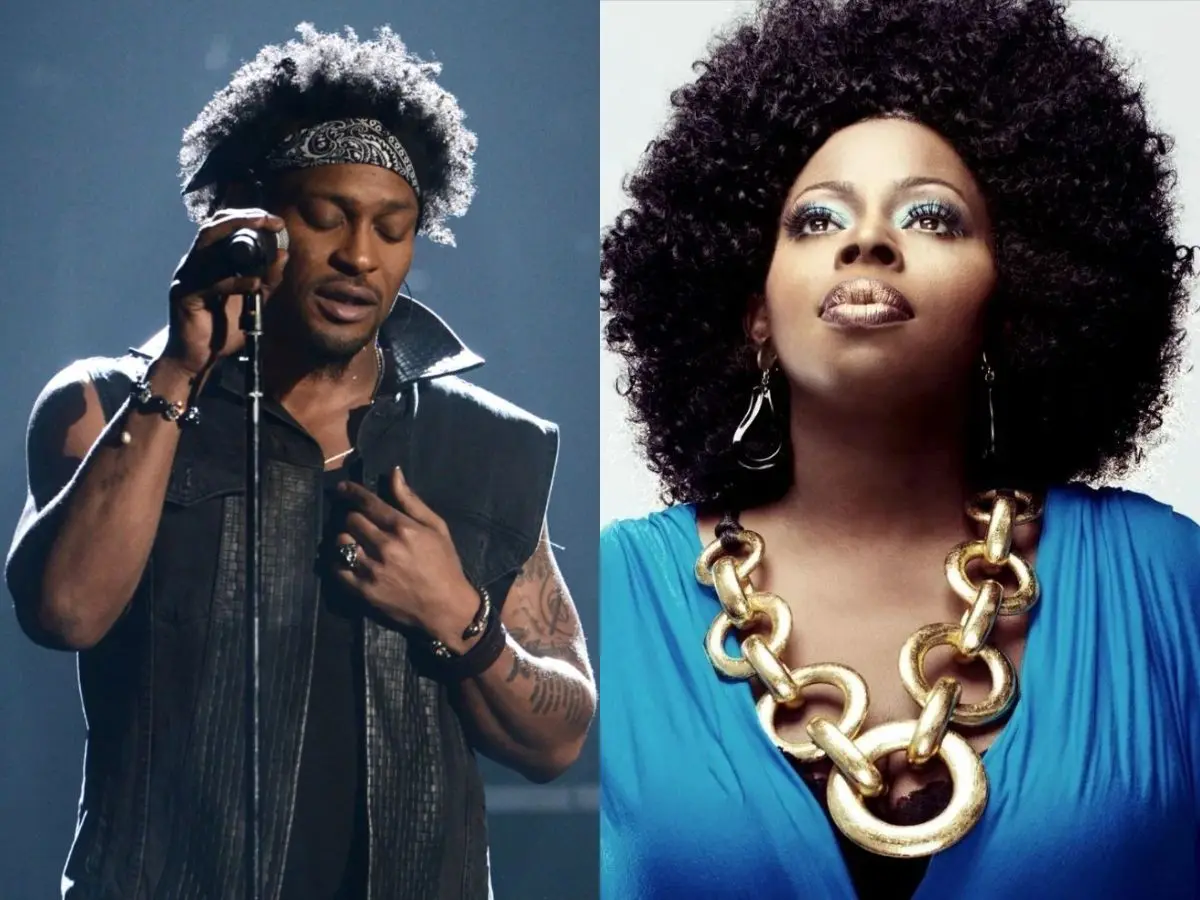
R&B singer-songwriters Angie Stone and D'Angelo dated during the mid-to-late 1990s, forming one of the most musically influential romantic partnerships in modern soul. Their relationship yielded both classic tracks on D'Angelo's seminal 1995 album Brown Sugar and a son, Michael D'Angelo Archer II, born in 1998, leaving a lasting mark on the neo-soul era.
The Origins of Angie Stone and D'Angelo's Relationship
The romantic connection between Angie Stone and D'Angelo developed at a pivotal turning point in modern R&B history. Before their paths crossed in the early 1990s, both artists possessed deep roots in traditional African American music traditions, including gospel, classic soul, and early hip-hop.
Angie Stone (born Angela Laverne Brown in Columbia, South Carolina) had already established her musical credentials long before the term "neo-soul" entered the popular lexicon. In the late 1970s and early 1980s, she performed as a member of The Sequence, the pioneering all-female hip-hop trio signed to Sugar Hill Records. The group’s hit single "Funk You Up" helped lay the foundation for female artists in hip-hop. Stone later transitioned into R&B as the lead vocalist and songwriter for the group Vertical Hold, scoring an R&B hit with "Seems You're Much Too Busy" in 1993. Her extensive background as a vocal arranger, multi-instrumentalist, and songwriter made her a respected figure among studio musicians and record executives alike.
D'Angelo (born Michael Eugene Archer in Richmond, Virginia) was a prodigy raised in the Pentecostal church. The son of a preacher, he taught himself to play the piano at an early age and absorbed the arrangements of gospel legends alongside secular soul icons like Stevie Wonder, Marvin Gaye, and Prince. After forming the group Precise and winning talent competitions at Apollo Theater, D'Angelo signed a publishing deal and began writing songs for established groups such as U.N.V.
When Angie Stone and D'Angelo met in the early 1990s, D'Angelo was a talented teenager preparing material for what would become his landmark debut solo album. Stone, who was thirteen years his senior, brought valuable industry experience, vocal mastery, and creative direction to their initial sessions. What began as a professional meeting quickly evolved into a deep romantic bond centered around their shared devotion to raw, organic soul music—a deliberate contrast to the quantized, digital R&B production that dominated the radio waves during that period.
Timeline of Their Romance and Personal Life
The relationship between Angie Stone and D meandered through intense creative collaboration, personal devotion, public interest, and eventual separation as both artists navigated the turbulent waters of commercial success.
- 1993–1994: Initial meeting, creative bonding, and romantic union.
- 1995: Release of D'Angelo's debut album "Brown Sugar," co-crafted with Stone.
- 1998: Birth of their son, Michael D'Angelo Archer II.
- 1999: Release of Stone's debut solo album "Black Diamond"; romantic separation.
- 2000s–Present: Transition to co-parenting, mutual artistic respect, and independent legacy.
Early Connection (1993–1994)
During the early production phase of D'Angelo's music, the couple spent countless hours in recording studios, experimenting with vintage keyboards, live drum tracks, and vocal harmonies. Their shared affinity for 1970s soul records created an intimate creative feedback loop. During this period, their artistic partnership blossomed into a full-fledged romantic relationship.
Peak Partnership and Commercial Breakthrough (1995–1997)
When D'Angelo released his debut studio album, Brown Sugar, in July 1995, the project received widespread critical acclaim and multi-platinum commercial success. Behind the scenes, Stone served as a major collaborator, co-writer, and back-up vocalist. As D'Angelo emerged as the face of the nascent neo-soul movement, Stone remained his closest confidante and sounding board.
Family Expansion and Separation (1998–1999)
In 1998, the couple welcomed their son, Michael D'Angelo Archer II. However, the immense pressure of sudden stardom, shifting personal priorities, and the challenges of managing dual music careers strained their romantic relationship. By 1999, around the time Angie Stone released her solo debut album Black Diamond, the couple had formally ended their romantic relationship, choosing instead to focus on co-parenting their son while continuing to respect each other's artistic contributions.
Artistic Synergy: How Their Relationship Shaped Neo-Soul
The romantic bond between Angie Stone and D'Angelo was inseparable from their musical chemistry. Together, they helped redefine the sonic architecture of R&B in the mid-1990s, steering the genre away from synthetic drum machines back toward live instrumentation, gospel-infused chord progressions, and layered vocal arrangements.
Contributions to Brown Sugar (1995)
Angie Stone played a foundational role in shaping the vocal texture and songwriting of D'Angelo's debut album. Her primary contributions include:
- Co-Writing "Lady": Stone co-wrote the classic ballad "Lady," which became D'Angelo's biggest pop crossover hit, reaching the top ten on the Billboard Hot 100. The song's relaxed tempo, acoustic guitar riffs, and layered harmonies showcased the distinct songwriting synergy between the two artists.
- Vocal Arrangements and Backing Vocals: Stone provided intricate background vocal arrangements across multiple album tracks, including "Smooth" and "Baby," imparting a rich, church-reared vocal depth that complemented D'Angelo's falsetto and lead vocals.
- Creative Consulting: Beyond formal writing credits, Stone served as an active creative consultant throughout the recording sessions at Battery Studios in New York, encouraging D'Angelo to lean heavily into organic instruments like the Fender Rhodes electric piano.
Influence on Black Diamond (1999)
Following their separation, the artistic dialog between the two musicians continued on Stone's solo debut, Black Diamond, released on Arista Records:
"Everyday": D'Angelo co-wrote and produced the soulful track "Everyday" for Stone's debut album. The track stands as a testament to their ability to collaborate musically even as their personal relationship evolved.
Emotional Depth: Songs on Black Diamond, such as the smash hit "No More Rain (In This Cloud)" and "Life Story," drew directly from Stone's personal experiences, including the emotional journey of loving and letting go of a partner in the high-stakes music industry.
Neo-Soul Sound Foundations:
- Vintage Keyboards (Fender Rhodes, Wurlitzer)
- Live Basslines & Organic Drum Loops
- Gospel Harmonization & Layered Vocals
- The Stone/D'Angelo Aesthetic (1995–1999)
Parenting and Next Generation: Michael D'Angelo Archer II
The personal legacy of Angie Stone and D'Angelo's relationship lives on through their son, Michael D'Angelo Archer II, born in 1998. Growing up immersed in an environment dominated by world-class musicianship, Michael II naturally gravitated toward the creative arts.
Performing under the stage name Swayvo Twain, Michael D'Angelo Archer II has established his own musical identity as a hip-hop artist, vocalist, and producer. Rather than merely copying the signature 1990s neo-soul sound of his parents, Swayvo Twain incorporates modern hip-hop rhythms, melodic trap elements, and contemporary songwriting into his work, while retaining the vocal intuition inherited from his lineage.
Both Angie Stone and D'Angelo have publicly expressed pride in their son's independence and creative drive. In various retrospective interviews, Stone has noted that raising their son served as a unifying bridge long after their romantic partnership concluded.
Musical and Biographical Overview
To understand the scope of Angie Stone and D'Angelo's shared history, the following table summarizes their personal, professional, and collaborative milestones:
| Category | Angie Stone | D'Angelo | Shared / Collaborative Detail |
|---|---|---|---|
| Birth Name | Angela Laverne Brown | Michael Eugene Archer | N/A |
| Era of Romance | Mid-1990s | Mid-1990s | Approximately 1993 to 1999 |
| Children Together | 1 (Mother of Michael II) | 1 (Father of Michael II) | Michael D'Angelo Archer II (born 1998) |
| Key Joint Track | Co-writer/Vocals ("Lady") | Lead Artist/Co-writer ("Lady") | Billboard Hot 100 Top-10 Hit (1996) |
| Debut Solo Album | Black Diamond (1999) | Brown Sugar (1995) | Both albums featured cross-collaboration |
| Key Musical Genre | Neo-Soul / Classic R&B / Gospel | Neo-Soul / Funk / Soul | Core pioneers of 1990s Neo-Soul movement |
| Grammy Nominations | Multiple nominations | Multi-Grammy Award winner | Highly recognized by The Recording Academy |
The Impact of Their Split on Their Subsequent Music
The end of Angie Stone and D'Angelo's romantic relationship marked a shift in both of their creative paths. Rather than halting their artistic momentum, the emotional complexity of their split fueled some of their most celebrated individual work.
Angie Stone's Solo Stardom
After Black Diamond, Stone released a string of acclaimed R&B albums, including Mahogany Soul (2001), Stone Love (2004), and The Art of Love & War (2007). Her signature songs, such as "Wish I Didn't Miss You" (which cleverly sampled The O'Jays), explored themes of romantic loss, betrayal, emotional resilience, and female empowerment.
In media retrospectives, including profiles on TV One's Unsung, Stone spoke openly about the double-edged sword of her relationship with D'Angelo. While acknowledging the profound love and artistic synergy they shared, she also addressed the frustration of having her extensive contributions to Brown Sugar occasionally minimized by critics who viewed her primarily as a muse rather than an essential co-architect of the sound.
"I was already established before D'Angelo, but when we came together, it was a spiritual explosion of music. We fed off each other's energy, and the music reflected that pure love."— Angie Stone, reflecting on their mid-90s creative era.
D'Angelo's Artistic Evolution
Following Brown Sugar, D'Angelo joined forces with the Soulquarians—an influential collective of experimental musicians including Questlove, J Dilla, Erykah Badu, Common, and Roy Hargrove—at Electric Lady Studios in New York. This era produced his 2000 masterpiece, Voodoo, which won the Grammy Award for Best R&B Album.
While Voodoo pushed into darker, more syncopated funk and blues directions, the emotional honesty that characterized his earlier work with Stone remained present. Following a lengthy hiatus from the music industry, D'Angelo returned in 2014 with Black Messiah, reaffirming his position as one of modern music's most vital visionary talents.
Public Perception and Legacy in R&B History
Within the context of popular music history, romantic relationships between major creative forces often result in significant artistic shifts. Much like Stevie Wonder and Syreeta Wright, or Marvin Gaye and Tammi Terrell, Angie Stone and D'Angelo generated a creative spark that extended far beyond their private lives.
Key Factors of Their Musical Legacy:
- Establishing the Neo-Soul Template: Their combined emphasis on Fender Rhodes grooves, live bass lines, and church-reared vocal layering set the standard for the 1990s soul revival.
- Championing Musical Autonomy: Both artists resisted the polished, computerized R&B trends of the 1990s, choosing instead to record live instrumentation and raw vocal performances.
- Enduring Catalog: Songs written or arranged during their period together—such as "Lady" and "Everyday"—remain staples of quiet storm and classic R&B radio formats nationwide.
Frequently Asked Questions
Did Angie Stone and D'Angelo ever get married?
No, Angie Stone and D'Angelo were never legally married. They were in a high-profile romantic relationship during the 1990s and had a son together, but they never officially wed.
Which specific songs did Angie Stone write for D'Angelo?
Angie Stone is officially credited as a co-writer on D'Angelo's hit single "Lady" from his 1995 debut album Brown Sugar. She also contributed background vocals and arrangement ideas to several other tracks on that album, including "Smooth" and "Baby."
Do Angie Stone and D'Angelo have children together?
Yes, they have one child together: a son named Michael D'Angelo Archer II, born in 1998. He is also a musical artist who performs under the stage name Swayvo Twain.
Why did Angie Stone and D'Angelo break up?
Their separation in the late 1990s was caused by a combination of factors, including the intense pressure of D'Angelo's rapid rise to global stardom, age differences, personal conflicts, and the challenges of managing two demanding music careers in the public eye.
Did they continue to record together after breaking up?
Yes. Despite their romantic separation around 1999, D'Angelo co-wrote and produced the song "Everyday" for Angie Stone's debut solo album Black Diamond (1999). Over the years, both artists have consistently expressed mutual respect for each other's musical gifts.
Practical Takeaway for R&B and Neo-Soul Fans
For listeners looking to explore the musical connection between Angie Stone and D'Angelo, a curated listening sequence highlights how their personal bond translated into recorded sound:
- Listen to "Lady" by D'Angelo (Brown Sugar, 1995): Pay close attention to the lyricism and vocal arrangement, which feature Angie Stone's distinct songwriting touch.
- Listen to "Everyday" by Angie Stone (Black Diamond, 1999): Notice the production choices and rhythmic feel crafted in collaboration with D'Angelo shortly after their romantic split.
- Explore "No More Rain (In This Cloud)" by Angie Stone (Black Diamond, 1999): Examine how the emotional arc of her personal life influenced her breakthrough solo success.
Understanding the history between Angie Stone and D'Angelo offers deeper insight into the classic records of the neo-soul era, illustrating how personal love, creative collaboration, and mutual respect can produce music that resonates across generations.