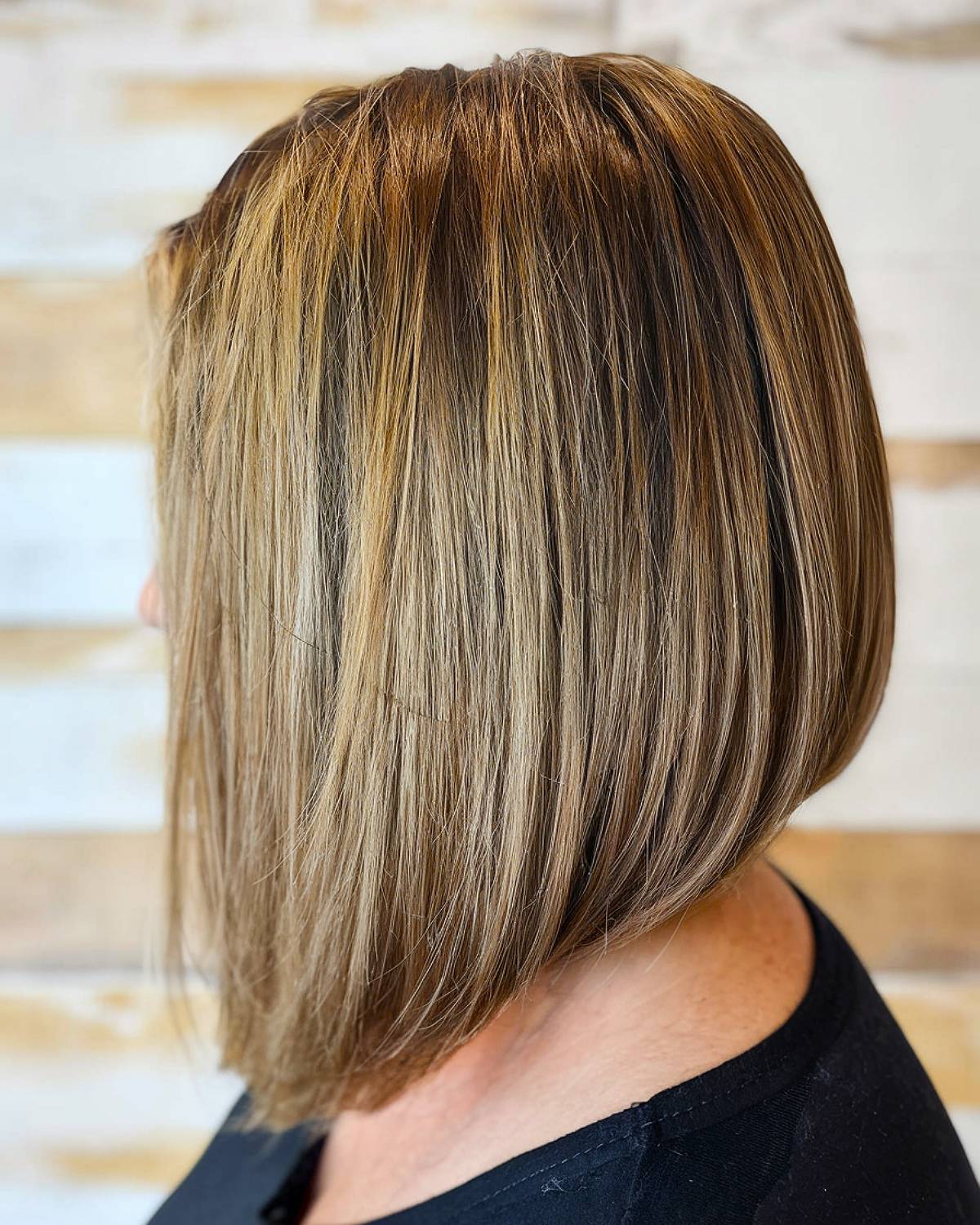
An angled bob is one of the most effective haircut strategies for thin or fine hair because its structural gradient builds optical density. By keeping hair shorter in the back and progressively longer toward the front, this style shifts structural weight forward, removes limp ends, and creates built-in volume at the crown without requiring excessive daily styling.
The Mechanics: Why the Angled Bob Suits Fine and Thin Hair
Managing thin hair requires balancing two opposing challenges: creating the illusion of fullness while preventing hair from lying flat against the scalp. Traditional long haircuts often worsen thinness because gravity pulls long, fine strands downward, exposing the scalp and causing the ends to appear sparse or stringy.
The angled bob—also known as an A-line bob or graduated bob—solves this problem through weight distribution and diagonal geometry.
- CROWN (Shorter, Stacked Back)
- Elevated Structure
- BACK BASELINE (Crisp & Supported)
- FRONT LENGTH (Frames the Face)
- Elevated Structure
Eliminating Excess Weight at the Nape
By cropping the hair shorter at the nape of the neck, you remove dead weight. Fine hair relies on structural support from adjacent strands; when back lengths are shortened, the remaining hair naturally bounces up, lifting the crown area.
Preserving Perimeter Density
The key to making thin hair look thick is a solid baseline. The forward angle allows you to keep dramatic, face-framing length around your collarbones or jawline while maintaining a thick, blunt foundation in the rear perimeter.
Shifting Visual Focus
Diagonal lines lead the eye along an incline rather than straight down. This upward diagonal perspective pulls visual attention toward the cheekbones and jawline, drawing focus away from sparse roots or a visible scalp.
Density vs. Diameter: Assessing Fine vs. Thin Hair
Before selecting a specific angled bob variation, you must distinguish between hair density and strand diameter:
- Fine Hair: Refers to the small width of individual hair strands. You can have a high volume of fine hair strands on your head, but each individual strand lacks rigid keratin structure.
- Thin Hair: Refers to overall hair density—meaning there are fewer hair follicles per square inch on the scalp.
If your hair is fine but dense, your main challenge is preventing limpness. You can comfortably handle moderate layering to release shape.
If your hair is thin (low density), your primary goal is preserving total hair volume. Excess internal layering will remove crucial structural mass, causing the ends to look transparent. Understanding your hair type ensures your stylist tailors the angle and layering technique to your specific needs.
4 Flattering Angled Bob Variations for Thin Hair
Not all angled bobs are cut the same way. Modifying the severity of the angle, the depth of graduation, and the interior texture creates distinct variations tailored to different face shapes and density levels.
| GRADUATED STACK | CLASSIC A-LINE | TEXTURED LOB | ASYMMETRICAL |
|---|---|---|---|
| (Maximum Lift) | (Crisp Perimeter) | (Soft Length) | (Dynamic Eye) |
1. The Graduated (Stacked) Angled Bob
The stacked angled bob features visible micro-layers cut at precise angles at the back of the head. This technique creates a stacked wedge of hair that pushes the top layers upward.
- Best For: Extremely flat or limp hair needing crown volume.
- Structural Edge: The stacked nape acts as a shelf, physically supporting the upper layers.
- Styling Requirement: Medium. Requires blow-drying with a small round brush to keep the stacked rear smooth and rounded.
2. The Blunt Classic A-Line Bob
The classic A-line features a clean diagonal perimeter line without internal stacked layers. The interior remains uniform, and the bottom edge is kept entirely blunt.
- Best For: Low-density, thin hair where every strand counts toward overall fullness.
- Structural Edge: Eliminating interior layers keeps the bottom edge crisp and thick, avoiding thin, stringy ends.
- Styling Requirement: Low. Looks polished straight out of a flat-iron or air-dried with a light texturizing cream.
3. The Textured Angled Long Bob (Lob)
For those hesitant to commit to a short nape, an angled long bob (lob) drops the front length past the collarbones while keeping the back at the base of the neck. Soft, point-cut internal texturizing adds movement.
- Best For: Wavy or medium-textured fine hair, and individuals with round or square face shapes looking to elongate features.
- Structural Edge: Provides the illusion of long hair in front while freeing up the back from excessive friction against clothing.
- Styling Requirement: Medium. Pairs well with loose, beachy waves created with a curling wand.
4. The Asymmetrical Angled Bob
This edgy variation features a steep forward angle on both sides, but one side is cut visibly longer than the other.
- Best For: Disguising uneven hair density or an irregular hairline.
- Structural Edge: The dramatic asymmetry draws visual focus to the geometry of the cut rather than the thickness of the hair.
- Styling Requirement: Low to Medium. Demands precise straight styling to emphasize the clean line.
Crucial Cut Considerations Before Visiting the Salon
Achieving a great haircut depends heavily on clear communication with your stylist. Requesting an angled bob without clarifying your hair texture can lead to over-thinning. Keep these crucial guidelines in mind during your consultation:
SALON CONSULTATION CHECKLIST
- Request point-cutting instead of thinning shears.
- Keep perimeter edges blunt to build weight.
- Match the front length to your jawline or collarbone.
- Customize bangs based on forehead height and hairline density.
Avoid Thinning Shears and Razor Cuts
Thinning shears, texturizing shears, and open razors shred the ends of individual hair strands to remove bulk. While beneficial for thick, coarse hair, they deplete fine hair of its structure. Shredded ends fray quickly, causing the bottom perimeter of thin hair to look stringy and sparse. Request that your stylist use blunt shears and apply subtle point-cutting only at the very ends for soft movement.
Define the Angle Severity
The slope of your bob dictates how dramatic the style looks.
- Subtle Angle (1 to 2 inches difference): A gentle slope from the nape to the collarbone. Ideal for professional environments and easy maintenance.
- Steep Angle (3 to 5 inches difference): A sharp incline from a short nape down to the chest area. Requires precise styling to keep the long front points from separating into thin strands.
Perimeter Weight Lines
Ensure your stylist preserves a solid baseline. If the interior is heavily layered while the baseline remains thin, light will shine through your hair, making it look sparse. A thick, blunt perimeter forms an opaque foundation that gives the impression of dense hair.
Bangs and Face-Framing Details
Adding fringe options can enhance an angled bob:
- Side-Swept Bangs: Blend naturally into the longer front sides, pulling hair forward to cover sparse areas around the temples.
- Curtain Bangs: Soften a steep angle, framing the cheekbones without sacrificing density at the bottom baseline.
- Avoid Thin, Full-Coverage Straight Bangs: Directing too much hair forward into a full fringe steals precious density from the sides of an angled bob.
Comprehensive Styling Techniques for Volume and Hold
Styling an angled bob on thin hair requires weightless volume techniques. Heavy creams, thick oils, and strong-hold waxes will weigh fine hair down, flattening your style within hours.
STYLING WORKFLOW
- PREP: Damp hair + Volumizing Mousse
- BLOW-DRY: Tension + Lift at roots with Round Brush
- SET: Cool shot to lock structure
- FINISH: Dry Texturizing Spray at mid-lengths
1. The Volumizing Blowout Mechanics
The foundation of a lasting bob is set during the blow-dry phase on damp hair.
- Preparation: Apply a lightweight, alcohol-free volumizing mousse or root-lifting spray directly to damp roots. Avoid applying heavy conditioners or serums to the scalp area.
- Inverted Rough-Dry: Flip your head upside down and rough-dry your hair using your fingers until it is roughly 80% dry. This directs root growth upward, away from the scalp.
- Sectioning and Precision Work: Flip your head upright. Divide hair into top, mid, and nape sections.
- Round Brush Tension: Using a small to medium ceramic round brush, grip the hair at the roots, lift upward at a 90-degree angle from the scalp, and roll the brush down through the ends. The ceramic barrel retains heat to mold the hair, while tension smooths fine, frizzy strands into a cohesive shape.
- Cool Shot Setting: Before releasing each section from the brush, press the cool shot button on your dryer for 5 seconds. Cooling sets the hydrogen bonds in the hair, locking in volume.
2. Creating Flat-Iron S-Waves
Flat-iron waves add width to an angled bob, making thin hair look significantly fuller.
- Take a 1-inch horizontal section of hair.
- Clamp a slim flat iron near the mid-lengths (avoid the roots to keep top volume intact).
- Rotate the iron 180 degrees away from your face while pulling downward smooth and fast.
- Leave the bottom half-inch of the ends straight. Leaving the ends straight maintains the angled geometry of the haircut while creating a modern, beachy texture.
- Once waves cool completely, break them up using your fingers or a wide-tooth comb. Never brush out fresh hot waves with a fine-toothed brush, as this flattens the wave structure.
3. Heatless Root Elevation
To minimize heat damage on fragile, fine strands, use heatless setting methods:
- Velcro Rollers: Place two or three large Velcro rollers along your top crown section while your hair is still warm from blow-drying. Leave them in place for 10–15 minutes while finishing your routine.
- Overnight Silk Scarf Wrapping: Wrap your hair gently in a silk bonnet or wrap it around a silk scarf to keep the short back lifted and tangle-free while you sleep.
Weightless Product Selection Guide
Using the wrong hair products can undermine a well-executed angled bob. Choose lightweight formulations designed to build structural texture without adding physical weight.
| PRODUCT CATEGORY | HOW IT WORKS FOR THIN HAIR | APPLICATION INSTRUCTIONS |
|---|---|---|
| Root-Lifting Mousse | Expands hair shafts with polymer chains without sticky residues. | Apply to damp roots before heat styling. |
| Dry Texturizing Spray | Uses zeolites/starches to create friction between fine strands. | Spray at mid-lengths in short bursts on dry hair. |
| Volumizing Dust/Powder | Micro-fine silica particles absorb natural oils and lift roots. | Tap lightly into scalp area and massage in with fingertips. |
| Lightweight Hairspray | Flexible polymers lock style against humidity without stiffness. | Spray 10–12 inches away to mist hair evenly. |
Products to Avoid on Thin Hair:
- Heavy Silicone Oils: They coat fine hair shafts, pulling strands down and making them piecey, which exposes the scalp.
- Heavy Cream Waxes & Pomades: These block natural root lift and bind fine strands together into sparse-looking bundles.
- Deeply Moisturizing Conditioners at the Scalp: Limit heavy conditioners to the bottom third of your hair ends to avoid weighing down your roots.
Detailed Comparison Matrix of Angled Bob Styles
| Angled Bob Style | Volume Potential | Maintenance Level | Best Face Shapes | Styling Time | Risk of Stringy Ends |
|---|---|---|---|---|---|
| Stacked / Graduated Bob | High (Built-in crown lift) | High (Requires trims every 4–6 weeks) | Heart, Oval, Square | 15–20 Mins | Low (Heavy weight support) |
| Blunt Classic A-Line | Medium (Flat crown, thick edges) | Low-Medium (Trims every 6–8 weeks) | Round, Oval | 5–10 Mins | Extremely Low (Clean baseline) |
| Textured Angled Lob | Medium-High (Adds lateral width) | Low (Trims every 8–10 weeks) | Round, Square, Long | 10–15 Mins | Moderate (If over-textured) |
| Asymmetrical Bob | High (Visual interest & movement) | High (Requires sharp edge precision) | Oval, Diamond, Heart | 15 Mins | Low to Moderate |
Upkeep, Trimming Timelines, and Nighttime Care
Maintaining an angled bob requires a consistent trim schedule. Unlike long, single-length haircuts that can grow out for months without losing shape, an angled cut relies on precise geometry.
MAINTENANCE SCHEDULE
- Week 0: Fresh Cut & Crisp Lines
- Week 4: Shape Relocates Lower; Check Nape Growth
- Week 6: Optimal Maintenance Window for Trims
- Week 8: Maximum Threshold (Angle flattens out)
Trim Schedule
- Stacked/Graduated Cuts: Schedule trims every 4 to 6 weeks. The short nape hair grows out quickly, causing the stacked stack to collapse and push the angle flat.
- Blunt A-Line & Lobs: Schedule trims every 6 to 8 weeks to keep the forward perimeter line sharp and remove split ends before they travel up fine hair shafts.
Nighttime Protection Strategy
Fine hair is vulnerable to friction breakage, which thins out ends over time.
- Silk or Satin Pillowcases: Swap traditional cotton pillowcases for silk or satin. The reduced friction prevents hair from tangling, preserving your blow-dry shape for the next day.
- Pineapple Wrap Method: If your front lengths are long enough, collect top strands into a very loose, high silk scrunchie (a "pineapple") on top of your head to prevent crushing root volume overnight.
4 Common Styling Mistakes That Flatten an Angled Bob
COMMON STYLING PITFALLS
- Over-thinning hair ends with texturizing shears.
- Flat-ironing roots straight downward against the scalp.
- Over-applying heavy serums and botanical oils.
- Cutting the front angle too long, creating wispy ends.
1. Flat-Ironing Straight Down
Clamping a flat iron at the roots and pulling straight down flattens your hair against your scalp, ruining the built-in shape of an angled bob. Instead, bend your wrist outward at the root to create an arch, ironing upwards and outwards to preserve volume.
2. Over-Applying Oils to Tame Flyaways
Fine hair is prone to static and flyaways, prompting many people to use hair oils. However, applying oil directly to fine hair often causes strands to clump together, exposing the scalp underneath. Instead, control flyaways by spraying a light flexible hairspray onto a clean blush brush or toothbrush, then gently smoothing down stray hairs.
3. Letting Front Lengths Grow Too Long
Allowing the front length of an angled bob to grow past the collarbone spreads thin hair over a larger area, causing the front ends to look sparse and wispy. Keep the front points balanced with your height and shoulder width.
4. Over-Washing Fine Hair with Harsh Sulfates
Fine hair tends to look greasy quickly because natural oils travel fast down fine hair shafts. However, washing daily with harsh sulfates strips the scalp, triggering excess oil production that quickly flattens hair roots. Switch to a gentle, volumizing, sulfate-free cleanser, and rely on a lightweight dry shampoo to absorb oil between washes.
Frequently Asked Questions
Does an angled bob make thin hair look thicker?
Yes, an angled bob is one of the most effective haircuts for making thin hair look thicker. By cutting the back shorter, weight is removed, allowing the remaining hair to lift at the crown. Meanwhile, maintaining a blunt baseline along the diagonal angle keeps the ends looking full and healthy rather than sparse.
Is a stacked bob better than a flat A-line bob for fine hair?
It depends on your overall hair density. If your hair is fine but you have plenty of strands, a stacked bob works exceptionally well to build structural height at the nape. However, if your hair is thin (low density), a classic blunt A-line bob without stacking is usually better, as it retains all available hair mass along the baseline without stripping away thickness.
How often do I need to get an angled bob trimmed?
An angled bob generally requires a trim every 6 to 8 weeks. If you have a dramatic stacked back, you may need a neck line touch-up every 4 to 6 weeks to keep the rear bevel sharp and clear of stray neck growth.
Can I air-dry an angled bob if I have fine, thin hair?
Yes, provided you apply a weightless texturizing cream or air-dry foam to damp strands. However, air-drying fine hair naturally yields less crown lift than blow-drying with a round brush. To maximize air-dried volume, flip your hair part to the opposite side while drying, then flip it back once completely dry.
What is the best product to hold volume in a thin angled bob?
A dry texturizing spray is ideal for thin angled bobs. Unlike traditional hairsprays that coat hair in a rigid, heavy film, dry texturizing sprays use fine mineral particles to add grip and lift between strands without adding weight or stiffness.
Summary and Next Steps
The angled bob is a practical, stylish, and structural choice for anyone dealing with fine or low-density hair. By distributing weight forward and creating a crisp perimeter, it creates natural volume while minimizing daily styling effort.
Your Recommended Action Plan:
- Determine Your Hair Density: Confirm whether your hair is fine in strand diameter, low in density, or both.
- Choose Your Angle Variation: Select a stacked back for crown volume, or a blunt A-line cut to maximize baseline density.
- Consult Your Stylist: Instruct your stylist to use sharp, blunt shears, avoid thinning razors, and keep perimeter edges solid.
- Refine Your Product Kit: Replace heavy hair oils and rich creams with a weightless root-lifting mousse, dry texturizing spray, and a quality ceramic round brush.