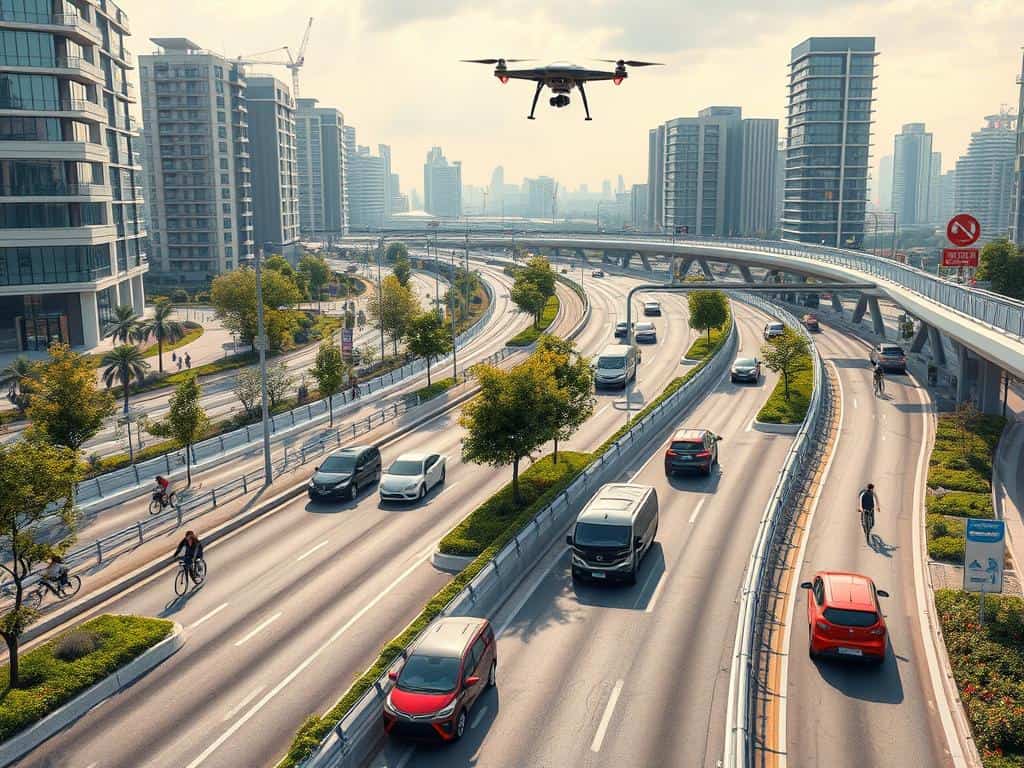
The Antlion and Dragonfly concept is a modular urban transport ecosystem that integrates high-agility tandem-wing eVTOL aircraft (Dragonfly) with automated, subterranean-linked docking hubs (Antlion). By 2026, this biomimetic framework has emerged as a leading solution for high-density "last-mile" logistics and passenger transit, utilizing insect-inspired stability to navigate turbulent urban micro-climates.
The Genesis of Biomimetic Urban Transport
As of 2026, the global push toward Urban Air Mobility (UAM) has moved beyond simple quadcopter designs. The industry realized early in the decade that traditional drone configurations struggled with the "canyon effect"—unpredictable wind gusts between skyscrapers. This led engineers to look toward biomimicry, specifically the Odonata (dragonfly) and the Myrmeleontidae (antlion), to solve the dual challenges of aerial agility and ground-based recovery.
The Dragonfly module represents the flight component. It mimics the ability of its biological namesake to move in six directions with extreme precision. Meanwhile, the Antlion interface refers to the specialized ground infrastructure designed to "capture," secure, and service these modules. Unlike traditional flat-pad vertiports, the Antlion system uses a recessed, funnel-like architecture that maximizes safety during high-wind landings, effectively "trapping" the flight module in a stabilized environment for rapid turnaround.
This dual-concept approach addresses the three primary bottlenecks of 2026 urban transit: energy density, landing precision in dense environments, and the seamless transition between aerial and ground-based logistics chains.
The Dragonfly Module: Aerial Agility and Engineering
The Dragonfly eVTOL (Electric Vertical Take-off and Landing) is the primary vehicle of this ecosystem. Unlike the bulky "air taxis" of the early 2020s, the 2026 Dragonfly utilizes tandem-wing architecture. This design features two sets of wings—one pair forward and one pair aft—each equipped with articulating rotors.
Aerodynamics and the "Canyon Effect"
In the dense urban environments of 2026, air is not a steady medium. Buildings create vortices that can flip standard consumer-grade drones. The Dragonfly module uses active aero-elasticity. Its wings are not rigid; they can subtly flex and change their angle of attack in milliseconds, controlled by an AI flight-control system that processes over 1,000 data points per second from onboard LIDAR and ultrasonic sensors.
This mimicking of a dragonfly’s "direct flight" muscles allows the module to hover with a 0.5-centimeter tolerance, even in gusts up to 45 knots. This level of stability is what makes the transition into the Antlion docking pits possible.
Power Systems: Solid-State and Hydrogen Hybrid
By 2026, the Dragonfly modules have transitioned from traditional lithium-ion to solid-state battery packs for short-range passenger hops (under 30km) and hydrogen-fuel-cell hybrids for heavy cargo duty. The solid-state batteries provide the high discharge rates necessary for the energy-intensive take-off and landing phases, while the hydrogen components offer the energy density required for sustained flight across metropolitan regions.
The Antlion Interface: The Ground-Station Revolution
While the Dragonfly handles the sky, the Antlion hub manages the ground. The name is derived from the antlion larva's ability to create a funnel-shaped trap. In a transport context, the Antlion is a high-tech "pit" or recessed docking station located on rooftops, within repurposed parking structures, or integrated into transit plazas.
The Automated Docking Sequence
Landing a 2-ton aircraft on a small, elevated platform in a storm is a recipe for disaster. The Antlion concept solves this by using magnetic levitation (MagLev) guidance. As the Dragonfly module descends into the "funnel" of the Antlion hub, high-power electromagnets in the hub walls engage with the aircraft’s chassis.
- Alignment Phase: The hub’s sensors sync with the aircraft’s avionics via 6G-Advanced protocols.
- Engagement: Magnetic arrays guide the vehicle into a centered position, counteracting lateral wind forces.
- The "Trap": Once the vehicle is within the lip of the hub, a mechanical iris or hydraulic tethering system secures the landing gear.
- Subterranean Transition: The floor of the Antlion hub is an elevator that immediately lowers the module into a climate-controlled servicing bay.
Micro-Fulfillment and Modular Logistics
In 2026, the Antlion hubs are not just landing pads; they are the nodes of a Physical Internet. When a Dragonfly cargo module lands, the Antlion’s internal robotics can strip the cargo pod from the flight frame in under 60 seconds. This pod is then automatically routed into a subterranean rail system or loaded onto a ground-based Autonomous Ground Vehicle (AGV) for the final 500 meters of delivery. This "modular separation" ensures that the expensive flight component—the Dragonfly—is back in the air almost immediately, maximizing its Duty Cycle.
Technical Specifications and Comparative Analysis
To understand the impact of the Antlion/Dragonfly concept, it is helpful to compare it to the legacy UAM solutions that were prevalent in the early 2020s.
| Feature | Legacy Quad-eVTOL (2022) | Dragonfly Module (2026) | Antlion Hub (2026) |
|---|---|---|---|
| Stability Mechanism | Rotor RPM adjustment | Articulating Tandem Wings | Magnetic Guidance Funnel |
| Landing Precision | +/- 1.5 Meters | +/- 0.05 Meters | Automated Centering |
| Turnaround Time | 20–30 Minutes | 3–5 Minutes | N/A (Ground servicing) |
| Max Wind Tolerance | 20 Knots | 45 Knots | 60+ Knots (Shielded) |
| Noise Profile | 75 dB at 50ft | 58 dB at 50ft | Near-silent (Recessed) |
| Energy Source | Li-ion Battery | Solid-State / H2 Hybrid | Grid + Solar Canopy |
Regulatory Landscape and Safety in 2026
The adoption of the Antlion/Dragonfly concept has been accelerated by the Specific Operations Risk Assessment (SORA) framework adopted by the EASA and FAA. Because the Antlion hub "shields" the landing process, the statistical probability of a "landing excursion" (missing the pad) is reduced by 88% compared to traditional flat-roof vertiports.
Redundancy Systems
Safety is paramount in 2026 urban transit. The Dragonfly module features:
- Octo-redundancy: Eight independent rotors across four wings; it can maintain flight even if three rotors fail.
- Ballistic Recovery Systems (BRS): In the event of a total power loss, a high-speed parachute deploys, though the 2026 models now include "directional steering" for the parachute to guide the craft away from crowded streets.
- V2X Communication: The Dragonfly is part of a "Swarm Intelligence" mesh. If one module detects an unexpected micro-burst or obstacle, every other module in a 5km radius is updated instantly, allowing for real-time re-routing.
Environmental and Social Integration
A major hurdle for urban transport has always been public acceptance. The Antlion/Dragonfly concept addresses the two biggest complaints: noise and visual pollution.
Acoustic Management
Traditional helicopters and early drones were loud because of the high tip-speeds of their rotors. The Dragonfly uses scalloped-edge rotor blades (mimicking owl feathers) and operates at lower RPMs due to the lift-efficiency of its tandem wings. Furthermore, because the Antlion hubs are recessed, the loudest part of the flight—the final descent and touchdown—happens below the "skyline," where the hub walls act as acoustic baffles.
Reclaiming Urban Space
In 2026, cities like Paris, Tokyo, and New York have begun removing traditional asphalt parking lots. The Antlion hubs are often built into the "dead space" of these lots. A single Antlion hub can process the same volume of goods and passengers as a four-lane highway, but with a footprint smaller than a neighborhood gas station. This allows for the "Green City" initiative where the surface level is reserved for parks and pedestrians, while the "middle air" is managed by Dragonfly modules.
Economic Viability and Costs
As of 2026, the cost per passenger-mile on a Dragonfly module has reached parity with premium ride-share services. This was achieved through:
- Mass Customization: The modular nature of the Dragonfly (the flight frame is separate from the passenger/cargo pod) allows for 24/7 utilization. Cargo by night, people by day.
- Autonomous Maintenance: The Antlion hubs are equipped with robotic diagnostic arms. Every time a module "traps" in the hub, it receives a 10-second health check, preventing costly mid-air failures and extending the lifespan of the solid-state batteries.
- Energy Arbitrage: Antlion hubs act as giant batteries for the city grid, charging modules during low-demand hours and selling excess hydrogen/electric power back to the grid during peak times.
Frequently Asked Questions
Is the Dragonfly module fully autonomous in 2026?
Yes, for the majority of flight paths. While "human-in-the-loop" monitoring is required by current FAA and EASA Part 135 regulations for passenger flights, the Dragonfly uses a Level 5 autonomous flight stack. Pilots act as remote supervisors, overseeing up to 15 modules simultaneously from a centralized Operations Center rather than sitting in the cockpit.
How does the Antlion hub handle snow or debris?
The Antlion hubs are designed with self-clearing mechanisms. The "funnel" uses a combination of heating elements to prevent ice buildup and high-pressure air curtains to blow away debris. Because the landing mechanism is magnetic and recessed, it is significantly less affected by surface-level weather conditions than traditional tarmac.
Can a Dragonfly module land outside of an Antlion hub?
While the Dragonfly is capable of landing on any flat, reinforced surface in an emergency, its optimal performance and safety metrics are tied to the Antlion interface. Landing at a non-integrated site disables the high-speed charging and magnetic stabilization features, requiring a more cautious, manually-assisted approach.
What is the maximum payload of the 2026 cargo Dragonfly?
The standard 2026 cargo-variant Dragonfly can carry a payload of 450 kilograms (approx. 1,000 lbs). This is specifically calibrated to handle a standard "Euro-pallet" or a 4-person passenger pod. Larger "Heavy Lift" variants are currently in testing for industrial applications, but they are not yet certified for dense urban overflight.
Are these vehicles prone to "hacking" or cyber-attacks?
Security is a core component of the 2026 UAM infrastructure. The Dragonfly/Antlion mesh operates on a Quantum-Key Distribution (QKD) network. This ensures that the communication between the aircraft and the hub is cryptographically secure against even the most advanced decryption attempts. Additionally, the flight control system has a hard-coded "return to home" protocol that operates independently of the main AI stack.
Practical Recommendation for 2026 Urban Planners
For municipalities looking to integrate the Antlion and Dragonfly concept, the priority should be the zoning of "Micromobility Corridors." Rather than trying to blanket an entire city with flight paths, success has been found in creating dedicated aerial "arteries" that connect Antlion hubs located at major transit interchanges.
Planners should focus on upgrading the local power grid at these hub sites to support megawatt-scale charging and hydrogen storage. Those who adopt the "Antlion" ground-infrastructure early will find themselves at the center of the 2026 logistics economy, as these hubs become the de facto sorting centers for the next generation of autonomous commerce.