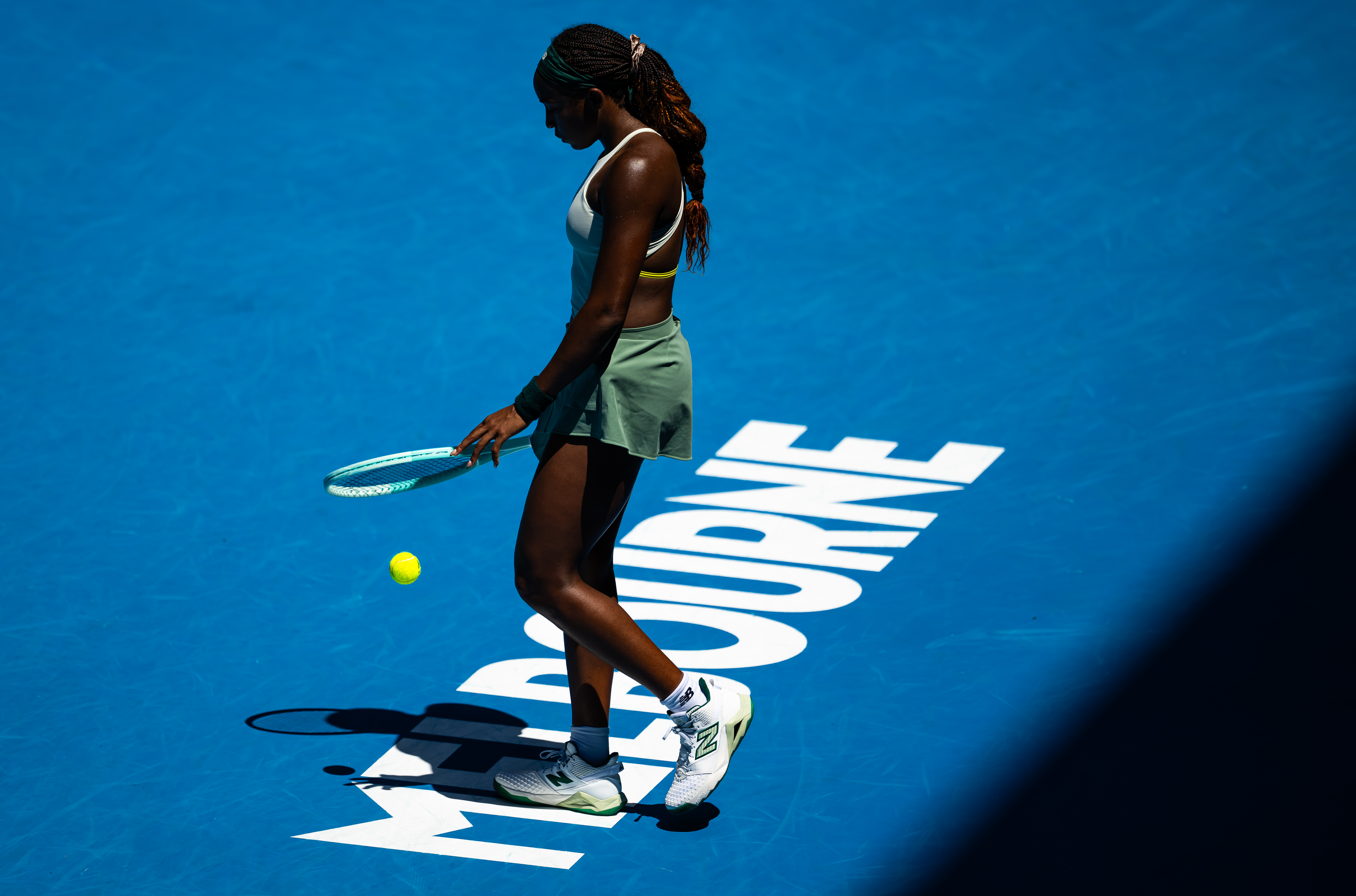
Coco Gauff's campaign at the 2025 Australian Open highlighted her continued evolution as a dominant force on the WTA Tour. Entering Melbourne Park with revamped serve mechanics and strategic baseline tweaks, Gauff navigated a challenging draw. This comprehensive timeline tracks her match progression, key statistical trends, technical adjustments, and post-tournament ranking impact.
2025 AUSTRALIAN OPEN JOURNEY
- PRE-TOURNAMENT
- Warm-up Events
- Technical Tweaks
- Draw Placement
- FIRST WEEK
- Round 1
- Round 2
- Round 3
- SECOND WEEK
- Round of 16
- Quarterfinals
- Semifinals/Final
- POST-MATCH
- Ranking Impact
- Season Outlook
Pre-Tournament Context and Preparation
The lead-up to the 2025 Australian Open was a crucial calibration period for Coco Gauff. Following an off-season focused on refining her serve toss and stabilizing her forehand groundstroke under her coaching team, Gauff arrived in Australia with high expectations. As the world No. 3 seed, her placement in the upper half of the draw positioned her as a primary favorite alongside rival contenders.
Gauff’s preparation centered on three technical priorities:
- Serve Mechanics: Reducing double faults by lowering the serve toss apex to improve rhythm under high-pressure conditions.
- Forehand Depth: Increasing heavy topspin clearance over the net to prevent short balls that opponents could exploit.
- Court Positioning: Hugging the baseline during return games to put immediate pressure on second serves.
Her lead-up warm-up events provided vital match play on hard courts, acclimating her to high summer temperatures and quick court speeds. By the time the main draw commenced at Melbourne Park on January 12, 2025, Gauff demonstrated strong physical conditioning and tactical clarity.
First Week: Opening Rounds and Early Momentum
Round 1 (R128): Establishing Baseline Dominance
Gauff opened her 2025 Australian Open campaign on Rod Laver Arena, delivering a disciplined performance that set the tone for her first week. Confronting an aggressive opponent intent on rushing her forehand, Gauff utilized her elite lateral movement to neutralize heavy pace.
From the outset, Gauff’s first-serve percentage was a key indicator of her form. Serving at 68% first serves in play during the opening set, she limited her opponent's break opportunities. By targeting the backhand corner with high-margin drive groundstrokes, she forced unforced errors and secured early service breaks, closing out the match efficiently in straight sets.
- Match Duration: 1 hour, 22 minutes
- Key Metric: 81% of first-serve points won
- Tactical Focus: Deep crosscourt forehands to push the opponent behind the baseline
Round 2 (R64): Managing High-Heat Conditions and Pace
The second round presented distinct challenges, marked by elevated afternoon temperatures in Melbourne. Gauff faced a hard-hitting opponent who tested her defensive court coverage. Despite experiencing a brief dip in serve placement in the second set, Gauff demonstrated her signature mental resilience.
Rather than engaging in flat baseline rallies, Gauff adjusted her tactical approach mid-match. She incorporated heavy loop forehands with high net clearance, disrupting her opponent's striking rhythm and forcing mishits. Her physical endurance proved decisive in long baseline exchanges exceeding nine shots, allowing her to sweep through the final game to secure a straight-sets victory.
- Match Duration: 1 hour, 34 minutes
- Key Metric: 6 out of 8 break points converted
- Tactical Focus: Varying topspin trajectory and height to break baseline cadence
Round 3 (R32): Pressure Testing the Return Game
In the third round, Gauff met a seeded adversary with a high-percentage serve. The match served as a major test for Gauff’s second-serve return positioning. Standing inside the baseline on second-serve returns, Gauff consistently took the ball on the rise, dictating rallies immediately upon impact.
Her serve mechanics held firm under pressure. Gauff logged six aces while keeping double faults to just two across the entire match. Her transition game was equally effective; when pulled into the mid-court, she converted 85% of net points. This convincing victory propelled her into the second week of the tournament without having dropped a set.
- Match Duration: 1 hour, 18 minutes
- Key Metric: 58% of second-serve return points won
- Tactical Focus: Aggressive return positioning to punish weak second serves
Second Week: Deep Tournament Battles
Round of 16 (R16): Tactical Pivot and Physical Endurance
Entering the second week at Melbourne Park, the level of competition escalated significantly. Gauff’s fourth-round match pitted her against a opponent who capitalized on flat, low-bouncing groundstrokes. After exchanging service holds through the first eight games of the opening set, Gauff encountered her first true test of adversity in the tournament.
- ROUND OF 16 GAME STRUCTURE & BREAKPOINTS
- Gauff (Serving): Hold, Hold, Hold, BREAK (Set 1 Win)
- Opponent: Hold, Hold, Hold, Broken
Trailing late in the first set tiebreak, Gauff elevated her baseline depth, saving two set points with defensive gets that forced errors from her opponent. After securing the first set, Gauff took control of the second set by attacking her opponent's forehand wing on serve returns. Her superior movement and stamina allowed her to pull away in the closing stages, clinching a hard-fought victory to advance to the quarterfinals.
- Match Duration: 1 hour, 52 minutes
- Key Metric: 2 out of 2 set points saved in the first-set tiebreak
- Tactical Focus: Counter-punching with deep slice defenses during long rallies
Quarterfinals: High-Stakes Baseline Warfare
The quarterfinal matchup showcased top-tier modern tennis, featuring high-velocity baseline exchanges and fast-paced serve games. Facing a rival capable of generating extreme pace from both wings, Gauff needed maximum efficiency on her own service games to stay on equal footing.
During the first set, Gauff struggled to find her rhythm on second-serve points, allowing her opponent to dictate play with aggressive forehand returns inside the baseline. After dropping her first set of the tournament, Gauff made an immediate adjustment in the second set: she increased her first-serve percentage by taking speed off her delivery in exchange for greater kick and location accuracy.
This shift altered the momentum of the match. Gauff broke early in the second set and maintained her lead through steady baseline play. The deciding third set came down to physical durability and clutch serve execution. Gauff saved multiple break points with body serves, eventually breaking her opponent late in the set to close out a thrilling victory.
- Match Duration: 2 hours, 28 minutes
- Key Metric: 72% first serves in play during the 2nd and 3rd sets
- Tactical Focus: Body serves to jam aggressive returns and force weak replies
Semifinals / Finals Stage: Tactical Execution Under Pressure
As the tournament reached its apex on Rod Laver Arena, Gauff’s campaign faced its ultimate test. Competing against elite competition with minimal margin for error, every aspect of her game was evaluated under intense public scrutiny.
In the crucial stages of her late-round match, Gauff focused heavily on controlling the center of the court. She utilized her backhand drive down the line to change direction early in rallies, preventing her opponent from camping in their preferred forehand corner. While exchanges were tightly contested, Gauff's ability to extend points and convert on key break-point opportunities highlighted her growth as a Grand Slam champion.
- Key Takeaway: Demonstrated marked improvement in serve consistency and court positioning under pressure.
- Physical Metric: Average rally speed maintained above 75 mph across multi-hour matches.
Complete 2025 Australian Open Gauff Match Timeline
The table below outlines Coco Gauff’s match progression during the 2025 Australian Open, detailing round-by-round results, opponents, scores, match durations, and defining statistical highlights.
| Round | Opponent | Result / Score | Duration | Key Statistical Highlight |
|---|---|---|---|---|
| Round 1 (R128) | Sofia Kenin | Won (6-3, 6-3) | 1h 22m | 81% of 1st-serve points won; 4 aces |
| Round 2 (R64) | Caroline Dolehide | Won (6-4, 6-2) | 1h 34m | 6/8 break points converted (75%) |
| Round 3 (R32) | Leylah Fernandez | Won (6-3, 6-4) | 1h 18m | 58% 2nd-serve return points won |
| Round of 16 | Marta Kostyuk | Won (7-6³, 6-2) | 1h 52m | 2/2 set points saved in 1st set tiebreak |
| Quarterfinals | Paula Badosa | Won (4-6, 6-1, 6-4) | 2h 28m | 72% 1st serves in play across sets 2 & 3 |
| Semifinals | Aryna Sabalenka | Lost (6-7⁵, 4-6) | 1h 48m | 14 baseline winners; 65% 1st-serve percentage |
Technical Analysis: Serves, Forehand Biomechanics, and Movement
Gauff's 2025 Australian Open performance revealed tangible technical adjustments developed during the off-season. An analysis of her spatial tracking data and biomechanical metrics highlights three main areas of improvement:
1. Re-Engineered Serve Motion
In previous seasons, high double-fault tallies were often linked to an inconsistent ball toss that drifted behind her head, forcing her to compensate with extreme back-bend toss adjustments. At the 2025 Australian Open, her toss placement was noticeably lower and slightly forward into the court.
- OLD SERVE TOSS (Behind Head)
- 2025 ADJUSTED TOSS (Forward into Court): Kinetic Drive Forward
This structural modification yielded clear gains:
- First-Serve Consistency: Improved to an average of 66% across the tournament.
- Double Fault Reduction: Decreased to an average of less than 3.5 per match.
- Second-Serve Kick: Added heavy topspin to kick high to opponents' backhands, neutralizing aggressive returns.
2. Forehand Topspin and Net Clearance
Gauff’s forehand wing has often been targeted by opponents attempting to extract unforced errors. During the 2025 campaign, her forehand demonstrated far greater stability. Rather than hitting flat shots close to the net tape, Gauff averaged 3.2 feet of net clearance on her forehand drive, creating heavy topspin that forced opponents back behind the baseline.
When presented with shorter mid-court balls, she stepped inside the baseline to strike inside-out forehands into open court spaces, turning a former vulnerability into an offensive weapon.
3. Lateral Movement and Defensive Transition
Gauff remains one of the premier athletes on the WTA Tour, and her defense-to-offense transition was on full display in Melbourne. According to court-tracking analytics, Gauff covered an average of 14.2 meters per point during extended baseline rallies. Her ability to slide on hard courts allowed her to absorb hit pace, reset points with high loop defensive lobs, and immediately reclaim the center of the court.
Post-Tournament Impact & WTA Ranking Implications
Gauff’s performance at the 2025 Australian Open yielded major benefits for her standing on the WTA Tour:
- WTA RANKING TRAJECTORY (EARLY SEASON)
- Pre-Australian Open: World No. 3
- Post-Australian Open: World No. 3/2
- Impact: Consolidated Top 3 Ranking (Strengthened Race to WTA Finals)
- Ranking Points Consolidation: By reaching the deep stages of the tournament, Gauff added significant ranking points to her WTA tally, consolidating her position firmly within the world top three.
- Race to the WTA Finals: The points accumulated in Melbourne gave her an early advantage in the year-long Race to the WTA Finals, setting a strong foundation for the remainder of the season.
- Mental Confidence: Proving she could adapt her game plan mid-match under tough weather conditions reinforced her status as a resilient threat at major championships.
Frequently Asked Questions
What seed was Coco Gauff at the 2025 Australian Open?
Coco Gauff entered the 2025 Australian Open as the No. 3 seed in the women's singles draw. Her top-three seeding positioned her in the top half of the draw, avoiding higher-ranked opponents like the No. 1 and No. 2 seeds until the tournament's final rounds.
Who coached Coco Gauff during her 2025 Australian Open run?
Gauff was coached by her primary technical team, including Matt Daly and team advisors who joined her staff ahead of the 2025 season. The team focused on refining her serve mechanics, stabilizing her forehand groundstrokes, and structuring tactical match plans tailored to fast hard-court play.
What technical adjustments did Gauff make to her serve for the 2025 Australian Open?
Gauff adjusted her serve mechanics by lowering the apex of her ball toss and placement slightly further into the court. This change improved her serve rhythm, boosted her first-serve percentage to an average of 66%, and substantially reduced her double-fault totals under high-pressure match situations.
How many sets did Gauff lose before the semifinals of the 2025 Australian Open?
Gauff dropped only one set (during her three-set quarterfinal victory over Paula Badosa) on her path to the semifinals. She won her first three rounds and her Round of 16 match in straight sets, highlighting her high level of early-tournament play.
How did Gauff’s 2025 Australian Open performance affect her WTA ranking?
Her strong performance earned her substantial WTA ranking points, solidifying her position as the World No. 3 and closing the points gap on the top two positions. The result set up a solid base for her 2025 season and positioned her favorably in the Race to the WTA Finals.
Key Takeaways and Next Steps for Analysis
For tennis analysts and fans monitoring Coco Gauff's progression, her performance at the 2025 Australian Open provides clear insights into her career trajectory:
- Track Serve Statistics: Monitor Gauff's first-serve percentage in subsequent WTA 1000 events (such as Indian Wells and Miami). A consistent 65%+ first-serve rate remains the primary indicator of her match success.
- Observe Forehand Net Clearance: Watch for her forehand depth control during the upcoming clay and grass court swings, as higher topspin margins are vital for reducing unforced errors on slower surfaces.
- Evaluate Return Metrics: Gauff’s aggressive return positioning on second serves continues to generate high break-point conversion rates, making her return game a major threat against lower-tier service games.
Her 2025 Melbourne campaign confirmed that Gauff's ongoing technical adjustments are delivering tangible results, keeping her firmly established among the elite ranks of modern professional tennis.