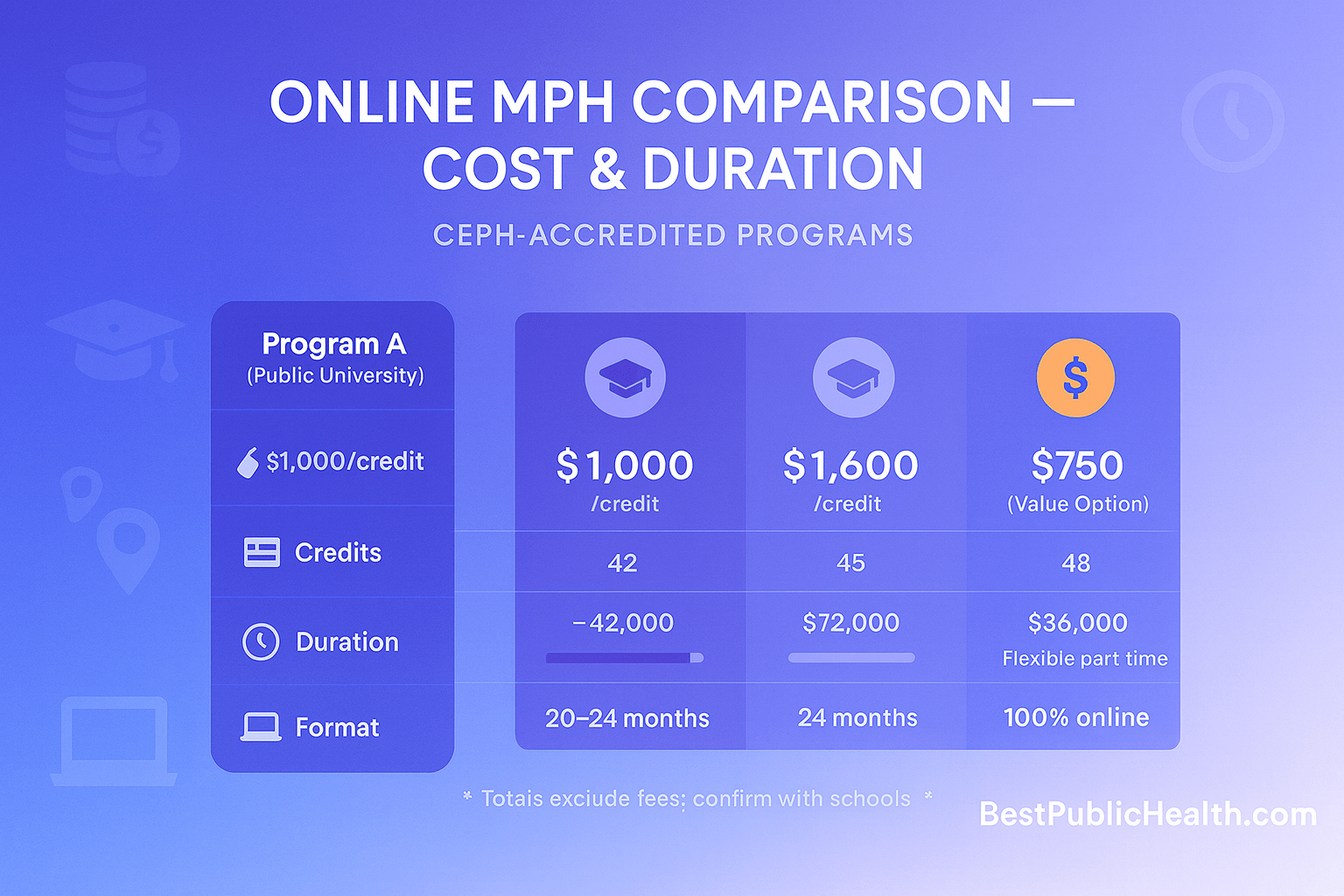
Choosing a Master of Public Health (MPH) program in 2026 requires a careful balance between educational quality and financial sustainability. Cheap MPH programs are worth it, provided they are accredited by the Council on Education for Public Health (CEPH). For most public health careers in government, non-profits, and community health, the skills gained and the accreditation status of the degree matter significantly more to employers than the prestige or price tag of the institution.
Defining "Cheap" in the 2026 MPH Landscape
In the current educational market, the definition of an affordable or "cheap" MPH has shifted. As of 2026, the cost of graduate education continues to rise, but the proliferation of high-quality online programs has created a competitive floor for pricing. Generally, a "cheap" MPH is defined as a program where the total tuition for the entire degree falls between $15,000 and $30,000.
In contrast, elite private universities or high-tuition state programs can easily exceed $80,000 to $100,000. When we analyze whether these lower-cost options are "worth it," we are essentially looking at the Return on Investment (ROI). Public health is a field known for its mission-driven work, but it is not always associated with the astronomical starting salaries found in corporate finance or specialized medicine. Therefore, minimizing student debt is often the most strategic move a prospective public health professional can make.
Affordability often stems from several factors:
- In-state tuition rates: Public universities offering discounted rates to residents.
- Online-only delivery: Programs that save on physical infrastructure and pass those savings to students.
- Competency-based models: Programs that allow students to progress faster based on existing knowledge, potentially reducing the number of semesters paid.
The Non-Negotiable: CEPH Accreditation
The most critical factor in determining if a cheap MPH is worth your time and money is its accreditation status. The Council on Education for Public Health (CEPH) is the independent agency recognized by the U.S. Department of Education to accredit schools of public health and public health programs.
If a program is cheap but not CEPH-accredited, it is likely not worth it. Many federal employers, such as the Centers for Disease Control and Prevention (CDC) and the Department of Health and Human Services (HHS), require a degree from a CEPH-accredited institution for specific roles. Furthermore, to sit for the Certified in Public Health (CPH) exam—a credential that is increasingly becoming a standard in the industry—you typically must have graduated from a CEPH-accredited school or program.
Accreditation ensures that the "cheap" program meets rigorous national standards regarding curriculum, faculty qualifications, and student support. Without it, you risk holding a degree that may be rejected by employers or doctoral programs later in your career.
Calculating the ROI of a Low-Cost MPH
To determine value, you must compare the anticipated debt service against your expected post-graduation salary. In 2026, the median salary for public health professionals varies widely by specialty:
- Epidemiologists: $82,000 – $110,000
- Health Educators: $55,000 – $75,000
- Public Health Administrators: $70,000 – $95,000
- Biostatisticians: $95,000 – $130,000
If you attend a program costing $90,000 and enter a role as a health educator earning $60,000, your debt-to-income ratio will be severely skewed, making it difficult to achieve financial milestones like homeownership or retirement saving. Conversely, attending a $20,000 program for the same role allows for a much faster path to financial independence. In the public sector, salary scales are often fixed based on the degree held and years of experience, regardless of whether that degree came from a "top-ten" school or a local state university.
Quality vs. Cost: What Do You Sacrifice?
While the core curriculum (Epidemiology, Biostatistics, Environmental Health, Social and Behavioral Sciences, and Health Policy) is standardized across accredited programs, there are material differences that often come with higher-priced degrees.
Networking and Alumni Reach
Premium-priced programs often boast extensive alumni networks that span global health organizations, major pharmaceutical companies, and prestigious consulting firms. A "cheap" program, particularly a smaller state school, may have a more localized network. If your goal is to work for the World Health Organization (WHO) in Geneva, a high-cost program with established international pipelines might offer an advantage. If your goal is to work for a State Department of Health or a local hospital system, the local program may actually offer better networking opportunities.
Faculty Access and Research Opportunities
Higher tuition often funds lower faculty-to-student ratios and robust research infrastructure. In a low-cost, high-volume online program, you may interact more with adjunct professors or teaching assistants than with world-renowned researchers. If you intend to pursue a PhD or a career in academic research, the "worth" of a more expensive program increases due to the mentorship and publication opportunities available.
Career Services and Practicum Placement
A significant part of the MPH is the "practicum" or internship. Expensive programs often have dedicated staff to place students in high-profile internships. In cheaper programs, the onus is often on the student to find and secure their own placement. While this requires more initiative, it does not necessarily result in a lower-quality experience.
Comparison: Low-Cost vs. High-Cost MPH Programs (2026 Estimates)
| Feature | Low-Cost MPH (Affordable) | High-Cost MPH (Premium) |
|---|---|---|
| Total Tuition Range | $15,000 – $30,000 | $70,000 – $110,000 |
| Accreditation | Must be CEPH-accredited | Almost always CEPH-accredited |
| Delivery Mode | Primarily Online / Asynchronous | On-Campus / Hybrid / Synchronous |
| Primary Audience | Working professionals, career changers | Full-time students, aspiring researchers |
| Networking Scope | Regional / Local | National / International |
| Typical ROI | High (Low debt, standard salary) | Variable (High debt, potential for high salary) |
| Employer Perception | Respected for practical skills | Respected for prestige and rigor |
When a Cheap MPH is the Right Choice
A low-cost MPH is the superior choice for the vast majority of students, particularly those in the following categories:
- Government and Non-Profit Aspirants: If you plan to work in civil service, your pay is determined by civil service grades (e.g., GS levels in the U.S. federal government). These grades recognize the degree type, not the prestige of the school.
- Career Changers Already in the Workforce: If you already have professional experience and just need the MPH credential to move into management or a different health department, the most affordable accredited degree is the most logical path.
- Debt-Averse Individuals: For those who do not qualify for significant scholarships or employer reimbursement, taking on six-figure debt for a master’s degree is a significant financial risk. Affordable programs mitigate this risk entirely.
- Those Planning on Public Service Loan Forgiveness (PSLF): While PSLF can eventually forgive debt, it requires 10 years of payments. Starting with lower debt provides more flexibility should you decide to leave the public sector before the 10-year mark.
When to Consider Investing More
There are specific scenarios where a more expensive, prestigious program might actually be "worth it":
- Specialized Niche Fields: If you are interested in a very narrow field, such as Pharmacoeconomics or Tropical Medicine, only a few high-cost institutions may have the laboratory facilities and specialized faculty required.
- Corporate Public Health / Consulting: For roles at firms like McKinsey, BCG, or in the executive suites of major insurance companies, the "brand name" of your school can act as a powerful signal during the recruitment process.
- Academic Trajectory: If your ultimate goal is a tenure-track faculty position, the pedigree of your master's degree can influence your admission into top-tier PhD or DrPH programs.
Common Pitfalls to Avoid with Cheap Programs
While low cost is attractive, you must perform due diligence to ensure the program isn't a "degree mill."
- Check the "For-Profit" Status: Be cautious of for-profit universities. Even if they are accredited, they often have lower graduation rates and higher costs than public state universities. In 2026, many public universities offer online MPH programs that are cheaper and more respected than for-profit alternatives.
- Verify Hidden Fees: Some programs advertise low tuition per credit hour but add "technology fees," "distance learning fees," and "graduation fees" that can add thousands to the final bill.
- Scrutinize Student Support: Does the cheap program offer writing centers, library access, and career advising? A program that is cheap because it provides zero support may lead to higher stress and lower completion rates.
Practical Steps for Evaluating a Program
Before enrolling in any MPH program, follow these steps to verify its value:
- Verify CEPH Status: Go directly to the CEPH website and search for the specific program. Check if they are "accredited" or "in applicant status." Applicant status is riskier, as accreditation is not guaranteed.
- Request an Alumni Salary Report: Most schools are required to track the outcomes of their graduates. Ask for the median starting salary of the last two graduating classes.
- Audit the Faculty: Look at the faculty directory. Are they practitioners currently working in the field, or are they purely academic? For a practical MPH, having instructors who work in local health departments is a major benefit.
- Compare Total Cost of Attendance (COA): Look beyond tuition. Calculate the cost of books, required travel for intensives (if any), and the opportunity cost of not working if the program requires full-time enrollment.
Frequently Asked Questions
Do employers care if my MPH was cheap or online?
By 2026, the stigma surrounding online degrees has largely vanished, provided the degree is from an accredited, reputable institution. Employers in public health prioritize your competencies, your practicum experience, and your ability to apply biostatistical or epidemiological methods to real-world problems.
Can I get a high-paying job with a low-cost MPH?
Yes. High-paying roles in biostatistics, health informatics, and pharmaceutical regulatory affairs are accessible to anyone with the right skills and an accredited MPH. Your performance in technical interviews and your previous experience often carry more weight than the name of your school.
Is an MPH still worth it in 2026 given the job market?
Yes. The demand for public health professionals remains strong due to an aging population, the ongoing management of endemic diseases, and the increasing focus on climate-related health issues. However, the degree is only "worth it" if the debt incurred does not outpace the earning potential.
What is the average cost of an MPH in 2026?
The national average for an MPH ranges from $35,000 to $65,000. Programs below $30,000 are considered affordable, while those above $75,000 are considered premium or high-cost.
Does a cheap MPH prepare you for the CPH exam?
As long as the program is CEPH-accredited, the curriculum is required to cover the foundational competencies tested on the Certified in Public Health (CPH) exam. Most affordable programs are specifically designed to align with these core competencies.
Recommendation
For the vast majority of prospective students in 2026, a cheap, CEPH-accredited MPH is the most prudent and valuable choice. The public health field values practical experience, cultural competency, and technical skills far more than institutional prestige. Unless you are aiming for a highly specific executive role in the private sector or an elite academic career, the "premium" paid for a high-cost degree rarely translates into a proportional increase in salary. Prioritize minimizing your debt to ensure you have the financial freedom to pursue the public health work you are passionate about.