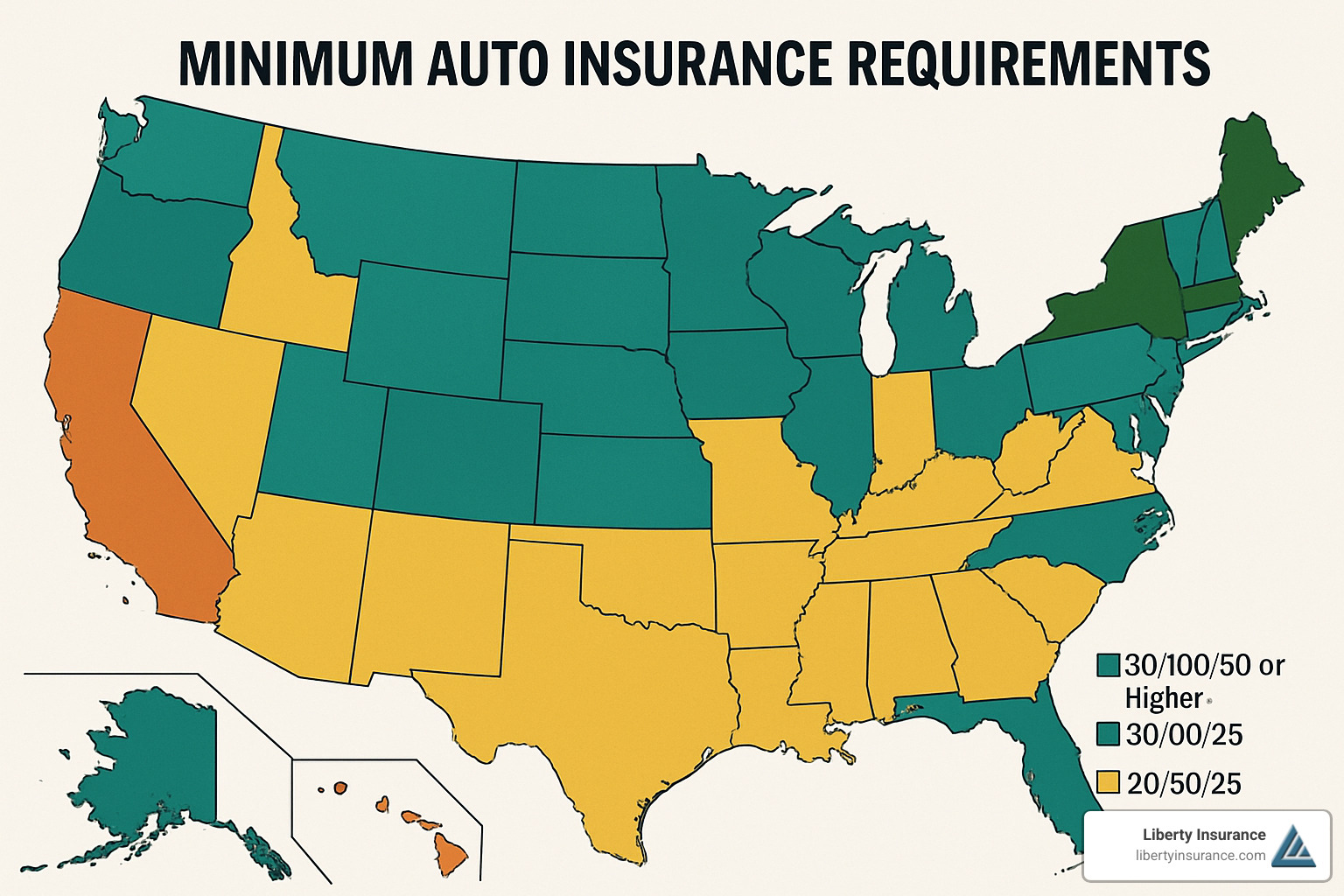
Arizona law requires all drivers to carry a minimum of $25,000 for bodily injury per person, $50,000 for bodily injury per accident, and $15,000 for property damage. Known as 25/50/15, these liability limits are mandatory for vehicle registration and legal operation on all public roads within the state.
Operating a motor vehicle in Arizona carries significant legal and financial responsibilities. Under the Arizona Revised Statutes (A.R.S. § 28-4135), the state mandates a "financial responsibility" requirement. This ensures that if you are at fault in a collision, there are funds available to compensate the victims for their medical expenses and property repairs. As we navigate the economic landscape of 2026, understanding these thresholds is critical for every resident, from students at Arizona State University to retirees in Sun City.
Detailed Breakdown of Arizona 25/50/15 Requirements
The shorthand "25/50/15" represents three distinct types of liability coverage. It is important to note that liability insurance does not cover your own injuries or your own vehicle; it only pays for the losses of others when you are the party at fault.
Bodily Injury Liability (Per Person): $25,000
This portion of the policy covers the medical expenses, lost wages, and pain and suffering of a single person injured in an accident you caused. In 2026, medical costs have continued to outpace general inflation. A $25,000 limit can be exhausted quickly by a single emergency room visit or a short hospital stay, leaving the driver personally liable for any costs exceeding this amount.
Bodily Injury Liability (Per Accident): $50,000
This is the total amount your insurance provider will pay for all injuries resulting from a single accident, regardless of how many people are hurt. For example, if you cause a collision involving a family of four, and each individual has $15,000 in medical bills (totaling $60,000), your $50,000 policy limit will fall $10,000 short. The victims can pursue your personal assets—such as your savings or future wages—to recover the difference.
Property Damage Liability: $15,000
This coverage pays for repairs to the other driver’s vehicle or any stationary property (like fences, buildings, or utility poles) damaged in the accident. Given that the average price of a new vehicle in 2026 often exceeds $50,000, and even used vehicles retain high value, a $15,000 limit is widely considered insufficient. If you total a modern SUV or an electric vehicle, you will likely owe tens of thousands of dollars out of pocket beyond what your insurance covers.
Verification and Compliance via the Arizona MVD
The Arizona Department of Transportation (ADOT) Motor Vehicle Division (MVD) maintains a sophisticated electronic insurance verification system. Unlike some states where proof of insurance is only checked during a traffic stop, Arizona insurance companies are required by law to notify the MVD whenever a policy is issued, canceled, or non-renewed.
If the MVD receives a notice of cancellation and does not receive a new policy notification within a short grace period, they will send an inquiry to the vehicle owner. Failure to provide proof of current, valid insurance can result in the immediate suspension of the vehicle’s registration. Driving with a suspended registration is a separate offense that carries additional fines and complications.
Proof of Insurance Requirements
Arizona allows drivers to present proof of insurance in two formats:
- Physical ID Cards: The traditional paper card issued by your insurer.
- Digital Proof: An electronic image of the ID card displayed on a smartphone or tablet. Arizona was an early adopter of digital proof, and law enforcement officers are trained to accept these during traffic stops.
Alternative Methods of Financial Responsibility
While most residents satisfy the law through a standard commercial auto insurance policy, Arizona provides alternative methods for establishing financial responsibility. These options are typically utilized by businesses with large fleets or individuals with high net worth who prefer to self-insure.
- Certificate of Deposit or Cash Bond: Under A.R.S. § 28-4084, a person may deposit $40,000 in cash or securities with the State Treasurer. The Treasurer will then issue a certificate that can be filed with the MVD to satisfy the insurance requirement.
- Surety Bond: A driver can obtain a surety bond for $40,000 from a company authorized to do business in Arizona.
- Self-Insurance: Companies or individuals who have more than 25 vehicles registered in their name may apply for a certificate of self-insurance from the MVD, provided they can prove the financial ability to pay judgments.
Penalties for Driving Without Insurance in Arizona
Arizona takes a strict stance on uninsured motorists. The penalties for failing to maintain the state minimum coverage are progressive, meaning they become significantly harsher with each subsequent offense within a 36-month period.
First Offense
- Civil Penalty: A minimum fine of $500.
- Suspension: Your driver’s license, registration, and license plates may be suspended for three months.
- Reinstatement Fee: To get your driving privileges back, you must pay a reinstatement fee (typically $10 to $25) and provide proof of an SR-22 certificate.
Second Offense (Within 36 Months)
- Civil Penalty: A minimum fine of $750.
- Suspension: A six-month suspension of your license, registration, and plates.
- SR-22 Requirement: You must maintain an SR-22 for three years.
Third and Subsequent Offenses
- Civil Penalty: A minimum fine of $1,000.
- Suspension: A one-year suspension of driving privileges.
- SR-22 Requirement: A mandatory three-year filing period.
The SR-22 is not insurance itself; it is a "Certificate of Financial Responsibility" that your insurance company files with the MVD to prove you have the required liability coverage. This usually results in a significant increase in your insurance premiums, as you are now classified as a high-risk driver.
Comparing Arizona Minimums to Recommended Coverage
Choosing the state minimum coverage is often the cheapest way to stay legal, but it is rarely the most cost-effective way to protect your finances. The table below compares the state-mandated minimums against the levels recommended by financial experts for the average driver in 2026.
| Coverage Type | Arizona State Minimum (2026) | Recommended "Standard" Coverage | Why You Need More |
|---|---|---|---|
| Bodily Injury (Per Person) | $25,000 | $100,000 | Covers severe injuries and high medical costs. |
| Bodily Injury (Per Accident) | $50,000 | $300,000 | Protects you if multiple people are injured. |
| Property Damage | $15,000 | $100,000 | Essential for accidents involving new or luxury cars. |
| Uninsured Motorist (UM) | Not Required | Match Liability Limits | Protects you if hit by a driver with no insurance. |
| Underinsured Motorist (UIM) | Not Required | Match Liability Limits | Protects you if the at-fault driver's limits are too low. |
| Collision Coverage | Not Required | Actual Cash Value | Pays to fix your car after an accident. |
| Comprehensive Coverage | Not Required | Actual Cash Value | Covers theft, fire, and Arizona monsoons/hail. |
Optional Coverages Required by Arizona Law (Offer of Coverage)
While Arizona only mandates liability insurance, state law requires insurance companies to offer you certain other protections in writing. You have the right to reject these coverages, but the insurer must keep a signed "Selection/Rejection" form on file.
Uninsured Motorist (UM) Coverage
This pays for your medical bills if you are hit by a driver who has no insurance at all. Given that Arizona historically has a high rate of uninsured drivers (often exceeding 10-15%), this is a critical protection.
Underinsured Motorist (UIM) Coverage
This applies when the at-fault driver has insurance, but their limits (like the $25,000 minimum) are not high enough to cover your total medical costs. UIM picks up where their policy leaves off.
Medical Payments (MedPay)
MedPay covers medical or funeral expenses for you and your passengers regardless of who was at fault. In Arizona, this is often used to cover health insurance deductibles after an accident.
Arizona’s Comparative Fault System
Arizona follows a Pure Comparative Fault rule (A.R.S. § 12-2505). This legal framework impacts how insurance companies handle claims. Under this system, you can recover damages even if you are 99% at fault, but your recovery is reduced by your percentage of fault.
For example, if you are in an accident and have $100,000 in damages, but a jury finds you were 20% responsible for the crash, you can only recover $80,000. Understanding this is vital because if your liability limits are set at the minimum, and you are found mostly at fault, your insurance will struggle to cover the other party's claims, even after the fault reduction is applied.
Common Mistakes with Arizona Auto Insurance
- Letting Coverage Lapse: Even a one-day lapse in coverage is reported to the MVD. In 2026, the automated systems are faster than ever, and a lapse can trigger a registration suspension notice almost immediately.
- Assuming Liability Covers Your Car: Many drivers buy "minimum coverage" and are shocked to find out their insurance won't pay to fix their own vehicle after a crash. You must add "Collision" coverage for that.
- Ignoring the SR-22 Impact: Some drivers choose to drive without insurance to save money, not realizing that the subsequent SR-22 requirement will make their future premiums significantly higher for at least three years.
- Underestimating Property Values: Arizona's $15,000 property damage minimum was set years ago. With the prevalence of high-tech sensors and expensive battery arrays in modern cars, even a minor fender-bender in 2026 can exceed this limit.
Frequently Asked Questions
Do I need insurance if my car is in storage?
If the vehicle is registered and has license plates, Arizona law requires it to be insured. If you plan to store the car long-term, you should apply for a "De-Insured" status through the MVD and surrender your plates to avoid suspension for lack of insurance.
Does Arizona insurance cover me in Mexico?
Generally, no. Standard Arizona auto policies usually stop at the border. To drive legally and be protected in Mexico, you must purchase a separate Mexican Auto Insurance policy. Some Arizona insurers offer "limited" Mexico coverage for short trips near the border, but this rarely satisfies Mexican legal requirements for liability.
What happens if I move to Arizona from another state?
You have 30 days to register your vehicle and obtain Arizona-compliant insurance after becoming a resident. Your out-of-state policy may not be accepted by the MVD if the company is not authorized to do business in Arizona and cannot electronically report your coverage.
Is Arizona a "No-Fault" state?
No. Arizona is an "At-Fault" or "Tort" state. This means the person who causes the accident is responsible for paying for the damages. This is why liability insurance is the only mandated coverage.
Can my insurance company cancel my policy if I have an accident?
In Arizona, an insurer generally cannot cancel a policy mid-term just because of a single accident. However, they can choose to "non-renew" your policy at the end of the term, or they can significantly increase your rates. They can only cancel a policy mid-term for specific reasons like non-payment of premiums or fraud.
Final Recommendation
While the state of Arizona only requires 25/50/15 liability limits, these amounts are often insufficient to protect your financial future in 2026. A single serious accident can result in medical bills and vehicle replacement costs that far exceed $50,000.
Next Steps: Review your current policy declarations page. If you are currently carrying the state minimum, contact your agent to get a quote for 100/300/100 limits. In many cases, the cost to quadruple your coverage is only a few dollars more per month, providing far greater peace of mind and asset protection. Additionally, ensure you have Uninsured Motorist coverage to protect yourself from the high number of non-compliant drivers on Arizona roads.