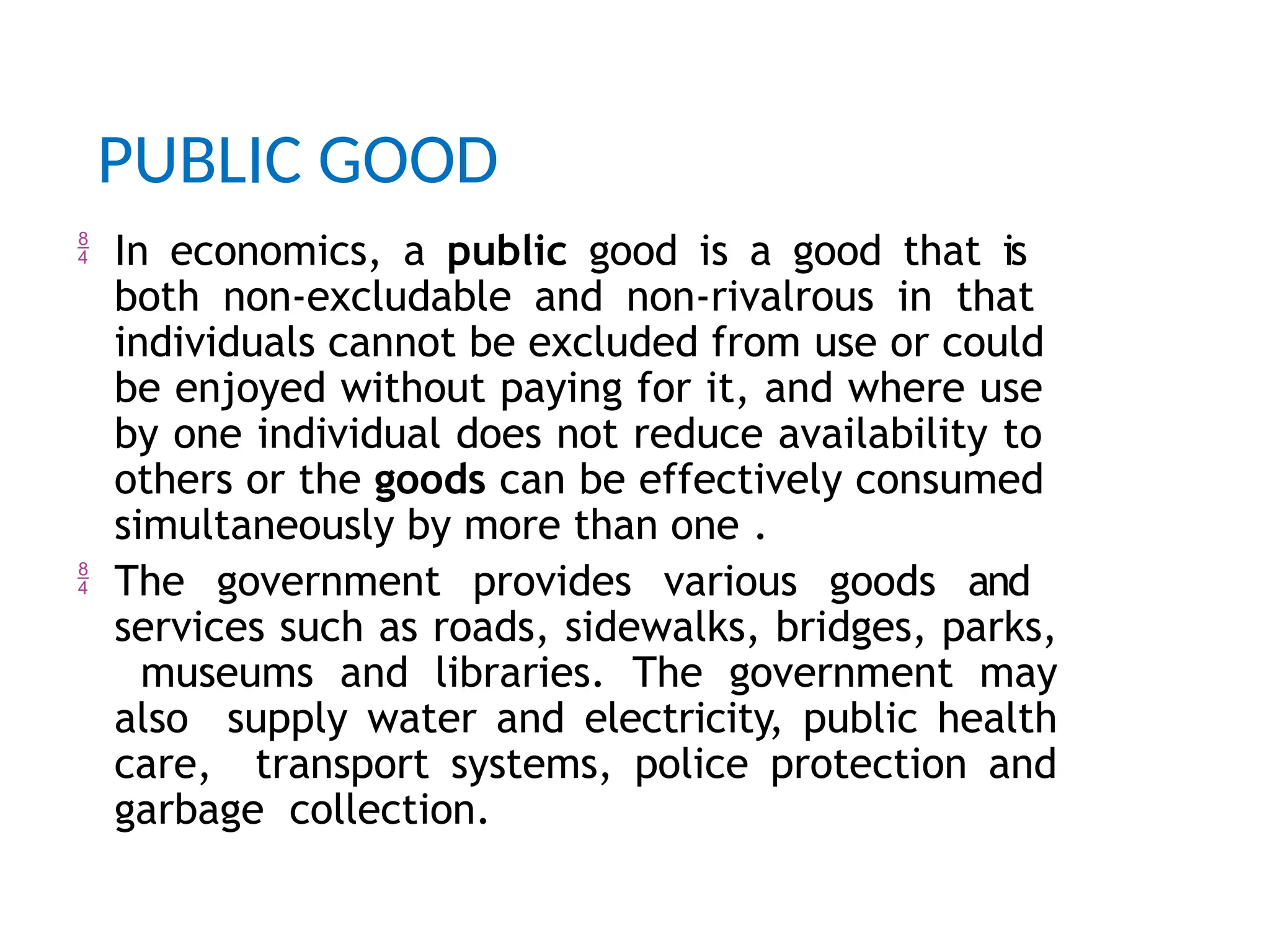
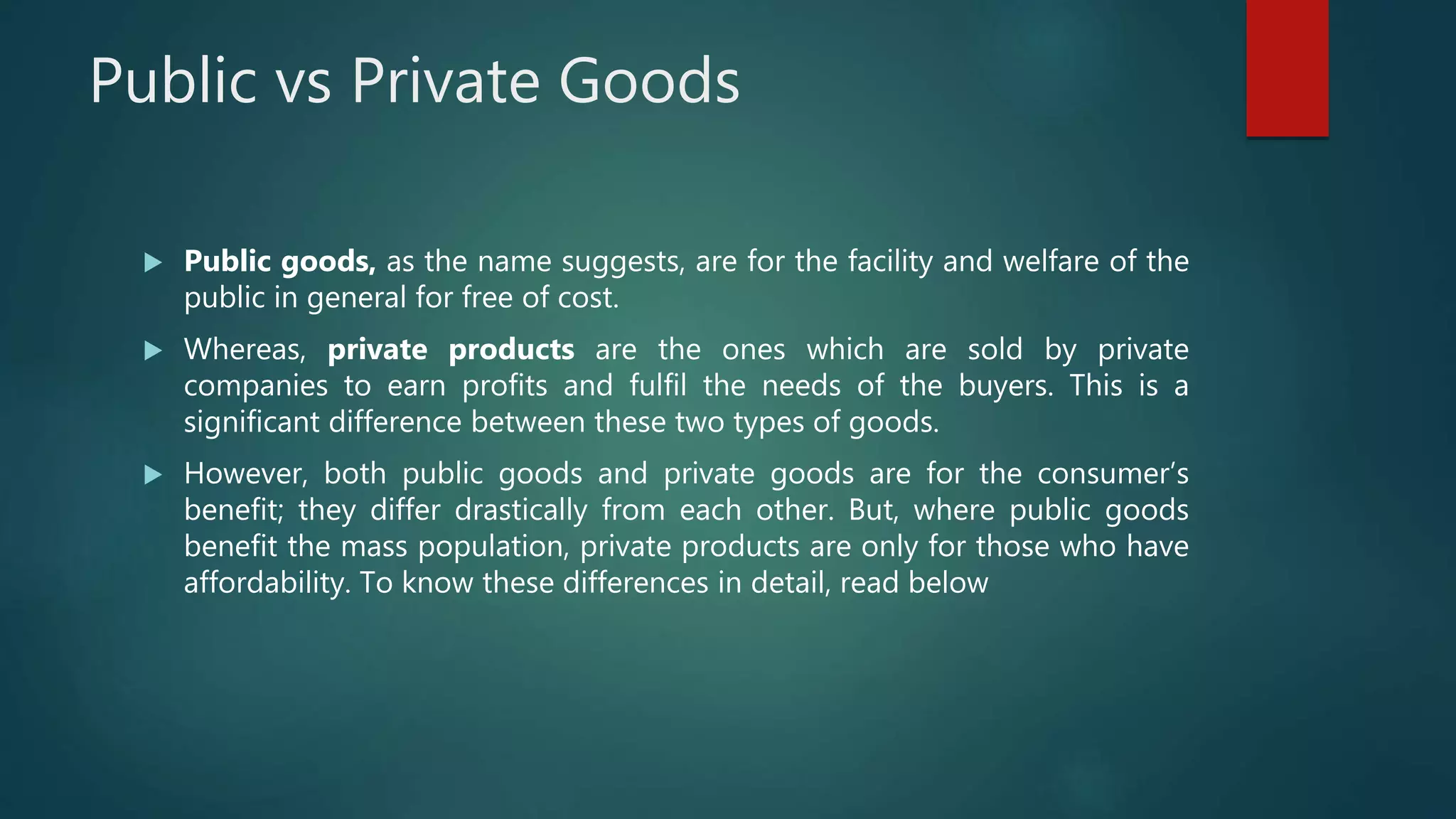
A classic example of a public good is national defense. In economic theory, national defense represents a pure public good because it is both non-excludable (no resident within a nation's borders can be excluded from its protection) and non-rivalrous (one citizen benefiting from defense does not reduce the security available to fellow citizens).
In microeconomics and public policy, understanding public goods is essential for recognizing how market mechanisms allocate resources and why governments step in to fund specific services. While private markets excel at producing goods like clothing, smartphones, and vehicles, they frequently fail to provide adequate quantities of public goods. This guide examines the fundamental definition of public goods, analyzes classic real-world examples, explores the famous "free-rider problem," and contrasts public goods with other major economic resource categories.
What Defines a Public Good?
In economic terms, a good is categorized based on two specific dimensions: excludability and rivalry. For a item or service to qualify as a "pure" public good, it must satisfy both criteria simultaneously.
| Excludable | Non-Excludable | |
|---|---|---|
| Rivalrous | PRIVATE GOODS (e.g., Food, Cars, Clothes) | COMMON-POOL RESOURCES (e.g., Ocean Fish, Timber) |
| Non-Rival | CLUB GOODS (e.g., Cable TV, Tolls) | PUBLIC GOODS (e.g., Defense, Lighting) |
1. Non-Excludability
Non-excludability means that once a good is produced, it is practically impossible—or prohibitively expensive—to prevent anyone from consuming or benefiting from it. If a company installs a streetlamp on a public corner, it cannot block specific pedestrians from using the light while allowing others to pass. Because non-payers cannot easily be excluded, private businesses struggle to charge individual consumers directly for access.
2. Non-Rivalrous Consumption
Non-rivalry (or non-rivalrous consumption) means that one individual’s use or consumption of a good does not diminish its utility or availability to anyone else. If you look at a public lighthouse to navigate your vessel into a harbor, your use of that light does not make the beam any less visible or useful to another ship captain navigating the exact same waters.
The concept was formally formalized by economist Paul Samuelson in his seminal 1954 paper, The Pure Theory of Public Expenditure, where he defined collective consumption goods as those "which all enjoy in common in the sense that each individual's consumption of such a good leads to no subtraction from any other individual's consumption."
Concrete Examples of Public Goods
To fully grasp the concept, it helps to examine real-world systems and services that fulfill the criteria of non-excludability and non-rivalry.
1. National Defense
National defense is the textbook economic example of a pure public good. Armed forces protect an entire geographic nation state.
- Why it is non-excludable: Military forces protect all residents within national boundaries. A government cannot defend 99% of a city while leaving a specific non-taxpayer undefended against incoming threats.
- Why it is non-rivalrous: The protection enjoyed by one citizen living in a city does not reduce the military protection available to their neighbor.
2. Street Lighting
Municipal streetlights illuminate public walkways and roadways to enhance safety and visibility at night.
- Why it is non-excludable: Anyone walking or driving down a public street benefits from the light. It is technically impossible to charge pedestrians per step or shut off the light for individual non-payers.
- Why it is non-rivalrous: Dozens of people can walk down the illuminated street simultaneously without reducing the brightness available to each person.
3. Lighthouses
Historically analyzed by economists such as Adam Smith, John Stuart Mill, and later Ronald Coase, lighthouses provide warning signals to maritime traffic near hazardous coastlines.
- Why it is non-excludable: Any ship within line of sight of the shore can see the light beam. Coastal operators cannot selectively blind non-paying ships while keeping the beam visible to paying clients.
- Why it is non-rivalrous: One ship referencing the light beam to avoid reefs does not prevent secondary or tertiary vessels from using the exact same signal.
4. Flood Control Systems and Levees
Large-scale infrastructure such as flood walls, dams, and levees protect entire river basins or coastal regions from severe flooding.
- Why it is non-excludable: When a levee holds back storm surge, every home and business behind the wall remains dry, regardless of whether individual property owners contributed to the construction fund.
- Why it is non-rivalrous: The safety conferred upon one building in a protected plain does not weaken the protection given to adjacent properties.
5. Basic Scientific Research and Open Knowledge
Fundamental mathematical theorems, theoretical physics principles, and open-source scientific discoveries represent intellectual public goods.
- Why it is non-excludable: Once a mathematical proof (such as the Pythagorean theorem) is published openly, anyone can learn, teach, and apply it.
- Why it is non-rivalrous: One engineer using calculus to design a bridge does not consume or deplete the calculus available for another engineer designing a airplane.
The Four Types of Economic Goods
To avoid confusing public goods with other economic categories, economists map goods across a two-by-two matrix based on rivalry and excludability.
| Category | Excludable? | Rivalrous? | Common Examples | Economic Characteristics |
|---|---|---|---|---|
| Private Goods | Yes | Yes | Food, clothing, personal electronics, cars | Private markets efficiently produce and allocate these via price mechanisms. |
| Public Goods | No | No | National defense, streetlights, flood levees | Subject to free-rider problems; usually provided or subsidized by governments. |
| Club Goods (Toll Goods) | Yes | No | Satellite television, private parks, toll bridges | Non-rivalrous until capacity limits are reached, but access can be restricted behind paywalls. |
| Common-Pool Resources | No | Yes | Ocean fish stocks, freshwater aquifers, public pastures | Vulnerable to overuse and depletion (the "Tragedy of the Commons"). |
Pure vs. Impure Public Goods
In practical policy analysis, very few goods are 100% "pure" public goods across all circumstances. Economists frequently distinguish between pure public goods and impure public goods.
Pure Public Goods
A pure public good strictly satisfies non-excludability and non-rivalry under all normal operating conditions. National defense and basic scientific knowledge closely approximate pure public goods because adding additional consumers costs zero marginal dollars and creates no congestion.
Impure Public Goods
An impure public good meets the criteria under low usage but becomes rivalrous or excludable as consumption increases.
- Public Roads and Highways: An open highway at 2:00 AM is non-rivalrous; one driver's presence does not hinder others. However, during rush hour, the road experiences severe congestion. At that point, the good becomes rivalrous, as each additional vehicle reduces travel speeds for everyone else.
- Public Parks: A city park is generally open to all (non-excludable) and spacious enough for visitors without interference (non-rivalrous). However, if thousands of visitors crowd into the park simultaneously, space becomes scarce, turning it into a rivalrous resource.
Market Failure and the Free-Rider Problem
Why can't private markets handle the supply of public goods? The primary reason is a phenomenon known as the free-rider problem.
Understanding the Free-Rider Problem
A free-rider is a consumer who benefits from a resource or service without paying for it. Because public goods are non-excludable, individuals have a financial incentive to withhold payment, expecting that someone else will bear the cost of production.
For example, imagine a neighborhood of 100 homes facing a $10,000 cost to install streetlights. Even if every homeowner values streetlighting at $200 (yielding a total collective benefit of $20,000), individual homeowners may refuse to contribute voluntarily. Each resident thinks: * "If my neighbors pay, I get the light for free. If my neighbors don't pay, my single contribution won't be enough to build it anyway."*
When everyone acts out of rational self-interest, zero funds are raised, and the streetlights are never built. This outcome represents a market failure—a scenario where competitive private markets fail to supply an economically desirable good.
- Individual Incentive to Free-Ride
- Lack of Private Voluntary Funding
- Underproduction or Zero Production by Private Firms
- Market Failure
- Government Intervention Required
Government Intervention and Taxation
To overcome market failure, societies rely on collective decision-making structures—primarily governments. Governments solve the free-rider problem by:
- Mandatory Taxation: Levying taxes on citizens and businesses to fund essential public infrastructure and defense.
- Direct Provision: Operating state-funded agencies (such as coastal guards, public health monitoring systems, and municipal public works departments) to manage and maintain public goods.
- Subsidies and Grants: Financing private research institutions and universities to perform basic research that benefits the general public.
Clarifying Terminology: Public Goods vs. Publicly Provided Goods
A common point of confusion in civil discourse is conflating public goods in the economic sense with publicly provided goods managed by governments.
- Economic Public Goods are defined strictly by their physical and technical attributes: non-excludability and non-rivalry.
- Publicly Provided Goods are any services funded or operated by governments, regardless of whether they meet economic public good criteria.
Examples of Government-Provided Goods That Are NOT Economic Public Goods:
- Public Education: Education is excludable (a student can be denied enrollment or suspended) and rivalrous (classrooms have finite desk space and teacher attention). Economists classify education as a private or merit good that generates positive externalities, which is why governments subsidize it.
- Public Healthcare: Medical appointments, vaccines, and hospital beds are rivalrous (a doctor spending an hour with Patient A cannot spend that same hour with Patient B) and excludable.
- Public Housing: A housing unit is strictly rivalrous and excludable. Only one family can occupy an apartment at a time.
Governments choose to fund these services not because they are technical "public goods," but because society values equitable access, health safety, and positive societal spillovers (externalities).
Frequently Asked Questions
What is the most common example of a public good?
National defense is universally cited as the standard example of a public good. It protects all residents within a nation's borders without excluding non-payers, and one person receiving security does not reduce the security available to fellow citizens.
Are public goods always provided by the government?
While governments provide the vast majority of public goods due to the free-rider problem, private entities or non-profits sometimes supply them. For example, philanthropic organizations fund open-source scientific software, public Wikipedia articles, and open-access scientific research databases.
Is clean air considered a public good?
Clean air exhibits characteristics of a public good because it is non-excludable (everyone breathes the ambient atmosphere). However, severe environmental pollution can turn clean air into a rivalrous common-pool resource, as heavy industrial emissions degrade air quality for surrounding communities.
How does a public good differ from a common-pool resource?
Both public goods and common-pool resources are non-excludable. However, public goods are non-rivalrous (one person's use doesn't lower availability), whereas common-pool resources are rivalrous (one person taking fish from an ocean or water from an aquifer leaves less for others).
Why do private markets underproduce public goods?
Private companies require revenue to cover production costs and earn profit. Because public goods are non-excludable, businesses cannot prevent non-paying individuals from consuming the good. As a result, consumers "free-ride," private demand signals disappear, and profit-driven firms choose not to produce the good.
Practical Recommendations for Economics and Policy Analysis
When analyzing public policy proposals, infrastructure projects, or economic frameworks, apply these standard evaluation steps to evaluate public goods:
- Test for Non-Excludability: Determine whether non-paying users can be realistically blocked from benefiting from the service. If technological or structural tools (like digital paywalls, electronic tolls, or physical fences) make exclusion low-cost, the service is likely a private or club good.
- Test for Non-Rivalry: Assess what happens when another user joins. If adding a user creates congestion, delays, or physical depletion, the service is an impure public good or a common-pool resource.
- Identify the Free-Rider Risk: Evaluate whether voluntary user fees can sustain the service long-term. If free-riding risks causing underinvestment, government intervention, tax funding, or non-profit grants are necessary to ensure supply.
- Distinguish Policy Goals from Economic Definitions: Keep in mind that a service funded by tax dollars (like public transit or state universities) is not automatically a public good. Recognizing this distinction helps policymakers select appropriate pricing models, subsidies, or regulation strategies.