When an 18-wheeler collides with a passenger vehicle, the resulting devastation often extends far beyond crushed metal, causing severe injuries, overwhelming medical bills, and complex legal battles against well-funded trucking corporations. Hiring an experienced 18 wheeler accident injury lawyer is crucial for navigating federal transportation regulations, preserving vital electronic evidence, and fighting for the comprehensive financial compensation you need to rebuild your life.
Commercial truck crashes are vastly different from standard car accidents. They involve multiple liable parties, complex insurance policies, and strict federal oversight by agencies like the Federal Motor Carrier Safety Administration (FMCSA). Navigating these legal waters requires specialized knowledge, prompt investigation, and a clear understanding of how commercial motor vehicle litigation operates.
Why 18-Wheeler Accidents Demand Specialized Legal Representation
Standard auto accidents usually involve two drivers and their respective insurance providers negotiating over straightforward rules of the road. In contrast, commercial trucking accidents implicate an intricate web of federal laws, corporate entities, and heavy machinery logistics. An 18-wheeler accident injury lawyer understands that these cases are rarely simple and requires a distinct approach to uncover liability.
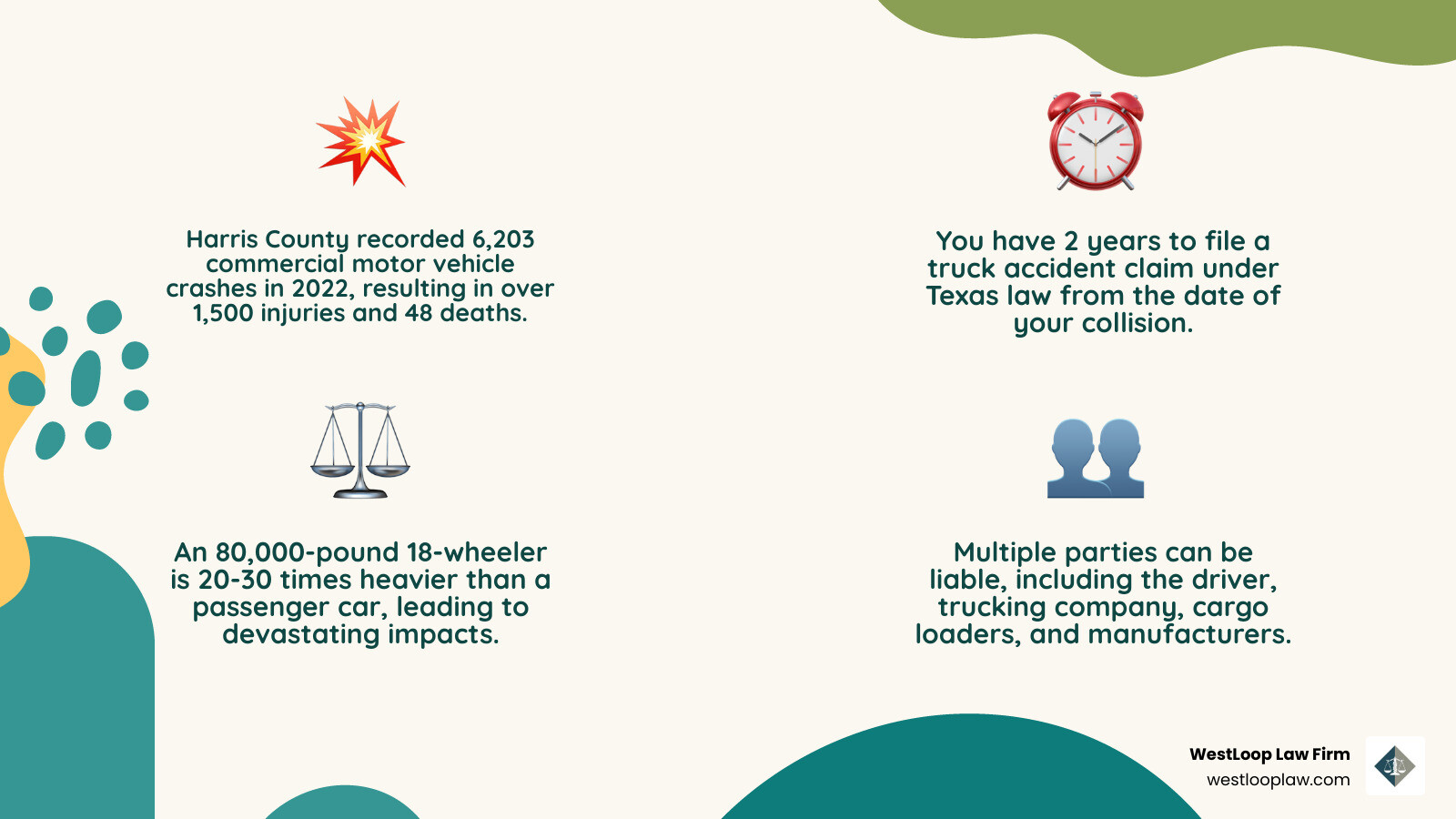
Commercial motor vehicles, often weighing up to 80,000 pounds when fully loaded, inflict catastrophic damage on smaller passenger cars. Because the stakes are so high, trucking companies and their insurers deploy rapid-response teams to accident scenes within hours to minimize their liability. To counter these corporate tactics, injured victims need legal representation that matches this urgency. Specialized attorneys know precisely what evidence to look for, how to interpret federal safety guidelines, and how to prevent trucking companies from destroying or altering critical data.
Furthermore, determining who is at fault in a commercial truck crash is rarely straightforward. While the truck driver may have made a critical error, liability can also extend to the trucking company, the cargo loader, the maintenance contractor, or the manufacturer of a defective vehicle part. Identifying every potential source of recovery is essential, especially when medical expenses and lost wages exceed the limits of a single insurance policy.
Understanding Liability and Multiple Responsible Parties
One of the most complex aspects of commercial vehicle litigation is identifying all liable parties. Unlike a typical two-car collision, an 18-wheeler crash often involves a chain of responsibility spanning several corporations and independent contractors.
The Truck Driver
The driver is frequently the most immediate source of fault. Driver negligence can manifest as fatigue from exceeding hours-of-service limits, distraction due to mobile device use, driving under the influence of drugs or alcohol, or operating the vehicle at unsafe speeds for weather and traffic conditions.
The Trucking Company or Motor Carrier
Under the legal doctrine of respondeat superior, employers are generally responsible for the negligent acts of their employees committed within the scope of employment. Additionally, trucking companies can be held directly liable for negligent hiring, improper training, failure to maintain vehicles, or forcing drivers to violate federal hours-of-service regulations to meet tight delivery schedules.
Cargo Loaders and Shippers
Improperly loaded or unsecured cargo can cause a semi-truck to jackknife, roll over, or lose control. If a third-party loading company or the shipper packed the trailer incorrectly and failed to distribute weight evenly, they share liability for the resulting crash.
Maintenance Providers and Parts Manufacturers
Trucks require rigorous, ongoing maintenance. If a mechanic or maintenance shop performed substandard repairs, or if a critical component—such as braking systems, steering mechanisms, or tires—suffered a sudden mechanical failure due to a design or manufacturing defect, the manufacturer or repair facility can be named in the lawsuit.
| Responsible Party | Potential Area of Negligence | Primary Evidence Required |
|---|---|---|
| Truck Driver | Fatigue, speeding, distraction, substance impairment | Electronic Logging Device (ELD) data, cell phone records, toxicology reports |
| Trucking Company | Negligent hiring, scheduling pressure, poor vehicle maintenance | Qualification files, dispatch logs, internal company communications |
| Cargo Loader | Overloading, improper weight distribution, insecure tie-downs | Bill of lading, loading dock surveillance, weight station receipts |
| Parts Manufacturer | Defective brakes, steering failure, tire blowouts | Product design specifications, recall notices, expert engineering analysis |
Critical Evidence Preserved by a Truck Accident Attorney
Time is of the essence following a commercial vehicle collision. Unlike standard auto insurance claims where evidence remains relatively stable, trucking evidence can disappear or be legally destroyed within days if immediate legal steps are not taken. An experienced 18-wheeler accident injury lawyer acts quickly to secure and preserve perishable evidence.
Electronic Control Modules (ECM) and Black Boxes
Most modern commercial trucks are equipped with an Electronic Control Module, commonly known as a black box. This device records critical pre-crash data, including vehicle speed, braking application, engine RPM, throttle position, and time intervals leading up to the impact. This data provides an objective timeline that can refute a driver's false statements.
Electronic Logging Devices (ELDs)
Federal law requires most commercial motor carriers to use ELDs to track a driver's Record of Duty Status (RODS). These devices monitor driving hours, rest breaks, and off-duty time. ELD data helps attorneys prove whether a driver was fatigued or operating in direct violation of federal hours-of-service rules designed to prevent drowsy driving.
Maintenance and Inspection Records
Federal regulations mandate that motor carriers systematically inspect, repair, and maintain all vehicles under their control. Attorneys request maintenance logs, driver vehicle inspection reports (DVIRs), and repair receipts to determine if the truck was operating with known mechanical defects.
Post-Accident Drug and Alcohol Testing
Federal regulations require commercial drivers to submit to alcohol and controlled substance testing following certain qualifying accidents. Prompt legal intervention ensures that these mandatory tests are conducted properly and that the results are preserved before they can be misplaced or compromised.
The Role of Federal Regulations in Your Claim
Commercial trucking is heavily regulated at the federal level. The Federal Motor Carrier Safety Administration establishes comprehensive rules governing driver qualifications, vehicle maintenance, weight limits, and maximum driving hours. Violations of these regulations serve as powerful evidence of negligence in a personal injury lawsuit.
For instance, the FMCSA hours-of-service rules dictate that property-carrying drivers generally cannot drive more than 11 hours following 10 consecutive hours off duty, and they must take a 30-minute break after 8 cumulative hours of driving. When a driver or trucking company cuts corners to maximize profit, these safety rules are frequently broken. An attorney who specializes in commercial vehicle accidents uses these federal standards to establish a standard of care and prove how the defendant's breach of that standard directly caused the crash and resulting injuries.
Furthermore, commercial carriers are required to maintain high levels of financial responsibility, often carrying minimum liability insurance policies ranging from $750,000 to $5,000,000 or more, depending on the type of cargo hauled, such as hazardous materials. Navigating policies of this magnitude requires familiarity with complex insurance structures, primary and excess coverage tiers, and corporate defense strategies.
Steps to Take Immediately Following an 18-Wheeler Collision
The moments, days, and weeks following a severe truck accident are chaotic and overwhelming. Taking deliberate, cautious steps protects both your physical health and your potential legal claim.
- Prioritize Medical Attention: Call emergency services immediately. Even if you feel fine adrenaline can mask severe internal injuries, traumatic brain injuries, or spinal damage. Comprehensive medical documentation establishes a direct link between the crash and your injuries.
- Document the Scene: If you are physically able and safe to do so, take photographs and videos of the vehicles, debris field, skid marks, road conditions, and traffic signs. Capture the truck's DOT number, license plate, and company name displayed on the cab or trailer.
- Gather Contact Information: Obtain names, phone numbers, and statements from eyewitnesses who saw how the accident occurred. Request the badge numbers and responding agency details from law enforcement officers.
- Decline Recorded Statements to Insurers: Insurance adjusters for the trucking company will likely contact you quickly. Do not sign documents, give recorded statements, or accept early settlement offers without consulting an attorney. Their primary goal is minimizing payout liability.
- Retain Legal Counsel: Contact a qualified 18-wheeler accident injury lawyer as soon as possible. Prompt legal representation allows your attorney to issue spoliation letters—formal legal notices demanding that the trucking company preserve all physical and electronic evidence.
Common Mistakes That Can Harm Your Truck Accident Claim
Injured victims frequently make unintentional missteps that insurance companies exploit to reduce or deny compensation. Avoiding these common errors protects the integrity of your case.
- Delaying Medical Treatment: Waiting days or weeks to see a doctor allows the opposing insurance company to argue that your injuries were not caused by the accident or that they resulted from a subsequent, unrelated event.
- Posting on Social Media: Insurance adjusters routinely monitor the social media profiles of plaintiffs. Posting photos, checking in at locations, or discussing the accident—even casually—can be twisted out of context to argue that your injuries are not as severe as claimed.
- Accepting Quick Settlement Offers: Initial settlement offers are almost always lowball figures designed to close your case before the full scope of your medical needs, long-term disability, and future lost earning capacity can be determined.
- Failing to Follow Treatment Plans: Missing physical therapy sessions, ignoring physician restrictions, or failing to fill prescribed medications gives defense attorneys ammunition to claim you failed to mitigate your damages.
Frequently Asked Questions About Truck Accident Claims
How long do I have to file an 18-wheeler accident lawsuit?
Every jurisdiction enforces a statute of limitations that sets a strict deadline for filing a personal injury lawsuit. This timeframe varies significantly by state, often ranging from one to three years from the date of the accident. Missing this deadline permanently bars you from recovering compensation. It is vital to consult an attorney promptly to ensure all filings are completed well within the statutory limit.
What types of compensation can I recover?
Injured victims may be entitled to recover economic damages, such as past and future medical expenses, rehabilitation costs, lost wages, and diminished earning capacity. You can also pursue non-economic damages for pain and suffering, emotional distress, disfigurement, and loss of enjoyment of life. In rare cases involving gross negligence or reckless disregard for safety, punitive damages may also be awarded.
Who pays for my medical bills while the lawsuit is pending?
Generally, you are initially responsible for your medical bills through your health insurance, auto insurance medical payments coverage (MedPay), or personal injury protection (PIP). Your attorney will work to coordinate these benefits and ensure that medical liens are addressed and resolved out of the final settlement or court verdict.
How much does an 18-wheeler accident injury lawyer cost?
Most reputable personal injury lawyers operate on a contingency fee basis. This means you pay nothing upfront and owe no hourly fees. The attorney's fee is a predetermined percentage of the final recovery obtained through a settlement or trial verdict. If there is no recovery, you owe no attorney fees.
Can I handle an 18-wheeler claim without an attorney?
Attempting to handle a commercial trucking claim on your own is extremely risky. Trucking corporations and their insurers possess vast financial resources, aggressive legal teams, and sophisticated defense strategies. An experienced attorney levels the playing field, handles complex negotiations, conducts thorough discovery, and advocates for your best interests.
Taking the Next Step Toward Recovery
Coping with the physical, emotional, and financial toll of a severe commercial vehicle crash requires immense resilience. You do not have to face powerful trucking corporations and their insurance adjusters alone. By partnering with a qualified 18-wheeler accident injury lawyer, you ensure that your rights are vigorously protected, vital evidence is preserved, and every responsible party is held accountable. If you or a loved one has been injured in a truck crash, schedule a confidential, no-obligation consultation with an experienced attorney today to discuss your legal options and begin charting your path forward.