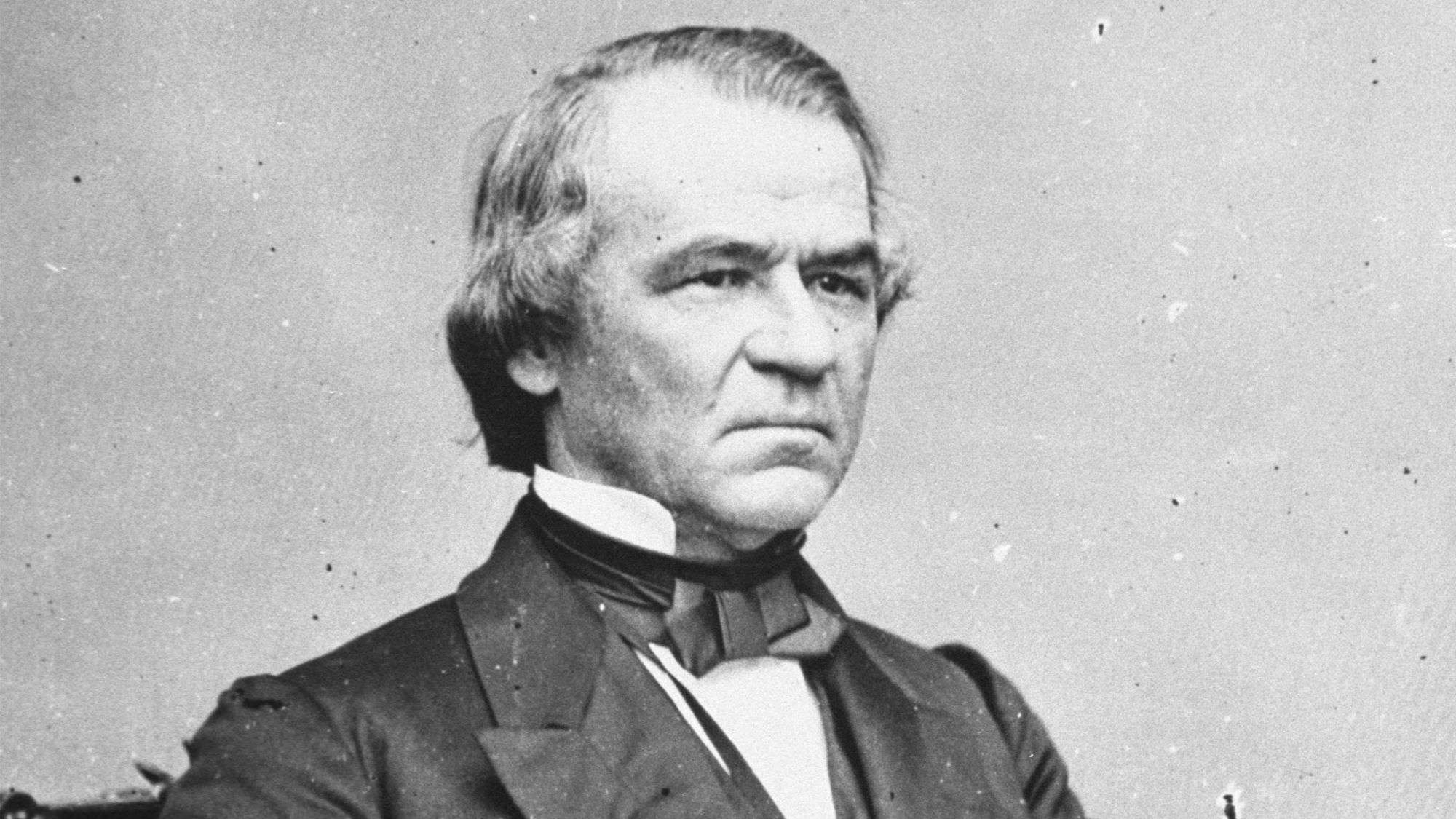
Andrew Johnson, the 17th President of the United States, is best known for his controversial Presidential Reconstruction policies following the American Civil War. Taking office after Abraham Lincoln's assassination in April 1865, Johnson pursued a lenient plan toward former Confederate states, granted thousands of executive pardons, opposed federal civil rights for newly freed African Americans, and sparked an unprecedented constitutional crisis that led to his impeachment in 1868.
Historical Context: A Southern Democrat in the Union White House
To understand why Andrew Johnson pursued his specific Reconstruction policies, one must examine his unique political position in 1865. Born into poverty in North Carolina and later establishing himself as a tailor and politician in Greeneville, Tennessee, Johnson built a political career as a staunch champion of white working-class yeoman farmers against the wealthy planter aristocracy.
Despite being a Southern Democrat and a slaveholder prior to the Civil War, Johnson broke with his region when Tennessee seceded in 1861. He was the only sitting U.S. senator from a seceding state who remained loyal to the Union. Recognizing his allegiance and wanting to signal national unity, President Abraham Lincoln appointed Johnson as the military governor of occupied Tennessee in 1862. Later, during the 1864 presidential election, Lincoln selected Johnson as his running mate on the bipartisan National Union Party ticket.
| Andrew Johnson (Executive Branch) | Radical Republicans (Congress) |
|---|---|
| Strict Constitutional Construction | Federal Protection of Freedmen |
| Rapid Southern Readmission | Structural & Social Reform |
| Presidential Control of Process | Congressional Supervision |
| States' Rights Emphasis | Equal Rights & Black Suffrage |
When Lincoln was assassinated in April 1865—just days after Robert E. Lee surrendered at Appomattox—Johnson ascended to the presidency. Congress was in recess from April until December 1865. This eight-month window gave Johnson absolute unilateral authority to shape the initial phase of post-war Reconstruction without legislative oversight.
The Core of Presidential Reconstruction (1865)
Johnson’s approach to post-war integration, commonly termed Presidential Reconstruction, was grounded in a strict interpretation of the U.S. Constitution. Johnson held that secession was legally impossible; therefore, the Southern states had never technically left the Union, but had merely been led astray by bad actors. Consequently, he believed the executive branch possessed sole authority to restore civil government in the South.
On May 29, 1865, President Johnson issued two pivotal proclamations that set his strategy into motion:
- Proclamation of Amnesty: Offered a full pardon and restoration of all property rights (except for enslaved people) to most former Confederates who took an oath of allegiance to the U.S. Constitution.
- Proclamation for North Carolina: Laid out the blueprint for readmitting Southern states, appointing provisional governors tasked with calling constitutional conventions to draft new state charters.
Policy Requirements for Southern Readmission
To re-establish self-government and send representatives back to Congress, Johnson required seceded states to satisfy only three main conditions:
- Repeal or Nullify Ordinances of Secession: States had to formally void their acts of secession.
- Repudiate Confederate War Debts: States could not use state funds to pay off debt incurred while warring against the United States.
- Ratify the Thirteenth Amendment: States were required to accept the constitutional abolition of slavery.
Beyond these points, Johnson imposed virtually no conditions regarding the legal, social, or political status of newly emancipated African Americans. He believed that voting qualifications and civil rights were matters strictly reserved for individual states under the Tenth Amendment.
The Special Pardon System
While Johnson’s amnesty proclamation excluded fourteen high-ranking categories of Confederates—including high military officers, former Confederate government officials, and wealthy landowners owning property worth over $20,000—he allowed members of these excluded classes to apply directly to him for individual presidential pardons.
Ex-Confederate elites flooded the White House with pardon applications. Johnson, who had long resented the Southern planter class, paradoxically granted these pardons by the thousands. By late 1865, he had issued over 13,000 individual presidential pardons. This policy quickly returned the pre-war Southern political establishment to power, allowing former Confederate generals, cabinet members, and governors to win election to state offices and Congress.
Southern Black Codes and the Freedmen’s Crisis
With local authority restored to pre-war elites under Johnson's broad pardon power, reconstituted Southern legislatures immediately moved to restrict the liberty of newly freed Black Americans. In late 1865 and early 1866, Southern states enacted restrictive laws known as the Black Codes.
| Category | Impact of Southern Black Codes |
|---|---|
| Labor Control | Mandated annual labor contracts; failure led to arrest for vagrancy and forced labor service. |
| Legal Restrictions | Prohibited Black citizens from voting, serving on juries, or testifying against white adults. |
| Property & Movement | Restricted land ownership and movement within urban areas through specialized licensing fees. |
The Black Codes effectively sought to replicate the economic and social conditions of slavery without the legal title of ownership. Freedmen were mandated to sign annual labor contracts with white landowners; if they failed to produce written proof of employment, they were arrested as vagrants, fined, and auctioned off to private employers to work off their debt.
Simultaneously, Johnson ordered the Bureau of Refugees, Freedmen, and Abandoned Lands (commonly known as the Freedmen's Bureau) to return confiscated and abandoned Confederate lands to their original white owners. Under Lincoln and General William T. Sherman's Special Field Orders No. 15, thousands of freed families had settled on plots of land in coastal South Carolina and Georgia. Johnson’s order revoked these settlements, evicting Black families and forcing them into precarious tenant farming and sharecropping arrangements.
The Clash with Congress: Presidential vs. Radical Reconstruction
When the 39th U.S. Congress convened in December 1865, lawmakers were shocked by the return of unrepentant Confederate leaders to Washington—including Alexander Stephens, the Vice President of the Confederacy, who had been elected U.S. Senator from Georgia. Led by Radical Republicans such as Representative Thaddeus Stevens and Senator Charles Sumner, Congress refused to seat the Southern delegations and established the Joint Committee on Reconstruction to investigate Southern conditions.
The disagreement between Johnson and Congress escalated from a policy divide into a bitter constitutional battle over the legislative process.
The Vetoes of 1866
In early 1866, moderate and radical Republicans combined forces to pass two major pieces of civil rights legislation:
- The Freedmen's Bureau Bill of 1866: Extended the life of the agency and expanded its authority to build schools, provide legal assistance, and protect freedpeople from discrimination.
- The Civil Rights Act of 1866: Declared all persons born in the United States to be citizens (regardless of race) and granted them equal legal rights to inherit, purchase, lease, sell, hold, and convey real and personal property.
President Johnson vetoed both measures. In his veto messages, he claimed that conferring citizenship on four million former slaves violated constitutional principles, discriminated against white Americans, and infringed on state sovereignty.
However, in April 1866, Congress mustered a two-thirds majority to override Johnson's veto of the Civil Rights Act of 1866—marking the first time in American history that Congress overrode a presidential veto on a major legislative bill. Congress subsequently passed a modified Freedmen’s Bureau bill over another presidential veto in July 1866.
The Fourteenth Amendment and the "Swing Around the Circle"
Fearing that future supreme court decisions or legislative majorities might overturn the Civil Rights Act, Congress drafted the Fourteenth Amendment in June 1866. The amendment defined national citizenship, guaranteed due process and equal protection of the laws, reduced Congressional representation for states that denied voting rights to adult males, and disqualified former Confederate officials from holding federal or state office unless pardoned by a two-thirds vote of Congress.
Johnson actively campaigned against the Fourteenth Amendment, urging Southern states to reject its ratification. In late summer 1866, he embarked on a nationwide speaking campaign known as the "Swing Around the Circle." The tour proved disastrous. Johnson engaged in hostile shouting matches with hecklers, insulted leading members of Congress, and made unpresidential statements that alienated Northern voters.
The 1866 midterm elections resulted in a sweeping victory for the Republican Party, granting them a veto-proof two-thirds supermajority in both the House of Representatives and the Senate.
Congressional Reconstruction Takeover (1867–1868)
With an absolute legislative majority, Congress dismantled Johnson’s Presidential Reconstruction model and instituted Congressional Reconstruction (also known as Radical Reconstruction).
In March 1867, Congress passed the first of four Reconstruction Acts over Johnson’s presidential vetoes. The landmark legislation:
- Divided the South into Military Districts: Placed ten former Confederate states under the command of five military governors equipped with federal troops.
- Mandated Universal Male Suffrage: Required states to draft new constitutions guaranteeing voting rights to Black men.
- Conditioned Readmission on the 14th Amendment: Required state legislatures to ratify the Fourteenth Amendment before regaining congressional representation.
| Feature | Presidential Reconstruction (Johnson) | Congressional Reconstruction (Radical) |
|---|---|---|
| Executive vs. Legislative | Unilateral executive control | Legislative supremacy & oversight |
| Executive Pardons | Mass pardons granted to Southern elites | Strict disqualification of ex-rebels |
| Protection for Freedpeople | Left entirely to individual states | Federal enforcement; 14th & 15th Amend. |
| Conditions for Readmission | Ratify 13th Amendment & void secession | Ratify 14th Amendment & Black suffrage |
| Southern Governance Model | Restoration of civilian ex-Confederates | Temporary military district control |
The Path to Impeachment (1868)
To block President Johnson from subverting congressional mandates through his military powers, Congress enacted the Tenure of Office Act in March 1867 over another presidential veto. The act prohibited the president from removing cabinet officers and other civil officials confirmed by the Senate without obtaining Senate consent first.
Johnson viewed the Tenure of Office Act as an unconstitutional infringement on executive authority. In August 1867, while Congress was out of session, he suspended Secretary of War Edwin M. Stanton, a radical Republican supporter who had used his office to enforce congressional Reconstruction orders throughout the South. Johnson replaced Stanton with General Ulysses S. Grant.
When the Senate reassembled in early 1868, it refused to concur with Stanton’s removal. Grant stepped aside, and Stanton reclaimed his office. On February 21, 1868, Johnson formally dismissed Stanton and appointed General Lorenzo Thomas as Secretary of War ad interim.
| Date | Event |
|---|---|
| March 1867 | Congress passes the Tenure of Office Act over Johnson's veto. |
| August 1867 | Johnson suspends Secretary of War Edwin M. Stanton. |
| Feb 21, 1868 | Johnson officially fires Stanton; Stanton barricades office. |
| Feb 24, 1868 | U.S. House of Representatives votes 126–47 to impeach Johnson. |
| March–May 1868 | Senate trial takes place; Chief Justice Salmon P. Chase presides. |
| May 16/26 1868 | Senate votes 35–19 (one vote short of two-thirds requirement). |
Three days later, on February 24, 1868, the House of Representatives voted 126 to 47 to impeach Andrew Johnson for "high crimes and misdemeanors." The House drafted eleven formal articles of impeachment, primary among them being his violation of the Tenure of Office Act and his attempts to bring Congress into disrepute.
The Senate Trial and Acquittal
The trial in the U.S. Senate lasted from March to May 1868, presided over by Chief Justice Salmon P. Chase. Johnson’s defense team argued that:
- The Tenure of Office Act did not cover Edwin Stanton because he had been appointed by Abraham Lincoln during his first term, not by Johnson.
- The President had a right to test the constitutionality of a congressional statute before the judicial branch.
- Political disagreements over policy did not meet the constitutional standard for impeachable offenses.
When the Senate voted on May 16 and May 26, 1868, on three of the articles of impeachment, the result was 35 votes for conviction and 19 for acquittal—falling precisely one vote short of the two-thirds supermajority needed to remove him from office. Seven moderate Republican senators broke party ranks to vote for acquittal, fearing that removing a president over a policy dispute would permanently damage the constitutional balance of powers between the executive and legislative branches.
Historical Legacy and Modern Assessment
Although Johnson remained in office for the remainder of his term until March 1869, his political influence was permanently broken. Congress controlled the narrative and implementation of Reconstruction, leading to the ratification of the Fifteenth Amendment in 1870, which prohibited states from denying voting rights based on race, color, or previous condition of servitude.
Johnson returned to Tennessee after leaving office and maintained that his policy was the only constitutional approach to restoring the nation. In 1875, he won election back to the U.S. Senate as a Democrat from Tennessee, making him the only former president to serve in the Senate, though he died of a stroke a few months later on July 31, 1875.
| Era / Perspective | View |
|---|---|
| Dunning School View (Early 1900s) | Framed Johnson as a constitutional hero defending states' rights against radicals. |
| Modern Consensus (Mid-20th–Present) | Views Johnson's policies as catastrophic failures that enabled racial oppression, entrenched Jim Crow, and undermined equality. |
Historiographical Evolution
Historical interpretations of Andrew Johnson have undergone dramatic shifts:
- The Dunning School Era (1900s–1950s): Early 20th-century historians, led by William Archibald Dunning, framed Johnson as a noble constitutional defender who resisted punitive Radical Republican policies aimed at victimizing the South.
- The Modern Revisionist View (1960s–Present): Modern scholars evaluate Reconstruction through the lens of civil rights and human freedom. Leading historians, including Eric Foner, view Johnson's presidency as a major national tragedy. Foner notes that Johnson’s refusal to grant fundamental protections to freedpeople, combined with his encouragement of Southern defiance, set back racial equality in America by nearly a century and sowed the seeds for the disenfranchisement and segregation of the Jim Crow era.
Today, professional historians consistently rank Andrew Johnson among the worst presidents in United States history, citing his racial animus, unwillingness to compromise, and failure to secure equal rights following the defeat of the Confederacy.
Frequently Asked Questions
What was the main goal of Andrew Johnson's Reconstruction plan?
Andrew Johnson’s primary goal was to quickly restore the seceded Southern states to the Union with minimal changes to their social and political structures. He sought to return civilian power to white Southerners, preserve states' rights, and retain executive authority over the Reconstruction process, explicitly excluding federal mandates for civil rights or voting access for African Americans.
Why did Andrew Johnson oppose federal civil rights for freed slaves?
Johnson maintained a strict constructionist view of the U.S. Constitution, holding that individual states possessed the sole constitutional right to define voting privileges and legal rights within their borders. Additionally, Johnson held deeply racist views common among Southern populists of his era, publicly expressing his belief that white citizens should govern the United States.
Why was Andrew Johnson impeached?
Andrew Johnson was impeached by the House of Representatives in 1868 primarily for violating the Tenure of Office Act after he fired Secretary of War Edwin M. Stanton without Senate approval. The political driver behind his impeachment was his persistent interference with Congressional Reconstruction acts, including his vetoes of civil rights legislation and opposition to federal protections for former slaves.
What was the difference between Lincoln's and Johnson's Reconstruction plans?
While Lincoln proposed a flexible, moderate plan—such as his "10 Percent Plan" aimed at winning the war quickly—he demonstrated a willingness to adapt his policies toward guaranteeing civil rights and limited suffrage for African Americans as the war concluded. Johnson, by contrast, pursued an unyielding policy that restored ex-Confederates to power while actively blocking all congressional attempts to protect African American citizenship and political rights.
How did Johnson's policies lead to the rise of Jim Crow?
By issuing broad pardons to pre-war Southern elites and refusing to impose civil rights protections during Presidential Reconstruction, Johnson allowed Southern state governments to pass the Black Codes in 1865 and 1866. These laws legally restricted Black labor, movement, and voting rights, laying the institutional framework for the sharecropping system and the eventual establishment of Jim Crow segregation laws.
Recommended Research and Primary Sources
For students, educators, and researchers conducting deeper historical study into Andrew Johnson's Reconstruction policies, the following primary document collections and official institutional archives provide foundational evidence:
- The Library of Congress (Andrew Johnson Papers): Contains executive proclamations, personal correspondence, veto messages, and official military records during his presidential term.
- The National Archives and Records Administration (NARA): Holds records of the Bureau of Refugees, Freedmen, and Abandoned Lands, documenting the enforcement and revoking of land grants under Johnson's presidency.
- The U.S. Senate Historical Office: Provides trial transcripts, voting tallies, and legal defenses from the 1868 presidential impeachment proceedings.