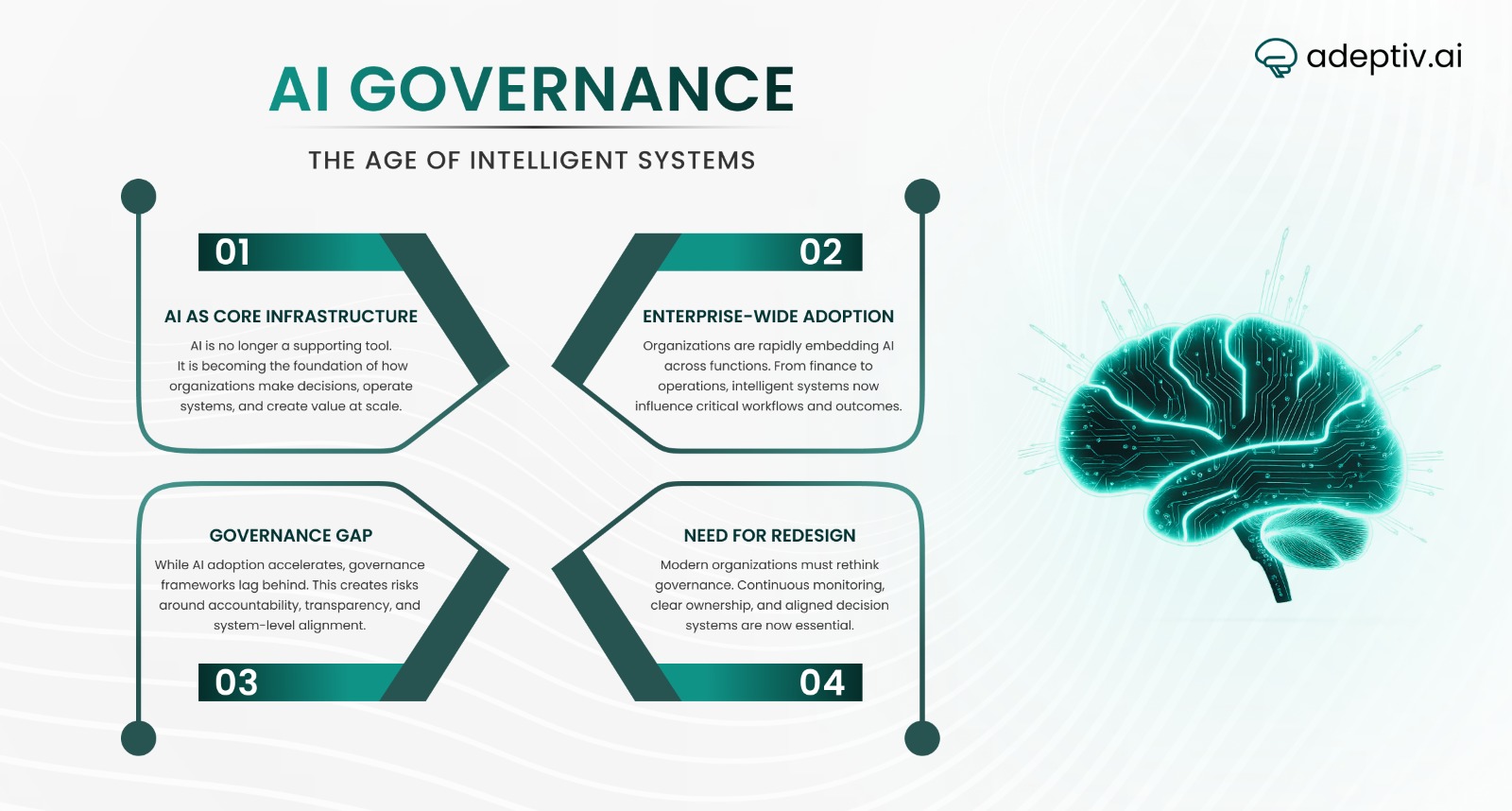
Artificial intelligence governance is a strategic framework of rules, ethical guidelines, and technical standards designed to ensure that AI systems are developed and deployed safely, ethically, and legally. It bridges the gap between raw technological capability and societal safety by establishing clear accountability, transparency, and risk management protocols throughout the entire AI lifecycle.
In 2026, the landscape of artificial intelligence has moved beyond experimental curiosity into the core of global infrastructure. As AI systems now manage everything from medical diagnostics to autonomous logistics and national power grids, the need for robust governance has transitioned from a theoretical preference to a mandatory operational requirement. Organizations no longer view governance as a hurdle to innovation but as the essential scaffolding that makes sustainable innovation possible.
The Core Pillars of AI Governance
Effective AI governance is built upon five foundational pillars. These pillars provide a roadmap for organizations to align their technical outputs with human values and legal obligations.
1. Transparency and Explainability
Transparency involves being open about when and how AI is used. In a governed environment, users must be informed they are interacting with an AI system. Explainability (often referred to as XAI) goes a step further, requiring that the internal logic of a model is not a "black box." For instance, if an AI denies a mortgage application, governance mandates that the system provides specific, human-understandable reasons for that decision, such as debt-to-income ratios or credit history nuances, rather than an opaque algorithmic score.
2. Accountability and Liability
One of the most complex aspects of governance is determining who is responsible when a system fails. Accountability frameworks assign clear roles: the provider (the entity that creates the model), the deployer (the entity that uses it), and the end-user. By 2026, legal precedents have solidified that corporations must maintain "human-in-the-loop" or "human-on-the-loop" oversight for high-risk decisions, ensuring that a physical person remains ultimately responsible for the outcomes of automated processes.
3. Fairness and Bias Mitigation
AI models are reflections of their training data. If that data contains historical biases, the AI will likely amplify them. Governance requires rigorous auditing of training sets and regular "bias testing" of live models. This involves checking for disparate impact, where a model might inadvertently disadvantage a protected group (e.g., gender, race, or age) even if those variables were not explicitly used in the training.
4. Safety and Reliability
Safety governance ensures that AI systems perform as intended, even under adversarial conditions. This includes "red-teaming"—the practice of intentionally trying to subvert an AI to find vulnerabilities—and implementing guardrails that prevent the system from generating harmful content or taking unauthorized actions. Reliability implies that the system is predictable and maintains performance levels over time, avoiding "model drift" where accuracy degrades as the real world changes.
5. Privacy and Data Sovereignty
AI governance is inextricably linked with data protection laws like the GDPR in Europe and various state-level acts in the US. It mandates that data used for training and inference is collected legally, stored securely, and used only for its intended purpose. In 2026, governance also focuses on unlearning, where organizations must demonstrate the ability to remove specific individuals' data from a trained model if requested.
The Global Regulatory Landscape in 2026
The regulatory environment has matured significantly, shifting from voluntary guidelines to enforceable statutes. Different regions have adopted varying philosophies regarding how to manage AI risk.
The European Union: The AI Act
The EU AI Act remains the most influential piece of legislation globally. It utilizes a risk-based approach, categorizing AI applications into four levels:
- Unacceptable Risk: Applications that are banned, such as social scoring by governments or manipulative cognitive behavioral systems.
- High Risk: Systems used in critical infrastructure, education, or law enforcement. These are subject to strict obligations, including high-quality data sets, logging of activity, and human oversight.
- Limited Risk: Systems like chatbots that must meet basic transparency requirements.
- Minimal Risk: Most AI applications, such as AI-powered video games or spam filters, which face no new obligations under the act.
The United States: NIST and Sector-Specific Rules
The US has avoided a single horizontal law like the EU, favoring a decentralized approach. The NIST AI Risk Management Framework (RMF) serves as the voluntary gold standard for federal agencies and private companies. However, specific sectors have issued mandatory rules. The SEC (Securities and Exchange Commission) regulates AI in trading, while the FTC (Federal Trade Commission) aggressively pursues companies that use "black box" algorithms for deceptive marketing or unfair credit practices.
The United Kingdom: The Innovation-First Model
The UK has maintained its "pro-innovation" stance, empowering existing regulators (like the ICO for privacy and the FCA for finance) to create their own AI guidelines rather than creating a new centralized AI watchdog. This allows for more flexibility but requires companies operating in the UK to navigate a complex web of different agency requirements.
Comparison of AI Governance Approaches
| Feature | European Union (EU AI Act) | United States (NIST/Sectoral) | United Kingdom (Contextual) |
|---|---|---|---|
| Primary Philosophy | Rights-based & Precautionary | Risk Management & Economic | Innovation-led & Decentralized |
| Enforcement Style | Mandatory, high fines | Mixed (Voluntary + Sectoral) | Empowering existing regulators |
| Compliance Trigger | Risk category of the application | Specific industry or use case | Impact on existing regulatory areas |
| Liability Focus | Strong focus on the "Provider" | Focus on "Deployer" & Use-case | Distributed across sectors |
Implementation: How Organizations Govern AI
Implementing AI governance is not merely a legal task; it is a cross-functional operational challenge involving IT, legal, HR, and executive leadership.
Establishing an AI Ethics Board
Leading organizations in 2026 have established formal AI Ethics Boards or Governance Committees. These bodies are responsible for reviewing high-impact AI projects before they are greenlit. They consist of diverse stakeholders, including data scientists, legal counsel, and often external ethicists, to ensure that the project’s goals align with the company’s stated values.
The Role of the Chief AI Officer (CAIO)
The emergence of the Chief AI Officer has been a defining trend of the mid-2020s. The CAIO sits at the intersection of the CTO and the Chief Risk Officer. Their role is to translate high-level governance principles into technical requirements, ensuring that developers have the tools and libraries necessary to build "governance-by-design" into their codebases.
Continuous Monitoring and Auditing
Governance does not end once a model is deployed. Continuous monitoring tools are used to track for:
- Hallucinations: In generative AI, where the system creates false but confident information.
- Latency and Performance: Ensuring the system meets service-level agreements.
- Adversarial Attacks: Detecting attempts by malicious actors to "prompt inject" or bypass safety filters.
- Data Drift: Identifying when the input data no longer matches the training data, requiring a model retrain.
Technical Mechanisms for Governance
To satisfy governance requirements, engineers utilize several specific technical strategies:
- Model Cards: Similar to nutrition labels for food, model cards document a model's training data, intended use cases, limitations, and performance metrics.
- Adversarial Robustness Training: Training models on "poisoned" or difficult data to make them more resilient to real-world errors.
- Differential Privacy: A mathematical technique that adds "noise" to data sets so that an AI can learn general patterns without "remembering" or exposing the specific data of any individual.
- Automated Lineage Tracking: Keeping a detailed record of every version of a model, the data it was trained on, and the specific code used to build it. This is essential for auditing and "rolling back" a system if it begins to behave poorly.
Common Challenges in AI Governance
Despite the frameworks available, several hurdles remain for organizations attempting to implement effective governance.
The Speed of Innovation vs. Regulation: AI capabilities often advance faster than the time it takes to draft and pass laws. This creates a "pacing problem," where organizations must rely on internal ethical principles to guide them when the law is silent on a new technology, such as agentic AI or multi-modal models.
Shadow AI: Similar to "Shadow IT," Shadow AI occurs when employees use unauthorized or ungoverned AI tools (like public web-based LLMs) to handle sensitive company data. Governance strategies must include clear acceptable-use policies and the provision of "enterprise-grade" internal tools to prevent employees from seeking risky external alternatives.
The Resource Gap: Smaller organizations often struggle with the cost of compliance. Implementing the rigorous auditing and monitoring required by the EU AI Act can be prohibitively expensive for startups, leading to a competitive landscape where only large incumbents can afford to be fully "governed."
Frequently Asked Questions
What is the difference between AI ethics and AI governance?
AI ethics refers to the moral principles and values that guide how AI should behave (the "Why"). AI governance is the practical implementation of those principles through rules, processes, and technical standards (the "How"). Ethics is the destination; governance is the vehicle that gets you there.
Does AI governance stifle innovation?
While some argue that strict rules slow down development, most experts in 2026 believe that governance actually accelerates adoption. Clear rules reduce the "risk of the unknown," making boards and investors more willing to fund and deploy AI systems because the legal and reputational risks are managed and understood.
Is AI governance only for big tech companies?
No. Any organization that uses AI to make decisions about people—whether in hiring, lending, or customer service—needs a governance framework. Small businesses may use lighter versions of governance, but the fundamental need for transparency and fairness applies regardless of company size.
Who is responsible for AI governance within a company?
Responsibility is typically shared. The Legal/Compliance team ensures adherence to laws; the IT/Data Science team implements the technical guardrails; and the Executive Leadership (or CAIO) sets the overall risk appetite and ethical strategy.
What happens if a company ignores AI governance?
In 2026, the consequences are severe. They include massive financial penalties (up to 7% of global turnover under the EU AI Act), legal injunctions forcing the shutdown of non-compliant models, and significant brand damage that can lead to a loss of customer trust and market share.
Practical Next Actions for Implementation
For organizations looking to solidify their AI governance in 2026, the first step is to conduct an AI Inventory. You cannot govern what you do not know exists. Identify every AI system currently in use or under development, from simple automation scripts to complex generative models.
Once the inventory is complete, perform a Risk Assessment for each tool based on its impact on human safety, privacy, and legal rights. For high-risk tools, immediately begin documenting the data lineage and establishing human oversight protocols. Finally, draft an AI Acceptable Use Policy for all employees to mitigate the risks of Shadow AI and ensure that the entire workforce understands their role in maintaining a responsible AI environment.