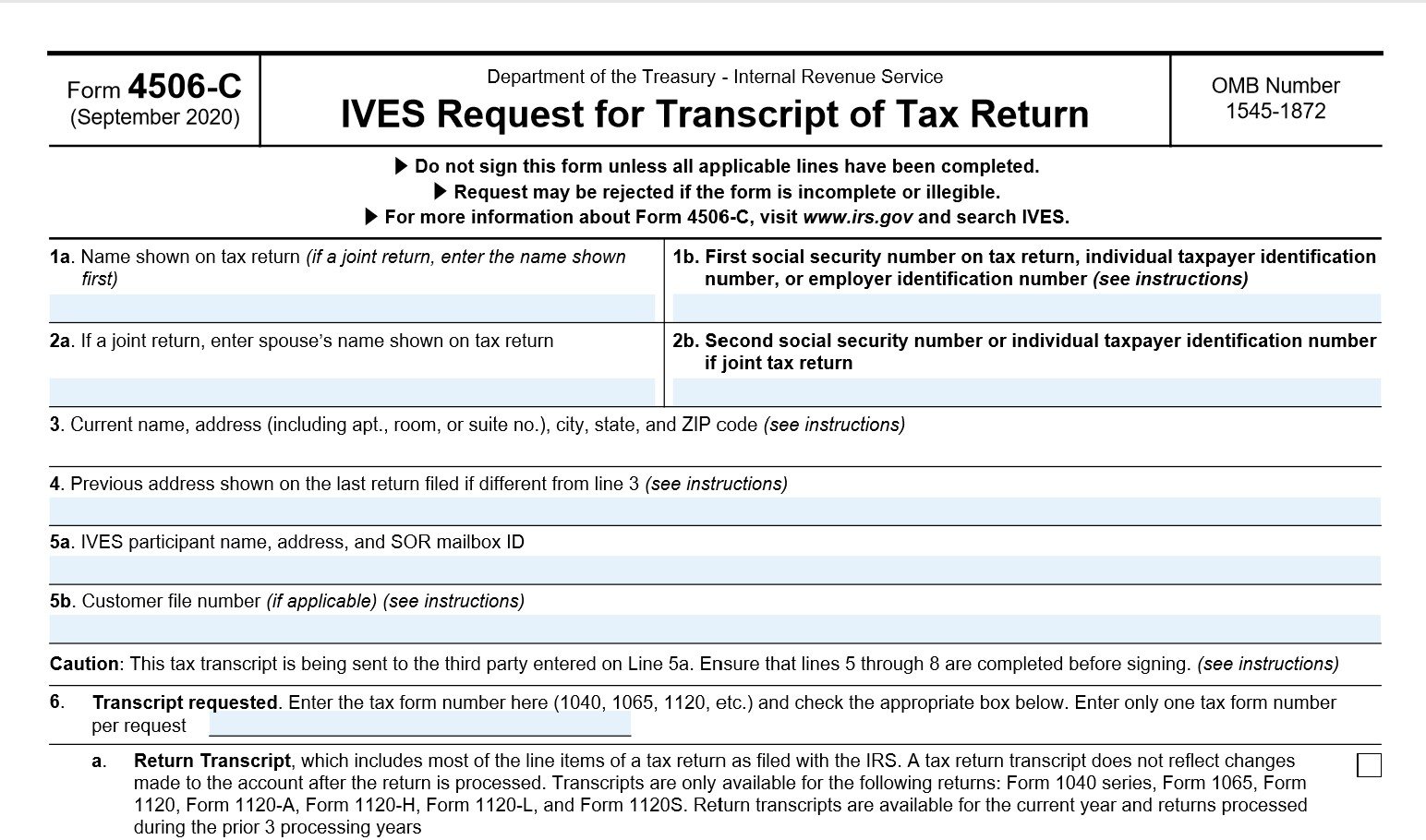
The IRS Form 4506-C PDF, officially designated as the IVES Request for Transcript of Tax Return, is a standardized document utilized by authorized third parties to request taxpayer transcripts directly from the Internal Revenue Service. It serves as an indispensable tool in modern lending, legal, and financial verification workflows, allowing institutions to securely validate income and tax history with the explicit consent of the taxpayer.
Understanding IRS Form 4506-C: What It Is and Why It Matters
Navigating financial transactions often requires proving income and tax history to lenders, government agencies, or legal representatives. The IRS Form 4506-C is the primary mechanism that enables this verification process safely, efficiently, and with the taxpayer's strict authorization.
What Is Form 4506-C?
Form 4506-C is a standardized IRS document titled "IVES Request for Transcript of Tax Return." IVES stands for Income Verification Express Service, a secure electronic platform operated by the IRS that allows certified third-party participants to pull tax transcripts on behalf of applicants. Unlike older or alternative forms that rely on traditional mail or slower processing queues, Form 4506-C is designed specifically for digital processing through authorized IVES participants.
The form itself is a legally binding consent instrument. By signing it, an individual or business authorizes the IRS to disclose specific tax return data to a designated third party, such as a mortgage lender, a financial institution, or a housing authority. It protects taxpayer privacy by ensuring that no data is released without explicit, verifiable permission.
The Evolution from Form 4506-T
For many years, lenders and financial institutions utilized IRS Form 4506-T (Request for Transcript of Tax Return) for income verification. However, the IRS phased out Form 4506-T in favor of Form 4506-C to streamline operations through the modern IVES platform and enhance fraud prevention measures.
While both forms accomplish a similar goal—requesting tax transcripts—Form 4506-C is optimized for the technological architecture of IVES vendors. It features updated formatting, clearer data fields for validation, and stricter compliance requirements for third-party submitters. Lenders and institutions that previously used 4506-T transitioned to 4506-C to maintain compatibility with updated IRS processing rules.
Primary Purpose in Lending and Finance
The dominant use case for Form 4506-C is mortgage underwriting. When a borrower applies for a home loan, lenders must verify that the income stated on the loan application matches the income reported to the federal government.
Rather than relying solely on self-reported W-2s, 1099s, or tax returns that could theoretically be altered, lenders use Form 4506-C to pull official IRS tax transcripts directly from the source. This protects financial institutions from mortgage fraud, satisfies secondary market guidelines (such as those established by Fannie Mae and Freddie Mac), and ensures compliance with federal lending standards.
Key Use Cases and Scenarios
While mortgage underwriting is the most frequent application, Form 4506-C is deployed across several distinct industries where income verification is paramount. Understanding these applications clarifies why the form is requested and how the data is utilized.
Mortgage Underwriting and Refinancing
In the real estate sector, home purchases and refinances almost universally require a signed Form 4506-C. Underwriters compare the tax transcripts obtained through the IVES system against the borrower’s tax returns submitted during the loan application process. Any discrepancy in Adjusted Gross Income (AGI), self-employment earnings, or business deductions triggers a secondary review to ensure the borrower meets debt-to-income (DTI) ratio requirements.
Small Business and Commercial Lending
Commercial lenders, banks, and the Small Business Administration (SBA) require Form 4506-C when evaluating business loans, lines of credit, or equipment financing. For business applicants, lenders typically request transcripts of corporate or partnership tax returns (such as Form 1120, 1120-S, or 1065) alongside personal returns to evaluate the holistic financial health and cash flow of the enterprise.
Student Loan Rehabilitation and Income-Driven Repayment
Federal and private student loan servicers occasionally use income verification protocols aligned with tax transcript requests to determine eligibility for income-driven repayment (IDR) plans or loan rehabilitation programs. This ensures that monthly payment calculations accurately reflect the borrower's current financial capacity.
Legal, Tax Resolution, and Forensic Accounting
Tax professionals, enrolled agents, and certified public accountants (CPAs) representing clients before the IRS often utilize transcript requests to uncover missing filing history, audit details, or account balances. Furthermore, in legal proceedings involving divorce, child support calculations, or bankruptcy, courts may order parties to execute a Form 4506-C to establish true taxable income.
Anatomy of the Form: Fields and Requirements
Completing Form 4506-C correctly is critical. The IRS and IVES vendors enforce strict rejection policies; even a minor typographical error or an outdated revision date can cause the request to be rejected, delaying loan closing dates or financial evaluations.
Breakdown of Form Sections
The form is structured into specific blocks that must be filled out precisely according to IRS instructions:
- Lines 1a–1b: Taxpayer Identification Information. For individuals, this requires the primary taxpayer's name and Social Security Number (SSN). For joint returns, Line 2 captures the spouse's information.
- Lines 2a–2b: Current Name and Address. If the taxpayer has moved or changed their name since filing the tax return in question, the current details must be supplied here.
- Line 3: Previous Address. Required if the address on the requested tax return differs from the address entered on Line 2.
- Line 4: Customer File Number. Often populated by the lender or third party with a unique loan or tracking number to match the returned transcript to the correct file.
- Line 5: Third-Party Permitted Recipient. Lists the name, address, and IVES participant identifier of the company authorized to receive the transcripts.
- Line 6: Transcript Type Requested. Checkboxes allow the selection of various transcript types, such as Tax Return Transcripts, Tax Account Transcripts, Record of Account, W-2, and 1099 transcripts.
- Line 7: Year or Period Requested. Specifies the exact tax years or periods required (e.g., matching the immediate past two tax years).
| Transcript Type | Common Application | Data Included |
|---|---|---|
| Tax Return Transcript | Mortgage underwriting, loan origination | Most line items from the original tax return as filed, including schedules. |
| Tax Account Transcript | IRS audit defense, tax resolution | Basic data plus payment history, penalties, adjustments, and balance due. |
| Record of Account | Comprehensive financial review | Combines the tax return transcript and tax account transcript into a single document. |
| W-2 / 1099 Transcript | Income verification for non-filers or gig workers | Information returns filed by employers or payers reporting earnings. |
Signatures and Execution Rules
The most stringent requirement of Form 4506-C involves the signature block. The form must be signed and dated by the taxpayer(s) listed on Line 1 (and Line 2, if filing jointly).
- Tax Year Alignment: The signature date must be within 120 days of submission to the IVES system in most lending contexts.
- Capacity and Power of Attorney: If signing on behalf of a corporation, estate, or trust, the signer must explicitly state their title (e.g., CEO, Executor) and attach documentation proving their legal authority, such as a Form 2848 or corporate resolution.
- Wet Signatures vs. Electronic Signatures: Lenders and IVES participants maintain specific policies regarding digital signatures. While many accept secure electronic signature platforms (such as DocuSign or Adobe Sign) provided they include a verifiable audit trail, certain institutional investors or loan programs may require wet ink signatures.
Step-by-Step Guide to Accessing and Completing the Form
Obtaining, filling out, and submitting Form 4506-C follows a structured pathway. Because consumers rarely submit this form directly to the IRS—rather, it is handled through a lender or mortgage processor—the workflow requires close coordination between the applicant and the requesting institution.
1. Obtaining the Correct PDF
Always ensure you are using the most current, unalterable PDF version of Form 4506-C supplied directly by your lender, IVES vendor, or the official IRS website (irs.gov). Using outdated revisions or third-party template sites that alter form fields will result in immediate rejection by IRS processing systems.
2. Reviewing Pre-Filled Data
In many digital lending environments, the lender pre-fills specific sections of the form—such as Line 5 (Third-Party Recipient details) and Line 6 (Transcript Type required). Review these pre-filled fields to ensure accuracy before providing your personal information.
3. Entering Taxpayer Data
Fill out your personal identification data meticulously:
- Verify that your Social Security Number or Employer Identification Number (EIN) contains no transposition errors.
- Ensure your name matches the name appearing on your Social Security card and the tax return filed for the requested year.
- Double-check street addresses, including apartment or suite numbers.
4. Selecting the Correct Transcript Years
Coordinate with your loan officer or financial advisor to determine exactly which tax years are required. For a standard mortgage application in 2026, lenders typically request the two most recent tax years (e.g., 2024 and 2025). Ensure the checkboxes for the corresponding ending dates (formatted as MM/DD/YYYY) are accurately completed.
5. Execution and Submission
Sign and date the form. Return the executed PDF to your lender or mortgage processor through their secure portal. Never transmit completed tax documents or signed IRS consent forms via unsecured email, as they contain sensitive personally identifiable information (PII).
Common Pitfalls and Troubleshooting
Form rejections can stall real estate transactions, business loans, and financial audits. Recognizing common errors helps ensure that your document clears processing on the first attempt.
Frequent Causes of IRS Rejection
- Signature Discrepancies: Signing a name differently than it appears on the tax return, or failing to include a joint filer's signature on a married-filing-jointly return.
- Outdated Revision Dates: Using an older version of the form where IRS guidelines, OMB control numbers, or IVES compliance disclosures have been updated.
- Altered or Unsecured PDFs: Submitting a form that has been scanned at poor resolution, contains handwritten cross-outs, or utilizes correction fluid (white-out). The IRS rejects altered physical documents.
- Mismatched Addresses: Entering a current address on Line 2 that does not match IRS records, without properly documenting the prior address on Line 3.
How Lenders Handle Rejections
When an IRS processing center rejects a Form 4506-C, the IVES vendor notifies the lender's processing department with an error code. The lender will then reach out to the borrower to execute a corrected form. To minimize delays, borrowers should respond immediately to requests for re-signing or clarifying documentation.
Frequently Asked Questions
Can I submit a Form 4506-C to the IRS myself?
No. Form 4506-C is specifically engineered for the Income Verification Express Service (IVES) program, which is restricted to certified third-party participants, lenders, and financial institutions. If an individual taxpayer needs their own tax transcripts for personal records, they should use the online "Get Transcript" tool on the official IRS website or submit Form 4506 instead.
How long does it take for the IRS to process a Form 4506-C?
When submitted electronically through the IVES platform by an authorized participant, tax transcripts are typically returned within 24 to 48 hours. However, peak tax season volumes or system maintenance can occasionally extend processing times.
Does signing Form 4506-C give the lender access to my future tax returns?
No. Form 4506-C authorizes the disclosure of specific tax years or periods explicitly requested on the form. It is a one-time consent agreement for the designated historical periods and does not grant perpetual or future access to upcoming tax filings.
Is my personal data secure when signing this form?
Yes, provided it is handled through secure channels. Authorized lenders and IVES participants are bound by strict federal privacy regulations, including the Gramm-Leach-Bliley Act (GLBA), requiring encrypted transmission and secure storage of sensitive consumer financial data.
What should I do if I didn't file a tax return for the requested year?
If you were not required to file or have not yet filed a tax return for a requested year, the IRS will return a "Verification of Non-Filing Letter" through the IVES system. Inform your lender immediately if a non-filing status applies to avoid underwriting delays.
Next Steps for Borrowers and Applicants
If you have been asked to complete an IRS Form 4506-C PDF, your primary action is to review the document provided by your financial institution for completeness. Verify that your personal identifiers, SSN, and requested tax years are correct before signing. Always return the executed document through the institution's secure client portal rather than standard email. For additional guidance on tax transcripts and federal verification standards, consult the official guidelines published on IRS.gov.