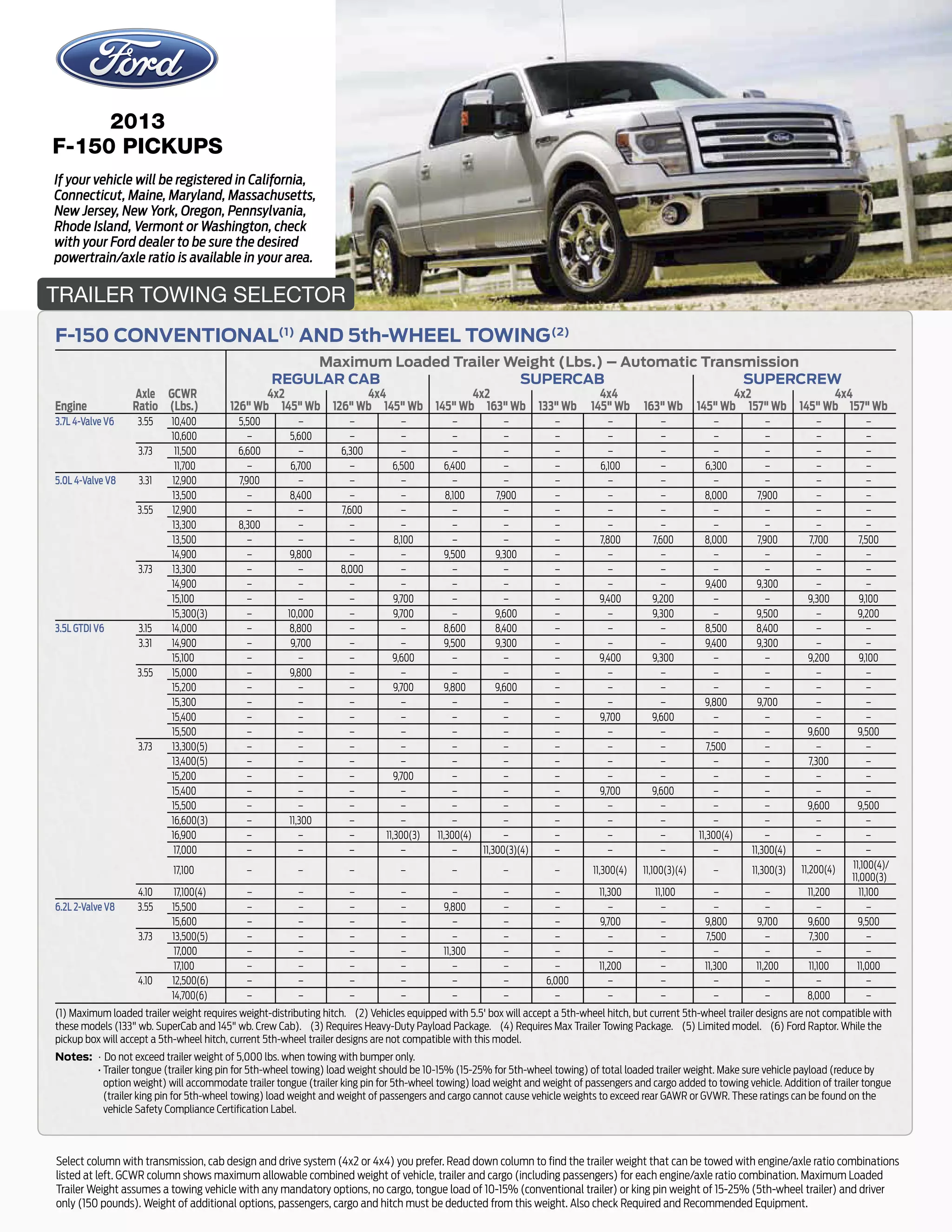
The 2018 Ford F-150 towing capacity ranges from a modest 5,000 pounds up to an impressive 13,200 pounds, depending entirely on the chosen engine, axle gear ratio, wheelbase, and whether the truck is equipped with the vital Trailer Tow Package or Max Trailer Tow Package.
Understanding the true capability of the 2018 Ford F-150 requires looking past maximum marketing numbers and examining the specific configuration of your truck. For the 2018 model year, Ford introduced significant revisions to its powertrain lineup, including a brand-new 3.3-liter V6 base engine, a refined 2.7-liter EcoBoost V6, an updated 5.0-liter Coyote V8, a high-output 3.5-liter EcoBoost V6, and the introduction of a 3.0-liter PowerStroke V6 Turbo Diesel. These diverse engine options, combined with a 10-speed automatic transmission (standard on most trims) and a high-strength military-grade aluminum-alloy body, create a wide spectrum of payload and towing capabilities.
Decoding the 2018 F-150 Powertrain Lineup and Towing Capabilities
To maximize your towing safety and efficiency, you must match your trailer's weight and tongue weight to the exact mechanical specifications of your truck. Each engine option in the 2018 F-150 lineup behaves differently under a heavy load, offering distinct advantages in horsepower, torque delivery, and fuel economy.
1. 3.3L Ti-VCT V6
Replacing the old 3.5-liter naturally aspirated V6, the 3.3-liter engine produces 290 horsepower and 265 lb-ft of torque, mated to a 6-speed automatic transmission.
- Max Towing Capacity: Up to 7,700 pounds (when properly equipped).
- Best Suited For: Light-duty utility trailers, small pop-up campers, and standard daily driving where heavy towing is only an occasional task.
2. 2.7L EcoBoost V6 (Second Generation)
This twin-turbocharged direct-injection engine punches well above its weight class, delivering 325 horsepower and a massive 400 lb-ft of torque. It is paired with the 10-speed automatic transmission.
- Max Towing Capacity: Up to 9,000 pounds.
- Best Suited For: Mid-sized travel trailers, boat trailers, and everyday contractors who need strong low-end torque without stepping up to a larger displacement engine.
3. 5.0L Ti-VCT V8
The legendary Coyote V8 received port and direct injection for 2018, bumping output to 395 horsepower and 400 lb-ft of torque, managed by the 10-speed automatic transmission.
- Max Towing Capacity: Up to 11,600 pounds.
- Best Suited For: Traditionalists who prefer naturally aspirated V8 power delivery, heavy livestock trailers, and heavy-duty utility equipment.
4. 3.5L EcoBoost V6 (High Output and Standard)
The undisputed heavyweight champion of the 2018 F-150 lineup produces 375 horsepower and 470 lb-ft of torque (or 450 hp and 510 lb-ft in the Raptor). Mated to the 10-speed automatic, this engine delivers maximum pulling power.
- Max Towing Capacity: Up to 13,200 pounds (when equipped with the Max Trailer Tow Package on SuperCrew 4x2 or SuperCab 6.5-foot box models).
- Best Suited For: Large travel trailers, multi-horse trailers, and heavy toy haulers.
5. 3.0L PowerStroke V6 Turbo Diesel
Late in the 2018 model year, Ford introduced the diesel option, generating 250 horsepower and 440 lb-ft of torque at a low 1,750 RPM, paired with the 10-speed automatic.
- Max Towing Capacity: Up to 11,400 pounds.
- Best Suited For: Long-distance towers seeking exceptional highway fuel economy while hauling moderate-to-heavy loads.
2018 Ford F-150 Towing Specifications Overview
| Engine Option | Transmission | Horsepower | Torque (lb-ft) | Max Towing Capacity (lbs) | Max Payload Capacity (lbs) |
|---|---|---|---|---|---|
| 3.3L V6 | 6-Speed Auto | 290 @ 6,500 RPM | 265 @ 4,000 RPM | 7,700 | 1,990 |
| 2.7L EcoBoost V6 | 10-Speed Auto | 325 @ 5,000 RPM | 400 @ 2,750 RPM | 9,000 | 2,470 |
| 5.0L V8 | 10-Speed Auto | 395 @ 5,750 RPM | 400 @ 4,500 RPM | 11,600 | 3,270 |
| 3.5L EcoBoost V6 | 10-Speed Auto | 375 @ 5,000 RPM | 470 @ 3,500 RPM | 13,200 | 3,230 |
| 3.0L PowerStroke Diesel | 10-Speed Auto | 250 @ 3,250 RPM | 440 @ 1,750 RPM | 11,400 | 2,020 |
Note: Maximum towing capacities assume a base vehicle with mandatory tow packages and specific axle ratios. Adding luxury trim packages, heavy 4x4 systems, and panoramic sunroofs adds weight, thereby reducing your maximum available payload and towing capacity.
Crucial Towing Equipment Packages for the 2018 F-150
A common mistake made by truck owners is assuming that because an F-150 has a powerful engine, it can automatically tow the maximum rating listed in the brochure. In reality, physical towing capacity is strictly governed by optional equipment groups.
Trailer Tow Package (53A)
This package is required if you plan to pull trailers exceeding standard bumper-pull limits (typically 5,000 pounds). It includes:
- 4-pin and 7-pin wiring harness
- Class IV trailer hitch receiver
- Smart Trailer Tow Connector
- Upgraded front stabilizer bar
- Pro Trailer Backup Assist (on select trims)
- Auxiliary transmission oil cooler and radiator upgrades (engine dependent)
Max Trailer Tow Package (53C)
Available exclusively on the 3.5L EcoBoost V6 engine, this is the definitive package required to reach the legendary 13,200-pound maximum towing ceiling. It adds:
- 3.31 Electronic-locking rear axle (or 3.55 depending on configuration)
- 4-pin and 7-pin wiring harness
- 36-gallon extended-range fuel tank
- Class IV trailer hitch receiver
- Smart Trailer Tow Connector
- Higher-capacity radiator and upgraded cooling fan
- Upgraded front stabilizer bar
- Pro Trailer Backup Assist with dynamic hitch assist
- Trailer brake controller integrated into the dashboard
Understanding Payload vs. Towing Capacity
Many drivers focus entirely on gross trailer weight while ignoring payload capacity, which is often the first limit you will exceed. Payload is the total weight of passengers, cargo, fuel, accessories, and the tongue weight of the trailer combined.
You can find your specific truck's exact payload capacity by checking the yellow and white Tire and Loading Information safety sticker located on the driver-side door jamb.
How to Calculate Real-World Limits:
- Find Payload Capacity: Locate the yellow sticker on your door jamb (e.g., "The combined weight of occupants and cargo should never exceed 1,800 lbs").
- Subtract Passengers and Cargo: Weigh all passengers, luggage, aftermarket bed liners, toolboxes, and equipment added to the cab and bed.
- Calculate Tongue Weight: A properly loaded conventional trailer places 10% to 15% of its total weight onto the truck’s hitch receiver as tongue weight.
- Verify Total Weight: Ensure your remaining payload capacity exceeds your total calculated tongue weight. If it does not, you are exceeding the legal and mechanical limits of your truck, regardless of what your engine can pull.
Essential Towing Technology Features on the 2018 F-150
The 2018 model year introduced advanced driver-assistance technologies designed to make towing safer and less stressful:
- Pro Trailer Backup Assist: This system allows the driver to steer the trailer in reverse using a small control knob on the dashboard while the truck automatically manages the steering wheel. To use it, you must apply specific calibration stickers to the trailer tongue during initial setup.
- Integrated Trailer Brake Controller (ITBC): Seamlessly integrated into the dashboard, this factory controller applies smooth, proportional braking to the trailer's electric brakes based on the truck's deceleration data.
- BLIS (Blind Spot Information System) with Cross-Traffic Alert and Trailer Coverage: When properly configured in the truck's productivity screen with your trailer's length entered, the blind spot sensors extend their radar range to cover the length of the trailer.
- Dynamic Hitch Assist: A camera guideline displayed on the 8-inch SYNC 3 infotainment screen that features a centerline to help you line up your receiver ball with the trailer coupler on the first try without a spotter.
Step-by-Step Guide to Hooking Up and Towing Safely
- Verify Your Weights: Confirm that your trailer's Gross Vehicle Weight Rating (GVWR) does not exceed your truck's maximum towing capacity, and that your tongue weight fits within your payload limit.
- Inspect the Hitch and Coupler: Ensure the hitch ball matches the coupler size (typically 2-inch or 2-5/16-inch). Check that the ball mount pin and safety clip are securely locked in place.
- Connect Safety Chains: Cross the safety chains under the trailer tongue in an "X" pattern to form a cradle that will catch the tongue if it separates from the ball. Ensure they have enough slack for turning, but will not drag on the pavement.
- Plug in Electrical Connections: Insert the 7-way or 4-pin plug. Twist to lock it securely to prevent it from vibrating loose during transit.
- Test All Lights and Brakes: Verify that running lights, brake lights, turn signals, and electric trailer brakes are fully operational. Use the manual slide lever on the integrated trailer brake controller to test the trailer brakes independently.
- Adjust Mirrors and Select Drive Modes: Adjust your towing mirrors outward. Rotate the drive mode selector on the shifter or dash to Tow/Haul Mode. This alters shift points to keep the engine in its optimal power band, reduces frequent gear hunting, and utilizes engine braking on downhills.
- Use Weight-Distribution Systems When Necessary: For conventional trailers weighing over 5,000 pounds, utilize a properly adjusted weight-distribution hitch with sway control to distribute tongue weight evenly across all four axles of the truck and trailer.
Frequently Asked Questions
Can a 2018 Ford F-150 with the 2.7L EcoBoost tow a travel trailer?
Yes, absolutely. With a maximum towing capacity of up to 9,000 pounds when properly equipped, the 2.7L EcoBoost easily handles most mid-sized travel trailers and camping setups. Its low-end torque delivery makes climbing grades effortless, though you must still monitor your payload and tongue weight carefully.
What is the difference between the 5.0L V8 and 3.5L EcoBoost for towing?
While both engines offer high towing capabilities (11,600 lbs for the V8 and 13,200 lbs for the EcoBoost), they deliver power differently. The 3.5L EcoBoost develops 470 lb-ft of torque at a low 3,500 RPM, making it feel effortless when pulling heavy loads up steep inclines at altitude. The 5.0L V8 produces its peak torque at a higher 4,500 RPM, requiring higher engine speeds to achieve maximum pulling power, but appeals to drivers preferring traditional V8 power delivery.
Do I need a weight-distribution hitch for my 2018 F-150?
Ford recommends using a weight-distribution hitch for any conventional trailer weighing over 5,000 pounds. This device redistributes the heavy tongue weight from the rear axle back to the front axle and the trailer wheels, restoring proper steering control, braking efficiency, and headlight alignment.
How do I activate Trailer Coverage in the 2018 F-150 blind spot system?
Using the steering wheel controls, navigate to the productivity screen on your dashboard. Select "Tow/Haul," then "Trailer Setup," and choose or add your trailer profile. Enter the exact length of the trailer when prompted. The BLIS radar sensors will automatically recalibrate their zones to account for the added length of your towed equipment.
Where is the factory trailer brake controller located on a 2018 F-150?
The factory-integrated trailer brake controller is located on the right side of the steering wheel on the center instrument panel, just below the 4WD selector knob (if equipped). If your truck has a coin tray or blank plastic panel in this location, it was manufactured without the factory tow package, and you will need to install an aftermarket unit if you plan to pull trailers with electric brakes.
Final Recommendation and Next Actions
Before hooking up any heavy load to your 2018 Ford F-150, locate the safety certification sticker on your driver's door jamb to verify your specific payload capacity. Cross-reference your VIN with a local Ford dealership or check your owner's manual to confirm your exact axle ratio and installed towing packages. If your truck lacks the integrated trailer brake controller or heavy-duty cooling upgrades, limit your towing weights to lighter utility trailers or invest in professional aftermarket auxiliary equipment to protect your transmission, engine, and braking components before hitting the highway.