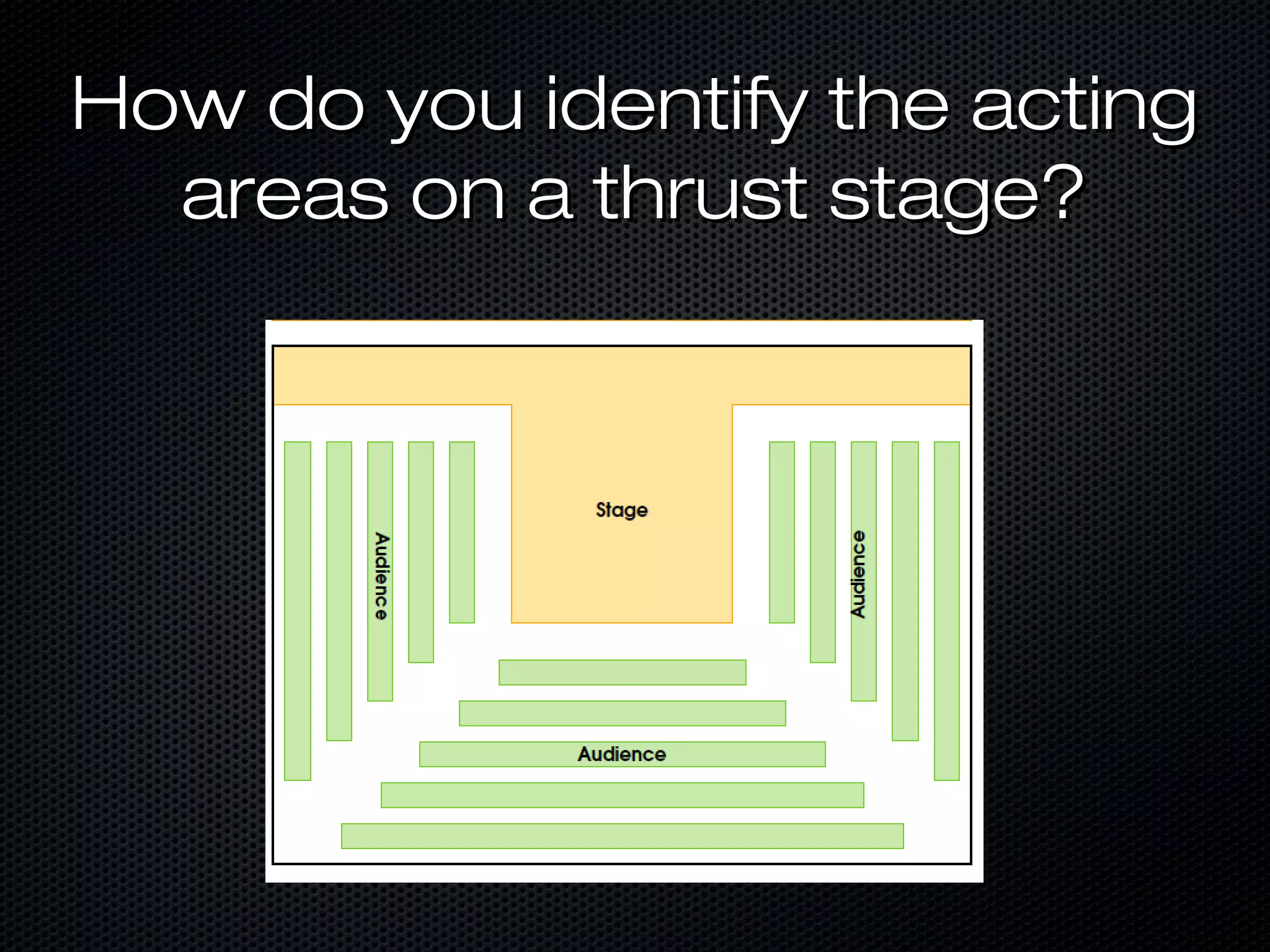
The areas of the stage are defined by a standardized system of directional terminology based on the performer’s perspective while standing at center stage and facing the audience. This grid, often referred to as stage geography, allows directors, designers, and performers to communicate movement, set placement, and lighting cues with precision, ensuring consistency across theaters of any size.
The Foundation of Stage Geography
The modern proscenium stage is rooted in a system that relies entirely on the actor’s point of view. By adopting this standard, a performer in London, New York, or a community theater in a small town can immediately understand a director’s instruction to "move stage left" or "enter upstage right." Because the audience remains stationary, the stage is divided into nine primary zones, creating a reliable map for blocking—the precise movement and positioning of actors.
This system is divided into three vertical segments (Upstage, Center, Downstage) and three horizontal segments (Stage Left, Center, Stage Right). When combined, these form the nine-part grid that serves as the universal language of theatrical production.
Defining the Horizontal and Vertical Axes
To master stage geography, you must first understand the two primary axes: the vertical (Depth) and the horizontal (Width).
The Vertical Axis: Upstage vs. Downstage
The terms "upstage" and "downstage" are historical holdovers from the days of "raked" or sloped stages. Centuries ago, stages were built on an incline, with the rear of the stage physically higher than the front to improve audience sightlines.
- Downstage: The area closest to the audience. In a sloped stage era, this was the lowest point.
- Upstage: The area furthest from the audience. This was the highest point.
- Center Stage: The midpoint between the front edge of the stage (the apron) and the back wall.
The Horizontal Axis: Stage Left vs. Stage Right
Horizontal orientation is strictly defined by the performer's perspective.
- Stage Left: The performer's left side when they are facing the audience.
- Stage Right: The performer's right side when they are facing the audience.
- Center Stage: The vertical line running down the exact middle of the acting area.
It is critical to note that the audience’s perspective is the exact opposite. When a director says "move stage left," the audience sees the actor moving toward their own right. This distinction is the most common point of confusion for beginners, but it remains the industry standard to prevent catastrophic errors in choreography and lighting design.
The Nine-Zone Grid
When you overlay these axes, you create the nine zones that directors use for blocking. Understanding these is essential for maintaining proper focus and composition on stage.
- Upstage Right (UR): The area furthest from the audience and to the performer's right.
- Upstage Center (UC): The area furthest from the audience, located on the center line.
- Upstage Left (UL): The area furthest from the audience and to the performer's left.
- Center Right (CR): The midpoint between upstage and downstage, on the right side.
- Center Stage (CS): The absolute middle of the acting area.
- Center Left (CL): The midpoint between upstage and downstage, on the left side.
- Downstage Right (DR): The area closest to the audience and to the performer's right.
- Downstage Center (DC): The area closest to the audience on the center line.
- Downstage Left (DL): The area closest to the audience and to the performer's left.
Comparison of Stage Areas and Tactical Use
The following table outlines how different areas of the stage are typically utilized in theatrical productions to influence the audience's perception of power, intimacy, and visibility.
| Stage Area | Relative Visibility | Emotional Impact | Common Tactical Use |
|---|---|---|---|
| Downstage Center | Highest | Intimate/Powerful | Soliloquies, climactic moments |
| Downstage Right/Left | Very High | Direct Connection | Addresses to the audience |
| Center Stage | High | Neutral/Balanced | Core ensemble interaction |
| Upstage Right/Left | Moderate | Distant/Mysterious | Entrances, secondary action |
| Upstage Center | Low | Isolated/Grand | Theatrical reveals, entrances |
Specialized Areas Beyond the Nine Zones
While the nine-zone grid covers the main acting space, professional theaters often incorporate additional areas that require specific terminology.
- The Apron: This is the extension of the stage that protrudes beyond the proscenium arch, closer to the audience than the downstage edge. Performers often use the apron for intimate moments or direct interaction with the front row.
- The Wings: These are the spaces off-stage to the left and right. They are used for storage of scenery and as waiting areas for actors before they enter. It is vital for actors to keep these areas quiet, as sound carries easily from the wings to the audience.
- The Backstage: Any area behind the scenery or beyond the stage house walls. This includes dressing rooms, green rooms, and crossovers.
- Crossover: A specific pathway behind the stage, hidden from the audience, that allows actors to move from stage left to stage right without being seen.
The Importance of Stage Orientation for Lighting and Sound
Technical crews rely on the same grid to plot lighting and sound. Lighting designers create "washes" or specific "specials" (focused beams of light) that are plotted to the nine zones. If a lighting plot labels an area as "Downstage Right," the technician knows exactly where to aim the fixture to highlight the actor standing in that specific zone.
Similarly, sound designers use stage geography to balance audio reinforcement. If a sound cue is triggered for a character in Upstage Left, the audio levels in the monitor speakers near that area are adjusted to ensure the actor's voice is heard clearly while maintaining a natural acoustic blend with the rest of the performance.
Common Pitfalls and How to Avoid Them
The most frequent mistake made by new actors and stage managers is "flipping" left and right. Remember that the stage does not care where the audience is sitting; the stage is a self-contained world.
- Never Use House Left/Right: Avoid using terms like "House Left" unless you are specifically referring to the audience seating area. House Left refers to the left side of the auditorium from the perspective of the audience looking at the stage. Using this interchangeably with Stage Left will lead to confusion during technical rehearsals.
- Maintaining the Perspective: Always establish your position relative to the audience as your starting point. If you are standing at the very back of the stage (Upstage) and you turn to face the rear wall, your stage left remains exactly where it was before you turned. The stage grid is fixed to the floor of the building, not to the actor's orientation at any given moment.
- Blocking Notation: When writing down blocking in a script, use shorthand. "DC" stands for Downstage Center, "UR" for Upstage Right. This efficiency allows you to record complex movements quickly while the director is talking.
Practical Tips for Stage Movement
When navigating the stage, your body language should reflect the geography. If you are moving Upstage, you are physically moving away from the audience, which can make you appear smaller. To compensate, actors often use more expressive gestures or adjust their posture to remain visible. Conversely, moving Downstage brings you closer to the audience, which naturally commands more focus and intimacy.
Performers should also be mindful of "masking." Masking occurs when an actor inadvertently stands in front of another actor or a piece of scenery from the perspective of the audience. By understanding the stage grid, you can ensure you are not blocking another performer’s light or visibility. If you notice you are "upstaging" someone—standing in a way that forces them to turn their back to the audience to speak to you—you should adjust your position immediately to balance the scene.
Summary of Best Practices
- Consistency: Always use the standard grid. Never invent personal shorthand with your cast or crew.
- Clarity: In the heat of a rehearsal, keep directions brief (e.g., "Cross to DC").
- Perspective: Remember that the stage is defined by the actor facing the audience.
- Professionalism: Maintain awareness of the wings and crossover areas; these are strictly controlled zones that keep the magic of the performance hidden from the audience.
By mastering the areas of the stage, you gain the vocabulary necessary to function effectively in any professional or community theater environment. Whether you are an actor working on your blocking or a technician plotting the next lighting cue, this standardized system is the bedrock of theatrical success.
Frequently Asked Questions
Why is it called "Upstage" if it is at the back of the stage? It is called Upstage because, historically, the back of the stage was elevated on an incline (the rake). Actors walking toward the back were literally walking "up" a hill. While most modern stages are flat, the terminology remains standard.
What is the best way to practice stage geography? Draw a grid on a piece of paper and mark the nine zones. Practice walking through a script, reciting the position of characters for every line. Muscle memory combined with mental visualization will make these terms second nature during rehearsals.
Can I use "House Left" when directing actors? It is generally advised against. Use "Stage Right" and "Stage Left" for all movement on the stage. Reserve "House Left" and "House Right" strictly for front-of-house operations, such as lighting the audience or sound checks in the seating area, to avoid confusion.
How do I handle a "thrust" or "in-the-round" stage? Proscenium geography is specifically designed for stages where the audience is on one side. On thrust or in-the-round stages, directors often switch to "clock" terminology (e.g., "move to 12 o'clock") or identify areas by the audience sections (e.g., "move toward the north section"). Always clarify the system being used before the first rehearsal.
What should I do if I forget which way is Stage Left? Stand at center stage, face the audience, and imagine you are the performer. Your left hand is Stage Left. If you are backstage, find the center line of the stage floor—most professional stages have a center-line mark—and orient yourself relative to the house.
Recommendation for Future Action For those new to theater, the next logical step is to attend a technical rehearsal or observe a "blocking session" from a balcony seat. Watching how a director navigates the nine-zone grid in real time will clarify how these labels facilitate efficient, creative, and professional stage management.