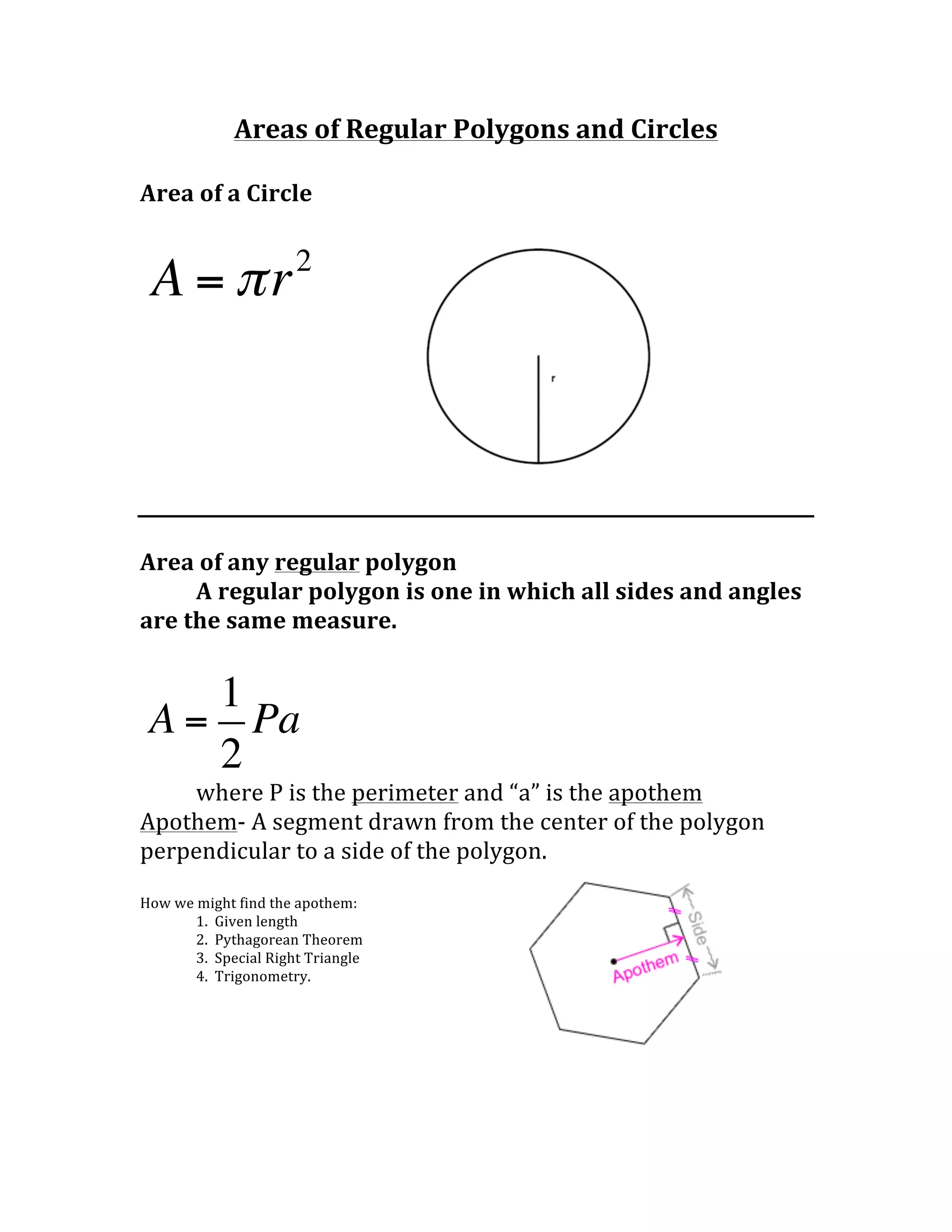
The area of a regular polygon is calculated by multiplying its perimeter by the apothem—the distance from the center to the midpoint of any side—and dividing the result by two. Expressed as the formula Area = ½ × Perimeter × Apothem, this calculation allows for the precise determination of space enclosed by any regular geometric shape, regardless of the number of sides.
Understanding Regular Polygons
Before applying any mathematical formula, it is essential to define what constitutes a regular polygon. In geometry, a polygon is a closed plane figure with at least three straight sides. For a polygon to be considered "regular," it must satisfy two specific conditions: all sides must be of equal length (equilateral), and all interior angles must be of equal measure (equiangular).
Examples of regular polygons include the equilateral triangle, the square, the regular pentagon, the regular hexagon, and so on. As the number of sides increases, the shape of the regular polygon begins to approximate a circle. Understanding this relationship helps in conceptualizing why the area formula for a polygon shares structural similarities with the formula for the area of a circle.
The Anatomy of the Area Formula
The standard formula for the area ($A$) of a regular polygon is:
$A = \frac{1}{2} \times P \times a$
In this expression, $P$ represents the perimeter of the polygon, and $a$ represents the apothem. To use this formula effectively, one must understand these two distinct components:
- The Perimeter ($P$): The perimeter is the sum of the lengths of all sides of the polygon. If a polygon has $n$ sides, each of length $s$, the perimeter is simply $P = n \times s$.
- The Apothem ($a$): This is the perpendicular distance from the center of the polygon to the midpoint of any one of its sides. The apothem is essentially the radius of the "inscribed circle" (incircle) that touches all sides of the regular polygon.
Deriving the Area from Triangles
The most intuitive way to understand why this formula works is to visualize the polygon as a collection of identical triangles. If you draw a line from the center of the polygon to each of its vertices, you partition the polygon into $n$ congruent isosceles triangles.
Each of these triangles has a base equal to the side length ($s$) of the polygon and a height equal to the apothem ($a$). The area of one such triangle is: Area of triangle = $\frac{1}{2} \times \text{base} \times \text{height} = \frac{1}{2} \times s \times a$
Since there are $n$ such triangles making up the entire polygon, the total area is: Total Area = $n \times (\frac{1}{2} \times s \times a)$
Rearranging this, since $n \times s$ is the perimeter ($P$), we arrive back at: $A = \frac{1}{2} \times P \times a$
Calculating Area When the Apothem is Unknown
In many practical scenarios, you may not be given the apothem directly. Instead, you might only know the side length ($s$) and the number of sides ($n$). In such cases, you can calculate the apothem using trigonometry.
By focusing on one of the central triangles, you can create a right-angled triangle by bisecting the isosceles triangle. The angle at the center of the polygon for this right-angled triangle is $360^\circ / (2n)$, or $\pi/n$ radians. Using the tangent function: $\tan(\frac{180^\circ}{n}) = \frac{\text{opposite}}{\text{adjacent}} = \frac{s/2}{a}$
Solving for $a$ gives: $a = \frac{s}{2 \times \tan(180^\circ/n)}$
By substituting this into the main area formula, you get an alternative version that relies only on the number of sides and the side length: $A = \frac{n \times s^2}{4 \times \tan(180^\circ/n)}$
Comparative Analysis of Area Formulas
Different geometric shapes allow for specialized versions of the area formula. While the general formula works for all, these specific versions are often more efficient for common shapes.
| Polygon | Sides ($n$) | Standard Formula ($A$) | Simplified Formula |
|---|---|---|---|
| Triangle (Equilateral) | 3 | $0.5 \times P \times a$ | $(\sqrt{3}/4) \times s^2$ |
| Square | 4 | $0.5 \times P \times a$ | $s^2$ |
| Pentagon | 5 | $0.5 \times P \times a$ | $\approx 1.720 \times s^2$ |
| Hexagon | 6 | $0.5 \times P \times a$ | $(3\sqrt{3}/2) \times s^2$ |
| Octagon | 8 | $0.5 \times P \times a$ | $2 \times (1 + \sqrt{2}) \times s^2$ |
Practical Applications
The ability to calculate the area of a regular polygon has significant applications in various fields:
- Architecture and Construction: Many floor plans, gazebo designs, and structural supports utilize hexagonal or octagonal footprints. Builders use these formulas to estimate the amount of materials required, such as flooring or roofing tiles.
- Manufacturing and Engineering: Nuts and bolts are often hexagonal. Understanding the area of these shapes is critical for determining material strength and weight during the design phase of mechanical engineering.
- Urban Planning: Land surveying often involves dividing large areas into smaller, regular polygons to estimate acreage and property boundaries accurately.
Common Mistakes to Avoid
When calculating the area, users frequently encounter errors due to the following oversights:
- Confusing Apothem with Radius: The radius of a polygon is the distance from the center to a vertex. The apothem is the distance from the center to the midpoint of a side. Using the radius in the area formula will result in a significant overestimation of the area.
- Degree vs. Radian Mode: When using the trigonometric formula for the apothem, ensure your calculator or software is set to the correct mode (Degrees or Radians) matching your input angle.
- Unit Inconsistency: Ensure that all measurements are in the same units (e.g., all in centimeters or all in inches) before starting the calculation. Mixing units without conversion is the most common cause of incorrect results.
Step-by-Step Problem Solving Strategy
To ensure accuracy, follow this logical flow when faced with a polygon area problem:
- Identify the variables: Determine how many sides ($n$) the polygon has and identify either the side length ($s$) or the apothem ($a$).
- Verify the shape: Ensure the polygon is truly "regular." If sides or angles differ, the standard formula does not apply.
- Determine the apothem: If the apothem is missing, calculate it using the trigonometric formula based on the number of sides and the side length.
- Calculate the perimeter: Multiply the number of sides by the side length.
- Compute the final area: Apply the values to the formula $A = 0.5 \times P \times a$.
- Verify units: State your answer in "square units" (e.g., square meters, square feet) to maintain mathematical accuracy.
Frequently Asked Questions
What is the difference between an apothem and a radius in a regular polygon? The apothem is the distance from the center to the midpoint of a side (forming a 90-degree angle). The radius is the distance from the center to a vertex. The radius is always longer than the apothem.
Can I use the area formula for an irregular polygon? No. The standard $A = 0.5 \times P \times a$ formula only works for regular polygons. For irregular polygons, you must use methods like the Surveyor’s Formula (Shoelace formula) or divide the shape into arbitrary triangles and sum their individual areas.
What happens to the area as the number of sides approaches infinity? As $n$ increases, a regular polygon gets closer to a circle. Consequently, the area formula for a regular polygon converges toward the area formula for a circle ($\pi \times r^2$), where the apothem becomes the radius of the circle.
Why is it sometimes easier to use the trigonometric version of the formula? If you are designing a structure in software like CAD or a spreadsheet, you may only have access to the side length. The trigonometric formula allows you to calculate the area using only the side length and the number of sides, removing the need for an intermediate apothem measurement.
Is there a way to calculate the area if I only know the circumradius (distance to vertex)? Yes. You can use the formula $A = \frac{1}{2} \times n \times R^2 \times \sin(360^\circ/n)$, where $R$ is the circumradius. This is useful when you have the distance from the center to the corner rather than to the side.
Recommendation
If you are performing these calculations for a professional project—such as architectural drafting or civil engineering—it is recommended to use a digital geometry tool or a dedicated spreadsheet template to automate the calculations. This minimizes the risk of human error in trigonometric inputs and unit conversion. For manual checks, always calculate the apothem separately and verify it is shorter than the side length before finalizing your area calculation.