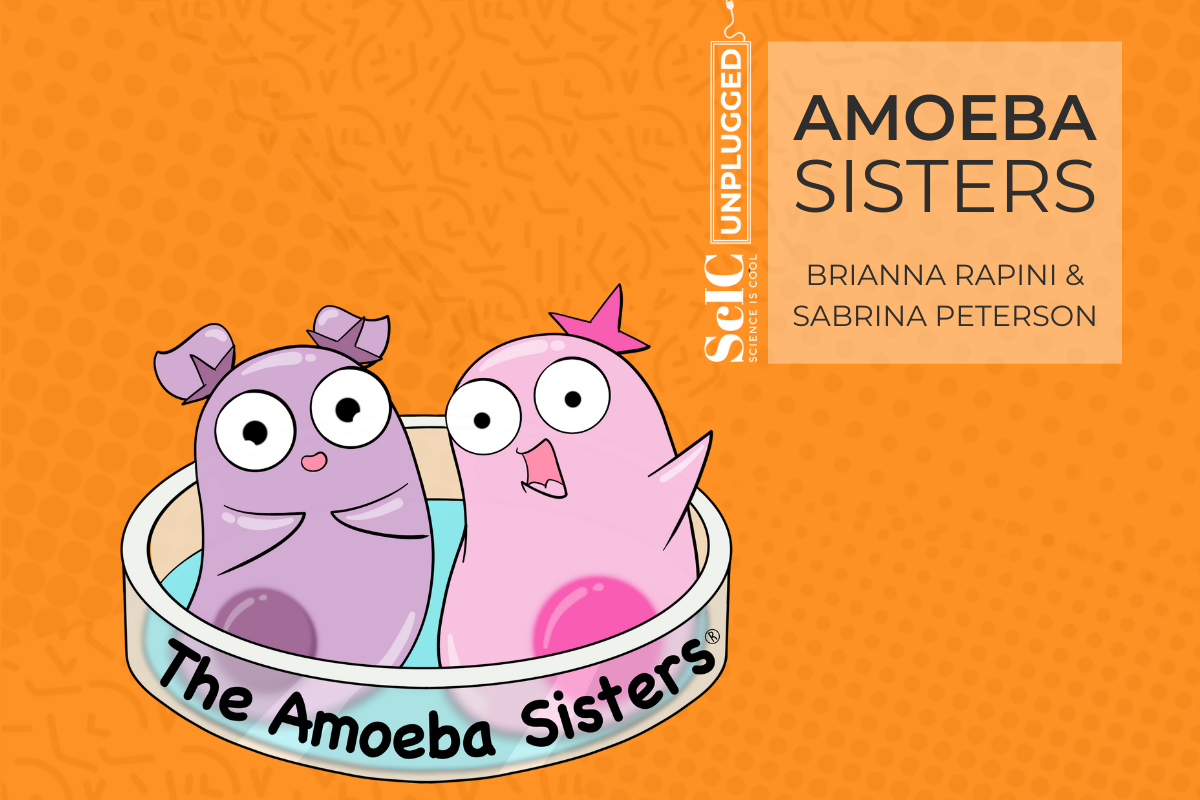
In real life, the Amoeba Sisters are two biological sisters named Brianna Rapini and Sarina Peterson. Based in Texas, Brianna is a former high school biology teacher who writes the scripts and voices the videos, while Sarina is a self-taught digital illustrator and animator who handles the artwork, visual storytelling, and channel administration.
The Real-Life Identities Behind the Characters
For millions of middle school, high school, and college students around the world, the Amoeba Sisters are personified by cute, pink-and-purple single-celled cartoon organisms that explain complex scientific concepts. However, behind the screen, the channel is driven by a real-life sister duo who combined their distinct professional expertise to transform science communication on YouTube and across educational platforms.
Brianna Rapini: The Educator, Scriptwriter, and Voice
Brianna Rapini (née Peterson) is the educational mastermind and primary voice actor behind the channel. Before turning digital science communication into a full-time endeavor, Brianna spent years working directly inside public school classrooms as a secondary science teacher.
Her classroom experience gave her direct insight into the specific topics that student audiences struggle with most, such as DNA replication, cellular respiration, protein synthesis, and Mendelian genetics. Recognizing that traditional textbook definitions often alienate visual learners, Brianna began developing simplified, analogy-driven explanations. In the real-world operation of the Amoeba Sisters, Brianna researches each topic, writes the detailed video scripts, records the voiceover tracks, and creates the companion educational handouts designed for classroom teachers.
Sarina Peterson: The Artist, Animator, and Business Strategist
Sarina Peterson is the creative engine responsible for the channel’s iconic visual style. Unlike many professional digital animators who hold formal art degrees, Sarina is largely self-taught in illustration and vector animation.
Her academic and early professional background was rooted in quantitative analysis, public policy, and business operations. When the sisters launched the project, Sarina applied her self-taught drawing skills to translate Brianna’s script concepts into hand-drawn digital assets. In addition to creating every frame, character design, and GIF used in their media, Sarina manages the channel’s operational logistics, publishing schedules, copyright management, and digital infrastructure.
The Origin Story: How the Amoeba Sisters Started
The Amoeba Sisters channel launched in July 2013. The project began not as a commercial media venture, but as a small-scale attempt to solve a common educational challenge: keeping students engaged with difficult science TEKS (Texas Essential Knowledge and Skills) and national curriculum standards.
| Amoeba Sisters Evolution |
|---|
| 2013: Channel launched with simple comic strips & short clips |
| 2015: Expansion into full topic playlists & student recap sheets |
| 2018: Widespread adoption in AP Biology & NGSS classrooms |
| 2021: Publication of graphic novels & companion study guides |
| 2026: Millions of subscribers; core standard in edtech science |
During her time as a high school science teacher, Brianna noticed that many students found standard educational videos dry, overly formal, or unnecessarily convoluted. She envisioned short, humor-infused videos that used memorable analogies—comparing cell organelles to city infrastructure or enzymes to key-making shops.
Because Brianna did not possess advanced digital drawing skills, she approached her sister Sarina to sketch custom comic panels to accompany her lessons. Initially, the duo created static comics and short slideshows. As student feedback proved overwhelmingly positive, they transitioned into full frame-by-frame digital animation and established their dedicated YouTube channel.
Over the past decade, their content library has grown from basic introductory cell concepts to advanced topics covering biotechnology, ecological succession, human anatomy, and AP Biology preparation. Despite their massive reach, the production model remains intentionally lean, keeping the core creative control strictly between the two sisters.
Educational Background and Professional Credentials
A major reason for the widespread adoption of Amoeba Sisters content in formal educational settings is the authentic academic grounding of its creators. Both sisters hold advanced degrees from established universities, allowing them to balance rigorous scientific accuracy with accessible pedagogy.
Brianna Rapini's Educational Credentials
- Bachelor of Science (B.S.) in Biology: Earned from Texas A&M University. This degree provided her foundational training in genetics, microbiology, botany, and zoology.
- Master of Education (M.Ed.) in Educational Administration: Earned from Lamar University. Her graduate studies focused on curriculum design, instructional leadership, and educational psychology.
- Teaching Certification: Former certified Texas high school science educator with classroom teaching experience in biology and environmental science.
Sarina Peterson's Educational Credentials
- Bachelor of Arts (B.A.) in Social Science: Earned from the University of Texas at Tyler.
- Master of Science (M.S.) in Public Policy and Management: Earned from Carnegie Mellon University. Her program emphasized data analysis, policy design, quantitative methodologies, and organizational management.
- Digital Media & Animation: Self-taught proficiency in Adobe Creative Cloud (including Adobe Animate, Illustrator, and Premiere Pro), vector graphics creation, and educational media production.
Behind the Scenes: How an Amoeba Sisters Episode Is Made
Understanding the Amoeba Sisters in real life requires examining their meticulous content production pipeline. Producing a single 7-to-10-minute animated science video requires weeks of research, scripting, illustration, audio synchronization, and resource preparation.
- Research & Scripting
- Audio Recording & Editing
- Storyboarding & Animation
- Video Rendering & QA
- Worksheet & Web Launch
1. Topic Selection and Curriculum Alignment
Brianna identifies topic requests from secondary school educators and aligns them with standard frameworks like the Next Generation Science Standards (NGSS) and Advanced Placement (AP) Biology guidelines. Topics range from foundational cell theory to intricate biochemical pathways like oxidative phosphorylation.
2. Scriptwriting and Analogy Construction
Brianna drafts the script, carefully structuring it to address common student misconceptions. Key scientific terms (such as homeostasis, hypertonic, or transcription factors) are bolded and defined on-screen. She integrates humor, pun-based jokes, and real-world analogies to make abstract microscopic processes tangible.
3. Voice Recording and Audio Editing
Once the script is finalized, Brianna records the voiceover using professional audio capturing tools and vocal editing software like Audacity or Adobe Audition. The audio is edited to maintain an upbeat, steady pacing suitable for English language learners and diverse student learning speeds.
4. Storyboarding and Digital Animation
Sarina takes the audio track and designs custom visual storyboards. Using digital drawing tablets and vector graphics software, she draws every character asset, organelle model, and animated movement. The signature aesthetic features bright pastel palettes, expressive character faces, and clear graphic callouts for technical vocabulary.
5. Educational Handouts and Answer Keys
While Sarina finalizes the animation rendering, Brianna creates companion resources, including recap worksheets, comic review sheets, and teacher answer keys. This dual approach ensures that an episode serves as a complete instructional unit ready for immediate classroom deployment.
Comparative Overview: Roles, Credentials, and Contributions
The table below breaks down the distinct real-world backgrounds and operational roles that Brianna Rapini and Sarina Peterson fulfill within the Amoeba Sisters organization:
| Feature / Metric | Brianna Rapini | Sarina Peterson |
|---|---|---|
| Primary Channel Role | Scriptwriter, Educator, Voice Actor, Handout Creator | Illustrator, Animator, Graphics Director, Business Operations |
| Undergraduate Degree | B.S. in Biology (Texas A&M University) | B.A. in Social Science (UT Tyler) |
| Graduate Degree | M.Ed. in Educational Administration (Lamar University) | M.S. in Public Policy & Management (Carnegie Mellon) |
| Prior Career Field | High School Science Teacher, Curriculum Specialist | Public Policy Analyst, Data Specialist |
| Key Content Focus | Biological accuracy, NGSS alignment, vocal delivery | Visual design, character branding, video editing, GIF creation |
| On-Screen Character | Voiced narrator / "Pinky the Amoeba" persona | Primary artist behind "Petunia the Amoeba" and visual cast |
Real-World Impact and Educational Resources
The real-world success of the Amoeba Sisters extends far beyond YouTube view counts. Their work has been integrated into middle school, high school, and undergraduate biology curricula globally.
| Core Educational Ecosystem |
|---|
| 1. Animated Video Lessons (YouTube, Edpuzzle integrations) |
| 2. Free & Premium Recap Worksheets (Direct PDF downloads) |
| 3. Visual Study Guides & Graphic Novels (Hardcover / eBook) |
| 4. Annotated GIFs & Infographics (Visual quick-reference tools) |
Classroom Handouts and Free Recaps
Educators widely utilize the free and low-cost PDF recap sheets available through the official Amoeba Sisters website. These worksheets feature questions directly mapped to timestamps in their videos, encouraging active listening, critical thinking, and diagram labeling.
Integration with Learning Management Systems (LMS)
Amoeba Sisters videos are natively embedded in widely used educational platforms such as Canvas, Google Classroom, Nearpod, and Edpuzzle. Teachers often use Edpuzzle to insert interactive check-for-understanding questions directly into Amoeba Sisters clips, transforming passive viewing into measurable formative assessment.
Books and Illustrated Study Guides
In addition to digital media, Brianna and Sarina have authored print resources designed to supplement standard science education:
- The Amoeba Sisters' Cartoon Guide to Biology: A visual companion book breaking down major biological concepts with original comic illustrations.
- Unannotated Diagram Packs: Visual learning sets curated specifically for teachers to use in direct instruction, test design, and student review modules.
Common Misconceptions About the Amoeba Sisters
Because of their cartoon personas and low-profile personal lives, several common misconceptions surround the creators:
Misconception 1: "They are a large media studio or production company."
Fact: Despite having millions of subscribers and hundreds of millions of views, the Amoeba Sisters team remains tiny. The core educational videos, illustrations, scripts, and handouts are produced almost entirely by Brianna and Sarina themselves, occasionally supported by web or legal consultants.
Misconception 2: "The animations are generated using automated software or AI."
Fact: Every Amoeba Sisters animation is custom illustrated and key-framed by Sarina using traditional digital vector art software. The distinctive visual style relies on intentional hand-drawn character design rather than automated template generators.
Misconception 3: "They only cover basic elementary science."
Fact: While their friendly animation style appeals to younger students, the scientific depth covered in their videos aligns with high school biology standard courses, Honors programs, introductory college biology courses, and Advanced Placement (AP) Biology curricula.
Frequently Asked Questions
Are the Amoeba Sisters actual biological sisters in real life?
Yes, Brianna Rapini and Sarina Peterson are biological sisters in real life. They grew up together in Texas and combined their respective expertise in science education and digital art to create the channel.
Are the Amoeba Sisters real scientists or certified teachers?
Brianna Rapini holds a B.S. in Biology and an M.Ed. in Educational Administration. She was a certified high school science teacher in Texas before working full-time on educational media creation.
Who does the voice for the Amoeba Sisters videos?
Brianna Rapini provides the voice narration for virtually all Amoeba Sisters videos. Her deliberate pacing, clear articulation, and warm tone are designed to help students and non-native English speakers process complex technical terms.
Where are the Amoeba Sisters located?
Brianna and Sarina are based in the state of Texas, USA, where they continue to run their independent educational media company.
How do the Amoeba Sisters make money if their videos and worksheets are free?
The Amoeba Sisters sustain their work through YouTube ad revenue, licensing fees, print book sales, official merchandise, and paid teacher resources (such as expanded answer key bundles sold on educational marketplaces like Teachers Pay Teachers).
What digital tools do the Amoeba Sisters use to create their videos?
Sarina Peterson primarily uses digital drawing tablets alongside creative software suites like Adobe Animate, Adobe Illustrator, and Adobe Premiere Pro. Brianna uses digital audio workstations like Audacity and Adobe Audition for sound recording.
Recommended Next Steps for Students and Educators
If you want to effectively integrate the Amoeba Sisters into your study routine or lesson planning, consider the following actionable strategies:
- Utilize Official Video Playlists: Organize student review sessions around their curated YouTube playlists, which categorize topics by subject matter (e.g., Cell Biology, Genetics, Ecology, and Biochemistry).
- Pair Videos with Official Recap Worksheets: Download the corresponding recap sheets directly from the Amoeba Sisters Website to ensure students engage in active note-taking while watching.
- Leverage Interactive Tools: Import Amoeba Sisters URLs into platforms like Edpuzzle or Nearpod to insert real-time comprehension checks and open-ended discussion questions.
- Explore Visual Study Guides: For students preparing for standardized end-of-course exams or AP Biology tests, utilize their illustrated companion books as visual recap references alongside formal textbooks.