Slow cooker apple crisp is a convenience-driven dessert that tenderizes sliced apples in warm spices while cooking a buttery, oat-filled topping directly in the crock. Achieving a tender fruit layer with a textured, non-soggy oat topping requires choosing high-acid, firm apples, adding a starch thickener, and placing a clean kitchen towel under the lid to capture condensation during cooking.
The Culinary Science of Slow Cooker Baking
Using a slow cooker for classic baked desserts like fruit crisps transforms the traditional high-heat baking process into a gentle, low-moisture-evaporation simmer. In a standard convection or thermal oven, dry hot air surrounds the baking dish at temperatures between 350°F and 375°F (175°C to 190°C). This rapid heat exposure browningly oxidizes surface sugars via the Maillard reaction while evaporating liquid from the fruit layer.
In contrast, a slow cooker operates as a closed thermal environment. As heating elements around the base and lower sidewalls raise internal temperatures to approximately 190°F to 200°F on LOW or 200°F to 300°F on HIGH, water releases from the cell walls of the fruit. In a sealed slow cooker, that moisture vapor rises, condenses on the underside of the heavy lid, and drips back down onto the contents.
- Closed Slow Cooker Environment:
- Heavy Glass Lid
- Rising Water Vapor
- Condensation Trapping Layer
- Oat & Butter Crisp Topping
- Sliced Apples + Spices + Starch (Slow Pectin Breakdown at 190°F-200°F)
- Heating Element
While this moist-heat environment is ideal for breaking down tough collagen in braising meats or softening dense pectin in fruit, it presents a unique challenge for pastry toppings. Without intentional interventions—such as incorporating a steam-trapping towel barrier or finishing under a broiler—the topping will steam rather than crisp. Understanding this microclimate allows home bakers to adapt traditional crisp recipes specifically for slow cooker mechanics, yielding tender, spiced apples surrounded by a silky syrup and a rich, golden topping.
Selecting the Ideal Apple Varieties
The choice of apple determines the final texture of the dessert. Cooking apples fall along a spectrum from high-moisture, low-pectin varieties that break down rapidly into smooth sauces, to dense, high-pectin, high-acid varieties that maintain structural integrity during extended heat exposure.
For slow cooker baking, select firm, tart-to-sweet-tart apples with low moisture dissipation and robust cell wall structure. Combining two or more varieties creates a balanced profile of flavor and texture.
- Apple Variety Performance in Slow Cooking:
- Granny Smith: Shape Retention: Excellent | Tartness: High
- Honeycrisp: Shape Retention: Very Good | Tartness: Medium
- Pink Lady: Shape Retention: Very Good | Tartness: Medium-High
- Braeburn: Shape Retention: Good | Tartness: Medium
- McIntosh: Shape Retention: Poor (Turns to Sauce)
- Red Delicious: Shape Retention: Poor (Mealy Texture)
Top Recommended Varieties
- Granny Smith: The industry standard for pie and crisp baking. Its high malic acid content resists structural collapse under heat, providing a crisp bite and a tart counterpoint to rich brown sugar and butter.
- Honeycrisp: Known for its large, air-filled cell structures that crack cleanly when bitten. Honeycrisp holds its form well in slow cookers while contributing a sweet, honeyed juice balance.
- Pink Lady (Cripps Pink): High in both natural sugars and firmness. Pink Lady retains a distinct toothsome bite and offers a subtle floral acidity that brightens extended-cook desserts.
- Braeburn: Delivers a concentrated spice-like flavor with minimal juice release, preventing the bottom of the slow cooker insert from becoming waterlogged.
- Golden Delicious: Softens slightly faster than Granny Smith, yielding a buttery texture while holding sufficient shape to prevent pureeing.
Varieties to Avoid
- Red Delicious: Possesses a low acid profile and a structural cellular matrix that quickly turns mealy and dry when subject to moist heat.
- McIntosh: Breaks down rapidly at temperatures above 160°F (71°C). While excellent for applesauce, McIntosh apples turn into a loose slurry inside a slow cooker before the topping can brown.
- Gala: Lacks the required acidity to cut through sweet toppings, leading to a flat, overly sweet flavor profile after long cooking cycles.
Essential Ingredients and Precise Ratios
A balance of fat, starch, sugar, and moisture is critical for slow cooker apple crisp. Because moisture cannot evaporate freely through a lid, the starch-to-liquid ratio in the filling must be higher than in traditional oven recipes.
- Revenue of Flavor & Structure:
- Topping Layer:
- Old-Fashioned Rolled Oats (1.5 cups)
- All-Purpose or Oat Flour (0.75 cup)
- Brown Sugar & Unsalted Butter
- Fruit Base:
- Firm Sliced Apples (6-7 cups)
- Cornstarch or Tapioca Thickener
- Warm Spices (Cinnamon, Nutmeg)
- Topping Layer:
The Fruit Filling Matrix
- Apples: 6 to 7 cups peeled, cored, and sliced into uniform 1/2-inch wedges (approx. 2.5 to 3 pounds of whole fruit). Uniformity ensures even cooking times.
- Granulated Sugar or Light Brown Sugar: 1/4 cup (50g). Sweetens the fruit base without overwhelming the natural apple flavor.
- Thickening Agent: 2 tablespoons of cornstarch or 2.5 tablespoons of arrowroot/tapioca starch. The starch gels free juices released by the apples during the first hour of cooking.
- Lemon Juice: 1 tablespoon freshly squeezed. Preserves color and adds acid to hydrolyze sucrose into bright, balanced invert sugars.
- Warm Spices: 1.5 teaspoons ground cinnamon, 1/4 teaspoon ground nutmeg, 1/4 teaspoon ground ginger, and 1/4 teaspoon fine sea salt. Salt balances sweetness and enhances spice perception.
The Oat Crisp Topping Matrix
- Old-Fashioned Rolled Oats: 1.5 cups (150g). Avoid instant or quick-cooking oats, which lack the fibrous husk structure necessary to remain distinct in a moist environment.
- All-Purpose Flour: 3/4 cup (90g). Binds the oats and melted butter into distinct structural clusters. For gluten-free applications, use a 1:1 gluten-free baking flour or certified gluten-free oat flour.
- Dark or Light Brown Sugar: 1/2 cup packed (100g). Supplies deep molasses flavor and caramelizes at lower thermal thresholds.
- Unsalted Butter: 1/2 cup (1 stick / 113g), melted or cold cubed. Fat coats the starch granules in the oats and flour, preventing excess water absorption from condensation steam.
- Leavening and Salt: 1/4 teaspoon baking powder (helps create air pockets for a lighter topping) and 1/2 teaspoon kosher salt.
Preventing Condensation: The Steam Barrier Technique
The primary challenge when baking crisps in a slow cooker is moisture management. Water escaping the apple slices vaporizes, hits the cool interior surface of the slow cooker lid, condenses into liquid drops, and rains directly down onto the oat topping. Left unmanaged, this turns crisp oats into a mushy, porridge-like layer.
To solve this, construct a absorbent steam barrier between the slow cooker basin and the lid.
- Condensation Control Setup:
- Slow Cooker Lid
- Taut Kitchen Towel / Paper Towels (Traps rising condensation)
- Oat Crisp Layer
- Sliced Apple Base
- Slow Cooker Liner
Steps for the Steam Barrier
- Select the Right Material: Use a clean, non-linting cotton dish towel, flour sack cloth, or three layers of heavy-duty paper towels. Do not use terrycloth towels, which can shed fibers into the food.
- Positioning: Place the towel stretched completely flat across the top of the slow cooker insert after layering the fruit and oat topping.
- Securing the Cover: Place the lid firmly over the towel, locking it in place. The towel should extend at least 2 inches past the outer rim of the slow cooker on all sides.
- Safety Adjustment: Fold or tie the excess towel corners upward over the lid handle. This prevents the cloth from touching outer electrical heating elements or resting near heat vents, mitigating fire risk and maintaining a secure seal.
This absorbent barrier captures water droplets as steam rises, keeping the oat topping dry and allowing the butter and sugars to caramelize undisturbed.
Step-by-Step Assembly and Cooking Process
Follow this sequence to achieve optimal separation between the tender fruit base and the structural oat layer.
Assembly & Cooking Flow:
- Preparation & Slicing: Slice apples to 1/2-inch uniform thickness
- Toss Fruit Base: Combine apples, starch, spices, lemon juice
- Assemble Topping: Combine oats, flour, brown sugar, butter
- Layer & Install Barrier: Add topping; secure towel taut under lid
- Cook Sequence: HIGH (2.5-3 hrs) or LOW (4-5 hrs)
- Rest Period: Vent lid for 15-20 min to set starch gel
Step 1: Prepare the Appliance and Fruit Base
Lightly grease the stoneware insert of a 4 to 6-quart slow cooker with butter or neutral cooking spray. Peel, core, and slice 2.5 to 3 pounds of firm apples (e.g., Granny Smith and Honeycrisp) into uniform 1/2-inch wedges.
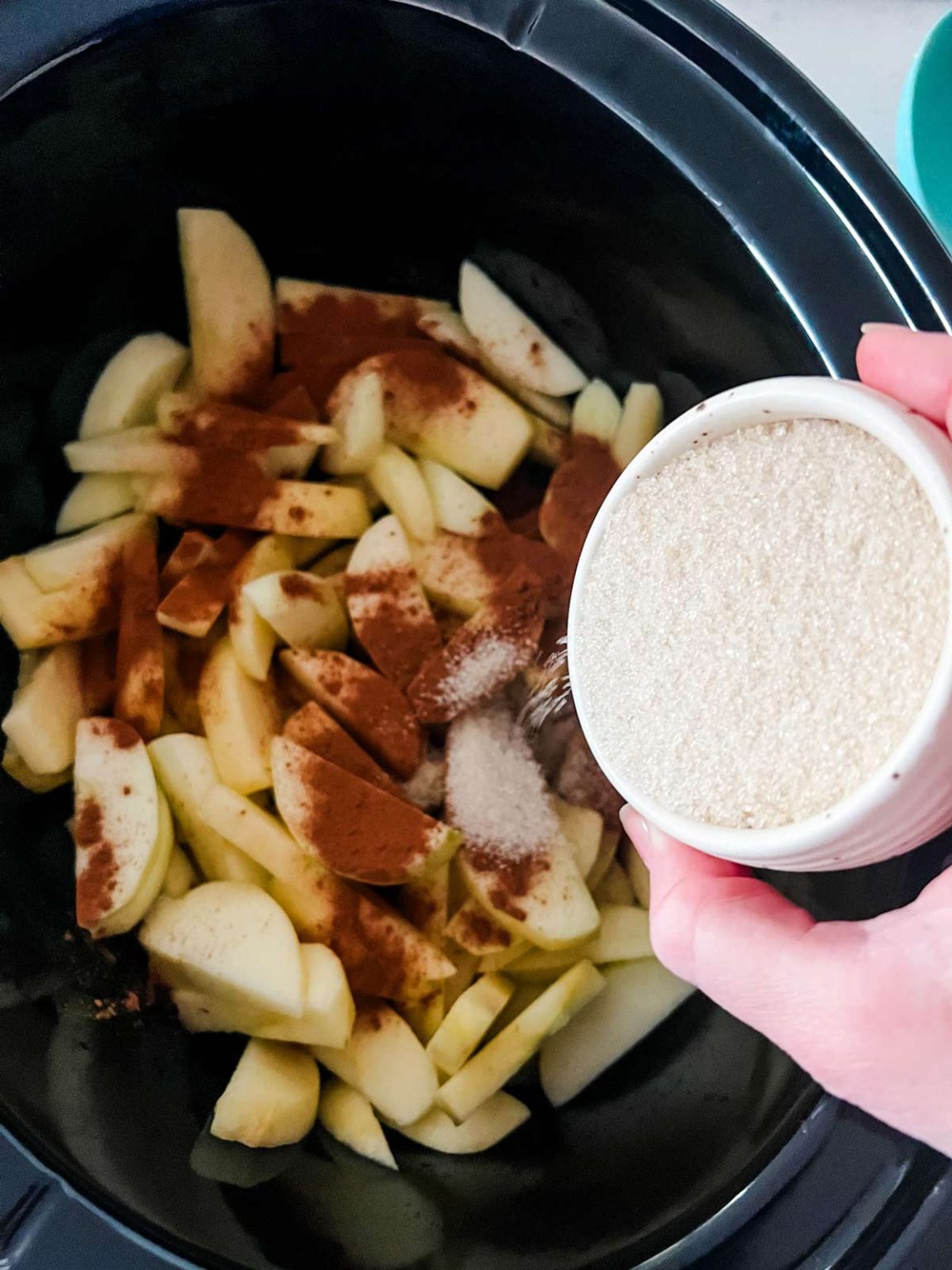
In a large mixing bowl, toss the sliced apples with 1 tablespoon of lemon juice, 1/4 cup of sugar, 2 tablespoons of cornstarch, 1.5 teaspoons of cinnamon, 1/4 teaspoon of nutmeg, 1/4 teaspoon of ginger, and 1/4 teaspoon of sea salt until every slice is evenly coated. Transfer the fruit mixture into the greased slow cooker insert, pressing down gently to form a level base.
Step 2: Mix the Oat Crisp Layer
In a separate dry bowl, combine 1.5 cups of old-fashioned rolled oats, 3/4 cup of flour, 1/2 cup of packed brown sugar, 1/4 teaspoon of baking powder, and 1/2 teaspoon of salt. Pour in 1/2 cup of melted unsalted butter (or cut in cold cubed butter using a pastry cutter until coarse crumbs form). Stir until dry spots are fully absorbed and structural clusters develop.
Step 3: Layer and Seal
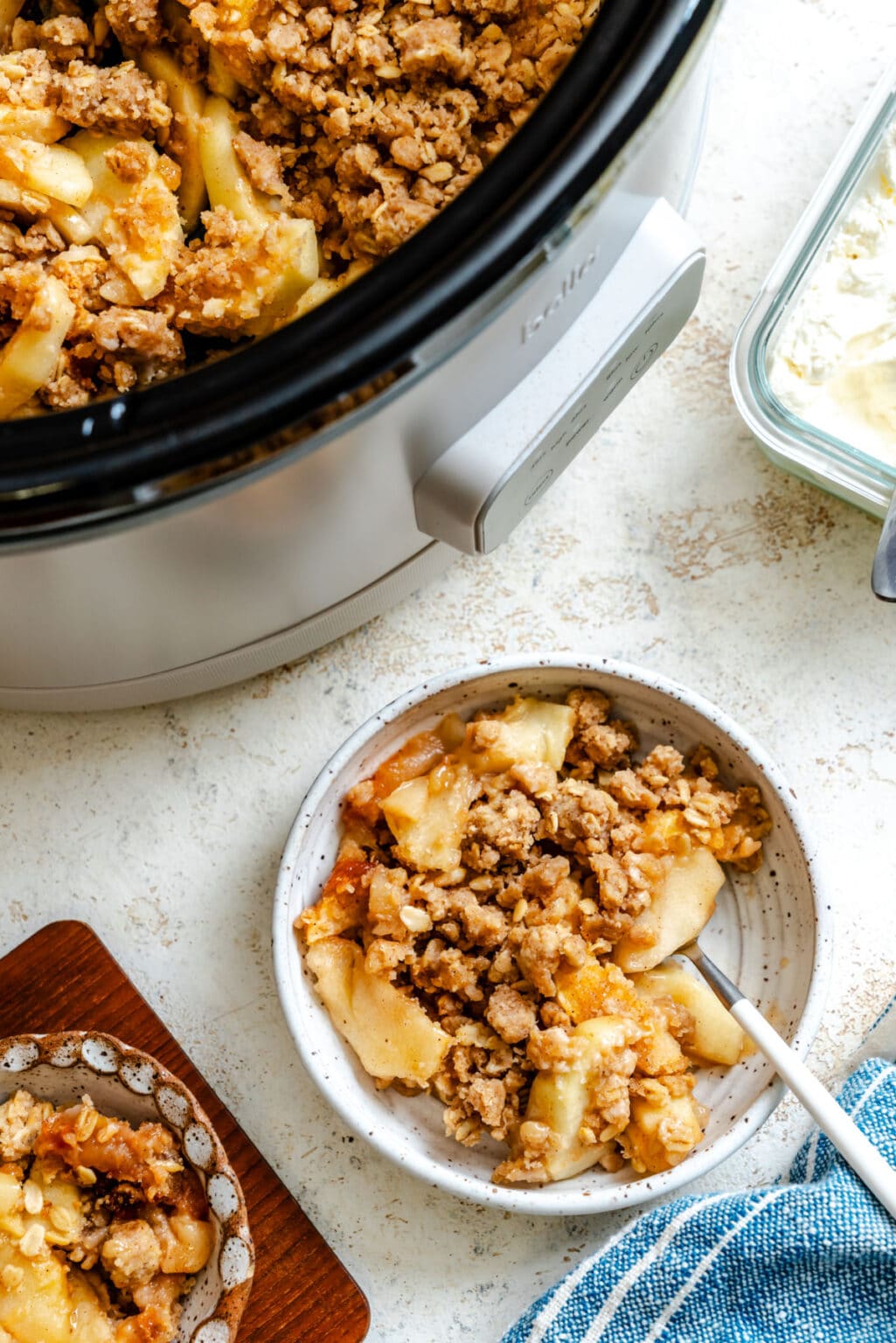
Evenly scatter the oat crisp mixture over the top of the apples. Do not pack the oats down tightly; leaving a slightly open, porous surface allows rising heat to pass through and crisp the clusters. Place the taut towel over the top of the slow cooker opening, anchor it down with the lid, and secure the overhanging edges away from external heat sources.
Step 4: Cook Settings and Times
Select your cooking duration based on your schedule:
- HIGH Setting: Cook for 2.5 to 3 hours. Best for firm apple varieties when rapid starch gelation is desired.
- LOW Setting: Cook for 4 to 5 hours. Delivers deeper spice infusion and slower fruit breakdown.
Apples are fully cooked when a knife blade inserts easily into the center layer with minimal resistance.
Step 5: The Crucial Setting & Venting Phase
Once the cooking cycle is complete, turn off the slow cooker and carefully remove the lid and moist towel barrier, taking care not to drip condensation into the crock.
Leave the slow cooker uncovered for 15 to 20 minutes before serving. During this cooling window, the starch gel matrix thickens the apple juices into a rich liquid, and surrounding air dries out the surface oats, producing a crisper texture.
Slow Cooker vs. Traditional Oven Crisp Comparison
Baking an apple crisp in a slow cooker alters energy efficiency, texture development, and workflow flexibility compared to conventional oven methods.
| Parameter | Slow Cooker Method | Traditional Oven Method |
|---|---|---|
| Cooking Profile | Low thermal heat, high moisture enclosure | High dry heat (350°F–375°F / 175°C–190°C) |
| Average Cook Time | 2.5 to 3 hours (HIGH) / 4 to 5 hours (LOW) | 40 to 50 minutes |
| Energy Consumption | Low (approx. 200–300 Watts/hour) | High (approx. 2,000–3,000 Watts/hour) |
| Condensation Level | High (requires towel steam barrier) | Minimal (evaporates freely into oven cavity) |
| Fruit Base Texture | Extremely tender, uniform caramelization | Tender with minor surface dehydration |
| Topping Browning | Requires broiler finish or towel trap for crunch | Natural surface browning via Maillard reaction |
| Kitchen Heat Impact | Negligible (keeps kitchen cool) | High heat ambient output |
| Make-Ahead Flexibility | High (maintains serving temp on WARM) | Medium (best served immediately fresh) |
Variations, Dietary Substitutions, and Upgrades
Adjusting the base recipe allows you to meet dietary needs or introduce secondary flavor profiles without sacrificing structural integrity.
- Recipe Variation Pathways:
- Gluten-Free Alternative: Use GF certified oats + almond/GF flour
- Vegan / Dairy-Free Option: Swap butter for refined coconut oil
- Low-Sugar / Low-GI Version: Substitute brown sugar with monk fruit
- Flavor & Texture Upgrades: Add toasted pecans, walnuts, or bourbon
Gluten-Free Adaptations
Substitute all-purpose flour in equal weight (1:1 ratio) with a commercial gluten-free measure-for-measure flour blend or fine oat flour. Ensure that the rolled oats carry a certified Gluten-Free designation to avoid cross-contamination from processing facilities.
Dairy-Free and Vegan Modifications
Replace the unsalted butter with an equal volume (1/2 cup) of refined coconut oil in its solid-malleable state, or high-quality vegan block butter. Refined coconut oil eliminates coconut flavor while maintaining the liquid-to-fat balance necessary to bind the oat clusters.
Reduced-Sugar Options
Lower the glycemic index by replacing brown sugar with an equal measure of golden monk fruit sweetener or erythritol-based brown sugar alternatives. Reduce the fruit thickener slightly (use 1.5 tablespoons of cornstarch instead of 2 tablespoons) because sugar substitutes yield less liquid volume during cooking.
Flavor and Texture Upgrades
- Nut Crunch Layer: Add 1/2 cup of finely chopped pecans, walnuts, or sliced almonds to the oat topping for extra texture and healthy fats.
- Bourbon Caramel Twist: Deglaze the apples before cooking by tossing them with 1.5 tablespoons of quality bourbon and 1 teaspoon of pure vanilla extract.
- Cranberry-Apple Crisp: Substitute 1 cup of peeled apple slices with 1 cup of whole fresh or frozen cranberries to add tartness and color.
Troubleshooting Common Slow Cooker Dessert Problems
| Problem | Cause | Solution |
|---|---|---|
| Soggy, Gummy Topping | Condensation dripped into crock | Apply taut cotton towel under lid |
| Watery Fruit Sauce | Insufficient starch binder | Use 2 tbsp cornstarch per 3 lbs fruit |
| Mushy, Formless Apples | Wrong variety used (e.g., McIntosh) | Switch to Granny Smith / Honeycrisp |
| Raw, Hard Fruit | Cut slices too thick or uneven | Keep slice thickness uniform at 1/2" |
Issue 1: The Oat Topping Is Soggy or Gummy
- Cause: Moisture vapor condensed on the inside of the glass lid and dripped directly onto the oat mixture during cooking.
- Remedy: Always place a taut towel beneath the lid. If the topping is already wet, remove the lid entirely, set the slow cooker to HIGH, and let it run uncovered for 20 to 30 minutes to evaporate surface moisture. Alternatively, transfer the removable inner ceramic crock to a conventional oven broiling rack for 3 to 5 minutes to brown and crisp the top layer (ensure your ceramic crock is oven-safe per manufacturer instructions).
Issue 2: Excess Watery Juice at the Bottom
- Cause: Sliced apples released high amounts of cell water, but insufficient starch thickener was present to bind the liquid into a gel.
- Remedy: Never omit the cornstarch or tapioca starch. If excess liquid builds up during cooking, prop the lid open slightly with a wooden spoon handle during the final 45 minutes of cooking to let steam escape.
Issue 3: Fruit Layer Is Too Soft or Mushy
- Cause: The apples chosen breakdown quickly under heat, or the crisp was cooked past the recommended duration on HIGH.
- Remedy: Use firm, high-acid baking apples such as Granny Smith or Braeburn. Slice them slightly thicker (up to 3/4 inch) if cooking for extended durations on LOW.
Issue 4: Fruit Remains Hard After Full Cook Time
- Cause: Apple slices were cut too thick, or the slow cooker failed to reach proper cooking temperatures.
- Remedy: Maintain uniform slice thickness of 1/2 inch. Ensure the lid stays closed during the first two hours of cooking so thermal mass accumulates inside the vessel.
Storage, Reheating, and Make-Ahead Strategies
Proper storage prevents leftover oat topping from absorbing moisture from the apple sauce layer underneath.
- Storage and Reheating Matrix:
- Refrigeration: Cool completely, seal in airtight glass container, store 4-5 days
- Reheating Method:
- Oven/Air Fryer: 350°F (10-12 min) (Preserves Crisp Texture)
- Microwave: Medium power (60-90 sec) (Convenient - Softer Topping)
Refrigeration Guidelines
Allow the dessert to cool to room temperature uncovered for no more than two hours. Transfer leftovers into airtight glass containers. Store in the refrigerator for up to 5 days. Avoid leaving leftovers in the slow cooker insert in the refrigerator, as the stoneware retains cold and delays proper thermal transfer when reheating.
Freezing Protocol
While cooked apples freeze well, oat crisp toppings can lose structural integrity upon thawing. To freeze:
- Bake the crisp completely and allow it to cool thoroughly.
- Portion into freezer-safe glass or aluminum containers.
- Freeze for up to 3 months.
- Thaw overnight in the refrigerator before reheating.
Reheating Options
- Oven / Toaster Oven (Recommended): Transfer single portions to an oven-safe dish and bake at 350°F (175°C) for 10 to 12 minutes. This restores crispness to the oat topping while heating the fruit center.
- Air Fryer: Place an air-fryer-safe ramekin inside at 325°F (160°C) for 4 to 5 minutes to crisp the top without burning.
- Microwave: Heat on medium power for 60 to 90 seconds. Note that this method will soften the oats.
Frequently Asked Questions
Can I put raw apples straight into the slow cooker for apple crisp?
Yes, raw apples are placed directly into the slow cooker without prior parboiling or sautéing. As the slow cooker heats, the trapped steam and juices tenderize the raw slices while absorbing the cinnamon, brown sugar, and lemon juice mixture. Simply peel, core, and slice the apples uniformly to ensure even cooking throughout the layer.
Should I cook apple crisp on HIGH or LOW in a slow cooker?
Both settings work well, but they yield subtle structural differences. Cooking on HIGH for 2.5 to 3 hours heats starch binders quickly, thickening juices before apples overcook. Cooking on LOW for 4 to 5 hours breaks down fruit tissue more slowly, intensifying spice absorption. Use HIGH if you prefer firmer apple slices and LOW for softer fruit.
How do I keep the oat topping from getting soft in a slow cooker?
Trap rising moisture by stretching a clean kitchen towel or three layers of paper towels across the top of the slow cooker basin before securing the lid. The fabric absorbs steam before it condenses and drips onto the oats. Additionally, leave the lid off for 15 to 20 minutes after turning off the heat to let surface moisture evaporate.
Do I need to peel apples before putting them in the slow cooker?
Peeling is recommended for the best texture. Apple skins contain dense cellulose fibers that do not break down at slow-cooker temperatures, resulting in tough, papery ribbons in your dessert. If you prefer unpeeled apples for extra color and dietary fiber, slice the fruit thinly (about 1/4-inch thick) to help soften the skins during cooking.
Can I make slow cooker apple crisp ahead of time for a party?
Yes. Assemble the spiced apple base directly in the greased slow cooker insert up to 12 hours ahead of time and store it covered in the refrigerator. Store the dry oat topping mixture in a separate airtight container at room temperature. When ready to cook, sprinkle the oat topping over the apples, apply the lid towel barrier, and set your cook time.
Can I transfer the slow cooker insert to the oven to brown the top?
Most modern ceramic slow cooker inserts are oven-safe up to 400°F (204°C), but you must verify this in your specific appliance user manual. If safe, transfer the uncovered ceramic liner to a preheated oven at 375°F for 8 to 10 minutes (or under a low broiler setting for 2 to 3 minutes) to achieve a deep golden, caramelized top layer. Never expose a cold ceramic insert to a preheated oven; allow it to warm up with the appliance to avoid thermal shock cracking.
Practical Recommendation
For reliable results, use a 50/50 mixture of Granny Smith and Honeycrisp apples sliced to a uniform 1/2-inch thickness. Toss the fruit with 2 tablespoons of cornstarch to bind free liquid, and always secure a clean, non-linting kitchen towel underneath the slow cooker lid to trap condensation. Finish by allowing the cooked crisp to stand uncovered for 15 minutes before serving with vanilla bean ice cream or heavy cream.