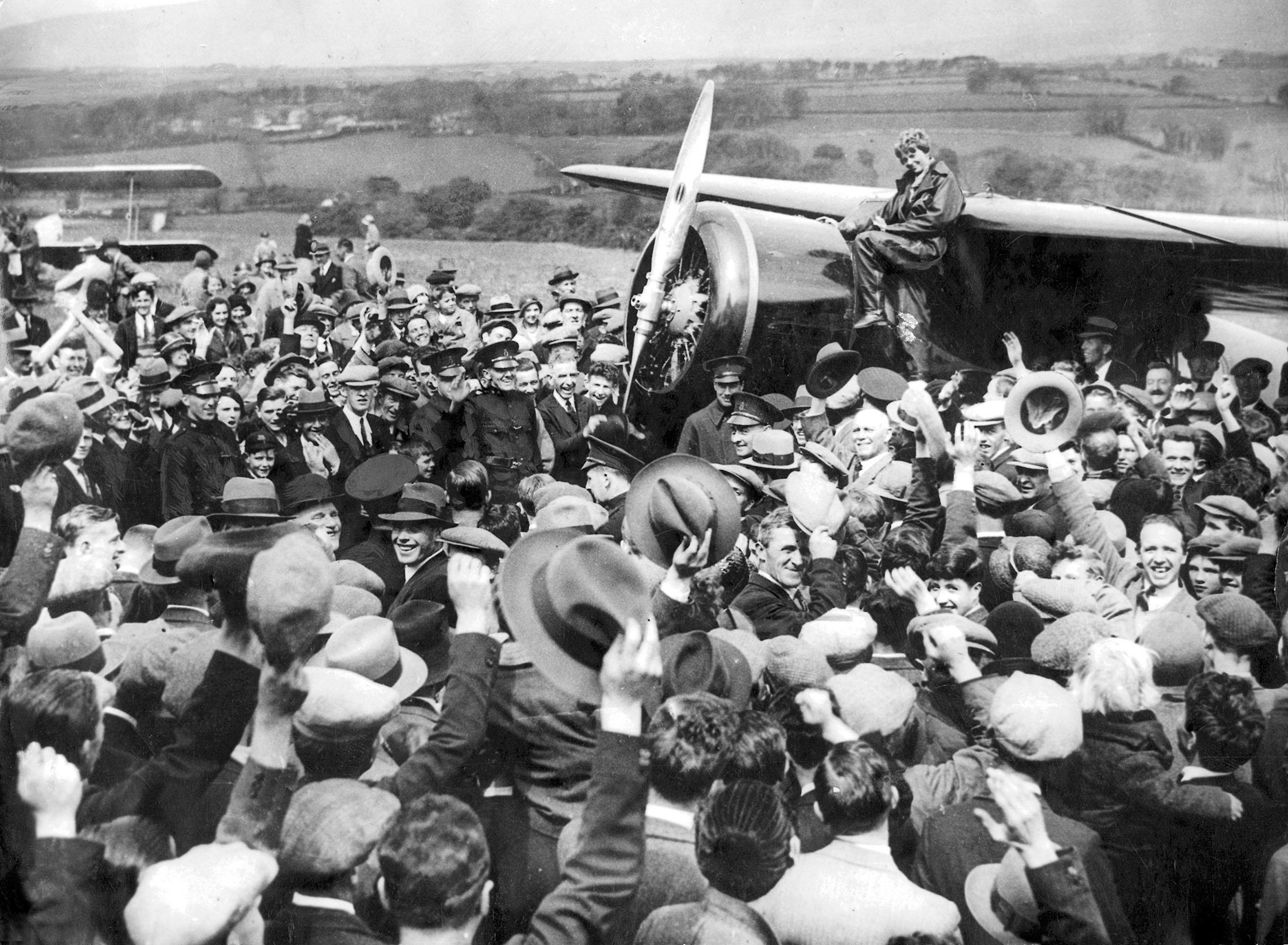
Amelia Earhart was a pioneering American aviator and author who became the first woman to fly solo across the Atlantic Ocean in 1932. Her disappearance in 1937 during a circumnavigational flight of the globe remains one of history’s greatest unsolved mysteries, fueling decades of scientific research, deep-sea exploration, and enduring cultural fascination.
The Early Life of a Record-Breaker
Born on July 24, 1897, in Atchison, Kansas, Amelia Mary Earhart did not follow the traditional path expected of women in the early 20th century. Her childhood was marked by a spirit of adventure, often preferring to climb trees and hunt rats with a rifle rather than participate in more conventional domestic activities. This foundational independence served as the precursor to her legendary career in the skies.
Earhart’s interest in aviation was not immediate. She attended an air show in Long Beach, California, in 1920, where she took a ten-minute flight that forever changed her trajectory. By 1921, she had purchased her first aircraft—a bright yellow Kinner Airster she nicknamed "The Canary." She worked various jobs, including as a social worker and a nurse’s aide, to fund her flying lessons under the tutelage of Neta Snook, another female aviation pioneer.
In these early years, Earhart set several unofficial records, but it was her association with George P. Putnam, who would later become her husband and promoter, that catapulted her into the international spotlight. Putnam was looking for a woman to fly across the Atlantic, following Charles Lindbergh’s success. While Earhart was merely a passenger on the 1928 "Friendship" flight, the experience cemented her status as "Lady Lindy" and fueled her desire to prove she could accomplish the feat as a pilot.
Defining Achievements in Aviation History
Amelia Earhart’s career was defined by a series of "firsts" that challenged the gender norms of the 1920s and 30s. Her most significant achievement occurred on May 20–21, 1932, when she flew solo across the Atlantic Ocean. Departing from Newfoundland and landing in a pasture in Northern Ireland, she overcame mechanical failures and inclement weather to become the first woman—and second person—to complete the journey.
Beyond the Atlantic crossing, Earhart’s resume of records includes:
- The first woman to fly solo nonstop across the United States (1932).
- The first person to fly solo from Honolulu, Hawaii, to Oakland, California (1935).
- The first person to fly solo from Mexico City to Newark, New Jersey (1935).
These flights were not merely publicity stunts; they were grueling tests of endurance and navigation. In the 1930s, pilots lacked the sophisticated GPS and radar systems available today. Earhart relied on celestial navigation, dead reckoning, and rudimentary radio equipment. Her success in these ventures demonstrated that women possessed the technical proficiency and physical stamina required for long-distance aviation, a point she advocated for through her leadership in The Ninety-Nines, an international organization for female pilots.
Technical Specifications: The Aircraft of Amelia Earhart
Throughout her career, Earhart transitioned from lightweight biplanes to advanced, long-range monoplanes. Understanding the technical limitations of these machines provides context for her successes and her ultimate disappearance.
| Feature | Lockheed Vega 5B (1932) | Lockheed Electra 10E (1937) |
|---|---|---|
| Engine | Pratt & Whitney Wasp (450 hp) | 2x Pratt & Whitney Wasp Jr. (600 hp each) |
| Wingspan | 41 feet | 55 feet |
| Maximum Speed | 185 mph | 202 mph |
| Fuel Capacity | Modified for long-range (420 gal) | 1,151 gallons |
| Purpose | Solo Atlantic Crossing | World Flight Attempt |
| Crew Capacity | 1 (Pilot) | 2 (Pilot and Navigator) |
The Lockheed Electra 10E used in the 1937 world flight was a "flying laboratory." It was heavily modified to include additional fuel tanks in the fuselage, significantly increasing its weight and altering its handling characteristics. These modifications were necessary for the vast distances required to cross the Pacific Ocean, but they also reduced the margin for error during takeoffs and landings.
The 1937 World Flight Attempt
In 1937, Earhart set out to achieve a dream: to circumnavigate the globe following the equatorial route, the longest path possible. She was accompanied by Fred Noonan, an experienced navigator formerly of Pan American Airways. Their journey began in Oakland, California, traveling eastward across Africa, India, and Southeast Asia.
By June 29, 1937, they arrived in Lae, New Guinea, having completed approximately 22,000 miles of the 27,000-mile journey. The next leg was the most dangerous: a 2,556-mile stretch across the Pacific to Howland Island, a tiny speck of land roughly mid-way between Australia and Hawaii. Howland Island is only 1.5 miles long and half a mile wide, making it an incredibly difficult target for celestial navigation.
To assist, the U.S. Coast Guard Cutter Itasca was stationed at Howland to provide radio bearings and weather reports. However, a series of communication breakdowns occurred. Earhart was unable to hear the Itasca’s voice transmissions, possibly due to a blown fuse in her receiver or mismatched frequencies. Her final confirmed transmissions indicated she was flying on a "Line of Position" (157/337 degrees) but could not see the island and was running low on fuel.
Analyzing the Disappearance Theories
Since July 2, 1937, numerous theories have emerged regarding the fate of Earhart and Noonan. In 2026, scientific advancements continue to narrow the possibilities, though a definitive physical recovery of the aircraft remains elusive.
1. The Crash and Sink Theory
The most widely accepted scientific explanation is that the Lockheed Electra ran out of fuel and crashed into the ocean near Howland Island. Given the extreme depths of the Pacific in that region—often exceeding 18,000 feet—locating a relatively small aircraft is a monumental task. In early 2024, the exploration firm Deep Sea Vision released sonar imagery of an object on the ocean floor that bears a striking resemblance to the Lockheed Electra’s unique twin-tail design. Research through 2025 and 2026 has focused on high-resolution imaging and ROV (Remotely Operated Vehicle) deployments to confirm if this "anomaly" is indeed Earhart’s plane.
2. The Gardner Island (Nikumaroro) Theory
The International Group for Historic Aircraft Recovery (TIGHAR) has long advocated that Earhart and Noonan landed on Gardner Island (now Nikumaroro), an uninhabited atoll approximately 350 miles south of Howland. This theory suggests they survived as castaways. Evidence cited by TIGHAR includes fragmented radio signals heard in the days following the disappearance, a size-9 shoe heel, and aluminum scraps. However, DNA analysis on skeletal remains found on the island in 1940 (and subsequently lost) has remained inconclusive despite modern forensic modeling.
3. The Japanese Capture Theory
A more controversial theory suggests that Earhart and Noonan veered off course into the Marshall Islands, which were then under Japanese mandate. Proponents argue they were captured as spies and died in captivity on the island of Saipan. While some eyewitness accounts from locals have been documented over the decades, the U.S. government and military records have never corroborated this claim, and it is generally dismissed by mainstream historians due to a lack of physical evidence.
The Enduring Legacy of an Icon
Amelia Earhart’s impact extends far beyond her flight records. She was a vocal advocate for the Equal Rights Amendment and worked closely with the National Woman's Party. She used her celebrity to promote the idea that a woman’s value was not tied to domesticity but to her individual achievements and courage.
In the realm of fashion and business, she launched her own line of functional "activewear" for women, featuring separates that allowed for greater mobility—a radical concept at the time. She also served as an aviation editor for Cosmopolitan magazine, using the platform to encourage more people to take to the skies.
Today, her legacy is preserved by organizations like the Smithsonian National Air and Space Museum and Purdue University, which houses the largest collection of her personal papers and artifacts. Her disappearance remains a symbol of the "Heroic Age of Aviation," representing both the limitless potential of human ambition and the inherent risks of exploring the unknown.
Frequently Asked Questions
Did Amelia Earhart ever reach Howland Island?
No, there is no evidence that Earhart ever sighted or reached Howland Island. Her final radio transmissions indicated she believed she was in the vicinity, but she was unable to establish a two-way connection with the USCG Itasca to receive a directional signal.
What were Amelia Earhart’s last words?
Her last recorded transmission at 8:43 a.m. local time was: "We are on the line 157 337. We will repeat this message. We will repeat this on 6210 kilocycles. Wait." This indicated she was flying along a specific navigational line of position, searching for the island.
Has her plane ever been found?
As of 2026, while promising sonar images have been identified near Howland Island (notably by Deep Sea Vision in 2024), there has been no definitive physical recovery or 100% confirmed identification of the Lockheed Electra 10E. Investigation of underwater anomalies is ongoing.
Who was Fred Noonan?
Fred Noonan was Earhart’s navigator for the 1937 world flight. He was a highly respected master mariner and aviator who had previously pioneered the navigation routes across the Pacific for Pan American Airways' China Clipper.
Why was the search for Earhart so difficult in 1937?
The search was hampered by the sheer scale of the Pacific Ocean and the limitations of 1930s technology. The search area covered over 250,000 square miles. Furthermore, inaccurate reporting of her fuel levels and the lack of a functioning "homing" signal meant searchers were essentially looking for a needle in a haystack.
Recommended Next Steps for Researchers
For those interested in the ongoing efforts to solve the Earhart mystery, it is recommended to monitor the official updates from the National Oceanic and Atmospheric Administration (NOAA) and the Smithsonian Institution. These organizations often collaborate with private exploration firms to validate deep-sea findings. Additionally, visiting the Amelia Earhart Hangar Museum in Atchison, Kansas, provides a comprehensive look at her life and the technical aspects of 1930s aviation through the lens of a restored Lockheed Electra.