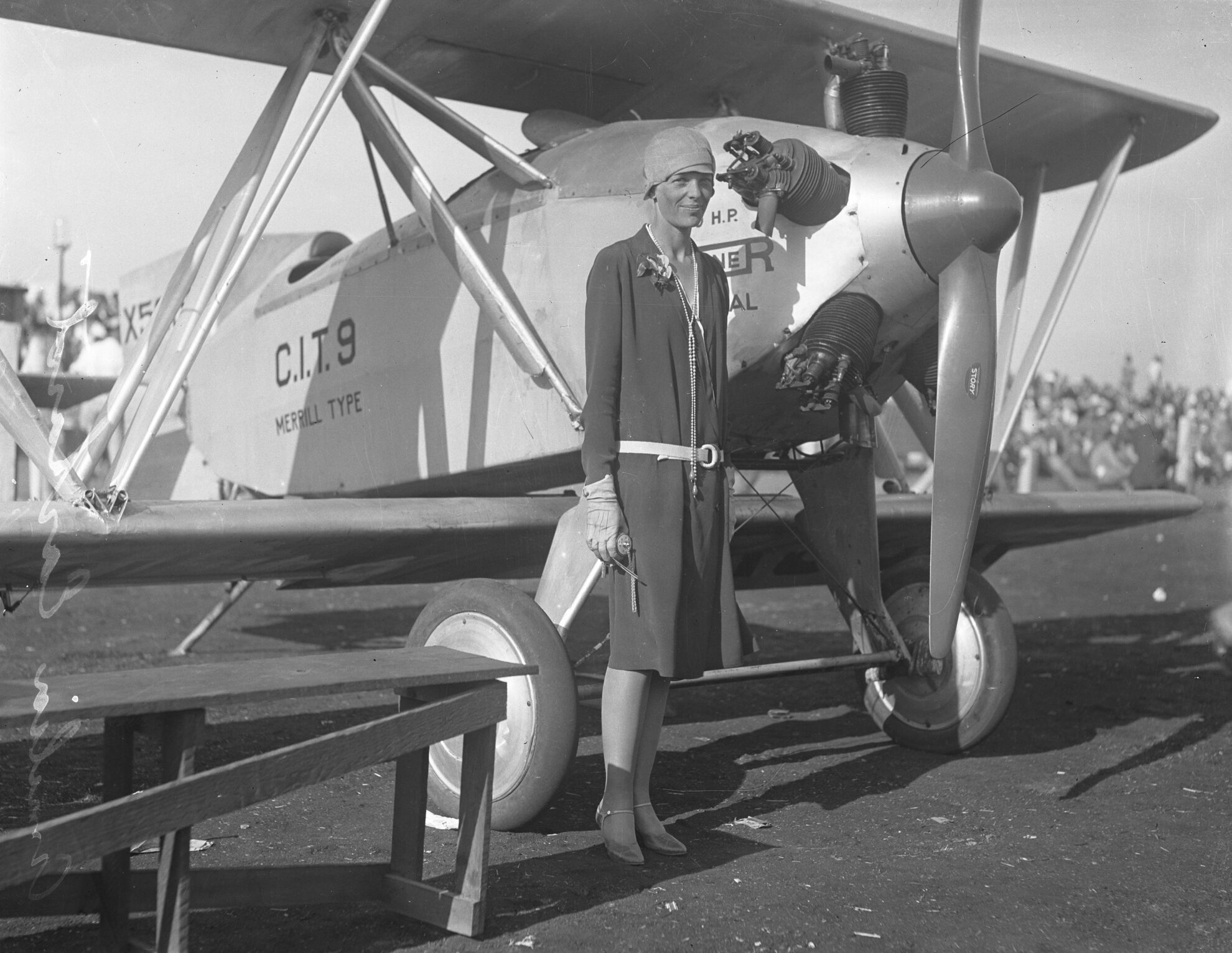
Amelia Earhart stories encompass her groundbreaking career as a record-setting aviator and the enduring enigma of her 1937 disappearance. Beyond her aerial achievements, these narratives explore her advocacy for women’s rights, her final flight with Fred Noonan, and the persistent modern-day search efforts to solve one of history's most compelling mysteries.
The Genesis of an Aviator: Early Amelia Earhart Stories
The narrative of Amelia Earhart does not begin in the cockpit of a Lockheed Electra, but in the adventurous spirit of a young girl in Atchison, Kansas. Born in 1897, Earhart was never a "proper" girl by the standards of the early 20th century. She climbed trees, hunted rats with a rifle, and kept a scrapbook of newspaper clippings about women succeeding in male-dominated fields. These early stories are foundational to understanding her later resolve; they depict a woman who viewed gender barriers not as walls, but as challenges to be overcome.
Her first encounter with aviation occurred at a stunt exhibition in Toronto, but the pivotal moment came in 1920 at an airfield in Long Beach, California. Frank Hawks gave her a ride that changed her life. "By the time I had got two or three hundred feet off the ground," she later said, "I knew I had to fly." This realization led her to take various jobs—from truck driving to working at a telephone company—to save the $1,000 required for flight lessons. She studied under Neta Snook, another female pioneer, and eventually purchased her first aircraft, a bright yellow Kinner Canary.
Earhart’s early aviation stories are characterized by grit and financial struggle. Unlike many of her contemporaries who came from immense wealth, Earhart often lived on the edge of insolvency to keep her planes in the air. This period of her life established the "Lady Lindy" persona that George P. Putnam, her future husband and publicist, would later use to turn her into a global icon.
Breaking Records and the Glass Ceiling
As Earhart’s skills grew, so did the scale of her ambitions. The most famous stories of her success involve a series of "firsts" that challenged the prevailing notions of female capability. In 1928, she became the first woman to fly across the Atlantic, though she was merely a passenger on the Friendship. She famously described herself as "just baggage," a sentiment that fueled her desire to prove she could cross the ocean at the controls herself.
That opportunity came in May 1932. Five years to the day after Charles Lindbergh’s historic flight, Earhart took off from Newfoundland in a Lockheed Vega 5B. The crossing was harrowing. She faced thick clouds, ice on the wings, and a manifold pressure gauge failure that leaked fuel. Despite a broken weld in the exhaust pipe that began to vibrate violently, she landed safely in a pasture in Culmore, Northern Ireland.
Following this, the stories of her exploits grew exponentially. She became the first person to fly solo from Honolulu to Oakland, California, in 1935, a feat that had claimed several previous lives. She also set records for transcontinental speed. These achievements were not merely for personal glory; Earhart used her platform to promote the commercial aviation industry and to advocate for the "Ninety-Nines," an international organization of licensed women pilots which she helped found and led as its first president.
The Final Flight: The 1937 Around-the-World Attempt
The most analyzed of all Amelia Earhart stories is her ill-fated attempt to circumnavigate the globe at the equator. By 1937, Earhart was 39 years old and felt that one "last great flight" remained in her. She acquired a Lockheed Electra 10E, a sophisticated "flying laboratory" funded largely by Purdue University.
Accompanying her was Fred Noonan, an experienced navigator with a background in marine and aerial navigation. After a failed first attempt starting from California (which ended in a ground loop in Hawaii), the duo reversed direction. They departed from Miami, Florida, on June 1, 1937, flying eastward across South America, Africa, the Indian subcontinent, and Southeast Asia.
By the time they reached Lae, New Guinea, on June 29, they had completed 22,000 miles of the journey. Only 7,000 miles remained—all of them over the vast, unforgiving Pacific Ocean. The next leg was the most difficult: a 2,556-mile flight to Howland Island, a tiny speck of land just 1.5 miles long and half a mile wide.
The stories of the final hours are reconstructed from radio logs of the Coast Guard cutter Itasca, stationed at Howland to guide them in. Communication was plagued by technical failures. Earhart could hear the Itasca, but the Itasca could not hear her clearly. Her last verified transmissions indicated she believed she was over the island but could not see it, and that fuel was running low. At 8:43 AM on July 2, 1937, she radioed: "We are on the line 157 337... We are running on line north and south." Then, silence.
Disappearance Theories: Separating Fact from Fiction
The mystery of what happened after that final radio call has generated thousands of stories, theories, and investigative expeditions. As of 2026, researchers generally categorize these into three primary schools of thought:
1. The Crash and Sink Theory
This is the most widely accepted scientific explanation. It posits that the Electra ran out of fuel shortly after the last radio transmission and ditched in the ocean. Given the depth of the Pacific around Howland Island—reaching over 18,000 feet—the aircraft would have sunk rapidly to the seafloor. In 2024, exploration firm Deep Sea Vision released sonar images of an object on the ocean floor that closely resembles the dimensions and shape of a Lockheed Electra. While further verification continues in 2026, this remains the most plausible explanation for the aircraft's final resting place.
2. The Nikumaroro (Gardner Island) Hypothesis
Promoted heavily by TIGHAR (The International Group for Historic Aircraft Recovery), this theory suggests that Earhart and Noonan missed Howland Island and landed on a flat reef at Nikumaroro, an uninhabited island about 350 miles to the south. Supporters point to various artifacts found on the island over the decades, including a woman’s shoe, a sextant box, and improvised tools. There are also stories of "post-disappearance" radio signals that some believe were genuine distress calls made by Earhart while the plane was trapped on the reef before being swept away by the tide.
3. The Capture/Spy Theory
A more sensational set of stories involves Earhart being captured by the Japanese. These theories range from her being a spy for the Roosevelt administration to her living out her days in captivity on the island of Saipan. While these stories have been the subject of numerous books and even a 2017 television documentary, most professional historians discount them due to a lack of physical evidence and the logistical impossibility of the Electra reaching the Marshall Islands with the fuel load reported at the time of her disappearance.
| Theory Name | Core Premise | Supporting Evidence | Primary Counter-Argument |
|---|---|---|---|
| Crash and Sink | Fuel exhaustion led to a mid-ocean ditching near Howland Island. | 2024 sonar imagery; radio logs indicating low fuel. | Difficulty in recovering physical debris at extreme depths. |
| Nikumaroro | Landed on a reef 350 miles south; lived as castaways. | Artifacts (shoes, glass); 1940 discovery of partial skeletal remains. | DNA on artifacts is inconclusive; no plane debris found on the island. |
| Japanese Capture | Deviated to the Marshall Islands; captured as spies. | Eyewitness accounts from local islanders (years later). | Lack of official Japanese records; fuel limitations of the Electra. |
| New Life/Identity | Survived and returned to the U.S. under a pseudonym. | Alleged photographic similarities to Irene Bolam. | Extensively debunked by forensic and genealogical research. |
The Role of Technology in Modern Earhart Stories
As we navigate through 2026, the story of Amelia Earhart has shifted from one of historical speculation to one of high-tech deep-sea exploration. The search has transitioned from surface-level island hopping to the use of Autonomous Underwater Vehicles (AUVs) and high-resolution synthetic aperture sonar.
The 2024 discovery by Tony Romeo and his Deep Sea Vision team has reinvigorated the "Crash and Sink" narrative. Using an expensive, specialized underwater drone, they mapped over 5,200 square miles of the seafloor. The resulting images showed a craft with the distinctive twin tails of the Lockheed Electra. In the two years since that discovery, international interest has focused on sending Remotely Operated Vehicles (ROVs) to the site to capture video evidence and, if possible, identify the registration number "NR16020" on the wing.
Furthermore, advancements in forensic DNA analysis have allowed researchers to re-examine biological samples found on Nikumaroro. While earlier tests were hampered by environmental degradation, modern "touch DNA" techniques are being applied to artifacts like the famous Freckle Cream jar found on the island, hoping to find a definitive link to Earhart.
The Cultural Impact: Why Her Story Persists
Why do Amelia Earhart stories continue to captivate the public nearly a century after her disappearance? The answer lies in the intersection of her life and her loss.
Earhart was a master of self-branding in an era when the concept was still in its infancy. With her cropped hair, leather jackets, and poised demeanor, she represented the "New Woman" of the 20th century. She was a prolific writer, authoring books like 20 Hrs. 40 Min. and The Fun of It, which allowed the public to feel a personal connection to her journey. She didn't just fly; she communicated the philosophy of flight—the idea that "adventure is worthwhile in itself."
Her disappearance provided a tragic, open-ended conclusion that prevents her story from ever truly "aging." Unlike other pioneers who lived to see their records eclipsed and their fame fade, Earhart remains frozen in time at the height of her powers. She is a symbol of both limitless potential and the inherent risks of pushing boundaries.
Technical Specifications of the "Flying Laboratory"
To fully understand the Amelia Earhart stories regarding her final flight, one must understand the machine she was flying. The Lockheed Electra 10E was an all-metal, twin-engine transport aircraft. For the world flight, it was heavily modified.
- Fuel Capacity: Extra fuel tanks were installed in the fuselage, increasing the capacity from the standard 200 gallons to over 1,100 gallons.
- Engines: It was powered by two Pratt & Whitney Wasp S3H1 engines, providing 600 horsepower each.
- Radio Equipment: The plane was equipped with a Western Electric 13C transmitter and a 20B receiver. However, the belly-mounted antenna was reportedly torn off during the takeoff from Lae, which may explain the communication failures during the final approach to Howland Island.
- Weight: Fully loaded with fuel, the aircraft was significantly over its intended gross weight, making it difficult to handle during the early stages of long-distance legs.
These technical details are not just trivia; they are central to the "stories" of her final hours. The weight influenced her fuel consumption, and the radio limitations dictated her inability to hear the Itasca's directional signals.
Frequently Asked Questions
Was Amelia Earhart's body ever found?
No, neither Amelia Earhart nor Fred Noonan's remains have been officially identified. While partial skeletal remains were found on Nikumaroro in 1940, they were lost in the 1940s after being examined by a doctor who initially identified them as male. Modern forensic re-evaluations of the measurements suggest they could have been Earhart's, but without the physical bones, this remains unconfirmed.
What was the last thing Amelia Earhart said?
Her final confirmed radio transmission was at 8:43 AM on July 2, 1937. She stated, "We are on the line 157 337. We will repeat this message. We will repeat this on 6210 kilocycles. Wait." This indicated she was flying along a navigational line of position, searching for Howland Island.
Why did she want to fly around the world?
Earhart wanted to be the first woman to circumnavigate the globe, and she chose the longest route—roughly 29,000 miles following the equator. She viewed it as the ultimate test of both human endurance and the reliability of modern aviation technology.
Is the 2024 sonar image definitely her plane?
As of 2026, the sonar image is considered a "highly compelling lead." Experts note the object's dimensions and shape match the Electra 10E, but sonar imagery can be deceptive. A definitive identification requires a visual inspection via an underwater camera to confirm specific structural features or the aircraft's serial number.
Did Amelia Earhart have children?
No, Amelia Earhart did not have any children. She was married to George P. Putnam in 1931, but she famously described their marriage as a "partnership" with "dual control," and she continued to prioritize her aviation career and independence.
Final Perspective and Next Steps for Enthusiasts
The stories of Amelia Earhart are a tapestry of documented historical achievement and speculative mystery. While the search for her aircraft continues to make headlines in 2026, her true legacy remains the millions of people she inspired to pursue careers in aviation, science, and engineering.
For those looking to explore her history further, the Purdue University Archives holds the largest collection of her personal papers, photographs, and logs. Additionally, the Smithsonian National Air and Space Museum houses her Lockheed Vega 5B, the red plane she used for her solo Atlantic crossing. Visiting these institutions or exploring their digital archives provides a fact-based foundation that balances the many myths and legends surrounding her name. Whether or not her plane is ever raised from the Pacific, the story of Amelia Earhart remains an essential chapter in the history of human courage.