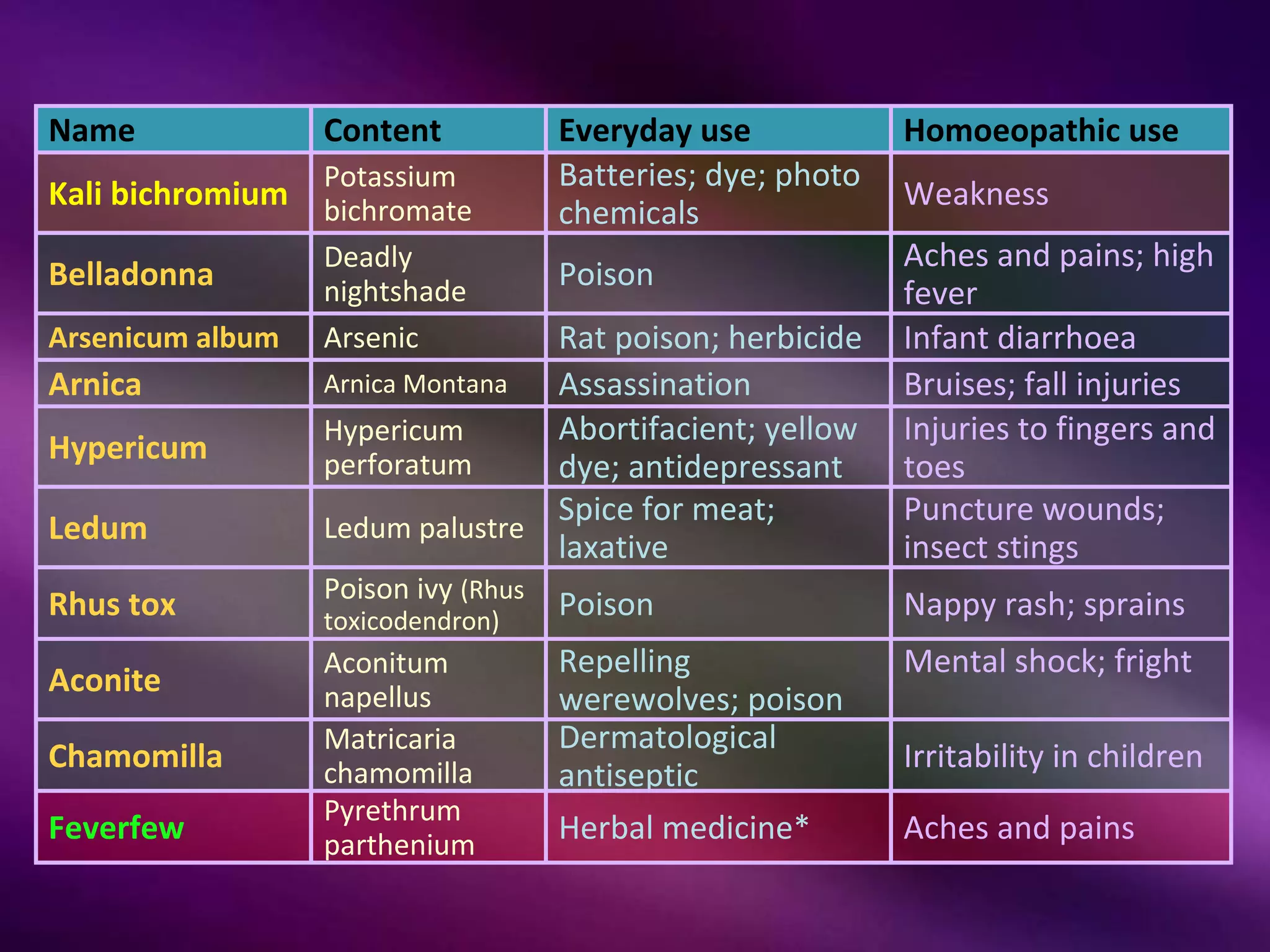
Homeopathy is considered a pseudoscience because its foundational principles—specifically the "Law of Similars" and the "Law of Infinitesimals"—contradict established laws of chemistry, physics, and biology. Despite extensive clinical testing, homeopathy has failed to demonstrate efficacy beyond the placebo effect, relying instead on non-falsifiable claims and anecdotal evidence.
The Theoretical Foundations of Homeopathic Practice
To understand why homeopathy is categorized as a pseudoscience, one must first examine the theories proposed by its founder, Samuel Hahnemann, in the late 18th century. At the time of its inception in 1796, modern germ theory, atomic theory, and pharmacology did not exist. Hahnemann’s system was built on two primary pillars that remain the core of the practice today.
The Law of Similars: "Like Cures Like"
The first pillar is the "Law of Similars" (Similia Similibus Curentur). This principle suggests that a substance that causes symptoms in a healthy person can cure those same symptoms in a sick person. For example, because onions cause watery eyes, a homeopathic preparation of onion (Allium cepa) is prescribed for hay fever.
From a scientific perspective, this principle lacks a biological mechanism. While some proponents attempt to compare this to vaccines or allergy desensitization, the analogy fails. Vaccines contain measurable antigens that stimulate a specific immune response; homeopathic remedies are diluted to the point where no active molecules remain, and the selection of the substance is based on superficial symptom matching rather than underlying pathology.
The Law of Infinitesimals and Potentization
The second pillar is the "Law of Infinitesimals," which posits that the more a substance is diluted, the more potent it becomes. This process, called "potentization" or "dynamization," involves serial dilution followed by "succussion" (vigorous shaking).
In modern chemistry, the concentration of a solution is governed by Avogadro's limit. Homeopathic remedies are often diluted to levels such as 30C. A 30C dilution involves taking one part of the original substance and adding it to 99 parts of water/alcohol, repeating this 30 times. This results in a dilution of 1 in $10^{60}$. To put this in perspective, there are approximately $10^{80}$ atoms in the observable universe. At a 30C dilution, it is mathematically certain that not a single molecule of the original substance remains in the final sugar pill or liquid drop.
The Demarcation Problem: Applying Scientific Criteria
The "demarcation problem" in the philosophy of science refers to the difficulty of distinguishing between science and pseudoscience. Homeopathy is a textbook case for this distinction because it exhibits several key characteristics of pseudoscientific systems.
Lack of Falsifiability
A hallmark of genuine science is that its claims can be tested and potentially proven false. Homeopathy often avoids falsifiability through "ad hoc" explanations. If a remedy fails to work, practitioners may claim the wrong remedy was chosen, the patient’s "vital force" was too weak, or that "antidotes" (like caffeine or mint) interfered with the treatment. Because any failure can be explained away, the core theory is never put at risk.
Resistance to Progress and New Evidence
Science is self-correcting. When new data emerges—such as the discovery of DNA or the refinement of the periodic table—scientific theories adapt or are replaced. Homeopathy, however, remains largely unchanged since Hahnemann’s Organon of Medicine was published in 1810. Despite 200 years of advancements in molecular biology and biochemistry that render the "Law of Infinitesimals" impossible, the practice continues to rely on 19th-century dogma.
Use of Misleading Scientific Language
Pseudosciences often use "sciency" sounding terms to gain a veneer of legitimacy. In the 21st century and leading into 2026, homeopathic literature frequently cites concepts like "water memory," "nanoparticles," or "quantum entanglement" to explain how a remedy works. However, these terms are typically misused. There is no evidence that water can "remember" the shape of a molecule it once touched, nor is there any evidence that quantum effects apply to macroscopic sugar pills stored at room temperature.
Clinical Reality: The Evidence Gap
For any medical intervention to be considered scientific, it must demonstrate efficacy in controlled environments. Homeopathy has been the subject of numerous high-quality meta-analyses and systematic reviews.
The NHMRC and EASAC Reports
One of the most comprehensive reviews was conducted by the Australian National Health and Medical Research Council (NHMRC) in 2015. After examining over 1,800 studies, the council concluded there were no health conditions for which there was reliable evidence that homeopathy was effective. This was echoed by the European Academies’ Science Advisory Council (EASAC) in 2017, which stated that homeopathy is scientifically implausible and produces nothing more than a placebo effect.
The Role of the Placebo Effect
The primary reason homeopathy persists is the placebo effect. When patients take a remedy and feel better, they attribute the recovery to the remedy. This is often due to:
- Natural Regression to the Mean: Many illnesses (like the common cold or back pain) resolve on their own over time.
- Confirmation Bias: Patients remember the times they felt better and forget the times the remedy did nothing.
- The Therapeutic Encounter: Homeopaths often spend an hour or more talking to patients, providing a level of emotional support and attention that can reduce stress and improve subjective well-being, regardless of the "remedy" prescribed.
Homeopathy vs. Evidence-Based Medicine
The following table highlights the fundamental differences between the scientific approach of evidence-based medicine and the pseudoscientific framework of homeopathy.
| Feature | Evidence-Based Medicine (EBM) | Homeopathy |
|---|---|---|
| Foundational Theory | Germ theory, genetics, physiology. | Vitalism and "Like cures like." |
| Dose-Response Relationship | Higher doses generally produce stronger effects (up to toxicity). | Higher dilutions are claimed to be more potent. |
| Plausibility | Consistent with physics and chemistry. | Contradicts the laws of chemistry (Avogadro's limit). |
| Mechanism of Action | Identified chemical or physical interactions. | Unidentified "energetic" or "spiritual" influence. |
| Clinical Testing | Double-blind, randomized controlled trials (RCTs). | Reliance on "provings" (subjective journals). |
| Regulatory Oversight | Strict requirements for safety and efficacy. | Historically exempt or lower standards for "efficacy." |
The Risks of Pseudoscientific Medicine
The classification of homeopathy as pseudoscience is not merely an academic exercise; it has real-world safety implications. While the sugar pills themselves are chemically inert and "safe," the practice poses secondary risks.
- Delay of Effective Treatment: The greatest danger is when a patient uses homeopathy for a serious condition—such as cancer, infections, or chronic diseases like asthma—instead of seeking evidence-based care. Delays in effective treatment can lead to worsened outcomes or death.
- Erosion of Scientific Literacy: Widespread acceptance of homeopathy undermines the public’s understanding of how science works. This can lead to skepticism of vital public health measures, such as vaccines or antibiotics.
- Economic Waste: Significant personal and public funds are spent on treatments that have no more benefit than a placebo. In 2026, many national health systems have completely de-funded homeopathy to redirect resources toward proven interventions.
The Global Regulatory Landscape in 2026
As of 2026, the regulatory stance on homeopathy has shifted significantly toward consumer protection and transparency. Many jurisdictions now require explicit labeling on homeopathic products.
In the United States, the Federal Trade Commission (FTC) maintains a policy that homeopathic product labels must communicate two key facts: there is no scientific evidence that the product works, and the product’s claims are based only on theories from the 1700s that are not accepted by most modern medical experts. Similarly, the National Health Service (NHS) in the United Kingdom has ceased the routine funding of homeopathy, categorizing it as a "misuse of resources."
These regulatory changes are based on the consensus that while individuals have the right to choose their treatments, those treatments must be labeled accurately to prevent the public from being misled by pseudoscientific claims.
FAQ: Common Questions About Homeopathy and Science
Is homeopathy the same as herbal medicine?
No. Herbal medicine uses plant-based extracts that contain measurable chemical compounds (such as aspirin from willow bark). These chemicals can have biological effects. Homeopathy dilutes substances until no active molecules remain, meaning there is no chemical similarity between the two.
Why do some doctors still practice homeopathy?
While the vast majority of the medical community rejects homeopathy, a small number of practitioners continue to use it. This is often due to a belief in "holistic" care or a personal conviction that outweighs the clinical evidence. However, professional medical bodies worldwide have increasingly moved to distance themselves from the practice.
Does "water memory" explain how homeopathy works?
No. While water molecules do form temporary hydrogen bonds with each other, these bonds last for picoseconds (trillionths of a second). Water cannot maintain a stable "memory" of a substance after that substance has been removed, especially not after being dropped onto a sugar pill and dried.
Hasn't some research shown homeopathy works?
Individual studies sometimes show positive results, often due to small sample sizes, poor study design, or bias. However, when scientists look at the "totality of evidence"—all studies combined in a meta-analysis—the positive effects disappear. High-quality, large-scale trials consistently show that homeopathy performs no better than a placebo.
Is homeopathy safe for children?
Because the remedies are mostly water or sugar, they do not cause direct side effects. However, they are not safe if they are used as a substitute for necessary medical treatments for childhood illnesses, such as ear infections, fevers, or respiratory issues.
Final Recommendation for Consumers
When evaluating health treatments, it is essential to distinguish between evidence-based medicine and pseudoscience. For those seeking "natural" or "holistic" options, many evidence-based interventions exist, such as nutritional counseling, physical therapy, and stress management, which do not require the rejection of basic chemistry.
If you are considering homeopathy, consult with a primary care physician to ensure that you are not overlooking a serious underlying condition. Always prioritize treatments that have a proven mechanism of action and a track record of success in clinical trials. Scientific literacy is the best tool for navigating the complex landscape of modern healthcare and avoiding the pitfalls of pseudoscientific alternatives.