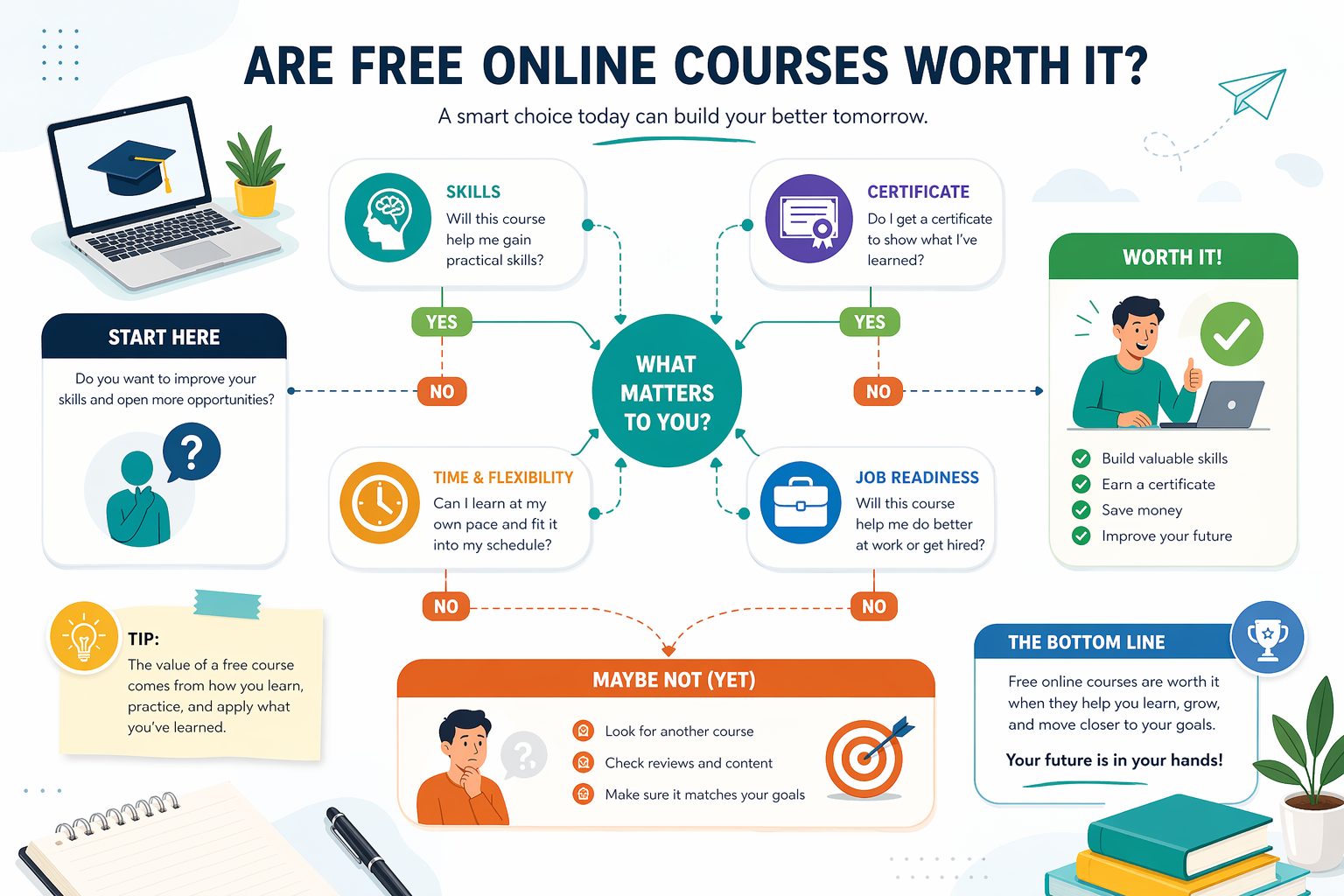
Determining whether investment online courses are worth the cost depends on your specific learning goals, current capital, and the quality of the curriculum. For most individuals, a well-structured course is worth the investment if it prevents significant capital losses through risk management education or provides access to specialized strategies that outperform basic indexing after accounting for fees and taxes.
In 2026, the landscape of retail investing has become increasingly complex. With the proliferation of algorithmic trading, fractionalized alternative assets, and sophisticated tax-optimization tools, the "buy and hold" mantra of the past often requires more nuanced execution. This complexity has driven a surge in online educational offerings, ranging from $20 introductory modules to $5,000 intensive bootcamps. To decide if these costs are justifiable, one must look beyond the sticker price and analyze the structural value of formal education versus self-taught methods.
The Value Proposition of Structured Financial Learning
The primary reason investors consider paid courses over free resources like YouTube or personal finance blogs is the transition from "information" to "knowledge." While the internet is saturated with free financial content, it is often fragmented, contradictory, or subtly biased toward specific brokerage products.
Curation and Sequential Learning
A primary benefit of a paid course is the curriculum's logical progression. Investing involves a hierarchy of concepts; you cannot effectively master options hedging without a deep understanding of underlying asset volatility and Greek risk metrics. Paid courses typically offer a structured path that ensures foundational concepts are solidified before moving into high-risk strategies. This reduces the "knowledge gaps" that often lead to catastrophic errors in live trading environments.
Accountability and the "Skin in the Game" Effect
Behavioral finance suggests that humans value what they pay for. The "sunk cost" in this context acts as a psychological lever, increasing the likelihood that a student will complete the coursework and pass the evaluations. For many retail investors, the discipline required to study market cycles and historical drawdowns is difficult to maintain without a formal commitment.
Access to Specialized Tools and Communities
High-tier investment courses often include proprietary calculators, back-testing software, or access to private discord servers where seasoned analysts share real-time insights. In 2026, many courses also provide integrations with AI-driven portfolio simulators, allowing students to test their strategies against historical data before risking real capital. The networking value of these communities can sometimes outweigh the educational content itself, as it connects learners with mentors and peers.
Evaluating the Tiers of Online Investment Education
Not all courses are created equal. To determine if a specific program is worth the cost, you must categorize it by its objective and the depth of its technical rigor.
| Course Category | Typical Price Range (2026) | Target Audience | Primary Focus |
|---|---|---|---|
| Introductory/MOOCs | $0 – $200 | Beginners | Core concepts: Stocks, bonds, ETFs, and compound interest. |
| Specialized Technical | $300 – $1,200 | Intermediate | Options trading, technical analysis, or sector-specific (e.g., REITS). |
| Professional/Certification | $1,000 – $5,000+ | Aspiring Professionals | Advanced valuation, CFA/CFP prep, and portfolio management. |
| Niche/Mentor-Led | $2,000 – $10,000 | Advanced/Active Traders | Proprietary strategies, day trading, and high-frequency methodology. |
The ROI of Introductory Courses
For a novice investor with $10,000 in capital, a $150 course that teaches the fundamentals of expense ratios and tax-advantaged accounts (like the 401k or IRA) can pay for itself within a single year. If the course prevents the investor from choosing a high-fee mutual fund with a 1.5% expense ratio in favor of an index fund with a 0.05% ratio, the savings over a lifetime can reach hundreds of thousands of dollars.
The ROI of Specialized Technical Training
For intermediate investors, the math changes. These courses are often judged by "Alpha"—the ability to generate returns above a benchmark like the S&P 500. If a $1,000 course on value investing teaches a methodology that allows an investor to identify undervalued equities resulting in a 2% outperformance on a $100,000 portfolio, the course pays for itself twice over in the first twelve months.
Quantitative vs. Qualitative Returns on Investment
When asking if a course is worth it, most people focus on the quantitative return (how much more money they will make). However, the qualitative returns—risk mitigation and time efficiency—are often more impactful.
Risk Mitigation and Capital Preservation
The most significant "profit" an investment course can provide is the prevention of a loss. Many retail investors enter the market during "bull runs" and take on excessive leverage or concentration risk. A course that emphasizes Modern Portfolio Theory (MPT) and the importance of a diversified efficient frontier can prevent the 20% to 50% drawdowns that occur when an uneducated investor's portfolio is poorly hedged.
Time Efficiency
Learning through trial and error in the stock market is arguably the most expensive education available. "Paying with losses" is a common phrase among traders. By spending $500 on a course, an investor might save 200 hours of scattered research and avoid the $2,000 loss that typically accompanies a beginner's mistake in the options or futures markets.
Red Flags: When a Course Is Definitely Not Worth the Cost
The financial education industry is unfortunately rife with "gurus" whose primary income is derived from course sales rather than actual investing. In 2026, sophisticated marketing can make it difficult to distinguish a legitimate educator from a salesperson.
- Guaranteed Returns: No legitimate investment educator will ever guarantee a specific percentage return. Markets are inherently stochastic (random), and any promise of "10% monthly gains" is a hallmark of a scam.
- Lack of Verifiable Track Record: If the instructor does not provide audited performance results or hold recognized credentials (like a CFA or a degree from an accredited institution), the technical depth of the course is likely shallow.
- Over-Emphasis on "Lifestyle" Marketing: Beware of courses marketed through videos of luxury cars and tropical vacations. Professional investing is a discipline of mathematics, psychology, and patience, not a "get rich quick" scheme.
- High-Pressure Upselling: If a $49 introductory course is merely a 10-hour sales pitch for a $5,000 "Mastermind" group, the initial cost is not an investment in education but an entry fee into a marketing funnel.
Alternatives to Traditional Online Courses
Before committing a significant portion of your investment capital to a course, consider whether other resources might achieve the same goal at a lower cost or higher authority.
Academic and Institutional Resources
Many top-tier universities offer their financial curricula for free or at a low cost through platforms like Coursera or edX. For example, Yale University’s "Financial Markets" course, taught by Nobel laureate Robert Shiller, provides a depth of institutional knowledge that few private "gurus" can match. These courses focus on the mechanics of the global financial system rather than "trading tips."
Books and White Papers
The most successful investors in history, such as Benjamin Graham or John Bogle, have laid out their entire philosophies in books that cost less than $30. For an investor willing to be self-directed, reading "The Intelligent Investor" or the Bogleheads' Guide to Investing provides a foundation that is often more robust than a flashy online video series.
Professional Financial Advice
If you have a significant amount of capital (typically $250,000+), the cost of a high-end investment course might be better spent on a session with a Fee-Only Certified Financial Planner (CFP). A CFP can provide personalized advice tailored to your tax situation and risk tolerance, which no generalized online course can offer.
The Role of AI in Investment Education (2026 Perspective)
As of 2026, the value of an investment course is increasingly tied to how it teaches the use of artificial intelligence. Purely manual "charting" or "fundamental analysis" is becoming obsolete as AI tools can process thousands of SEC filings in seconds.
A course is worth the cost today if it teaches you how to audit AI-generated investment theses, how to use Large Language Models (LLMs) to scan for sentiment in earnings calls, and how to understand the limitations of algorithmic models. Learning to manage the "machine" is now a prerequisite for modern investors, and specialized courses that bridge the gap between traditional finance and financial technology (FinTech) hold the highest current value.
FAQ
1. Can I learn everything for free on YouTube?
While you can find individual tutorials for almost any financial concept on YouTube, you lack a structured syllabus and quality control. Free content creators often prioritize engagement metrics over technical accuracy. A paid course is worth the cost if it provides a cohesive, verified framework that saves you the time of filtering through noise and misinformation.
2. How much of my portfolio should I spend on education?
A general rule of thumb is to spend no more than 1% to 2% of your investable capital on education. If you have $5,000 to invest, a $2,000 course is mathematically difficult to justify, as you would need a 40% return just to break even on the education cost. In that scenario, $20 books or $50 MOOCs are more appropriate.
3. Are "live trading room" subscriptions worth it?
These are generally high-risk. While they offer real-time interaction, they often foster a "copy-trading" mentality where the student doesn't actually learn the underlying mechanics. For long-term wealth building, courses that teach independent analysis are far more valuable than subscriptions that promise to let you "trade along" with a pro.
4. Do online investment courses count as a tax deduction?
In many jurisdictions, the cost of education related to managing your investments is not directly deductible against capital gains for retail investors. However, if you are operating as a professional trader or a business entity, these may be considered business expenses. Always consult a tax professional regarding your specific 2026 tax code requirements.
5. What is the most important topic a course should cover?
If a course does not have a significant section on Risk Management and Position Sizing, it is likely not worth the cost. Understanding what to buy is only 20% of the battle; knowing when to sell and how much of your total capital to risk on a single trade is what determines long-term survival in the markets.
Final Recommendation
Online investment courses are worth the cost only when the marginal utility of the information exceeds the price of the course and the time spent. Before purchasing, verify the instructor's credentials via the CFA Institute or check if the provider is registered with educational oversight bodies.
For beginners, start with low-cost academic courses on platforms like Coursera to build a foundation. For advanced investors, seek out specialized technical training that offers proprietary tools or access to institutional-grade data. Always remember that education is a tool to enhance your strategy, but it can never replace the discipline of a well-defined investment plan.