Annuities and life insurance companies are inextricably linked because life insurers are the primary entities authorized to issue annuity contracts. These companies use actuarial science to manage long-term risks, providing death benefits through life insurance and guaranteed lifetime income through annuities. In 2026, choosing the right company requires evaluating financial strength, product transparency, and regulatory compliance.
The Structural Link Between Annuities and Life Insurance Companies
To understand annuities, one must first understand the business model of a life insurance company. While many people view life insurance as a product that pays out upon death, the industry is fundamentally built on the "pooling of risk." Life insurance protects against the financial risk of dying too soon, whereas an annuity protects against the financial risk of living too long—often referred to as "longevity risk."
Life insurance companies are uniquely positioned to offer annuities because they possess the massive capital reserves and actuarial expertise required to guarantee payments that could last for decades. When you purchase an annuity, you are essentially entering into a private contract with an insurance carrier. In exchange for a lump sum or a series of payments, the company promises to provide regular disbursements, either immediately or at some point in the future.
In 2026, the convergence of these products is more visible than ever. Many modern "hybrid" policies combine the features of both, such as life insurance policies with long-term care riders or annuities that offer a death benefit for beneficiaries. This dual-purpose approach allows insurance companies to stabilize their balance sheets; the premiums collected from life insurance policies help fund the obligations of annuity contracts, and vice versa.
Evaluating the Financial Strength of Insurance Carriers
Because an annuity is a long-term promise, the most critical factor in selecting a provider is the company's "claims-paying ability." Unlike bank accounts, which are insured by the Federal Deposit Insurance Corporation (FDIC), annuities are backed solely by the financial strength of the issuing insurance company. If a company becomes insolvent, your principal and income stream could be at risk.
Investors in 2026 rely on independent rating agencies to gauge the stability of life insurance companies. These agencies perform deep audits of an insurer’s debt levels, investment portfolio, and reserve adequacy.
Major Rating Agencies
- A.M. Best: This is the most significant agency for the insurance industry, as it focuses exclusively on insurers. A rating of A++ or A+ signifies "Superior" ability to meet ongoing insurance obligations.
- Standard & Poor’s (S&P): Provides a broader financial perspective. An AAA or AA rating indicates extremely strong financial security.
- Moody’s Investors Service: Focuses on the company’s ability to pay senior policyholders and claims. Ratings of Aaa or Aa are preferred.
- Fitch Ratings: Evaluates the creditworthiness and "vulnerability" of the insurer.
A useful metric often used by financial advisors is the Comdex Score. This is not a rating itself but a composite score (ranging from 1 to 100) that averages the ratings a company has received across all the major agencies. A Comdex score of 90 or higher generally indicates a company is in the top tier of financial stability.
Types of Annuities Offered by Life Insurance Companies
Life insurance companies have diversified their annuity offerings to meet various risk tolerances and retirement goals. As of 2026, the market is primarily divided into four categories, each with distinct mechanics and tax treatments.
Fixed Annuities
Fixed annuities are the most straightforward. The insurance company guarantees a specific interest rate for a set period, similar to a Certificate of Deposit (CD) but with tax-deferred growth. These are popular for conservative investors who prioritize capital preservation. The insurance company takes the investment risk, promising a minimum return regardless of market conditions.
Fixed Indexed Annuities (FIAs)
FIAs have seen significant growth leading into 2026 due to their "floor" protection. The returns are linked to a market index (such as the S&P 500), but the principal is protected from market losses. While the upside is usually capped or subject to a participation rate, the guarantee that the account value will not decrease during a market downturn makes them a staple for those nearing retirement.
Variable Annuities
In a variable annuity, the owner chooses from a menu of sub-accounts (similar to mutual funds). The value of the annuity fluctuates based on the performance of these investments. These products offer the highest potential for growth but also the highest risk, as the owner can lose principal. Variable annuities are regulated as securities and require a prospectus.
Immediate vs. Deferred Income Annuities
- Single Premium Immediate Annuities (SPIAs): You pay a lump sum, and income starts almost immediately (within 12 months).
- Deferred Income Annuities (DIAs): You pay now, but the income starts at a later date, such as age 75 or 80. These are often used as "longevity insurance."
The Role of State Guaranty Associations
While annuities lack FDIC insurance, they are not entirely without a safety net. Every state in the U.S. operates a State Guaranty Association. If a life insurance company fails, the association in the state where the policyholder lives coordinates with other states to ensure that claims are paid, up to certain statutory limits.
Most states provide coverage up to $250,000 or $300,000 for the present value of annuity benefits. However, it is important to note that these limits apply per person, per company. Relying on guaranty associations should be a secondary strategy; the primary strategy remains choosing a company with a high financial rating to avoid insolvency scenarios altogether. Detailed information on specific state limits can be found at the National Organization of Life and Health Insurance Guaranty Associations (NOLHGA).
Comparative Overview of Top-Tier Life Insurance Carriers
The following table compares the general characteristics of major life insurance companies that dominate the annuity market in 2026. Note that ratings can change, and it is essential to verify current standings.
| Company Type | Typical Financial Rating (A.M. Best) | Primary Strength | Ideal For |
|---|---|---|---|
| Mutual Companies | A++ | Owned by policyholders; often pay dividends. | Long-term stability and legacy planning. |
| Stock Companies | A to A+ | Focused on shareholder value; often have lower fees. | Cost-conscious investors seeking standard fixed products. |
| Global Diversified | A+ to AA- | Large asset bases across multiple sectors. | Investors seeking variable annuities with diverse sub-accounts. |
| Boutique/Specialty | A- to A | Specialized in specific riders (e.g., LTC). | Niche needs like chronic illness or nursing home riders. |
2026 Regulatory Environment and Tax Implications
The landscape for annuities in 2026 is heavily influenced by the aftermath of the SECURE Act 2.0. This legislation made it easier for employers to offer annuities within 401(k) plans and increased the accessibility of Qualified Longevity Annuity Contracts (QLACs).
Tax-Deferred Growth
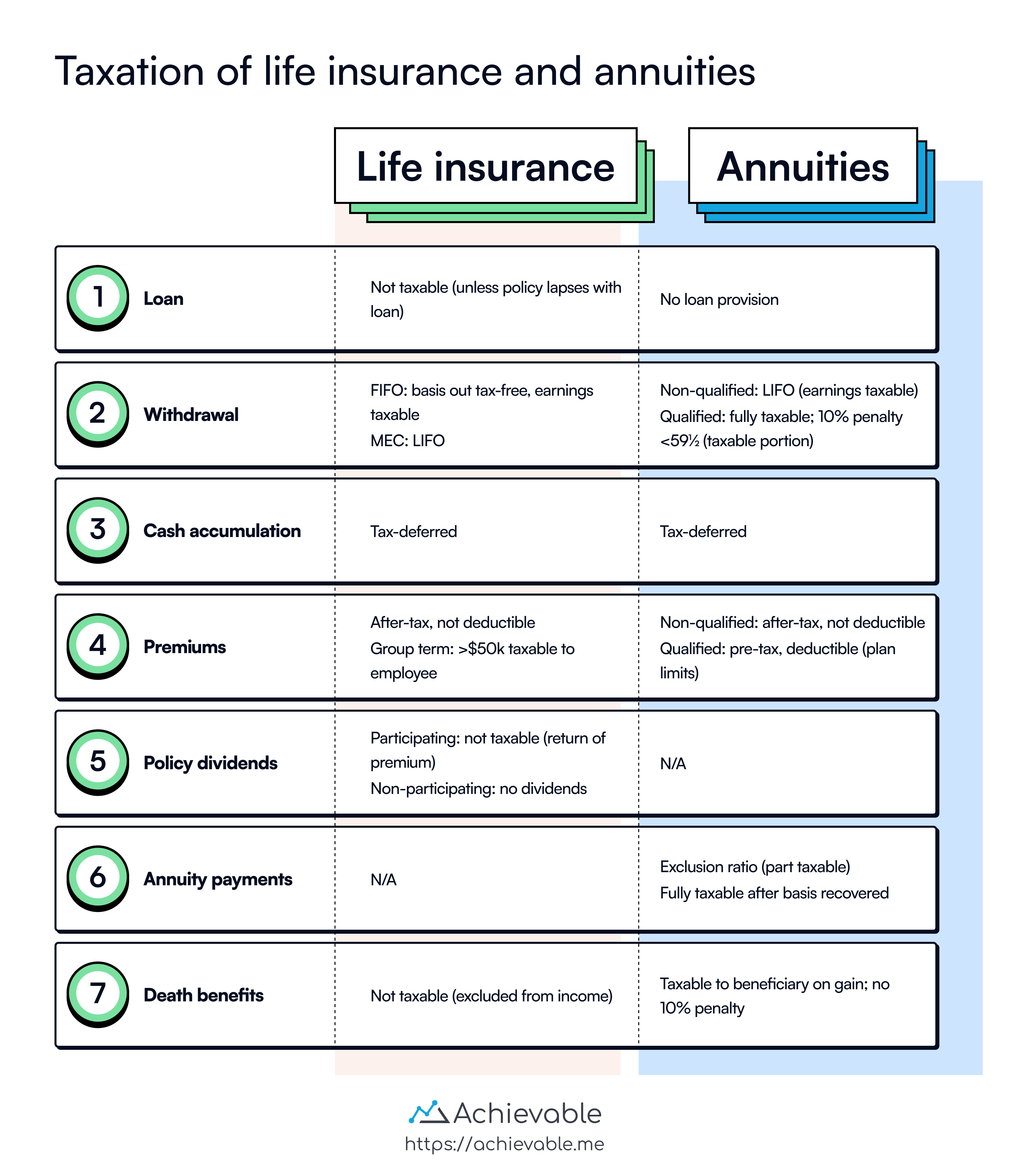
One of the primary advantages of buying through a life insurance company is that annuities grow tax-deferred. You do not pay taxes on interest or capital gains until you begin taking distributions. If the annuity is "qualified" (funded with pre-tax dollars like a traditional IRA), the entire distribution is taxed as ordinary income. If it is "non-qualified" (funded with after-tax dollars), only the earnings portion is taxed, thanks to the exclusion ratio.
The 1035 Exchange
The Internal Revenue Code Section 1035 allows policyholders to swap an existing annuity for a new one without triggering a taxable event. This is a vital tool in 2026 for investors who find that their current insurance company is no longer competitive or has had its credit rating downgraded. However, one must be cautious of new surrender charge periods when performing an exchange.
Common Pitfalls When Dealing with Insurance Companies
Despite the benefits, annuities are complex contracts that require careful scrutiny. In 2026, consumer advocates emphasize several areas where buyers often encounter trouble:
- Surrender Charges: Most annuities have a "surrender period" lasting 5 to 10 years. If you withdraw more than the allowed amount (usually 10% annually) during this time, the insurance company will charge a penalty, which can be as high as 7% to 10% of the account value.
- Complex Fees: Variable annuities, in particular, can have layers of fees, including mortality and expense (M&E) charges, administrative fees, and rider fees for guaranteed living benefits. These can sometimes exceed 3% annually.
- Inflation Risk: A fixed annuity payment that seems generous in 2026 may lose significant purchasing power by 2046. Some companies offer "cost-of-living adjustment" (COLA) riders, but these usually result in a lower initial payment.
- Complexity of Indexing: In Fixed Indexed Annuities, the way the company calculates interest (using "caps," "spreads," or "participation rates") can be difficult to understand. If the company has the right to change these rates annually, the investor loses some control over future returns.
How to Verify an Insurance Company’s Standing
Before committing capital, individuals should perform "due diligence" beyond just reading a brochure.
- Check the SEC Database: If you are considering a variable annuity, you should review the prospectus on the U.S. Securities and Exchange Commission (SEC) website to understand the underlying sub-accounts and risks.
- Verify State Licensing: Ensure the company is licensed to do business in your state by checking with your state's Department of Insurance.
- Review the NAIC Complaint Index: The National Association of Insurance Commissioners (NAIC) provides a complaint index that compares the number of complaints a company receives against its market share. A score of 1.0 is average; anything significantly higher may be a red flag regarding customer service or claims processing.
Frequently Asked Questions
Are annuities from life insurance companies safe?
Annuities are generally considered safe, but their safety is tied to the financial health of the issuing insurance company. While state guaranty associations provide a backup, they have limits (typically $250,000–$300,000). The most effective way to ensure safety is to select companies with "A" or "AA" ratings from agencies like A.M. Best or S&P.
Can I lose money in an annuity?
It depends on the type. In a fixed or fixed-indexed annuity, your principal is generally protected from market losses by the insurance company. However, in a variable annuity, you can lose money if the underlying sub-accounts perform poorly. Additionally, all annuities carry the risk of loss if you withdraw funds early and incur surrender charges.
Why do life insurance companies sell annuities?
Life insurance companies sell annuities to balance their actuarial risks. Life insurance policies pay out if a person dies early, while annuities pay out for as long as a person lives. By holding both types of contracts, the insurance company can hedge its "mortality risk" (people dying sooner than expected) against its "longevity risk" (people living longer than expected).
What is the difference between a life insurance death benefit and an annuity?
A life insurance death benefit is a tax-free lump sum paid to beneficiaries when the insured person dies. An annuity is designed to provide a living benefit—a stream of income for the owner while they are still alive. While some annuities have death benefit riders, their primary purpose is wealth distribution rather than wealth creation for heirs.
Is the year 2026 a good time to buy an annuity?
The suitability of an annuity in 2026 depends on current interest rates and your personal retirement timeline. When interest rates are higher, insurance companies can offer better payout rates on fixed products. However, an annuity should be viewed as a long-term insurance product for income security, not a short-term investment for high returns.
Final Recommendation: Next Steps for Investors
If you are considering an annuity in 2026, your first action should be to define the specific problem you are trying to solve. If you need a "pension-like" income that you cannot outlive, an immediate or deferred income annuity is the most efficient tool. If you are seeking market-linked growth with a safety net, a fixed indexed annuity may be appropriate.
Before signing a contract, request a "specimen policy" to read the fine print regarding surrender charges and fee structures. Always compare at least three different companies with Comdex scores above 85. Finally, consult with a fiduciary financial advisor—preferably one who is not compensated solely through commissions—to ensure the annuity fits within your broader tax and estate plan.