An APA research paper example serves as a visual and structural template for academic writing following the American Psychological Association (APA) guidelines. To correctly format a paper, you must include a title page, distinct body sections (Introduction, Method, Results, and Discussion), and a reference list, all adhering to specific 7th Edition standards for margins, font, and citations.
The APA style is the most widely used format for social sciences, business, nursing, and education. It provides a standardized framework that ensures clarity, precision, and a logical flow of information. While the core principles of APA style remain consistent, the 7th edition—which remains the gold standard in 2026—introduced significant distinctions between student and professional papers to simplify the writing process for learners.
The Purpose of Following an APA Research Paper Example
Using an APA research paper example is not merely about aesthetic consistency; it is about establishing a shared language within the scientific community. When research follows a predictable structure, readers can quickly locate key information, such as the methodology used or the specific statistical findings. This standardization minimizes the cognitive load on the reader, allowing them to focus on the research findings rather than the layout.
Furthermore, APA style emphasizes bias-free language and ethical reporting. By adhering to these guidelines, researchers ensure they are using inclusive terminology and providing enough detail for their studies to be replicated—a cornerstone of the scientific method. Whether you are a graduate student or a seasoned researcher, the goal is to produce a document that is transparent, professional, and easy to navigate.
Distinguishing Between Student and Professional Papers
In 2026, the distinction between student and professional formatting remains a critical starting point. If you are writing for a course, your requirements are slightly more relaxed than if you were submitting to a peer-reviewed journal.
Student Paper Requirements
Student papers are designed for submission to instructors. The most notable difference is the omission of a running head (the shortened title in the header). Student papers also typically do not require an abstract unless specifically requested by the professor. The title page includes the student’s name, the department and university, the course number and name, the instructor's name, and the assignment due date.
Professional Paper Requirements
Professional papers are intended for publication. These must include a running head on every page, written in all capital letters in the page header. They also require an abstract and, often, a list of keywords below the abstract to facilitate database indexing. If you are following an APA research paper example for a professional submission, you must also include an "Author Note" on the title page, which provides contact information and disclosures regarding funding or conflicts of interest.
Structural Components of an APA Research Paper
A complete research paper is divided into several mandatory sections. Understanding the function of each section is essential for constructing a cohesive argument.
1. The Title Page
The title page is the first page of your document. The title itself should be focused, centered, and bolded. It should summarize the main idea of the paper and identify the variables or issues under investigation. Avoid unnecessary words like "A Study of" or "An Investigation into."
- Page Numbers: All pages, starting with the title page, must have a page number in the top right corner.
- Affiliation: This indicates where the research was conducted. For students, this is the university and department.
2. The Abstract
The abstract is a concise summary of the entire paper, usually between 150 and 250 words. It should be on its own page (page 2). A good abstract highlights the research problem, the methodology, the primary findings, and the implications of those findings. In a professional APA research paper example, the word "Abstract" is centered and bolded at the top of the page, and the text is not indented.
3. The Introduction
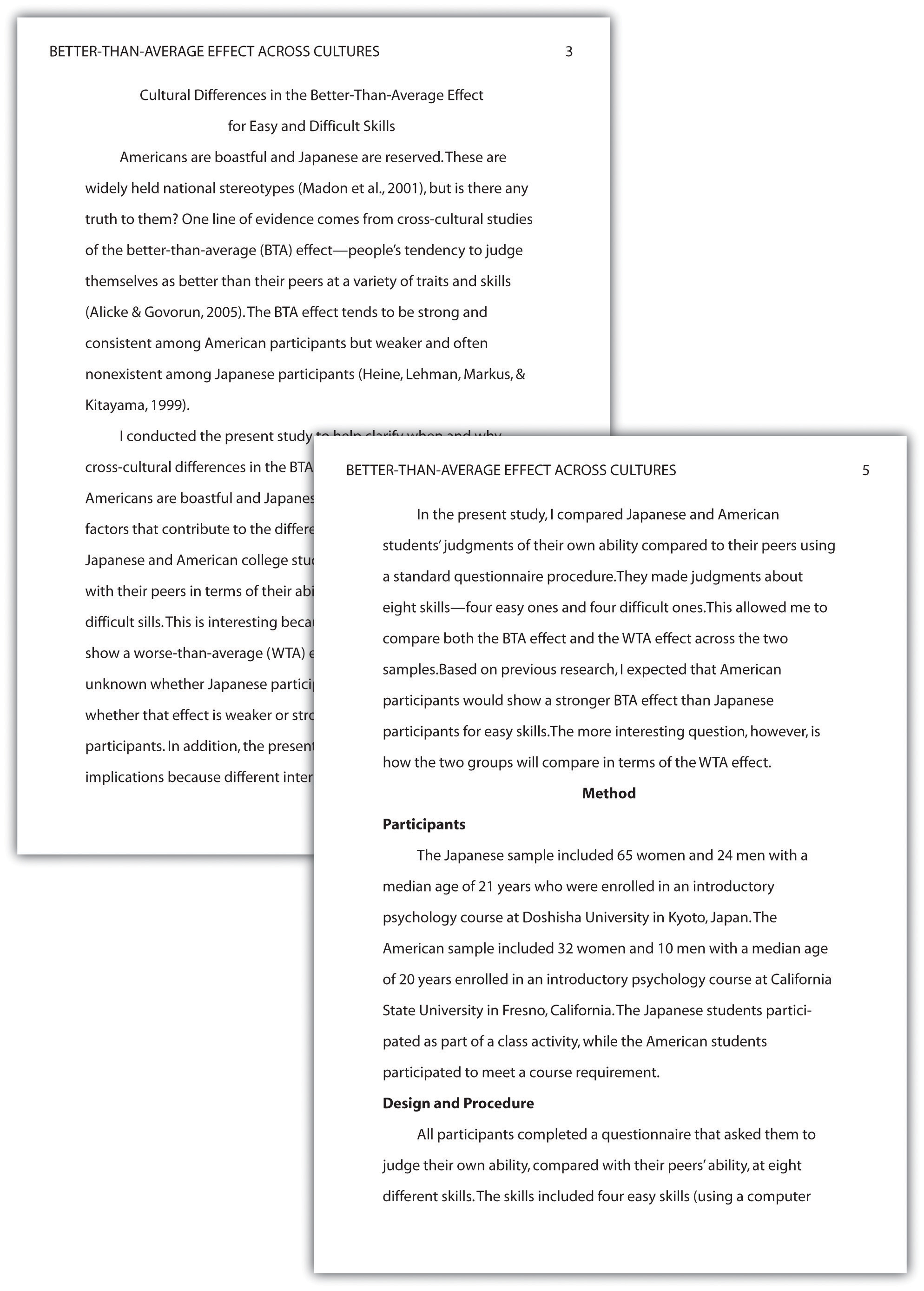
The introduction begins on a new page (usually page 3). Interestingly, the word "Introduction" is not used as a heading; instead, the full title of the paper is repeated, centered and bolded, at the top of the page. The introduction provides the context for the study, reviews existing literature, and concludes with a clear hypothesis or research question.
4. The Method Section
The Method section describes how the study was conducted. It is usually broken down into subheadings:
- Participants: Who was studied? Include demographic information and recruitment methods.
- Materials/Apparatus: What tools, surveys, or equipment were used?
- Procedure: A step-by-step account of what the participants did and how the data was collected.
5. Results and Discussion
The Results section reports the data findings without interpretation. Use tables and figures to represent complex data, but ensure the text summarizes the key takeaways. The Discussion section is where you interpret the results, acknowledge limitations, and suggest directions for future research.
Technical Formatting Specifications
Consistency is the hallmark of a high-quality APA research paper. If any of these technical details are missed, the paper may lose credibility or be returned for revisions.
Margins and Spacing
Every APA paper must have one-inch margins on all sides. The entire document, including the reference list and block quotes, must be double-spaced. Do not add extra lines between paragraphs; instead, use the "Indent" feature (usually 0.5 inches) for the first line of every new paragraph.
Font Choices
The 7th Edition of the APA manual, still standard in 2026, allows for a variety of accessible fonts. While Times New Roman (12 pt) remains the traditional choice, sans-serif options like Calibri (11 pt), Arial (11 pt), and Lucida Sans Unicode (10 pt) are also acceptable because they are easier to read on digital screens.
Heading Levels
APA uses a five-level heading system to create a hierarchical structure.
- Level 1: Centered, Bold, Title Case Heading.
- Level 2: Flush Left, Bold, Title Case Heading.
- Level 3: Flush Left, Bold Italic, Title Case Heading.
- Level 4: Indented, Bold, Title Case Heading, Ending with a Period. (Text begins on the same line).
| Feature | Student Paper | Professional Paper |
|---|---|---|
| Running Head | Not required | Required (Shortened title in all caps) |
| Abstract | Usually not required | Required (150-250 words) |
| Author Note | Not required | Required (Funding, acknowledgments) |
| Page Numbers | Top right corner | Top right corner |
| Title Format | Bold, Centered, Title Case | Bold, Centered, Title Case |
| Line Spacing | Double-spaced throughout | Double-spaced throughout |
| Margins | 1 inch on all sides | 1 inch on all sides |
Mastering In-Text Citations
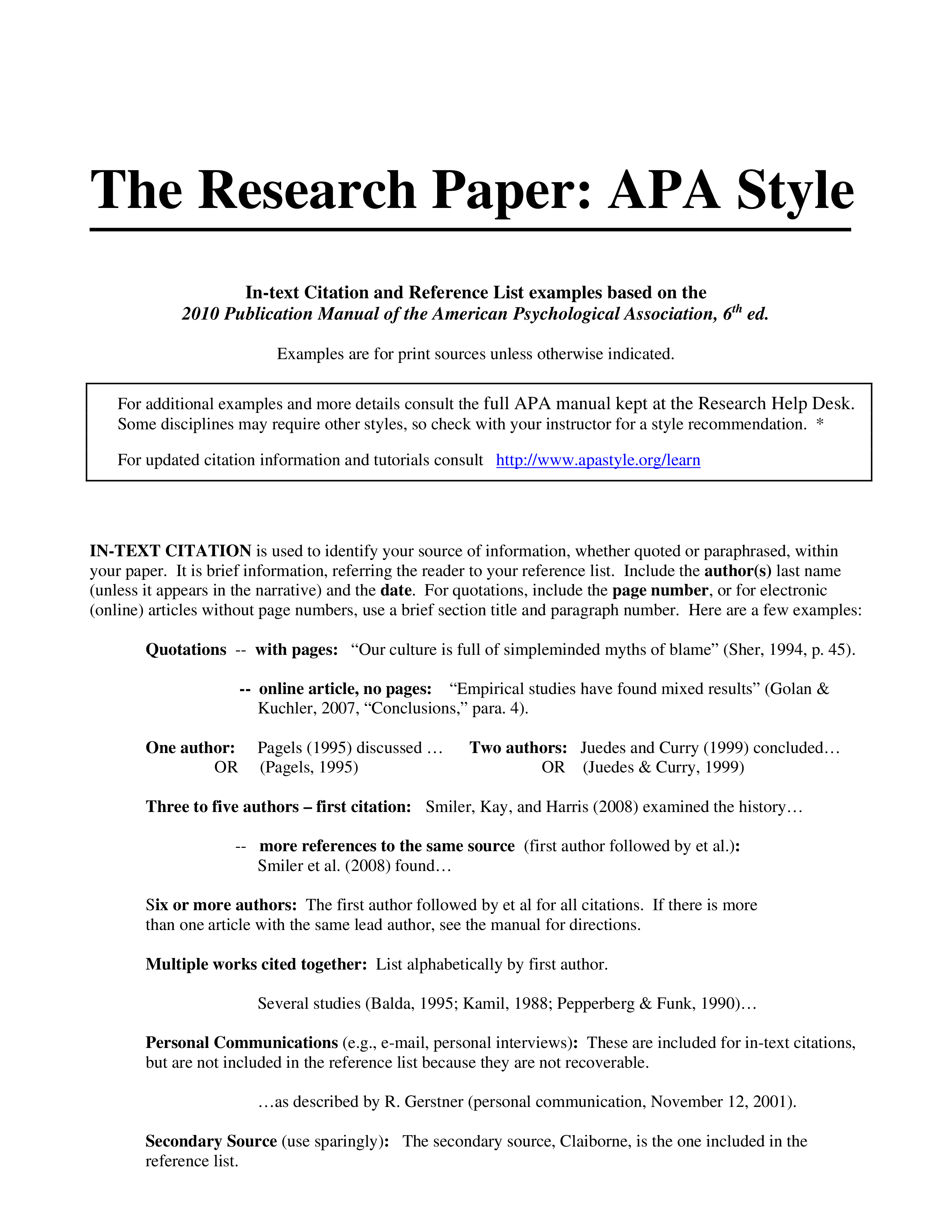
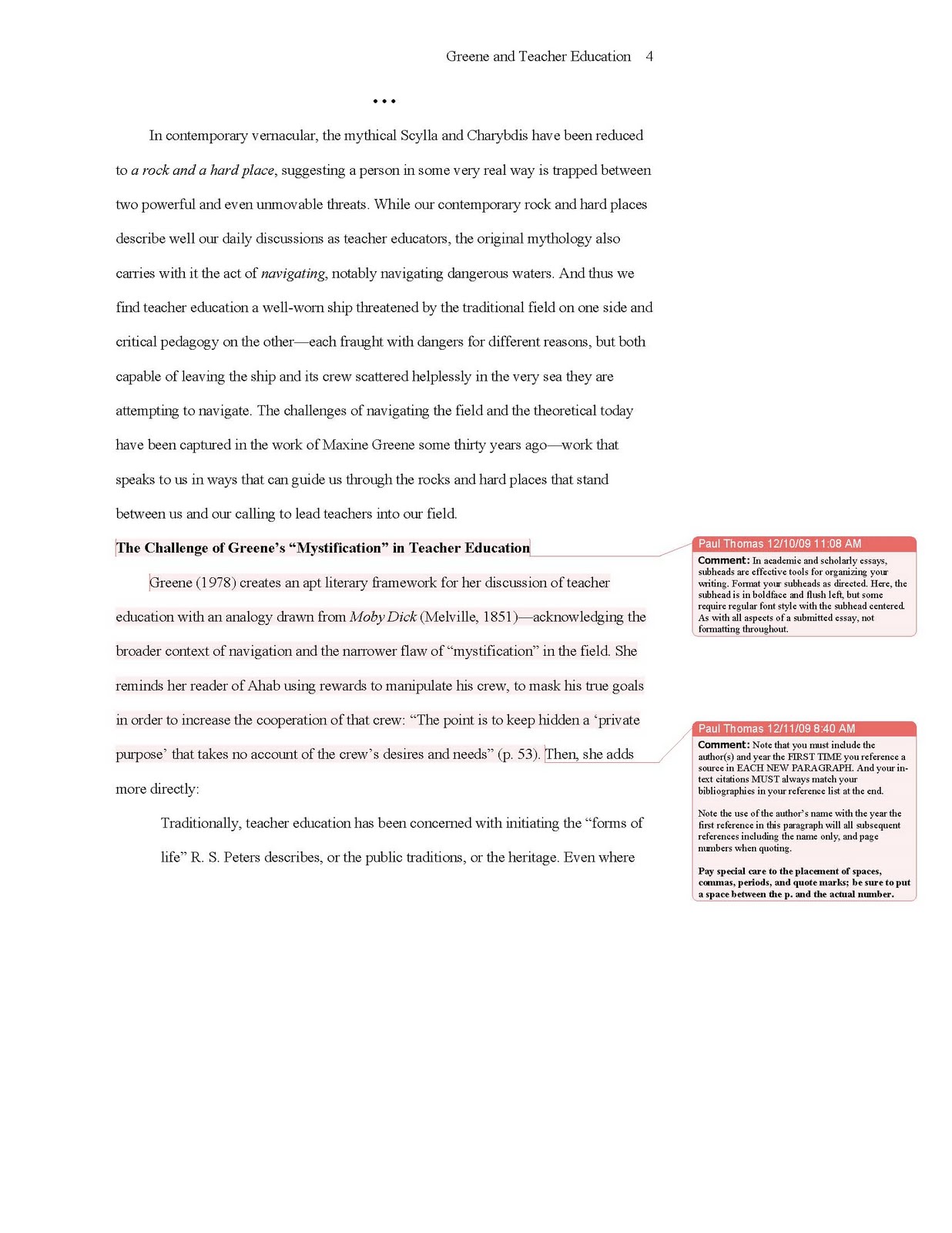
In-text citations are the mechanism by which you credit others' ideas within the body of your paper. APA uses an author-date system.
Narrative vs. Parenthetical Citations
There are two ways to cite sources in the text:
- Parenthetical: The author and date appear in parentheses at the end of the sentence (Smith, 2024).
- Narrative: The author's name is part of the sentence logic, with the date in parentheses immediately following. For example: "According to Smith (2024), the results were significant."
Multiple Authors
For works with two authors, always cite both names. For works with three or more authors, use the first author's name followed by "et al." from the very first citation. This 7th Edition rule significantly streamlined the process compared to previous versions.
Direct Quotations
When quoting directly, you must include a page number (e.g., Smith, 2024, p. 15). If you are citing a website without page numbers, use paragraph numbers (para. 4) or section headings.
Constructing the Reference List
The reference list is located at the end of the paper on a new page titled "References" (bolded and centered). Every source cited in the text must appear in the reference list, and vice versa.
General Format
References are organized alphabetically by the author's last name. They use a hanging indent, where the first line of each entry is flush left and subsequent lines are indented 0.5 inches.
Common Reference Examples
- Journal Article: Author, A. A. (Year). Title of article. Title of Periodical, Volume(Issue), pages. https://doi.org/xxxx
- Book: Author, B. B. (Year). Title of work. Publisher.
- Website: Author, C. C. (Year, Month Day). Title of page. Site Name. URL
In 2026, the use of DOIs (Digital Object Identifiers) is mandatory for all sources that have them. DOIs should be formatted as live URLs (e.g., https://doi.org/10.1037/rev0000126) to ensure they are clickable in digital formats.
Avoiding Common Mistakes in APA Papers
Even with an APA research paper example in hand, certain errors frequently occur. Being aware of these can help you avoid losing points or professional credibility.
- Over-citation and Under-citation: You do not need to cite common knowledge (e.g., "The earth revolves around the sun"), but you must cite any specific data point, theory, or unique phrasing that is not your own.
- Incorrect Use of "Et al.": Remember that "et al." is plural. It should never be used for a single author. Also, ensure there is a period after "al" but not after "et."
- Anthropomorphism: Avoid attributing human actions to non-human entities. Instead of saying "The study found," it is often better to say "The results indicated" or "We found in our study."
- Reference and Citation Mismatch: Ensure that every name and year in your text matches the reference list exactly. A common mistake is a typo in the spelling of a name or a discrepancy in the publication year.
- Title Case vs. Sentence Case: In the reference list, article and book titles use sentence case (only the first word and proper nouns are capitalized). However, journal titles use title case (all major words capitalized). This is a subtle but frequent area of error.
Frequently Asked Questions
Do I need to use "Running head:" in the header?
No. In the APA 7th Edition (standard in 2026), the label "Running head:" is no longer used. For professional papers, you simply put the shortened title in all caps in the header. For student papers, you usually omit the running head entirely and only include the page number.
How do I cite a source with no author?
If a source has no identified author, use the first few words of the title in the in-text citation, placed in quotation marks. For example: ("New Research Trends," 2025). In the reference list, the title moves to the author position.
What is the rule for citing a source I found in another source?
This is known as a secondary source. You should try to find the original source if possible. If you cannot, cite the original work in the text but provide the citation for the source you actually read. For example: (Miller, 2019, as cited in Smith, 2024). Only Smith (2024) would appear in your reference list.
Is the abstract required for every APA paper?
No. Most student papers do not require an abstract unless the instructor specifically requests one. Professional papers intended for publication almost always require an abstract of 150 to 250 words.
Can I use "I" or "we" in an APA research paper?
Yes. APA style encourages the use of the first person when describing actions you took as a researcher (e.g., "I interviewed the participants"). However, avoid using the "editorial we" (referring to people in general) and stay focused on the research process.
Next Steps for Finalizing Your Paper
Once you have followed an APA research paper example to structure your work, the final step is a rigorous proofread. Check your heading levels for consistency and ensure your reference list is perfectly alphabetized. Utilize the official APA Style website or the Purdue Online Writing Lab (OWL) for specific edge cases, such as citing social media posts or AI-generated text, which have specific guidelines updated as of 2024-2026. Finally, ensure your DOI links are active and that your margins haven't shifted during the formatting of tables or figures.