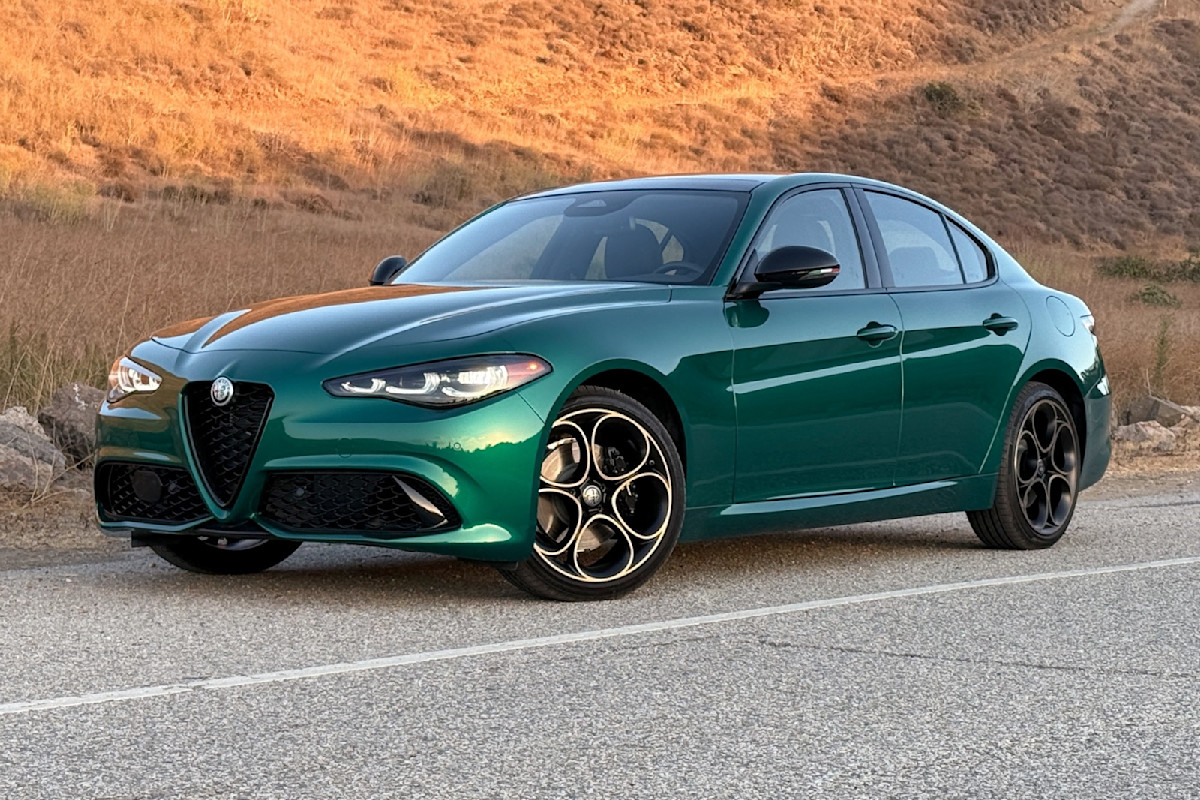
The Alfa Romeo Giulia achieves its signature 0–60 mph sprint in as little as 3.8 seconds for the high-performance Quadrifoglio trim, while the standard 2.0L turbocharged models complete the feat in approximately 5.1 to 5.5 seconds. This rapid acceleration is the result of a class-leading power-to-weight ratio, a lightweight carbon fiber driveshaft, and a sophisticated ZF 8-speed automatic transmission.
The Engineering Philosophy Behind the Giulia’s Acceleration
To understand how the Alfa Romeo Giulia delivers its impressive zero to 60 mph sprint, one must first look at the "Giorgio" platform upon which it is built. In 2026, this platform remains a benchmark for rear-wheel-drive architecture, prioritizing a 50/50 weight distribution and extreme weight reduction. Acceleration is not merely a product of engine output; it is a calculation involving traction, rotational mass, and gear ratios.
Alfa Romeo engineers utilized lightweight materials extensively throughout the Giulia’s construction. The most notable inclusion across all trims—from the base Sprint to the range-topping Quadrifoglio—is the standard carbon fiber driveshaft. By reducing the rotational inertia of the drivetrain, the engine can transfer power to the wheels with significantly less parasitic loss. This means that when the driver floors the accelerator, the response is near-instantaneous, a critical factor in achieving competitive 0–60 times.
Furthermore, the use of aluminum for the doors, fenders, and engine components keeps the curb weight lower than many of its German competitors. A lighter vehicle requires less force to overcome inertia, allowing even the four-cylinder variants to punch above their weight class in short-distance sprints.
The 2.0L Turbocharged Engine: Performance for the Everyman
The majority of Giulia models on the road in 2026 are powered by the 2.0L direct-injection turbocharged inline-four engine. This powerplant is designed to provide a balance between daily drivability and the spirited performance Alfa Romeo is known for. It produces 280 horsepower and 306 lb-ft of torque, with the torque peak arriving as low as 2,000 RPM.
This low-end torque is essential for the 0–60 mph sprint. Because the turbocharger is a twin-scroll design, turbo lag is minimized, ensuring that the car begins its surge forward the moment the throttle is engaged. In the Rear-Wheel Drive (RWD) configuration, the Giulia Sprint and Veloce typically clock in at 5.5 seconds. However, when equipped with the Q4 All-Wheel Drive (AWD) system, that time drops to roughly 5.1 seconds. The AWD system provides the necessary bite to prevent wheel spin, effectively "launching" the car more efficiently on varied road surfaces.
The integration of the MultiAir electro-hydraulic variable valve lift system also plays a role. By controlling the intake air directly through the intake valves without a throttle valve, the engine achieves higher volumetric efficiency. In practical terms, this results in a more aggressive power delivery during the initial stages of acceleration.
The Quadrifoglio: A Ferrari-Derived Masterpiece
When discussing how the Alfa Romeo Giulia delivers the zero to 60 sprint, the Quadrifoglio is the undisputed champion of the lineup. It utilizes a 2.9L 90-degree V6 twin-turbocharged engine that produces 505 horsepower and 443 lb-ft of torque. Heavily influenced by Ferrari’s V8 engineering, this engine allows the Giulia to compete with dedicated supercars.
The Quadrifoglio’s 3.8-second 0–60 time is achieved through several specialized technical features:
- Cylinder Deactivation and Management: While primarily a fuel-saving measure, the engine management system is tuned to transition from efficiency to maximum performance in milliseconds when the "Race" mode is engaged.
- Short Stroke Design: The engine's oversquare design (larger bore than stroke) allows it to rev freely and reach its power peak quickly.
- Active Aero Splitter: At higher speeds during a sprint, the carbon fiber active aero splitter adjusts to manage downforce, though its impact is more felt as the car approaches triple-digit speeds rather than the initial 0–60 burst.
The Quadrifoglio also features a unique torque-vectoring rear differential. Unlike a traditional limited-slip differential that uses brakes to manage wheel spin, this system uses two clutches to direct power to the wheel with the most grip. During a hard launch, this ensures that every bit of the V6’s power is converted into forward momentum rather than tire smoke.
Transmission and Gear Ratios: The ZF 8-Speed Advantage
No engine can deliver a fast 0–60 sprint without a capable transmission. Every Giulia is equipped with the ZF 8HP 8-speed automatic transmission. This gearbox is widely considered one of the best in the automotive industry, and Alfa Romeo’s specific tuning makes it a key component of the car's performance.
The transmission is capable of shifting gears in as little as 100 milliseconds when in its most aggressive setting. In a 0–60 sprint, the first three gear ratios are optimized for acceleration. The gear spacing is tight, ensuring the engine remains in the heart of its power band as the car moves through the gears.
The driver’s interaction with the transmission via the column-mounted aluminum paddle shifters (available on most trims) provides a tactile connection, but for the fastest 0–60 times, the transmission’s onboard computer is usually more efficient when left in "Dynamic" or "Race" mode. The software monitors throttle position, lateral G-forces, and wheel speed to determine the exact millisecond a shift should occur to maximize traction and torque.
Comparative Performance Table
The following table outlines the acceleration capabilities of the primary Giulia configurations available in 2026.
| Model Trim | Engine Type | Horsepower | Torque (lb-ft) | Drivetrain | 0–60 MPH (Seconds) |
|---|---|---|---|---|---|
| Giulia Sprint/Ti | 2.0L Turbo I4 | 280 | 306 | RWD | 5.5 |
| Giulia Veloce | 2.0L Turbo I4 | 280 | 306 | AWD (Q4) | 5.1 |
| Giulia Competizione | 2.0L Turbo I4 | 280 | 306 | AWD (Q4) | 5.1 |
| Giulia Quadrifoglio | 2.9L Twin-Turbo V6 | 505 | 443 | RWD | 3.8 |
| Giulia GTAm (Ltd) | 2.9L Twin-Turbo V6 | 540 | 443 | RWD | 3.6 |
Note: Times may vary based on environmental conditions, tire wear, and fuel quality.
The Impact of Tires and Road Surfaces
While the mechanical components of the Giulia are designed for speed, the final delivery of the zero to 60 sprint is heavily dependent on the interface between the car and the road: the tires.
Standard Giulia models often come equipped with all-season run-flat tires, which offer a balance of longevity and grip. However, owners looking to replicate the manufacturer's 5.1 or 5.5-second claims often switch to summer performance tires, such as the Pirelli P Zero. These tires use a softer compound that provides a higher coefficient of friction, allowing the car to put down more power without breaking traction.
In the Quadrifoglio, the tires are even more specialized. It typically utilizes the Pirelli P Zero Corsa, a tire developed specifically for high-performance Alfas. These tires are almost slick in their design, maximizing the contact patch. If these tires are not properly warmed up, the 0–60 time can easily slip into the 4-second range because the rear wheels will struggle to find purchase on the pavement.
The DNA Drive Mode System
Alfa Romeo’s DNA system (Dynamic, Natural, Advanced Efficiency) is more than just a marketing gimmick; it fundamentally alters how the car delivers its performance. In "Dynamic" mode, the following changes occur to assist in a fast 0–60 sprint:
- Throttle Mapping: The relationship between the pedal position and the butterfly valve is sharpened, providing more immediate response.
- Braking: The Integrated Brake System (IBS) pre-fills the lines for faster response, though this is more relevant for stopping than accelerating.
- Steering: The electronic power steering weight increases for better feedback.
- Engine Tuning: The turbocharger’s wastegate is managed to keep boost levels higher for longer periods.
In the Quadrifoglio, a fourth mode, "Race," is added. This mode disables the Electronic Stability Control (ESC) and opens the exhaust valves completely. While "Race" mode offers the potential for the fastest sprint, it requires significant driver skill, as the safety nets that prevent the car from spinning out are removed.
Maintaining Performance in 2026
To ensure an Alfa Romeo Giulia continues to deliver its peak zero to 60 sprint as the vehicle ages into 2026, consistent maintenance is required. Performance engines with high boost pressures are sensitive to heat and lubrication quality.
- Oil Quality: Using the manufacturer-specified synthetic oil is non-negotiable. High-speed sprints generate significant heat in the turbocharger bearings; inferior oil can break down, leading to reduced efficiency or eventual turbo failure.
- Air Filtration: Turbocharged engines are essentially giant air pumps. A clogged air filter restricts the engine's ability to "breathe," directly impacting the 0–60 time.
- Spark Plugs: In the high-compression environment of the 2.0L and 2.9L engines, even a slightly fouled spark plug can cause a micro-misfire under heavy load, ruining an acceleration run.
- Tire Pressure: Under-inflated tires increase rolling resistance, while over-inflated tires reduce the contact patch. Both are detrimental to a perfect launch.
How the Giulia Compares to the Competition
In the 2026 landscape of premium sport sedans, the Giulia remains one of the most "analog" feeling cars in terms of feedback, despite its digital sophistication. When compared to the BMW 3 Series or the Audi A4, the Giulia often feels more eager off the line.
The BMW 330i, a direct competitor to the Giulia 2.0L, offers similar 0–60 times, but the Giulia’s steering is significantly quicker, making the sensation of speed more pronounced. The Audi A4, with its Quattro AWD system, often matches the Giulia’s AWD 0–60 times in wet conditions, but the Giulia’s RWD-biased Q4 system is generally preferred by enthusiasts for its more dynamic handling characteristics during the transition from a sprint into a corner.
The Quadrifoglio occupies a unique space against the BMW M3 and Mercedes-AMG C63. While the newest iterations of those competitors have moved toward heavy hybridization in 2026, the Giulia Quadrifoglio’s reliance on pure internal combustion and lightweighting gives it a distinct power-to-weight advantage that is felt most clearly during that initial 0–60 mph dash.
FAQ
Does the Alfa Romeo Giulia have launch control?
The Alfa Romeo Giulia does not have a "dedicated" launch control button like some of its competitors. However, a similar effect can be achieved in "Dynamic" or "Race" mode by using the "brake torquing" method: holding the brake firmly with the left foot while building engine RPM with the right, then releasing the brake rapidly. In the Quadrifoglio, the car's computers will manage the torque delivery to minimize wheel spin during this process.
Does the AWD (Q4) system make the car faster to 60 mph?
Yes, the Q4 All-Wheel Drive system generally makes the Giulia about 0.4 seconds faster from 0 to 60 mph than the Rear-Wheel Drive version. This is because the system can transfer up to 50% of the engine’s torque to the front wheels almost instantaneously if it detects rear-wheel slip, providing better traction at the start of the sprint.
Will using premium fuel improve my 0–60 time?
The Alfa Romeo Giulia is calibrated for premium high-octane gasoline. Using lower-grade fuel will cause the engine management system to retard the ignition timing to prevent engine knocking. This results in a noticeable drop in horsepower and torque, which will significantly slow down the 0–60 mph sprint. For the best performance, 91 octane or higher is required.
Is the zero to 60 sprint different in the 2026 models?
As of 2026, the mechanical specifications for the Giulia's internal combustion engines have remained consistent with the refinements made in the previous few model years. While software updates have smoothed out gear transitions, the physical 0–60 times remain within the established range of 3.8 to 5.5 seconds depending on the trim and drivetrain.
Can the Giulia GTA or GTAm go faster than the Quadrifoglio?
Yes, the limited-edition Giulia GTAm is the fastest accelerating version of the car. Due to a weight reduction of approximately 220 pounds and an increase in power to 540 horsepower, it can deliver a zero to 60 sprint in roughly 3.6 seconds. These models are rare in 2026 and are considered collector's items.
Final Considerations for Prospective Owners
For those seeking to experience how the Alfa Romeo Giulia delivers the zero to 60 sprint, the choice of trim is paramount. The 2.0L AWD models offer the most consistent and "usable" speed for daily driving and inclement weather. However, for the purest expression of Italian performance, the Quadrifoglio remains the gold standard. Regardless of the trim, the combination of the Giorgio platform, the carbon fiber driveshaft, and the ZF transmission ensures that the Giulia remains one of the most rewarding sport sedans to drive in 2026. To maximize your vehicle's performance, ensure you are utilizing high-performance tires and maintaining a strict adherence to the manufacturer's service schedule.