Whether you must pay taxes on student loan forgiveness depends on the specific forgiveness program, your state of residence, and the year your debt is canceled. While programs like Public Service Loan Forgiveness (PSLF) are permanently exempt from federal income tax, other forms of cancellation—such as Income-Driven Repayment (IDR) forgiveness—may trigger federal tax liability depending on current federal tax code provisions and individual insolvency status.
Overview of Student Loan Forgiveness Tax Rules
The taxability of forgiven student loan debt in the United States is governed by the Internal Revenue Code (IRC) at the federal level and individual state tax statutes at the state level. Historically, the Internal Revenue Service (IRS) treated forgiven debt as taxable gross income under Section 61(a)(11) of the IRC, which defines cancellation of debt (COD) as reportable income. Over time, Congress enacted targeted statutory exceptions to protect specific borrowers from unexpected tax burdens.
A major temporary shift occurred with the passage of the American Rescue Plan Act (ARPA) of 2021. ARPA added Section 108(f)(5) to the Internal Revenue Code, making virtually all student loan discharges—including private loan forgiveness and Income-Driven Repayment (IDR) discharges—federally tax-free for tax years 2021 through 2025.
Because the temporary ARPA relief provision carried a statutory expiration date of December 31, 2025, the tax treatment for student loan discharges taking place in 2026 and subsequent years depends on whether the forgiveness program is backed by permanent statutory exemptions or temporary measures. Understanding which category your loan discharge falls into is essential for accurate financial planning and avoiding a sudden tax bill, commonly referred to as a "tax bomb."
Taxability Breakdown by Forgiveness Program
Not all student loan forgiveness programs are treated equally by tax authorities. Some programs carry permanent tax-exempt status written into federal law, while others revert to taxable status when temporary legislation expires.
| PERMANENTLY TAX-FREE (Federal) | POTENTIALLY TAXABLE (Federal) |
|---|---|
| - Public Service Loan (PSLF)- Teacher Loan Forgiveness- Borrower Defense to Repayment- Closed School Discharge | - Income-Driven Repayment (IDR)- Non-statutory discharge |
Public Service Loan Forgiveness (PSLF)
Discharges granted under the Public Service Loan Forgiveness (PSLF) program and the Temporary Expanded PSLF (TEPSLF) program are 100% federally tax-free. This protection is codified under IRC Section 108(f)(1), which explicitly excludes from gross income any student loan discharge contingent upon the borrower working for a specified period in designated public service occupations. This exclusion is permanent and does not rely on temporary congressional extensions.
Income-Driven Repayment (IDR) Plans
Forgiveness achieved after completing 20 or 25 years of qualifying payments under Income-Driven Repayment plans—such as Saving on a Valuable Education (SAVE), Pay As You Earn (PAYE), Income-Based Repayment (IBR), and Income-Contingent Repayment (ICR)—presents a different tax scenario.
During the 2021–2025 tax window created by ARPA, IDR forgiveness was federally tax-exempt. However, for discharges occurring in tax year 2026 and beyond, IDR forgiveness is treated as taxable income at the federal level unless Congress enacts new legislation to extend the exclusion or borrowers qualify for specific tax exceptions, such as the insolvency exclusion under IRS Section 108(a)(1)(B).
Teacher Loan Forgiveness
Borrowers who receive up to $17,500 in loan forgiveness under the Teacher Loan Forgiveness program after teaching full-time for five consecutive years in a low-income school or educational service agency do not owe federal income tax on the forgiven amount. Like PSLF, Teacher Loan Forgiveness is permanently exempt from federal taxation under IRC Section 108(f)(1).
Total and Permanent Disability (TPD) Discharge
Discharges granted to federal and private student loan borrowers who experience total and permanent physical or mental disability were made federally tax-free through temporary provisions in the Tax Cuts and Jobs Act (TCJA) of 2017, which were aligned through 2025 with ARPA. For TPD discharges processed in 2026, federal taxability depends on whether administrative rules or updated federal legislation maintain tax-free status. Borrowers receiving TPD discharges who face federal tax exposure can frequently utilize the IRS insolvency exclusion to offset potential liabilities.
Borrower Defense to Repayment and Closed School Discharges
Forgiveness issued under Borrower Defense to Repayment (for borrowers defrauded by their postsecondary institutions) and Closed School Discharges are generally non-taxable. The IRS has consistently maintained through administrative rulings and guidance that relief provided due to institutional misrepresentation or school closure represents a non-taxable adjustment to the purchase price of the education or a return of capital, rather than reportable debt cancellation income.
Employer Student Loan Repayment Assistance
Under IRC Section 127, employers can offer up to $5,250 annually in tax-free educational assistance benefits, which can be applied directly toward employee student loan principal or interest. Benefits provided up to the $5,250 annual ceiling are excluded from the employee's gross taxable income. Any employer-provided student loan assistance exceeding $5,250 in a single calendar year is added to the employee’s W-2 taxable wages and subject to income and payroll withholding taxes.
Federal vs. State Taxability Summary
State tax laws do not automatically follow federal rules. Some states conform directly to the federal Internal Revenue Code, while others maintain independent tax statutes regarding debt cancellation.
| Loan Forgiveness Program | Federal Tax Status (2026 Onward) | State Tax Exposure | Primary Reporting Document |
|---|---|---|---|
| Public Service Loan Forgiveness (PSLF) | Permanently Tax-Free | Exempt in almost all states | None (Form 1099-C not issued) |
| Teacher Loan Forgiveness | Permanently Tax-Free | Exempt in almost all states | None |
| Income-Driven Repayment (IDR) | Taxable (unless extended) | High risk in non-conforming states | IRS Form 1099-C |
| Borrower Defense to Repayment | Tax-Free (Administrative Ruling) | Exempt in most states | IRS Form 1099-C (if issued, marked non-taxable) |
| Closed School Discharge | Tax-Free | Exempt in most states | None or Form 1099-C (Exempt) |
| Total & Permanent Disability (TPD) | Taxable / Dependent on statute | Moderate risk | IRS Form 1099-C |
| Employer Repayment Benefit | Tax-Free up to $5,250/year | Varies by state conformity | Form W-2 (Overages included in Box 1) |
State Income Tax Rules on Forgiven Student Debt
Even when student loan forgiveness is federally tax-exempt, state income tax liabilities can still apply. State income tax treatment depends on how each state's legal code adopts changes to the federal Internal Revenue Code:
- Rolling Conformity States: These states automatically adopt federal tax code definitions and exclusions as soon as federal laws are enacted. If a discharge is federally tax-exempt, it is automatically exempt from state income tax in these jurisdictions.
- Static (Fixed-Date) Conformity States: These states adopt the Internal Revenue Code as it existed on a specific date. If the state static code date does not align with federal legislation, the state may treat forgiven loan balances as taxable state income.
- Non-Conforming States: These states maintain independent statutory definitions for taxable gross income and explicitly decoupled from federal student loan tax exclusions.
Key States with Specific Tax Considerations
Several states have historically levied state income taxes on certain forgiven student loan balances, or maintained laws requiring specific state-level tax filings:
- Indiana: Indiana state law does not automatically conform to federal exemptions for certain student loan discharges. Forgiven IDR balances may be subject to Indiana state and county income taxes.
- Mississippi: Mississippi taxes forgiven debt as gross income unless the discharge is explicitly exempted by state statute. Public service forgiveness is generally protected, but IDR discharges are vulnerable to state income tax.
- North Carolina: North Carolina tax law explicitly decoupled from federal tax exclusions for generalized student loan forgiveness, requiring taxpayers to add back canceled loan balances when calculating state taxable income unless covered by public service exemptions.
- Wisconsin & Arkansas: Both states have historically required specific statutory updates to align state tax codes with federal exclusions. Borrowers residing in these states must verify current state department of revenue guidelines prior to tax filing.
If you reside in a state that taxes forgiven student debt, your state tax obligation is calculated by applying your state's marginal income tax rate to the total principal and interest canceled.
How Taxable Loan Forgiveness Works: The "Tax Bomb"
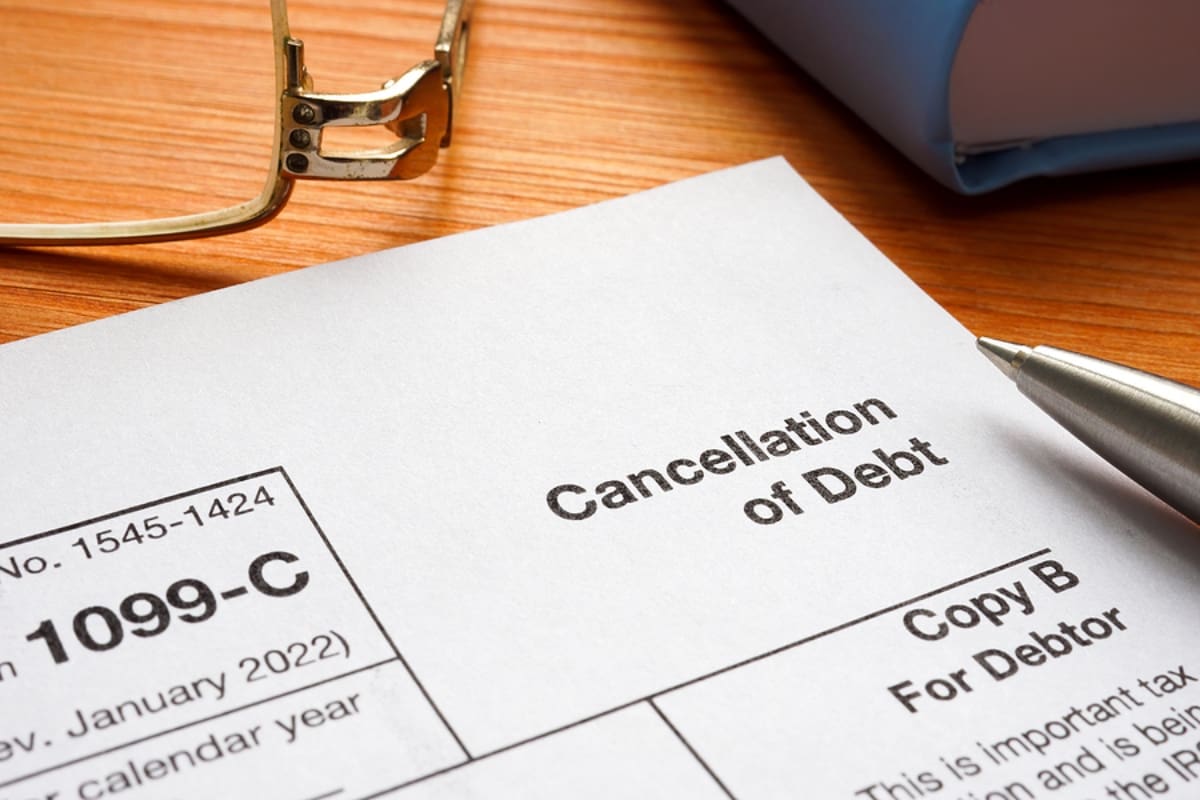
When a student loan balance is forgiven under a program that is considered taxable, the lender or loan servicer files IRS Form 1099-C (Cancellation of Debt) with the IRS and sends a copy to the borrower. Box 2 of Form 1099-C displays the exact amount of debt canceled, which includes both principal and accrued, unpaid interest.
- Loan Servicer / Lender
- Sends Form 1099-C (Box 2: Amount Canceled)
- IRS (Reports gross income addition)
- Borrower (Must report on Form 1040)
Calculating the Tax Impact
The amount listed on Form 1099-C is added directly to your standard adjusted gross income (AGI) on IRS Form 1040. This phantom income can push you into a higher federal marginal income tax bracket and trigger additional state tax obligations.
Example Calculation:
Assume a single borrower earns a regular salary of $60,000 per year and receives $80,000 in IDR loan forgiveness in a taxable tax year.
- Adjusted Gross Income: Regular salary ($60,000) + Forgiven Debt ($80,000) = $140,000 total gross income.
- Tax Bracket Shift: The added $80,000 elevates the borrower from the 22% federal tax bracket into the 24% marginal bracket for the earnings exceeding federal threshold limits.
- Tax Liability: Assuming an effective federal tax rate of roughly 22% on the canceled portion, the borrower faces an additional federal tax liability of approximately $17,600, plus any applicable state taxes.
Because the forgiven debt is not paid in cash, the borrower must pay this tax liability out-of-pocket when filing their annual tax return.
How to Reduce or Eliminate Taxes using the Insolvency Exclusion
Borrowers who face tax liabilities on canceled student loans may qualify to eliminate or substantially reduce their tax bill using the Insolvency Exclusion under IRC Section 108(a)(1)(B).
What Is Insolvency?
Under IRS regulations, a taxpayer is considered insolvent when their total liabilities (debts) exceed the total fair market value (FMV) of all their assets immediately before the debt cancellation occurs.
$$\text{Insolvency Amount} = \text{Total Liabilities} - \text{Total Asset Fair Market Value}$$
If you are insolvent immediately before your student loan is forgiven, you can exclude the canceled debt from your taxable income up to the total amount by which you are insolvent.
SCENARIO A: Fully Insolvent
- Assets: $30,000 | Liabilities: $100,000 | Insolvency: $70,000
- Forgiven Debt: $50,000
- Taxable Portion: $0 (Entire $50k excluded)
SCENARIO B: Partially Insolvent
- Assets: $50,000 | Liabilities: $70,000 | Insolvency: $20,000
- Forgiven Debt: $50,000
- Taxable Portion: $30,000 ($50k forgiven - $20k insolvency limit)
Calculating Insolvency Step-by-Step
To claim the insolvency exclusion, you must complete the Insolvency Worksheet found in IRS Publication 4681 based on your financial position the day before the loan discharge occurred:
- Calculate Assets: Add up the fair market value of everything you own. This includes bank accounts, retirement accounts (401k, IRA), real estate, vehicles, household goods, jewelry, and investments.
- Calculate Liabilities: Add up all your outstanding debts. This includes credit card balances, mortgage balances, car loans, medical bills, unpaid taxes, and the full amount of your student loans (before forgiveness).
- Determine Insolvency Limit: Subtract your total assets from your total liabilities. If liabilities exceed assets, that difference is your insolvency limit.
- Apply Exclusion: You do not pay federal tax on the forgiven student loan balance up to that insolvency limit. Any forgiven debt exceeding your insolvency limit is reported as taxable income.
How to File IRS Form 982
To claim the exclusion, submit IRS Form 982 (Reduction of Tax Attributes Due to Discharge of Indebtedness) alongside your federal income tax return (Form 1040). You must check line 1b (discharge of indebtedness in a title 11 case or to the extent insolvent) and record the excluded amount on line 2.
IRS Payment Options if You Owe
If you owe tax on forgiven student debt and cannot qualify for insolvency, the IRS provides several structured payment arrangements:
- Short-Term Payment Plan: Grants up to 180 additional days to pay the full balance, though interest and penalties accumulate.
- IRS Installment Agreement: Allows monthly payments over a period of up to 72 months (6 years).
- Offer in Compromise (OIC): An agreement between a taxpayer and the IRS that settles a tax liability for less than the full amount owed if paying in full would create severe financial hardship.
Common Mistakes to Avoid
- Assuming All Forgiveness Is Tax-Free: Assuming IDR discharges are automatically exempt from federal tax after 2025 without checking current statutory guidelines.
- Ignoring State Tax Filing Requirements: Forgetting that states like Indiana or North Carolina may tax loan cancellation even if the federal government does not.
- Failing to Calculate Insolvency Prior to Discharge: Disposing of assets or paying off other debts immediately before loan discharge can reduce your insolvency margin, increasing your overall tax exposure.
- Failing to File Form 982: Omitting Form 982 when you are eligible for the insolvency exclusion causes the IRS to process your Form 1099-C as fully taxable income.
- Miscalculating Asset Values: Underreporting asset values on IRS worksheets can trigger audits, while overreporting asset values unnecessarily increases your calculated tax burden.
Frequently Asked Questions
Do I have to pay taxes on Public Service Loan Forgiveness (PSLF)?
No. Debt forgiven under the PSLF program is permanently exempt from federal income tax under Section 108(f)(1) of the Internal Revenue Code. Additionally, almost all U.S. states follow this federal rule and do not levy state income tax on PSLF discharges.
What happens if I receive an IRS Form 1099-C for my forgiven student loan?
IRS Form 1099-C reports canceled debt to you and the IRS. If your forgiveness is non-taxable (such as PSLF or Borrower Defense), you do not add the amount to your taxable income, though you should retain your forgiveness documentation. If the discharge is taxable, you must report the amount on your Form 1040 unless you qualify for an exclusion using IRS Form 982.
Will I owe taxes if my student loan is forgiven under an Income-Driven Repayment (IDR) plan?
Under the American Rescue Plan Act, IDR forgiveness was federally tax-free through tax year 2025. For discharges occurring in 2026 and later, IDR forgiveness is subject to federal income tax unless Congress extends the provision or you qualify for the IRS insolvency exclusion.
How does the IRS know if I am insolvent when my student loan is forgiven?
The IRS does not automatically calculate insolvency for you. You must proactively document your financial position on the day before the debt discharge using the worksheet in IRS Publication 4681 and file IRS Form 982 with your annual tax return.
Are private student loans taxed differently than federal student loans when forgiven?
Private student loan forgiveness follows general tax rules. If a private lender cancels or settles debt for less than the full balance, the canceled amount is considered taxable gross income unless covered by temporary federal provisions, statutory exclusions, or the insolvency exception.
Next Steps for Borrowers
- Identify Your Forgiveness Timeline and Program: Determine the exact year your loans will be forgiven and whether your discharge falls under a permanently tax-exempt program (like PSLF) or an IDR plan.
- Monitor Annual Federal and State Tax Rules: Review federal tax laws and state department of revenue updates for the tax year in which your forgiveness takes effect.
- Conduct an Insolvency Pre-Assessment: If facing potential taxable forgiveness under IDR, list your total assets and liabilities ahead of your discharge date to determine if you qualify for the Section 108 insolvency exclusion.
- Consult a Qualified Tax Professional: Work with a Certified Public Accountant (CPA) or Enrolled Agent (EA) experienced in debt cancellation rules to prepare IRS Form 982 and calculate state tax obligations accurately.