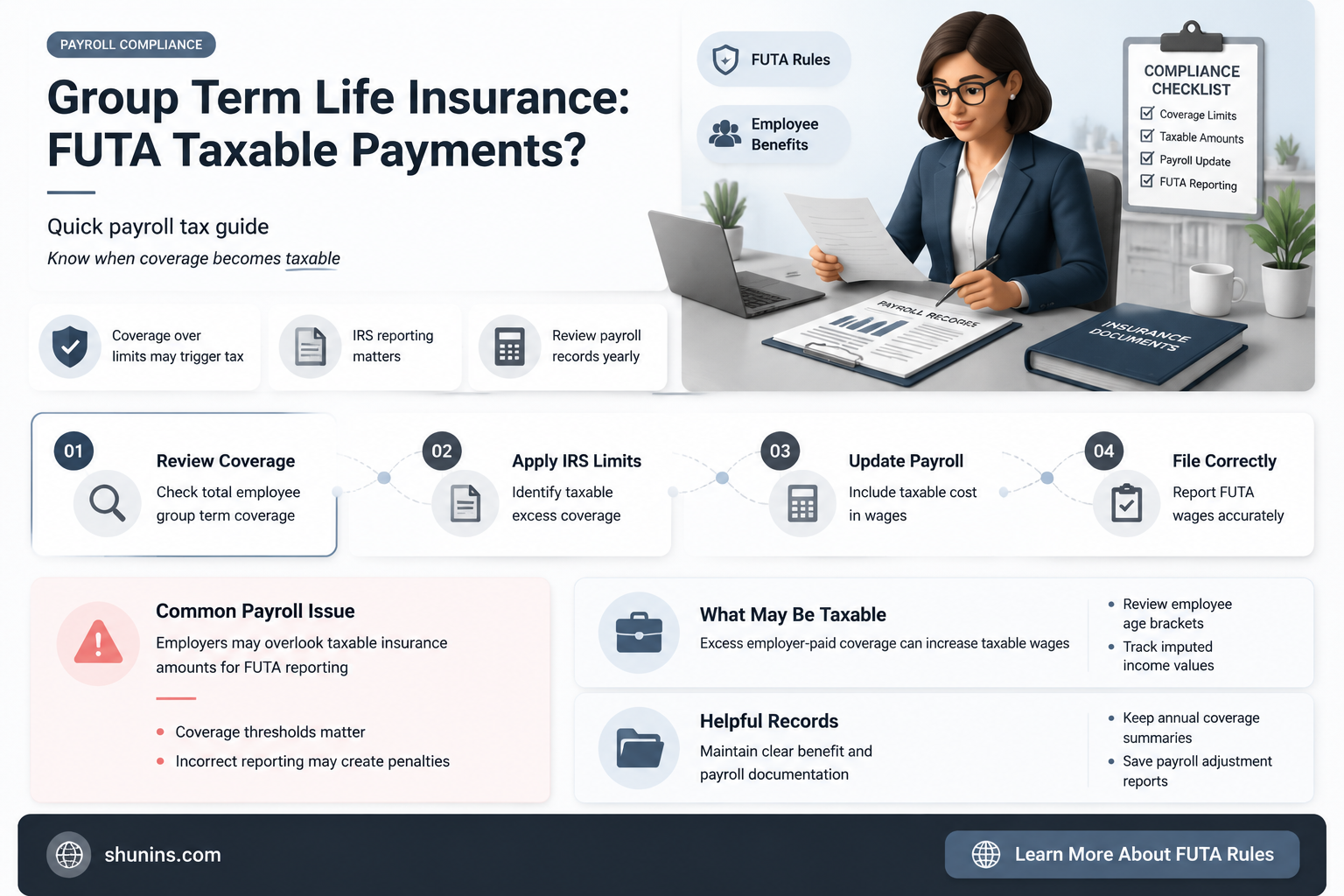
Employer-paid premiums for group-term life insurance are not taxable for FUTA (Federal Unemployment Tax Act) purposes. Under Internal Revenue Code Section 3306(b)(2)(C), employer contributions toward group-term life insurance coverage are explicitly excluded from FUTA taxable wages. This full exemption applies to both standard coverage under $50,000 and coverage exceeding the $50,000 threshold.
Understanding Group-Term Life Insurance and Payroll Taxes
Employer-provided group-term life insurance (GTLI) is one of the most common employee fringe benefits offered across businesses in the United States. Under Internal Revenue Code (IRC) Section 79, employers can offer up to $50,000 of group-term life insurance coverage to employees as a tax-free benefit. When coverage exceeds $50,000, the cost of the coverage above that limit becomes a taxable fringe benefit, commonly referred to as imputed income.
However, payroll tax obligations vary depending on the specific tax type. While federal income tax (FIT) withholding, Federal Insurance Contributions Act (FICA) taxes (Social Security and Medicare), and Federal Unemployment Tax Act (FUTA) taxes frequently overlap, fringe benefits carry unique exclusions under the tax code.
For payroll specialists, tax accountants, and human resources administrators, distinguishing between FICA taxable wages and FUTA taxable wages is critical. Mischaracterizing group-term life insurance payments on federal tax returns can lead to overpaid employment taxes, erroneous Form 940 filings, and unnecessary administrative burdens during payroll audits.
Statutory Basis: Why GTLI Payments Are Exempt from FUTA
The exclusion of group-term life insurance from FUTA tax is codified directly within federal law. Under IRC § 3306(b)(2)(C), the definition of "wages" for federal unemployment tax purposes specifically excludes any payment made to, or on behalf of, an employee or their dependents under a plan or system established by an employer on account of death.
The Internal Revenue Service (IRS) reinforces this statutory exclusion in IRS Publication 15-B (Employer's Tax Guide to Fringe Benefits). In Publication 15-B's Fringe Benefit Inclusion Rules table, group-term life insurance protection is explicitly listed as:
- Federal Income Tax Withholding: Excluded up to $50,000 of coverage. Imputed cost of coverage over $50,000 is included in gross income, but mandatory FIT withholding is not required (though employers may choose to withhold or allow employees to adjust withholding).
- Social Security and Medicare (FICA): Excluded up to $50,000 of coverage. Imputed cost of coverage over $50,000 is subject to Social Security and Medicare taxes.
- Federal Unemployment Tax (FUTA): Exempt entirely. Neither employer-paid premiums nor the calculated imputed income for coverage over $50,000 are subject to FUTA tax.
Because FUTA is an employer-only tax designed to fund the federal administration of unemployment compensation programs, the tax code explicitly shields employer-provided death benefits from this tax liability.
Comparing Tax Treatment: FIT, FICA, FUTA, and SUTA
To understand how group-term life insurance payments flow through payroll, it is helpful to contrast FUTA rules against other common payroll tax requirements. The tax treatment depends heavily on whether the policy coverage amount is equal to or less than $50,000, or if it exceeds $50,000.
| Tax Type | Coverage Up to $50,000 | Imputed Value of Coverage Over $50,000 | Taxpayer Responsibility |
|---|---|---|---|
| Federal Income Tax (FIT) Withholding | Exempt | Exempt from mandatory withholding (included in Box 1 gross income) | Employee |
| Social Security Tax (FICA) | Exempt | Taxable (6.2% up to annual wage cap) | Employer & Employee |
| Medicare Tax (FICA) | Exempt | Taxable (1.45% + Additional Medicare if applicable) | Employer & Employee |
| Federal Unemployment Tax (FUTA) | Exempt | Exempt | Employer Only |
| State Unemployment Tax (SUTA) | Exempt (in vast majority of states) | Exempt (in vast majority of states; check local law) | Employer (varies by state) |
Key Takeaways from the Comparison
- Coverage of $50,000 or Less: Employer contributions are completely exempt from FIT, FICA, and FUTA. No imputed income is calculated or added to employee earnings.
- Coverage Over $50,000: The calculated cost of coverage exceeding $50,000 (determined by IRS Table I) becomes imputed income. This amount is reported as income on Form W-2 (Box 1) and is subject to FICA taxes (Boxes 3 and 5). However, it remains 100% exempt from FUTA tax.
- FUTA Wage Limit: FUTA tax applies only to the first $7,000 of taxable wages paid to each employee in a calendar year at a base rate of 6.0% (typically reduced to 0.6% after the maximum State Unemployment Tax credit). Because GTLI payments are excluded from the definition of wages under IRC § 3306(b), GTLI values are never counted toward an employee's $7,000 FUTA wage base.
How Imputed Income Is Calculated (IRS Table I)
While GTLI is exempt from FUTA, payroll systems must accurately calculate the imputed income of coverage over $50,000 to process FICA taxes and W-2 reporting correctly without accidentally dragging those figures into FUTA calculations.
The IRS provides monthly cost figures per $1,000 of protection based on the employee's age as of the last day of the tax year. These figures are set forth in IRS Publication 15-B (Uniform Premiums for Group-Term Life Insurance Protection):
- Under 25: $0.05 per $1,000 per month
- 25 to 29: $0.06 per $1,000 per month
- 30 to 34: $0.08 per $1,000 per month
- 35 to 39: $0.09 per $1,000 per month
- 40 to 44: $0.10 per $1,000 per month
- 45 to 49: $0.15 per $1,000 per month
- 50 to 54: $0.23 per $1,000 per month
- 55 to 59: $0.43 per $1,000 per month
- 60 to 64: $0.66 per $1,000 per month
- 65 to 69: $1.27 per $1,000 per month
- 70 and older: $2.06 per $1,000 per month
Practical Example Calculation
Suppose an employer provides a 42-year-old employee with $150,000 in group-term life insurance coverage, fully paid by the employer.
- Determine Excess Coverage: $$$150,000 - $50,000 = $100,000 \text{ excess coverage}$$
- Calculate Coverage Units: $$$100,000 / $1,000 = 100 \text{ units}$$
- Lookup IRS Table I Rate: For age 42, the rate is $0.10 per $1,000 per month.
- Calculate Monthly Imputed Income: $$100 \text{ units} \times $0.10 = $10.00 \text{ per month}$$
- Calculate Annual Imputed Income: $$$10.00 \times 12 \text{ months} = $120.00 \text{ annually}$$
Payroll Tax Application for this $120 Imputed Income:
- Federal Income Tax (FIT): Added to Box 1 gross wages on Form W-2. Employer is not required to withhold FIT, but the employee pays income tax on this $120 when filing their annual tax return.
- FICA (Social Security & Medicare): Added to Box 3 and Box 5 on Form W-2. The employer must withhold $7.44 ($120 × 6.2% Social Security) and $1.74 ($120 × 1.45% Medicare) from the employee's regular pay, and match that amount as the employer portion.
- FUTA Tax: $0.00. The $120 imputed income is entirely excluded from FUTA wage calculations. It does not count toward the employee's $7,000 FUTA ceiling, and no FUTA tax is owed on it.
Form W-2 and Form 940 Payroll Reporting Requirements
Proper setup in payroll software ensures that group-term life insurance values are reported accurately on quarterly and annual federal tax forms.
- Group-Term Life Insurance Benefit
- Coverage <= $50,000
- Fully Tax-Exempt
- Excluded from W-2
- Excluded from FUTA
- Coverage > $50,000
- Calculate Imputed Income via IRS Table I
- Add to W-2 Boxes 1, 3, 5
- Report Box 12 (Code C)
- EXCLUDED from FUTA (Form 940)
- Coverage <= $50,000
Form W-2 Reporting Guidelines
When an employee receives GTLI coverage exceeding $50,000, the calculated imputed income must be reported on Form W-2 as follows:
- Box 1 (Wages, tips, other compensation): Include the imputed income amount.
- Box 3 (Social Security wages): Include the imputed income amount (up to the annual Social Security wage base limit).
- Box 5 (Medicare wages and tips): Include the imputed income amount.
- Box 12 (Code C): Report the total taxable value of group-term life insurance coverage over $50,000. Code C allows the IRS to track the imputed income that was included in Box 1.
Form 940 Reporting Guidelines
On Form 940 (Employer's Annual Federal Unemployment Tax Return):
- Part 2, Line 3 (Total payments to all employees): If your payroll software includes total gross compensation including taxable fringe benefits in total payments, GTLI imputed income may be reflected in initial gross totals depending on system setup.
- Part 2, Line 4 (Exempt payments): Payments for group-term life insurance should be included under statutory exemptions/exempt fringe benefits.
- Part 2, Line 7 (Total taxable FUTA wages): GTLI payments are completely excluded from the net taxable FUTA wage figure.
If payroll software is misconfigured, it may accidentally classify Box 12 Code C amounts as taxable FUTA wages, causing employers to pay an unintended 0.6% to 6.0% tax surcharge on life insurance coverage.
State Unemployment Tax (SUTA) and Special Edge Cases
While FUTA is a federal tax governed by federal statute, state unemployment taxes (SUTA) are governed by individual state departments of labor and revenue services.
SUTA Alignment with FUTA
In the vast majority of U.S. states and territories, state unemployment tax codes mirror federal FUTA definitions regarding taxable wages. Consequently, employer-paid group-term life insurance premiums and imputed income are exempt from SUTA in almost all jurisdictions.
However, because states retain independent taxing authority, employers operating in multi-state environments should periodically verify local state unemployment wage definitions.
After-Tax Employee Contributions
If an employer offers a voluntary supplemental group-term life insurance plan where employees pay premiums with after-tax dollars, those employee contributions directly reduce the taxable imputed income calculated under IRS Table I.
For example, if an employee has $120 of annual Table I imputed income but pays $50 annually in post-tax payroll deductions toward the excess coverage, the reportable imputed income drops to $70 ($120 - $50). This reduced figure is subject to FICA and FIT reporting, but remains 100% exempt from FUTA.
Pre-Tax Salary Deductions via Section 125 Cafeteria Plans
If employees purchase supplemental life insurance through a Section 125 Cafeteria Plan using pre-tax dollars, specific IRS rules apply:
- Pre-tax salary reductions used to buy up to $50,000 of group-term life insurance are exempt from FIT, FICA, and FUTA.
- Pre-tax salary reductions used to purchase coverage exceeding $50,000 cannot be used to reduce the imputed income calculated under Table I. The cost of coverage over $50,000 purchased through a cafeteria plan remains subject to FICA, while remaining exempt from FUTA.
Former Employees and Retirees
When an employer provides group-term life insurance coverage exceeding $50,000 to former employees or retirees:
- The imputed income remains exempt from FUTA tax.
- For FICA taxes, special W-2 reporting applies: Former employees pay their share of Social Security and Medicare taxes directly on their Form 1040 (using Box 12 Code M and Code N on Form W-2), as employers are not required to withhold FICA from non-payroll checks for former employees.
Common Employer Errors and Audit Risks
Misunderstanding the interaction between group-term life insurance and payroll taxes often leads to operational mistakes during payroll processing:
1. Overpaying FUTA Taxes
The most frequent mistake is overpaying FUTA tax. Many off-the-shelf payroll software configurations treat all Box 1 earnings as FUTA-taxable by default. If a company fails to map "Group-Term Life Imputed Income" as a non-FUTA fringe benefit, the system will apply FUTA taxes to those amounts until the employee reaches the $7,000 annual wage cap.
2. Confusing FICA Liability with FUTA Liability
Because excess GTLI coverage is subject to Social Security and Medicare taxes, payroll administrators sometimes assume that all employer taxes apply equally. Assuming FUTA applies simply because FICA applies leads to inaccurate tax returns.
3. Miscalculating Employee Ages
IRS Table I requires calculating the employee's age as of December 31 of the tax year, not their age at the time the monthly premium is paid. Using an outdated age bracket results in inaccurate imputed income calculations for FICA and FIT reporting (though FUTA remains zero in both cases).
4. Non-Discrimination Rule Violations
Under IRC § 79(d), if a group-term life insurance plan discriminates in favor of highly compensated employees (HCEs) or key employees regarding eligibility or benefits, key employees lose the $50,000 tax exclusion.
In a discriminatory plan, key employees must include the actual cost of the policy (or the Table I cost, whichever is higher) in their gross income for all coverage, including the first $50,000. However, even under a discriminatory plan, employer payments for group-term life insurance for key employees remain exempt from FUTA tax under IRC § 3306(b)(2)(C).
Frequently Asked Questions
Are life insurance payments ever taxable for FUTA purposes?
No. Employer payments for group-term life insurance plans covering employees or their dependents are excluded from FUTA wages under IRC § 3306(b)(2)(C). Individual whole life insurance or non-group executive policies that do not qualify as group-term plans under IRC § 79 may be treated differently and could be subject to full payroll taxes.
Is group-term life insurance over $50,000 subject to Social Security and Medicare?
Yes. The calculated imputed income for coverage exceeding $50,000 is subject to both Social Security (6.2%) and Medicare (1.45%) taxes for both the employer and the employee. Only FUTA (and generally SUTA) provides a full exemption for coverage over $50,000.
How do I report group-term life insurance on Form 940?
On Form 940, total gross payments (including taxable fringe benefits) are reported on Line 3. Exempt payments, including statutory GTLI exclusions, are reported on Line 4. This ensures that GTLI payments are subtracted before determining net taxable FUTA wages on Line 7.
Does employer-paid dependent life insurance qualify for the FUTA exemption?
Yes. IRC § 3306(b)(2)(C) covers payments made on behalf of an employee or their dependents under a death benefit plan. Furthermore, de minimis dependent life insurance (face value of $2,000 or less) paid by an employer is completely tax-free for all federal payroll tax purposes.
What should an employer do if FUTA tax was mistakenly paid on GTLI?
If an employer discovers that FUTA taxes were overpaid due to misclassifying GTLI imputed income as FUTA wages, the employer can file Form 941-X (if quarterly reporting was impacted) or an amended Form 940 for the affected tax years within the statutory period of limitations (generally three years from the date the return was filed).
Recommended Compliance Checklist for Employers
To ensure full compliance with IRS regulations and prevent unnecessary payroll tax payments:
- Review Payroll Mapping: Verify in your payroll management system that the earning code assigned to "Group-Term Life Imputed Income" (Box 12 Code C) is explicitly marked as Exempt from FUTA and Exempt from SUTA.
- Audit Form 940 Filings: Reconcile your annual Form 940 filings against your Form W-2 totals. Ensure that GTLI imputed income included in Box 1 is properly accounted for in exempt payments so that FUTA tax is not calculated on those dollars.
- Automate IRS Table I Updates: Confirm that your payroll provider automatically adjusts employee age brackets on December 31 of each year to accurately compute FICA and FIT imputed income amounts.
- Distinguish Policy Types: Maintain a clear distinction between standard group-term life insurance policies and specialized individual life policies (such as split-dollar or key-person policies), as tax treatment for non-group policies differs significantly.
Disclaimer: Tax laws, IRS regulations, and payroll guidelines are subject to change. This guide provides general educational information based on federal tax rules. For specific corporate tax guidance or payroll audits, consult a certified public accountant (CPA) or qualified employment tax professional.