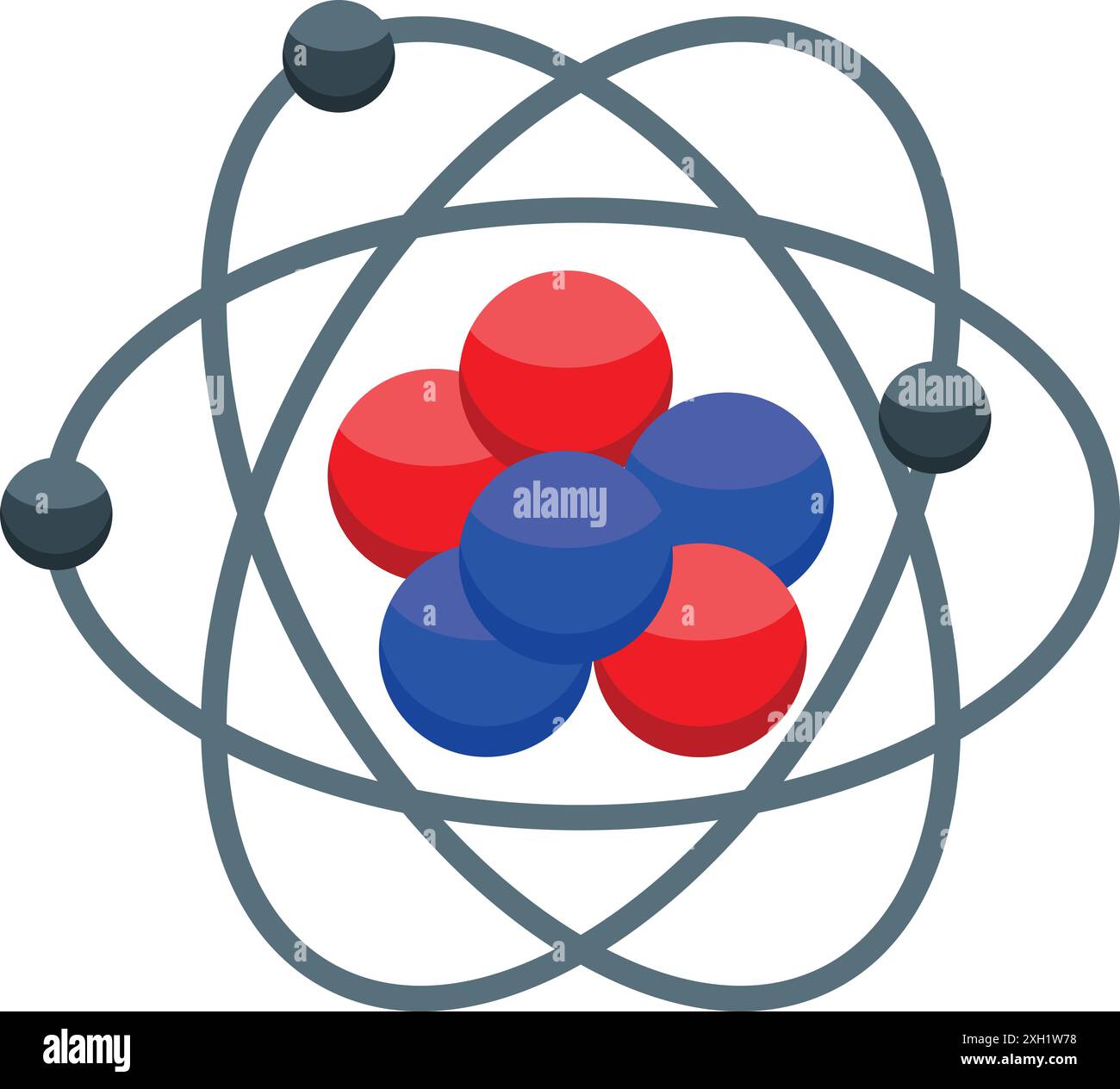
An atomic nucleus is the dense, central core of an atom, composed primarily of protons and neutrons. These subatomic particles, collectively known as nucleons, are held together by the strong nuclear force, forming the vast majority of an atom's mass while occupying a minuscule fraction of its total volume.
Understanding the Architecture of the Atom
To comprehend the nature of the atomic nucleus, one must first visualize the structure of the atom itself. If an atom were expanded to the size of a professional sports stadium, the nucleus would be roughly the size of a marble placed on the center of the field. Despite this extreme disparity in scale, the nucleus contains more than 99.9% of the atom's mass. The nucleus is not a solid, static object but a dynamic system of nucleons—protons and neutrons—interacting through fundamental physical forces.
Protons carry a positive electrical charge, defining the chemical identity of the element. Neutrons are electrically neutral, possessing no charge, yet they play a critical role in the stability of the nucleus. The interplay between these two particles determines the characteristics of every element found on the periodic table.
Protons: The Identity of the Element
Protons are stable subatomic particles with a positive electric charge of +1 elementary charge. The number of protons within a nucleus is defined as the atomic number ($Z$). This number is the fundamental identifier for a chemical element; for instance, any atom containing exactly six protons is classified as carbon, regardless of how many neutrons are present.
Protons are composite particles made of quarks—specifically two "up" quarks and one "down" quark held together by gluons. Because like charges repel, the protons within a nucleus experience a powerful electrostatic repulsion that would cause them to fly apart if not for the presence of the strong nuclear force.
Neutrons: The Stability Anchors
Neutrons carry no net electric charge and have a mass slightly greater than that of a proton. Like protons, they are composed of quarks—one "up" quark and two "down" quarks. In the context of the atomic nucleus, neutrons act as a "nuclear glue."
By introducing additional mass and interacting via the strong nuclear force without contributing electrostatic repulsion, neutrons help space out the protons. This dilution of charge density allows the strong force to overcome the repulsive electromagnetic force between protons, keeping the nucleus intact. Atoms of the same element that contain different numbers of neutrons are referred to as isotopes. For example, Carbon-12 has six protons and six neutrons, while Carbon-14 has six protons and eight neutrons.
The Strong Nuclear Force: Binding the Core
The defining mystery of the atomic nucleus is how protons—which repel each other with immense force—stay confined within such a tiny space. The answer lies in the strong nuclear force (also known as the residual strong interaction).
The strong nuclear force is one of the four fundamental forces of nature. Unlike electromagnetism, which acts over infinite distances, the strong force is effective only at the incredibly short range of approximately one femtometer ($10^{-15}$ meters). At this distance, the force between nucleons is significantly stronger than the electromagnetic repulsion, effectively "locking" the protons and neutrons into a tight cluster.
If the distance between nucleons increases even slightly beyond this threshold, the strong force drops off rapidly, leaving electromagnetic repulsion to dominate. This explains why very large, heavy nuclei are often unstable; their size makes it difficult for the strong force to maintain cohesion across the entire diameter of the nucleus.
Comparing Protons and Neutrons
To better understand how these nucleons contribute to atomic structure, we can compare their physical properties and functional roles.
| Feature | Proton | Neutron |
|---|---|---|
| Electric Charge | Positive (+1) | Neutral (0) |
| Mass (approx) | 1.007276 u | 1.008665 u |
| Primary Role | Determines element identity | Provides stability (isotopes) |
| Composition | 2 Up, 1 Down Quark | 1 Up, 2 Down Quark |
| Stability | Stable on its own | Unstable outside the nucleus (decays) |
Nuclear Stability and Radioactivity
Not all combinations of protons and neutrons result in a stable nucleus. The ratio of neutrons to protons is a critical factor. For lighter elements, a 1:1 ratio is generally ideal. As atomic nuclei become heavier, they require a progressively higher proportion of neutrons to remain stable—often as high as 1.5:1 for the heaviest stable elements.
When a nucleus has an imbalance—too many or too few neutrons relative to protons—it may be radioactive. Such a nucleus will spontaneously decay, emitting radiation (alpha particles, beta particles, or gamma rays) to reach a more stable configuration. This process is known as radioactive decay. Understanding this balance is essential for fields ranging from medical imaging and cancer therapy to nuclear energy generation.
Practical Applications of Nuclear Structure
The composition of the atomic nucleus is not merely a theoretical concern; it is the basis for several modern technologies.
- Nuclear Power Generation: By inducing fission—splitting the nucleus of heavy elements like Uranium-235—we release binding energy that heats water to create steam for electricity.
- Medical Diagnostics: Isotopes with specific proton-neutron balances are used in Positron Emission Tomography (PET) scans. These unstable isotopes decay within the body, allowing medical professionals to map physiological activity.
- Radiocarbon Dating: The decay rate of the Carbon-14 isotope, which contains two extra neutrons compared to common carbon, provides an accurate clock for determining the age of organic archaeological artifacts.
- Materials Science: Neutron scattering experiments allow researchers to study the structure of complex materials at the atomic level, a technique made possible because of the unique way neutrons interact with matter.
Common Misconceptions
One frequent misunderstanding is the assumption that the nucleus is static. In reality, nucleons are in constant motion within the nucleus, occupying discrete energy levels analogous to how electrons orbit the nucleus. This "shell model" of the nucleus helps explain why certain "magic numbers" of protons and neutrons—such as 2, 8, 20, 28, 50, 82, and 126—result in particularly stable isotopes.
Another misconception is that the mass of the nucleus is simply the sum of its parts. In fact, the mass of a nucleus is slightly less than the sum of its individual protons and neutrons. This difference is known as the "mass defect." The missing mass is converted into binding energy, as described by Albert Einstein’s famous equation, $E=mc^2$. This energy is the "cost" of holding the nucleus together.
Frequently Asked Questions
Are there other particles inside the nucleus besides protons and neutrons? While protons and neutrons are the primary building blocks, they are made of smaller components called quarks. Additionally, gluons act as the exchange particles that carry the strong force. However, in standard physics, the nucleus is defined by the presence of these two main nucleons.
Why don't the protons repel each other and explode? They would if not for the strong nuclear force. This fundamental force is significantly more powerful than electromagnetic repulsion at very short ranges. The presence of neutrons helps to dilute the density of the protons, allowing the strong force to keep the structure bound together.
What determines if a nucleus is radioactive? A nucleus is generally radioactive if the number of neutrons is not sufficient to stabilize the repulsive forces between protons. An unstable ratio leads the nucleus to transform through radioactive decay to achieve a more favorable, lower-energy state.
Can an element exist without neutrons? Yes, the most common isotope of hydrogen, protium, consists of a single proton and no neutrons. It is the only stable nucleus in nature that contains no neutrons.
How do scientists measure the mass of a nucleus? Scientists use mass spectrometers, which ionize atoms and pass them through magnetic fields. The amount the particles deflect depends on their mass, allowing for precise measurements of the nucleus.
Next Steps for Further Learning
If you are interested in exploring the atomic nucleus further, consider investigating the "Standard Model" of particle physics. This framework provides the context for how protons and neutrons—and the quarks they are made of—fit into the broader hierarchy of matter. For those seeking technical data on specific isotopes and their stability, the International Atomic Energy Agency (IAEA) maintains extensive databases on nuclear properties that are accessible for researchers and students alike.