An arithmetic sequence is a numerical pattern where the difference between any two consecutive terms remains constant. In Algebra 1, this constant is known as the common difference ($d$). By identifying the first term ($a_1$) and the common difference, you can calculate any term in the sequence using either an explicit or recursive formula.
Understanding the Fundamentals of Arithmetic Sequences
To master arithmetic sequences in Algebra 1, you must first understand what constitutes a sequence in a mathematical context. A sequence is simply an ordered list of numbers. Each number in that list is referred to as a "term." We denote the position of a term using a subscript, where $a_1$ is the first term, $a_2$ is the second, and $a_n$ represents the "nth" term—the general term at any given position $n$.
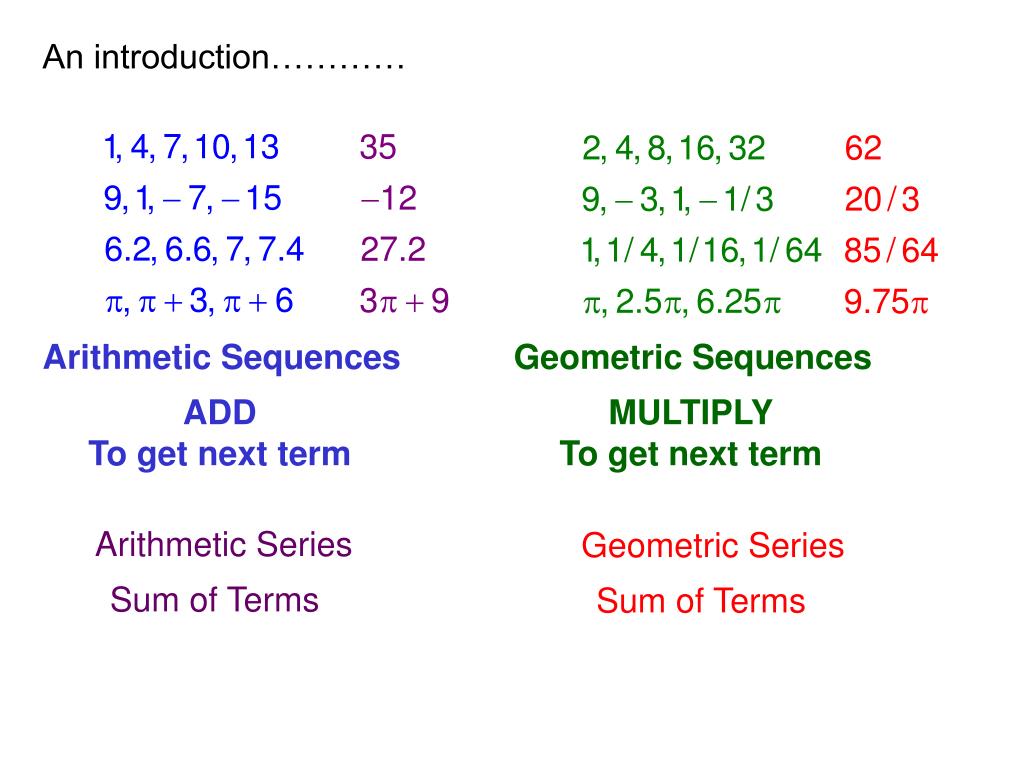
What distinguishes an arithmetic sequence from other types of sequences, such as geometric or quadratic sequences, is its additive nature. To move from one term to the next, you always add (or subtract, if the difference is negative) the exact same value. This unchanging value is the "common difference."
Identifying the Common Difference
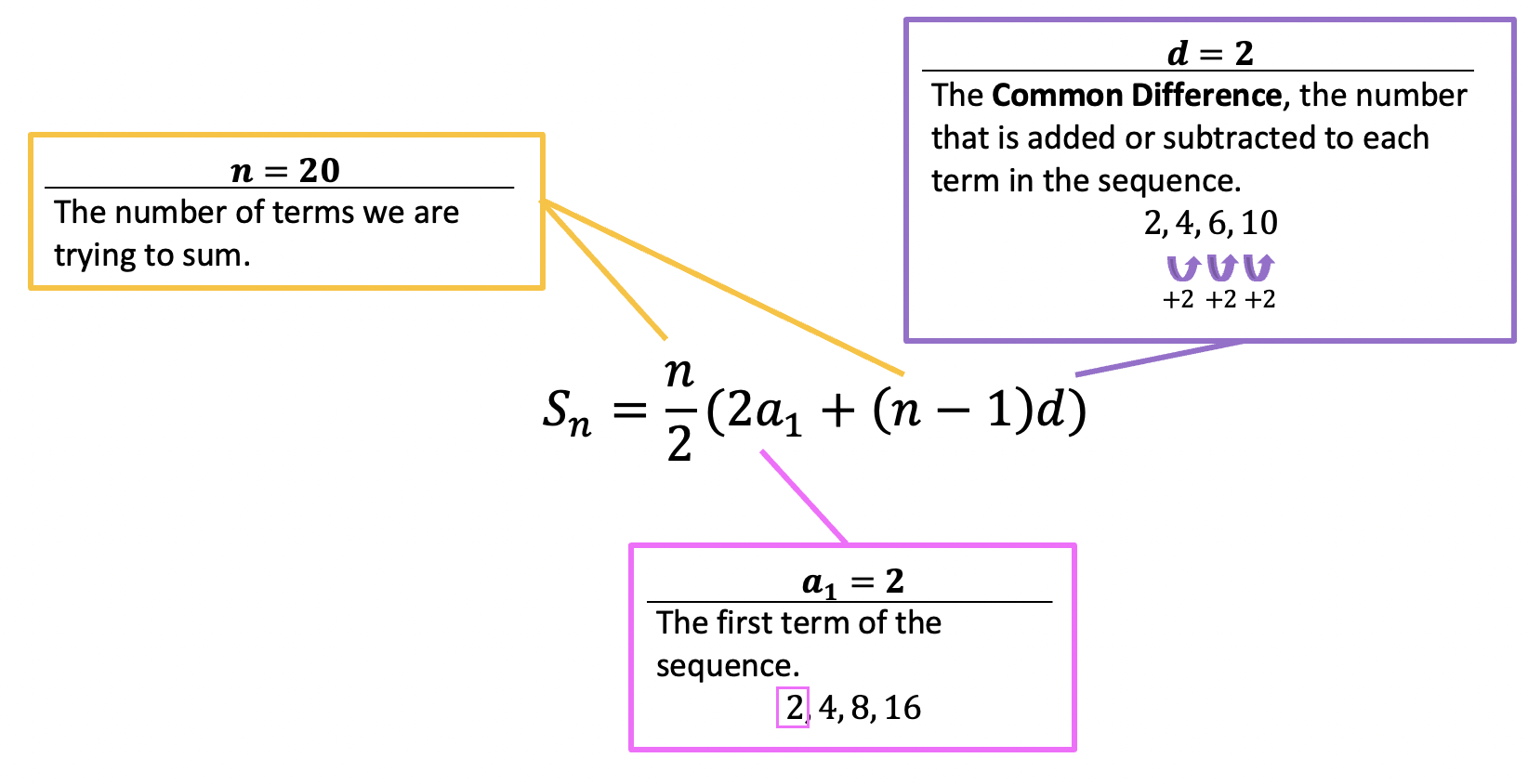
The first step in solving any problem involving an arithmetic sequence is identifying the common difference, represented by the letter $d$. To find $d$, you subtract any term from the term that follows it. The formula is expressed as:
$$d = a_n - a_{n-1}$$
For example, consider the sequence: $5, 12, 19, 26, 33, \dots$
- Subtract the first term from the second: $12 - 5 = 7$.
- Subtract the second term from the third: $19 - 12 = 7$.
- Subtract the third term from the fourth: $26 - 19 = 7$.
Since the difference is consistently $7$, this is an arithmetic sequence where $d = 7$. If the difference were to change at any point, the sequence would no longer be considered arithmetic. In 2026 curriculum standards, being able to quickly verify a sequence by checking at least three pairs of terms is a foundational skill for high school mathematics.
The Two Essential Formulas: Explicit and Recursive
In Algebra 1, you will encounter two primary ways to define an arithmetic sequence. Each serves a specific purpose depending on the information you have and the goal you are trying to achieve.
The Explicit Formula
The explicit formula is arguably the most powerful tool in this unit. It allows you to calculate any term in the sequence ($a_n$) without needing to know the term that came immediately before it. This is particularly useful if a problem asks you to find the 100th or 1,000th term.
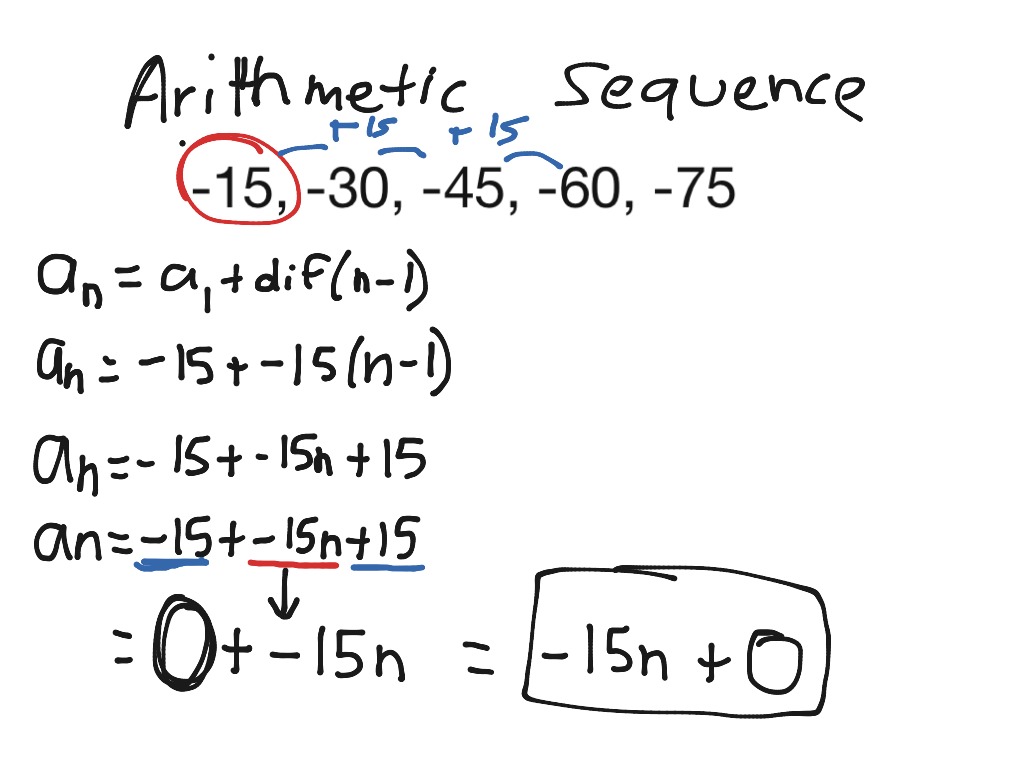
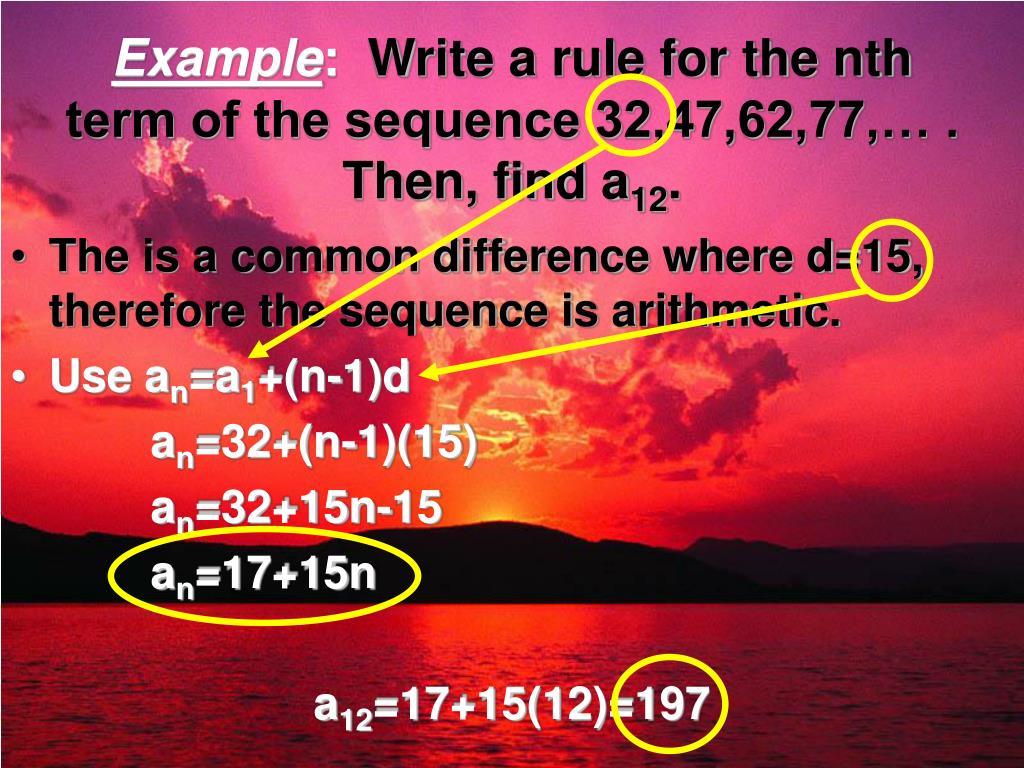
The explicit formula is written as: $$a_n = a_1 + (n - 1)d$$
Breaking down the components:
- $a_n$: The value of the term you are looking for.
- $a_1$: The first term in the sequence.
- $n$: The position number of the term (e.g., for the 50th term, $n = 50$).
- $d$: The common difference.
Why is it $(n - 1)$? Students often wonder why we subtract 1 from the position $n$. The reason is logical: to get to the first term ($a_1$), you add the common difference zero times. To get to the second term ($a_2$), you add the difference once. To get to the third term ($a_3$), you add it twice. Therefore, to get to the $n$th term, you add the common difference $n - 1$ times.
The Recursive Formula
The recursive formula is more like a set of instructions for building the sequence step-by-step. It defines the next term based on the current term. While it is less efficient for finding distant terms, it is excellent for computer programming and understanding the iterative nature of patterns.
The recursive formula is written in two parts:
- $a_1 = \text{value}$ (You must state the starting point).
- $a_n = a_{n-1} + d$
This tells the reader: "To find the current term ($a_n$), take the previous term ($a_{n-1}$) and add the common difference ($d$)."
Comparing Explicit and Recursive Formulas
| Feature | Explicit Formula | Recursive Formula |
|---|---|---|
| Primary Use | Finding any term ($a_n$) instantly. | Building a sequence term-by-term. |
| Structure | $a_n = a_1 + (n - 1)d$ | $a_n = a_{n-1} + d$ |
| Requirements | Needs $a_1$ and $d$. | Needs $a_1$, $d$, and the previous term. |
| Efficiency | High (finds $a_{100}$ in one step). | Low (requires finding $a_{99}$ first). |
| Connection | Similar to Linear Functions ($y = mx + b$). | Similar to step-by-step counting. |
Arithmetic Sequences and Linear Functions
One of the most important realizations in Algebra 1 is that arithmetic sequences are actually linear functions. When you graph the terms of an arithmetic sequence, they form a straight line.
The Connection to $y = mx + b$
If you distribute the $d$ in the explicit formula $a_n = a_1 + (n - 1)d$, you get: $a_n = a_1 + dn - d$ $a_n = dn + (a_1 - d)$
This looks remarkably like $y = mx + b$, where:
- $n$ is the independent variable (like $x$).
- $a_n$ is the dependent variable (like $y$).
- The common difference $d$ is the slope ($m$).
- $(a_1 - d)$ represents the $y$-intercept ($b$), or the "0th term."
Graphing the Sequence
There is one major difference between a standard linear function and an arithmetic sequence: the domain. A linear function usually has a continuous domain (all real numbers), represented by a solid line. An arithmetic sequence has a discrete domain, consisting only of natural numbers ($n = 1, 2, 3, \dots$).
When graphing an arithmetic sequence, you should only plot individual points. Do not connect them with a solid line, as there is no such thing as a "1.5th term" in a standard sequence.
Step-by-Step Example: Solving a Problem
Let’s walk through a common Algebra 1 exam question: Find the 42nd term of the sequence 11, 8, 5, 2, ...
Step 1: Identify the known values
- First term ($a_1$): 11
- Common difference ($d$): $8 - 11 = -3$
- Position ($n$): 42
Step 2: Choose the correct formula
Since we need a specific, distant term, we use the explicit formula: $a_n = a_1 + (n - 1)d$
Step 3: Substitute the values
$a_{42} = 11 + (42 - 1)(-3)$
Step 4: Simplify and solve
$a_{42} = 11 + (41)(-3)$ $a_{42} = 11 - 123$ $a_{42} = -112$
The 42nd term of the sequence is -112.
Real-World Applications of Arithmetic Sequences
Mathematics is most useful when applied to real-world scenarios. Arithmetic sequences appear frequently in financial planning, construction, and logistics.
1. Simple Interest and Savings
Suppose you open a savings account in 2026 with an initial deposit of $500. Every month, you decide to deposit exactly $50. This is an arithmetic sequence:
- Month 1: $550 ($a_1$)
- Month 2: $600 ($a_2$)
- Month 3: $650 ($a_3$)
- $d = 50$
If you want to know how much you will have after 3 years (36 months), you can use the explicit formula to find $a_{36}$ without listing every month.
2. Seating Arrangements
In theater or stadium design, rows often increase by a fixed number of seats to account for the curve of the building. If Row 1 has 20 seats and each subsequent row has 2 additional seats, the sequence of seats per row is 20, 22, 24, 26, ... This allows architects to calculate the capacity of the 50th row ($a_{50}$) instantly.
3. Salary Schedules
Many professional contracts, especially in teaching or civil service, use "steps." A 2026 employment contract might state a starting salary of $45,000 with a guaranteed annual "step increase" of $1,500. To find your salary in year 10, you would treat this as an arithmetic sequence where $a_1 = 45,000$ and $d = 1,500$.
Common Mistakes and How to Avoid Them
Even students who understand the concept often make small errors that lead to incorrect answers. Being aware of these pitfalls is key to mastering Algebra 1.
Misidentifying the Sign of $d$
If a sequence is decreasing (e.g., 20, 15, 10, ...), the common difference $d$ must be negative. Many students accidentally use a positive 5 instead of -5, which causes the sequence to grow in their calculations rather than shrink. Always double-check by subtracting the first term from the second: $15 - 20 = -5$.
The "Off-by-One" Error
A frequent mistake is forgetting the $(n-1)$ in the explicit formula. If you use $a_n = a_1 + nd$, you are essentially adding the common difference one too many times. Remember that the first term does not have the common difference added to it yet.
Confusing $n$ and $a_n$
- $n$ is the address or position of the number (e.g., Row 5).
- $a_n$ is the value at that address (e.g., 28 seats).
If a question asks "Which term is equal to 100?", you are solving for $n$. If it asks "What is the 100th term?", you are solving for $a_n$.
Finding the Missing Term Between Two Others
Sometimes, an Algebra 1 problem will give you two non-consecutive terms and ask you to find the terms in between. These are called arithmetic means.
Example: Find the missing terms in the sequence: $10, _, _, 31$.
- Identify the positions: $a_1 = 10$ and $a_4 = 31$.
- Use the explicit formula: $a_4 = a_1 + (4 - 1)d$.
- Substitute: $31 = 10 + 3d$.
- Solve for $d$: $21 = 3d$, so $d = 7$.
- Fill in the blanks: $10 + 7 = 17$, and $17 + 7 = 24$.
- The sequence is $10, 17, 24, 31$.
FAQs About Arithmetic Sequences
What is the difference between an arithmetic sequence and an arithmetic series?
An arithmetic sequence is a list of numbers (e.g., 2, 4, 6, 8). An arithmetic series is the sum of those numbers (e.g., 2 + 4 + 6 + 8 = 20). In Algebra 1, you primarily focus on sequences, while series are often introduced toward the end of the year or in Algebra 2.
Can the common difference be a fraction or a decimal?
Yes. While many classroom examples use integers, $d$ can be any real number. For example, a sequence could be $0.5, 1.25, 2.0, 2.75, \dots$ where $d = 0.75$. The formulas work exactly the same way regardless of whether $d$ is a whole number, a fraction, or a decimal.
Is a sequence with a common difference of 0 arithmetic?
Technically, yes. If a sequence is $5, 5, 5, 5, \dots$, the common difference is $d = 0$. This is called a constant sequence. While it is rarely the focus of Algebra 1 problems, it meets the mathematical definition of an arithmetic sequence.
How can I tell if a word problem describes an arithmetic sequence?
Look for phrases that indicate a constant rate of change. Keywords like "increases by the same amount each year," "adds a fixed fee," or "loses a set number of points per minute" all signal an arithmetic pattern. If the change is based on a percentage (e.g., "grows by 5%"), it is a geometric sequence, not arithmetic.
Does the sequence have to start at $n=1$?
In standard mathematical notation for sequences, we almost always start with $n=1$ as the first term. However, in some real-world modeling, you might see $n=0$ used to represent an "initial value" before any time has passed. In an Algebra 1 classroom, stick to $n=1$ unless the problem explicitly states otherwise.
Practical Recommendation for Students
To truly master arithmetic sequences, you should practice converting between the recursive and explicit forms. Many exam questions in 2026 focus on "multiple representations"—asking you to look at a table, a graph, or a word problem and write both formulas.
Start by always finding $a_1$ and $d$ first. Once you have those two pieces of information, the rest of the problem becomes a simple substitution exercise. If you are struggling with the algebra, try sketching a quick graph of the first three terms; the visual of a straight line often helps clarify the linear relationship and makes it easier to spot errors in your calculations.