Most Arizona auto dealerships can and should negotiate their surety bond premiums because, while the $100,000 bond amount is mandated by the state, the premium rate is not fixed. By improving credit profiles, providing CPA-prepared financial statements, and leveraging competitive quotes from multiple surety markets, dealers can significantly reduce their annual overhead and improve their business's bottom line.
Understanding the Arizona Motor Vehicle Dealer Bond Requirement
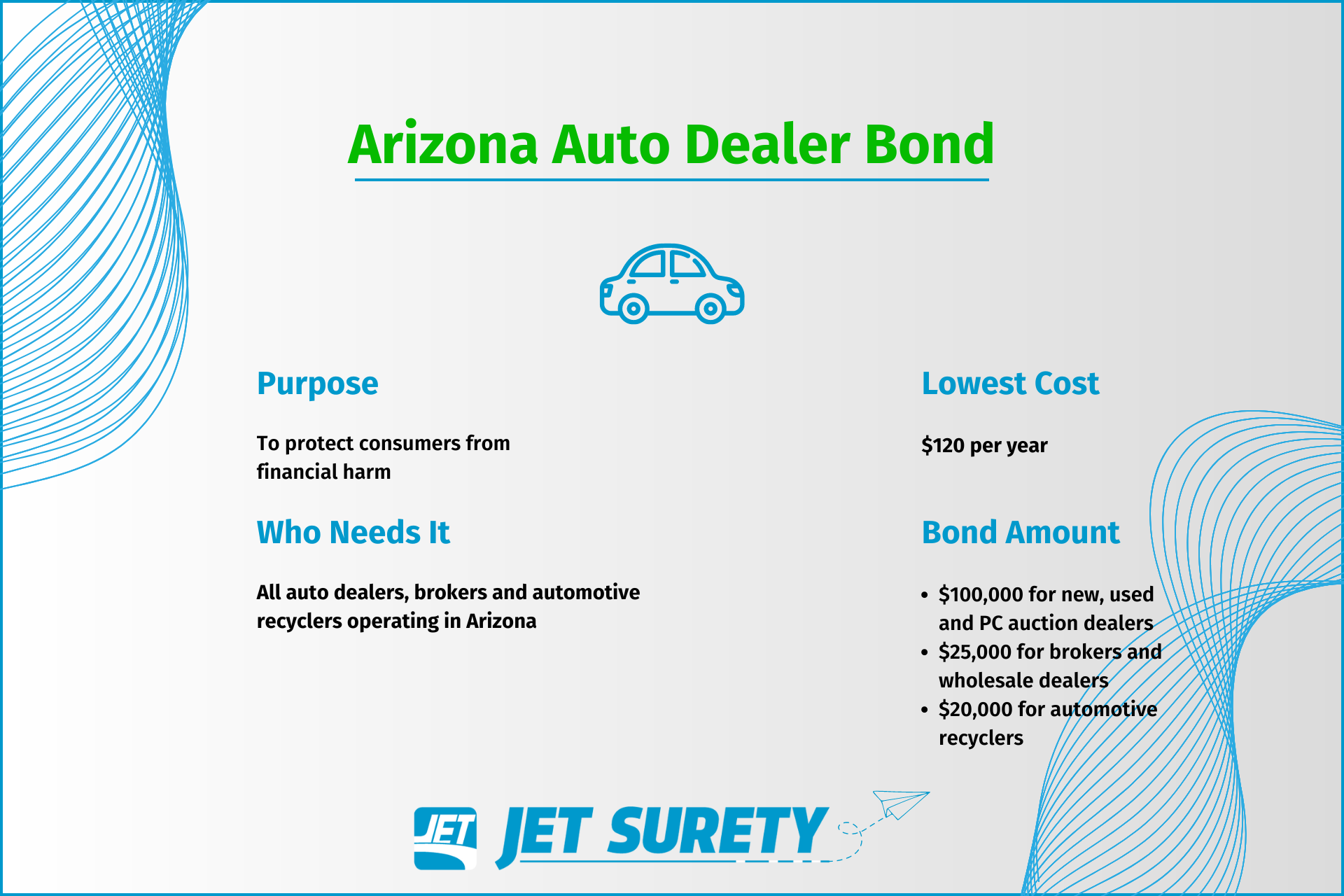
In 2026, the regulatory landscape for automotive sales in Arizona remains strictly governed by the Arizona Department of Transportation (ADOT) Motor Vehicle Division (MVD). Central to these regulations is the Motor Vehicle Dealer Bond, a form of financial guarantee required under Arizona Revised Statutes (ARS) § 28-4333. This bond is not insurance for the dealership; rather, it is a tri-party agreement between the dealership (the principal), the surety company (the guarantor), and the State of Arizona (the obligee).
The primary purpose of the bond is to protect the public and the state from financial loss caused by a dealership’s failure to comply with state laws. This includes scenarios such as failing to pay sales taxes, engaging in title fraud, or misrepresenting the condition of a vehicle. For the vast majority of motor vehicle dealers—including new and used car retailers—the bond amount is set at $100,000. Wholesale dealers and auto recyclers typically operate under a lower requirement of $25,000, though this can vary based on specific license sub-types.
Because the bond is a requirement for licensure, many dealers treat it as a "check-the-box" expense. They receive a renewal notice and pay the premium without question. However, this passive approach often results in "standard" or "substandard" pricing that does not reflect the actual risk profile of a well-run dealership. In a high-volume market like Arizona, where margins are constantly pressured by inventory costs and digital competition, negotiating this premium is a critical financial strategy.
The Financial Impact of the $100,000 Bond Requirement
When the Arizona legislature increased the bond requirement to $100,000 several years ago, it fundamentally changed the cost of doing business. At a $25,000 bond level, a 2% premium was a manageable $500. At $100,000, that same 2% rate becomes a $2,000 annual expense. For a multi-location dealer group, these costs scale quickly.
Surety premiums are essentially "service fees" for the use of the surety’s balance sheet. Unlike traditional insurance, where the carrier expects to pay out a certain percentage of premiums in claims (the loss ratio), surety companies operate on a "zero-loss" expectation. They only issue bonds to entities they believe are financially stable enough to reimburse the surety if a claim occurs.
Despite this, the rates offered to Arizona dealers fluctuate wildly. A dealer with excellent credit and strong financials might pay 0.75% ($750), while a dealer with poor credit or lack of transparency might be quoted 5% ($5,000) or more. Over a five-year period, the difference between a negotiated rate and a standard rate can exceed $20,000. This is capital that could otherwise be used for floor plan interest, marketing, or facility upgrades.
Why Most Arizona Dealerships Can (and Should) Negotiate
The central reason negotiation is possible is that the surety market is highly competitive and fragmented. There is no "set price" for a bond in the same way there is a set price for a title transfer fee. Instead, underwriters use proprietary algorithms to assess risk, and different surety companies have different "appetites" for automotive risk at different times.
The Role of the "Middleman"
Most dealers obtain their bonds through a general insurance agent. While convenient, these agents often lack direct access to specialized surety markets. They may only have access to one or two carriers. When you negotiate, you are effectively demanding that your agent shop your "file" to multiple markets or provide the necessary documentation to move you into a "preferred" tier.
Risk Perception vs. Reality
Surety underwriters are naturally cautious. If a dealership provides the bare minimum of information, the underwriter will assume the highest level of risk. Negotiation in the surety world is less about haggling over numbers and more about providing evidence that justifies a lower risk rating. By presenting a professional financial package, you shift the conversation from "what is the rate?" to "why does this business deserve the lowest possible rate?"
Key Factors That Influence Your Bond Premium
To negotiate effectively, a dealership principal must understand the levers that underwriters pull to determine the premium. In 2026, these factors have become more data-driven, but the core fundamentals remain the same.
- Personal Credit Score: For smaller or mid-sized independent dealerships, the personal credit of the owners remains the single most influential factor. A score above 700 typically triggers automated "preferred" pricing. However, if your score has improved since your last renewal, you must point this out to ensure you aren't being rated on old data.
- Years in Business: Experience is a major risk mitigator. A dealership that has survived multiple economic cycles in the Arizona market is statistically less likely to trigger a bond claim. Most sureties offer significant discounts once a dealer hits the 3-year and 5-year milestones.
- Financial Liquidity: Sureties look at "working capital" (current assets minus current liabilities). If your dealership maintains a healthy cash reserve or has a robust line of credit, you are a lower risk for the surety because you have the means to settle disputes before they escalate to a bond claim.
- License History: A clean record with the Arizona Department of Transportation is essential. If you have had no administrative actions or complaints, this should be highlighted during negotiation.
Strategies for Effective Bond Negotiation
Negotiation is a proactive process that should begin at least 60 to 90 days before your bond renewal date. Waiting until the last minute strips you of your leverage and forces you to accept whatever rate is offered.
Improving Credit Standing and Reporting
If a dealer’s credit is on the borderline of a better pricing tier (e.g., a 690 score when 700 triggers a discount), it is worth delaying the application by a month to pay down personal revolving debt and boost the score. Furthermore, ensure that the surety is pulling a "soft" credit inquiry that does not negatively impact your score.
Leveraging CPA-Prepared Financial Statements
For $100,000 bonds, many sureties will provide a quote based solely on credit. However, these "credit-only" quotes are rarely the lowest possible price. By providing a "Review" or "Audit" level financial statement prepared by a Certified Public Accountant (CPA), you provide the surety with verified data. This transparency almost always leads to lower premiums because it removes the "uncertainty premium" that underwriters bake into credit-only quotes.
Shopping Multiple Markets
Not all surety companies are the same. Some specialize in high-risk "non-standard" bonds, while others only want "prime" business. If your current agent is only presenting one option, they aren't working for you. Demand a market summary showing which carriers were approached and what their responses were. In the 2026 market, there are dozens of treasury-listed sureties competing for Arizona business.
Utilizing "Rolling" or Multi-Year Bonds
Some sureties offer discounts if you prepay for two or three years. While this requires more cash upfront, the effective annual rate is often 10% to 15% lower. This also protects you against potential rate hikes in the following years.
Comparison Table: Negotiable vs. Fixed Elements of Dealer Bonds
| Feature | Status | Flexibility / Negotiation Potential |
|---|---|---|
| Bond Amount | Fixed | Mandated by ADOT ($100k for most). Cannot be changed. |
| Premium Rate | Negotiable | Varies from 0.5% to 5%+ based on risk profile. |
| Payment Terms | Negotiable | Some agencies offer financing or multi-year discounts. |
| Collateral | Negotiable | Stronger financials can eliminate collateral requirements. |
| Surety Company | Negotiable | You can choose any ADOT-approved, T-Listed surety. |
| Bond Language | Fixed | Must follow the official Arizona MVD Form #40-0204. |
The Role of the Surety Agent in the Negotiation Process
A common mistake dealerships make is treating their bond agent as a vendor rather than a partner. A specialized surety agent understands the internal "desk guides" of various underwriters. They know that Surety A hates dealerships with high floor-plan-to-asset ratios, while Surety B is perfectly fine with them as long as there is strong personal indemnity.
When negotiating, ask your agent the following questions:
- "What is the 'loss cost' for this bond class in Arizona right now?"
- "Which sureties are currently aggressively targeting the Arizona automotive sector?"
- "If we provide an irrevocable letter of credit (ILOC) or a personal financial statement, how much will the rate drop?"
- "Is this quote coming from a standard market or a surplus lines carrier?" (Surplus lines often include additional fees and taxes that inflate the cost).
By asking these technical questions, you signal to the agent that you are an informed consumer, which often miraculously "discovers" lower rates that weren't initially offered.
Common Pitfalls to Avoid During the Renewal Cycle
Even the best negotiation strategy can be derailed by simple administrative errors. Avoid these common mistakes to ensure you maintain your leverage:
- Lapses in Coverage: If you let your bond lapse, even for a day, you are no longer in compliance with Arizona Revised Statute § 28-4333. This makes you a high-risk "emergency" applicant, and sureties will charge a premium for the risk of covering a "gap."
- Inaccurate Dealer Name: The name on the bond must match the name on the MVD license exactly. If there is a discrepancy, the bond will be rejected, and you may lose your "early bird" pricing discounts while the paperwork is corrected.
- Ignoring the "Indemnity Agreement": Negotiation isn't just about price; it's about terms. Most bonds require a personal indemnity agreement (GIA). If you have a very strong business, you might negotiate to have the personal indemnity requirement waived, protecting your personal assets from business-related bond claims.
Frequently Asked Questions (FAQs)
Can a new Arizona dealership negotiate their first bond?
Yes, though it is more difficult than for an established business. New dealers should focus on providing a "pro forma" business plan and a strong personal financial statement. Highlighting previous experience in dealership management can also help underwriters justify a lower "new business" rate.
Does the $100,000 bond requirement apply to wholesale dealers?
Generally, no. According to current Arizona MVD guidelines, wholesale motor vehicle dealers are required to maintain a $25,000 bond. However, if a wholesale dealer also holds a retail license, they must meet the higher $100,000 threshold. Always verify your specific license type with the MVD to avoid over-bonding.
What happens if I can't find a surety willing to negotiate?
If your credit is severely damaged or you have active bond claims, you may be stuck with "market rates" in the high-risk pool. In this case, your best strategy is to take a short-term bond (1 year) and work on credit repair and financial transparency so that you have leverage for the 2027 renewal cycle.
Does the Arizona MVD provide a list of "preferred" bond companies?
No. The MVD only requires that the surety company be authorized to do business in Arizona. You can verify a company’s status through the Arizona Department of Insurance and Financial Institutions (DIFI). It is up to the dealership to shop for the best rate among these authorized carriers.
Is the bond premium tax-deductible for my dealership?
Yes, surety bond premiums are considered a necessary business expense for tax purposes. Because it is a requirement for maintaining your professional license in Arizona, the full cost of the premium is generally deductible on your federal and state tax returns.
Final Recommendation for Arizona Dealers
For the 2026 fiscal year, Arizona dealerships should treat their surety bond as a manageable financial instrument rather than a fixed tax. The difference between an "auto-renewal" and a "negotiated renewal" can be thousands of dollars.
Your next action: Contact your bond agent today and request a copy of your current underwriting file. Ask specifically for your "rate tier" and what specific financial improvements would be required to move you to the next lower tier. If your agent cannot provide a clear path to a lower premium, it is time to seek a specialist surety broker who has direct access to the broader commercial surety market.