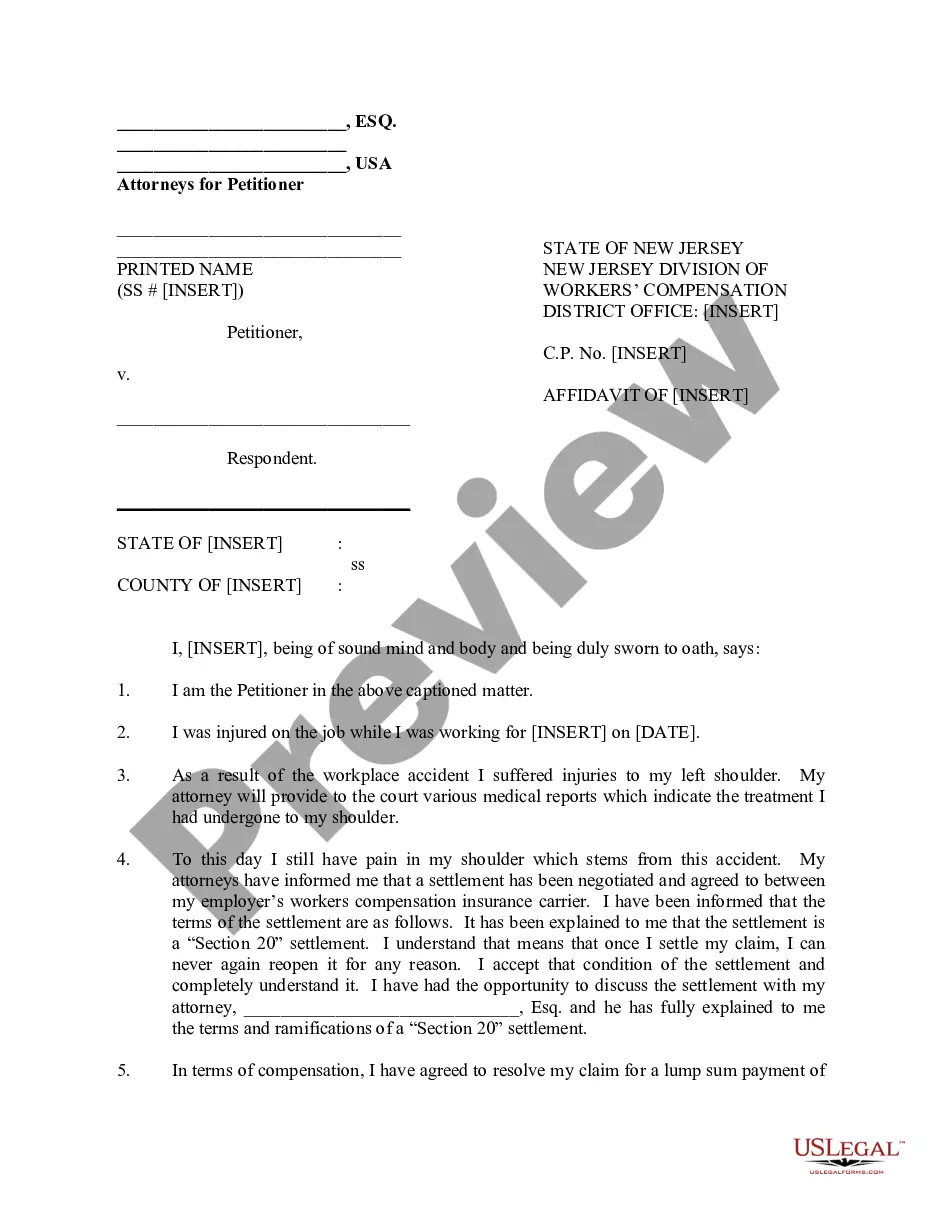
When an employer or workers' compensation insurance carrier denies authorized medical treatment and temporary disability benefits, an injured worker (the appellant or petitioner) in New Jersey faces immediate physical and financial hardship. Under New Jersey law, injured employees can challenge these denials through the New Jersey Division of Workers' Compensation by filing a Formal Claim Petition alongside an emergency Motion for Temporary Disability and Medical Benefits, or by appealing an adverse administrative judgment to the Appellate Division of the New Jersey Superior Court.
Understanding Denials of Medical and Temporary Disability Benefits
In New Jersey, workers' compensation is governed by the New Jersey Workers' Compensation Act (N.J.S.A. 34:15-1 et seq.). Under this statutory scheme, employers are legally required to provide two fundamental forms of initial relief to employees who suffer job-related injuries or occupational illnesses:
- Medical Benefits (N.J.S.A. 34:15-15): The employer or their insurance carrier must furnish necessary and reasonable medical, surgical, and hospital services to restore the injured worker's health or function, as far as possible.
- Temporary Disability Benefits (N.J.S.A. 34:15-12(a)): If an injury prevents an employee from working for more than seven consecutive days, the employer must pay wage-replacement benefits. These benefits are calculated at 70% of the worker’s average weekly wage (AWW), subject to annual maximum and minimum statutory caps established by the New Jersey Department of Labor and Workforce Development.
Common Reasons Insurance Carriers Deny Claims
Unlike healthcare systems where patients choose their own providers, New Jersey gives the employer and insurer the primary right to select authorized medical providers. Insurers frequently leverage this statutory control—or issue outright claim denials—based on several recurring defenses:
- Lack of Causation: The carrier asserts that the injury or illness did not arise out of and in the course of employment (e.g., alleging the condition is degenerative, pre-existing, or occurred off-duty).
- Independent Medical Examination (IME) Reports: Insurers frequently order an examination under N.J.S.A. 34:15-19. If the defense doctor concludes that the worker requires no further medical care or has reached Maximum Medical Improvement (MMI), the carrier will cut off treatment and temporary disability payments.
- Employment Status Disputes: The respondent may claim the injured party was an independent contractor rather than a covered employee.
- Failure to Report Timely: The employer argues that the worker failed to satisfy the statutory notice requirements under N.J.S.A. 34:15-17 (which mandates notice within 14 to 90 days depending on circumstances).
When an insurer denies both benefits simultaneously, the worker is left without medical care to heal and without income to cover basic living expenses. Reversing this dual denial requires strict adherence to New Jersey administrative and appellate court procedures.
Initial Administrative Remedies: Informal Hearings vs. Formal Claim Petitions
An injured worker seeking to overturn a denial cannot simply file a lawsuit in Superior Court Law Division. New Jersey Workers' Compensation Court maintains exclusive original jurisdiction over work-injury disputes. Injured employees have two primary administrative pathways within the Division:
[Denial of Medical & Disability Benefits] | ----------------------------------------------------- | | [Option A: Informal Hearing] [Option B: Formal Claim Petition] | | (Non-binding advisory session) (Required for enforceable relief) | | (No mandatory compliance) (Filing of Motion under N.J.A.C. 12:235-3.2) | [Trial / Order by Judge] | [Appellate Division Appeal]
The Informal Hearing (N.J.A.C. 12:235-3.1)
An Informal Hearing is a non-binding proceeding conducted before a Judge of Compensation. It is designed to act as a mediation session where an injured worker, an insurance representative, and a judge discuss the dispute.
- Pros: It can be scheduled relatively quickly and does not require complex legal pleadings.
- Cons: The recommendations made by the judge at an informal hearing are purely advisory. The insurance company cannot be forced to provide medical care or pay temporary disability benefits as a result of an informal recommendation. If the carrier refuses to comply, the worker gains no enforceable order.
The Formal Claim Petition (N.J.S.A. 34:15-51)
To secure legally binding relief, the petitioner must file a Formal Claim Petition with the Division of Workers' Compensation.
- Statute of Limitations: Under N.J.S.A. 34:15-51, a Formal Claim Petition must be filed within two years from the date of the accident, or within two years from the date of the last payment of compensation (whichever is later). For occupational diseases, the petition must be filed within two years of the date the worker knew or should have known of the nature of the disability and its relation to employment.
- Legal Effect: Filing a Formal Claim Petition opens an official litigation file, assigns a judge and docket number, and grants the court full authority to issue binding judgments, enforce sanctions, and award attorney fees.
Fast-Tracking Urgent Denials: Motion for Temporary Disability and Medical Benefits
Because a standard Formal Claim Petition can take several months or longer to reach full trial, New Jersey administrative regulations provide an expedited process specifically designed for medical emergencies and wage interruptions: the Motion for Temporary Disability and Medical Benefits governed by N.J.A.C. 12:235-3.2.
Requirements for Filing the Motion
A worker cannot file this motion in isolation; it must be filed concurrently with or after a Formal Claim Petition. Under N.J.A.C. 12:235-3.2, the motion must include supporting affidavits and objective medical evidence. To establish a prima facie case, the petitioner's motion must attach:
- A Supporting Affidavit from the Injured Worker: Detailing the accident, the denial of benefits, current physical limitations, and financial hardship caused by wage loss.
- A Comprehensive Medical Report or Physician Affidavit: A written report from an examining or treating physician explicitly stating:
- The causal connection between the workplace incident and the medical condition.
- The specific medical treatment, surgery, or therapy that is currently necessary and reasonable.
- That the petitioner remains temporarily and totally disabled from working as a direct result of the injury.
- An estimated timeframe for the requested treatment and expected period of temporary disability.
Hearing Timelines and Procedure
Once the motion is served upon the employer/insurer (the respondent) and filed with the court, strict regulatory timelines take effect:
- Respondent Answer: The respondent must file a formal answer to the motion within 21 days of service.
- Listing for Hearing: The court must schedule the motion for a hearing within 30 days of filing.
- Evidentiary Hearing: If the respondent continues to contest the motion, the Judge of Compensation conducts an expedited hearing. The judge will review sworn medical reports, hear oral argument, and may require live testimony from the petitioner and medical experts.
If the judge finds in favor of the injured worker, an enforceable Order for Medical and Temporary Disability Benefits is issued. This order mandates that the insurance company immediately authorize the requested treatment and pay accrued retroactive and ongoing temporary disability benefits.
Comparative Summary of Appeal Avenues in New Jersey
The table below outlines the features, legal standards, and requirements across the different stages of challenging a workers' compensation denial in New Jersey:
| Dispute Avenue | Forum / Rule | Primary Purpose | Legal Binding Status | Expected Timeframe | Key Required Evidence |
|---|---|---|---|---|---|
| Informal Hearing | Division of Workers' CompN.J.A.C. 12:235-3.1 |
Voluntary mediation and advisory evaluation | Non-binding; voluntary compliance only | 3 to 6 weeks | Basic medical notes, incident report, wage statements. |
| Formal Claim Petition | Division of Workers' CompN.J.S.A. 34:15-51 |
Full legal claim for temporary, medical, and permanent disability | Legally Binding (enforceable judgment) | Months to over a year (full trial) | Complete medical records, expert witness testimonies, proof of earnings. |
| Motion for Temp / Medical | Division of Workers' CompN.J.A.C. 12:235-3.2 |
Expedited interim relief for treatment & wage replacement | Legally Binding (interlocutory order) | Scheduled within 30 days | Detailed physician affidavit establishing causation, necessity, and disability. |
| Appellate Division Review | NJ Superior CourtRule 2:2-3(a)(1) |
Judicial review of final administrative decision | Legally Binding (Appellate Court mandate) | 6 to 18 months | Trial record, transcripts, formal legal briefs on error of law/fact. |
Building the Evidentiary Record before the Compensation Court
In any trial or motion hearing before a Judge of Compensation, the burden of proof rests entirely on the injured worker (petitioner). The petitioner must prove entitlement to benefits by a preponderance of the credible evidence.
Navigating Medical Evidence Conflicts
Workers' compensation cases frequently turn into a battle of medical experts:
- Petitioner’s Expert / Treating Physician: Focuses on functional limitations, objective diagnostic test results (e.g., MRIs, EMG nerve conduction studies, surgical evaluations), and the continuous need for active treatment.
- Defense IME Physician: Hired by the insurance carrier, this physician often testifies that the worker has reached MMI, that further care is merely palliative (which insurers are generally not obligated to cover under N.J.S.A. 34:15-15 unless it maintains functional capacity), or that the underlying issue is age-related degeneration.
To overcome a defense IME denial, the petitioner’s legal team must demonstrate that the defense doctor’s conclusions lack objective support or fail to account for specific clinical findings, job duties, and diagnostic imaging.
Calculating Temporary Disability Benefits Correctly
When appealing a wage benefit denial, establishing the accurate Average Weekly Wage (AWW) is crucial. Under N.J.S.A. 34:15-37, AWW is generally calculated based on the employee's gross weekly earnings over the 26 weeks prior to the injury.
- The 70% Rule: Temporary Total Disability (TTD) benefits equal 70% of the worker’s AWW.
- Statutory Caps: Benefits are capped at a statewide maximum (set annually at 75% of the statewide average weekly wage) and subject to a minimum rate (20% of the statewide average weekly wage).
- Overtime and Multiple Jobs: Regular overtime and wages earned from secondary employment may be factored into the AWW calculation if statutory conditions are satisfied.
Appealing an Adverse Decision to the NJ Superior Court Appellate Division
If a Judge of Compensation issues a final order denying medical and temporary disability benefits, the worker (now formally the appellant) has the right to appeal the administrative decision to the judicial system.
Judicial Forum and Deadlines
In New Jersey, appeals from administrative agencies like the Division of Workers' Compensation do not go to the Law Division of the Superior Court. Under New Jersey Court Rule 2:2-3(a)(1), appeals are taken directly to the Appellate Division of the Superior Court of New Jersey.
- Deadline to File: The Notice of Appeal must be filed within 45 days from the date of entry of the final judgment or order by the Judge of Compensation.
- Interlocutory Appeals: Orders on Motions for Temporary Disability and Medical Benefits are sometimes classified as interlocutory (interim) orders unless they resolve all outstanding issues. If an order is interlocutory, the appellant must file a Motion for Leave to Appeal under Court Rule 2:5-6 within 20 days, rather than an automatic Notice of Appeal.
[Final Order by Judge of Compensation] | (45-Day Statutory Deadline) | [File Notice of Appeal in NJ Appellate Division (Rule 2:2-3)] | [Order Complete Trial Transcripts & Re-create Record] | [Submit Appellant Brief focusing on Legal/Fact Errors] | [Appellate Standard of Review: "Substantial Credible Evidence"]
The Standard of Review: The Close v. Kordulak Bros. Standard
The Appellate Division does not re-try the facts of the case or re-evaluate the credibility of live witnesses. Instead, appellate courts apply a highly deferential standard of review established by the landmark Supreme Court of New Jersey decision, Close v. Kordulak Bros., 44 N.J. 589 (1965).
Under this standard, the Appellate Division will affirm the Judge of Compensation’s decision if it is supported by sufficient or substantial credible evidence in the record as a whole, giving due regard to the judge’s expertise and opportunity to evaluate witness credibility firsthand.
To overturn a denial at the Appellate Division, the appellant must demonstrate that:
- The judge’s factual findings were so wide of the mark, arbitrary, or unsupported by the evidence that a clear injustice occurred.
- The judge misapplied New Jersey workers' compensation statutes or administrative rules.
- The judge completely ignored undisputed, objective medical evidence establishing disability and the need for treatment.
Common Pitfalls and Strategic Recommendations for Appellants
Overturning a medical and temporary disability denial requires precise execution. Appellants frequently undermine their claims by falling into avoidable traps:
- Unilateral Unauthorized Medical Care: Except in life-threatening emergencies, seeking medical treatment from an unapproved provider without court authorization or an emergency motion can leave the worker personally liable for all medical bills.
- Failing to Maintain Continuous Disability Notes: To receive temporary disability benefits, the worker must present continuous out-of-work notes or restrictive work duty notes from a treating physician covering every period of claimed wage loss.
- Ignoring the Statute of Limitations: Waiting for informal negotiations to resolve can cause the strict two-year filing limit (N.J.S.A. 34:15-51) to lapse, permanently barring recovery.
- Incomplete Motion Pleadings: Filing a Motion for Temporary Disability under N.J.A.C. 12:235-3.2 without an explicit, causation-backed medical affidavit can result in immediate dismissal or severe hearing delays.
Frequently Asked Questions
What should I do immediately if my employer’s workers' comp insurance denies my medical treatment?
Request the denial in writing from the insurance adjuster and obtain your full medical file from the authorized doctor. Consult an experienced New Jersey workers' compensation attorney to immediately file a Formal Claim Petition accompanied by an emergency Motion for Temporary Disability and Medical Benefits under N.J.A.C. 12:235-3.2.
How quickly can a Motion for Temporary Disability and Medical Benefits be heard in New Jersey?
By regulation (N.J.A.C. 12:235-3.2), the Division of Workers' Compensation must schedule a hearing on the motion within 30 days of filing. The insurance carrier has 21 days to respond to the motion.
Can I collect State Disability (TDI) while my workers' compensation denial is being appealed?
Yes. If your workers' compensation claim is denied or contested, you may apply for New Jersey Temporary Disability Insurance (TDI) through the State. You must disclose that your injury occurred at work and is being contested. If awarded, the State will place a lien on your eventual workers' compensation recovery to recoup the funds paid.
What is the deadline to appeal a Judge of Compensation’s decision to the NJ Appellate Division?
Under New Jersey Court Rule 2:2-3, you have 45 days from the date a final order or judgment is entered by the Judge of Compensation to file a Notice of Appeal with the Appellate Division of the Superior Court.
Who pays for my attorney fees if I successfully overturn a denial?
Under N.J.S.A. 34:15-64, the Judge of Compensation has the authority to award reasonable attorney fees. If you prevail on a Motion for Medical and Temporary Benefits, the judge typically orders the insurance carrier to pay a substantial portion (often up to 20%) of the awarded benefits toward your attorney fees.
Recommended Next Actions
If your medical care and temporary disability payments have been denied:
- Secure Official Records: Obtain complete medical records, diagnostic reports (MRIs, X-rays), and official denial letters from the insurance carrier.
- Obtain Detailed Work Status Notes: Ensure your examining or treating physician provides a clear, written statement connecting your diagnosis directly to your work injury and explicitly stating your work restrictions.
- File Administrative Pleadings: Engage legal counsel to prepare and file a Formal Claim Petition and a Motion for Temporary Disability and Medical Benefits via the NJ Division of Workers' Compensation electronic filing system (COURTS Online).
- Track Financial Relief Options: Apply for New Jersey State Disability (TDI) or temporary public assistance if wage interruptions create immediate housing or food instability while litigation is pending.
Disclaimer: This guide is provided for educational and informational purposes only and does not constitute formal legal advice. Workers' compensation laws and administrative regulations change over time. Consult a licensed attorney in New Jersey for guidance specific to your legal matter.