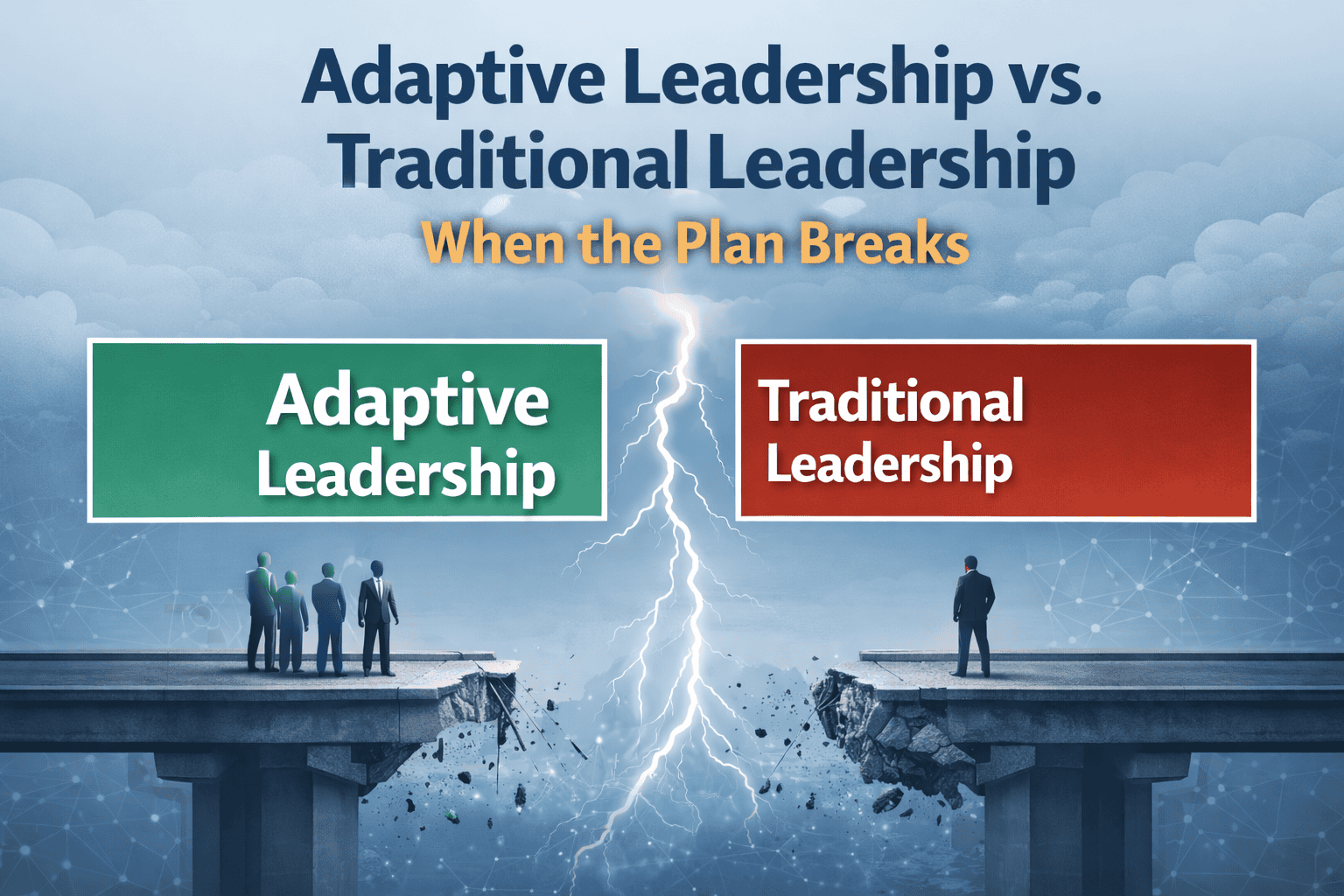
Adaptive leadership is a practical framework that helps individuals and organizations navigate complex, rapidly changing environments by distinguishing between technical problems that require known fixes and adaptive challenges that demand profound behavioral and cultural shifts. Originating from the work of Harvard Kennedy School scholars Ronald Heifetz and Marty Linsky, this approach focuses on mobilizing people to tackle tough challenges and thrive through continuous learning.
Understanding Adaptive Leadership: Core Concepts and Origins
The modern business environment is characterized by volatility, uncertainty, complexity, and ambiguity. In such conditions, traditional command-and-control management frequently fails. Employees and leaders often look to authority figures for answers, expecting a silver bullet to solve systemic issues. However, when an organization faces a novel problem—such as digital disruption, shifting consumer habits, or cultural transformation—standard operating procedures are no longer sufficient. This is where adaptive leadership becomes essential.
Developed extensively by Ronald Heifetz and Marty Linsky in foundational texts such as Leadership on the Line and The Practice of Adaptive Leadership, the framework shifts the focus of leadership from holding a formal title to exercising a process. Leadership is treated as an activity, not a position. Anyone in an organization, regardless of their rank, can exercise adaptive leadership by diagnosing the systemic environment, protecting minority voices, and orchestrating constructive conflict.
To fully grasp this framework, it is vital to understand that adaptive leadership is not about charisma, charm, or possessing all the right answers. Instead, it is about creating an environment where a group can confront difficult truths, unlearn obsolete habits, and discover new ways of operating. This requires emotional intelligence, resilience, and a willingness to tolerate the anxiety that naturally arises during periods of transition.
Technical Problems vs. Adaptive Challenges
The cornerstone of the adaptive leadership framework is the diagnostic distinction between technical problems and adaptive challenges. Misdiagnosing these two categories is the primary reason organizational change initiatives fail. Leaders frequently attempt to solve adaptive challenges with technical solutions, or they freeze when faced with technical problems that require simple, decisive operational management.
Technical problems, while sometimes complicated, are well-defined and have known solutions. They can typically be resolved by experts using established routines, current knowledge, or standard operating procedures. The expertise required to solve them usually resides within the authority figure or specialized department.
Adaptive challenges, by contrast, are complex, systemic, and ill-defined. There are no straightforward answers or expert blueprints available. Solving an adaptive challenge requires changes in people’s priorities, beliefs, habits, and loyalties. The solution requires the people facing the problem to do the heavy lifting, as the necessary learning cannot be delegated to an outside consultant or executive.
| Dimension | Technical Problems | Adaptive Challenges |
|---|---|---|
| Definition | Clear problem; known solution and procedures. | Ambiguous problem; no current template or known answer. |
| Locus of Work | Solved by authority figures or designated experts. | Requires the learning and effort of the people themselves. |
| Primary Action | Apply current expertise, standard operating procedures, and execution. | Shift mindsets, experiment, unlearn old behaviors, and adapt culture. |
| Resistance Level | Low to moderate; implementation depends on coordination. | High; involves loss, competing values, and psychological anxiety. |
| Examples | Software bug fixes, payroll processing errors, regulatory compliance updates. | Post-merger cultural integration, shifting business models toward sustainability, surviving industry disruption. |
The Key Behaviors of Adaptive Leaders
Practicing adaptive leadership requires mastering specific behaviors that challenge the status quo while keeping organizations stable enough to function. Heifetz, Grashow, and Linsky outline several core activities that define how an adaptive leader operates day-to-day.
1. Get on the Balcony
Leaders are routinely caught in the fast-paced action of daily operations—answering emails, attending back-to-back meetings, and putting out fires. To diagnose systemic issues, an adaptive leader must periodically step back to observe the pattern of the dance from a "balcony" perspective. From this vantage point, the leader can spot hidden dynamics, tribal loyalties, avoidance behaviors, and structural bottlenecks that are invisible from the dance floor.
2. Identify the Adaptive Challenge
Once a leader has observed the system, they must accurately categorize the pain point. Are teams struggling because of poor software (technical), or are they resisting collaboration due to siloed departmental metrics and historical mistrust (adaptive)? Naming the challenge correctly prevents the organization from wasting resources on surface-level fixes that ignore deep-seated cultural realities.
3. Regulate Distress
Change creates anxiety. If an organization operates in a state of complete comfort, no motivation for change exists. Conversely, if anxiety spikes too high, the organization panics, becomes dysfunctional, and regresses to old habits. Adaptive leaders operate within the "productive range of distress"—hot enough to motivate learning and engagement, but cool enough to prevent destructive conflict or paralysis. Leaders regulate this temperature by pacing the work, breaking large transformations into manageable milestones, and providing a steady presence.
4. Maintain Disciplined Attention
When faced with difficult choices, groups naturally use deflection mechanisms: pointing fingers, creating scapegoats, focusing on minor administrative details, or demanding that the leader make the hard choice for them. An adaptive leader resists these diversions, holding the group's attention on the tough, uncomfortable realities they would rather avoid. This means encouraging people to lean into the discomfort of ambiguity rather than rushing to premature consensus.
5. Give the Work Back to the People
Authority figures are conditioned to solve problems for their teams. Adaptive leadership demands the exact opposite. When an adaptive challenge arises, the leader must return ownership of the problem to the stakeholders. While this approach can feel uncomfortable for teams accustomed to top-down direction, it is the only way to build long-term organizational capacity and resilience.
6. Protect Voices of Leadership from Below
Innovators, whistleblowers, and dissidents often face marginalization because their ideas threaten institutional norms and comfort zones. Adaptive leaders protect these marginalized voices, shielding them from retaliation while forcing the broader organization to listen to dissenting perspectives. Breakthrough insights frequently originate at the periphery of an organization rather than the executive suite.
Practical Application in Modern Organizations
Implementing adaptive leadership in a professional setting requires shifting organizational rituals and daily habits. Leaders can operationalize this framework through structured steps that foster psychological safety and continuous experimentation.
Creating Psychological Safety
People will not engage in the vulnerable work of unlearning and adapting if they fear retribution for failure. Leaders must explicitly separate honest experimentation from reckless negligence. By framing setbacks as data-gathering exercises, teams feel empowered to test new approaches without fear of public punishment.
Conducting Rapid Experimentation
Because adaptive challenges lack upfront blueprints, organizations must treat solutions as hypotheses. Rather than rolling out a massive, multi-year strategic pivot, adaptive leaders design small, low-risk experiments. They test assumptions, gather feedback rapidly, and iterate based on real-world evidence rather than theoretical assumptions.
Navigating the Sense of Loss
Every adaptive change requires people to give up something they value—familiar routines, status, professional identity, or operational predictability. Effective adaptive leaders explicitly acknowledge this loss. They do not dismiss the emotional friction of transition, but honor past contributions while clearly articulating why the old ways are no longer viable.
Common Pitfalls and Limitations of Adaptive Leadership
While adaptive leadership offers a robust lens for modern management, it is not a universal panacea. Recognizing its limitations prevents misapplication.
- Misapplying Adaptive Frameworks to Technical Crises: In acute emergencies—such as an active cybersecurity breach or a factory floor accident—there is no time for broad stakeholder engagement or emergent learning. Direct, authoritative command-and-control is required.
- Exhausting Organizational Energy: Sustained organizational learning creates cognitive and emotional fatigue. If a leader keeps the organizational "temperature" too high for too long, burnout, cynicism, and high turnover will ensue.
- Resistance from Executive Peers: Traditional corporate structures reward certainty, predictability, and rapid metrics. Practicing adaptive leadership can frustrate stakeholders who demand immediate, definitive answers where none exist.
Frequently Asked Questions
What is the difference between adaptive leadership and traditional management?
Traditional management focuses on maintaining operational efficiency, executing established plans, and solving technical problems using existing expertise. Adaptive leadership focuses on navigating complex, ambiguous environments where no known solution exists, requiring teams to change their behaviors, values, and organizational culture.
Can anyone practice adaptive leadership without a formal title?
Yes. Adaptive leadership is defined as an ongoing practice and process rather than a formal organizational rank. Anyone who helps a group diagnose a systemic challenge, manages anxiety, and mobilizes peers toward constructive change is exercising adaptive leadership.
How do adaptive leaders manage resistance to change?
Instead of forcing compliance or dismissing detractors, adaptive leaders explore the underlying source of resistance. They distinguish between operational pushback and deep psychological loss, protect dissenting voices, and engage skeptics in dialogue to understand what valued habits or statuses are threatened by the transition.
Why do adaptive leadership initiatives often fail?
Initiatives typically fail when leaders misdiagnose adaptive challenges as technical problems and attempt to implement quick, top-down fixes. Other common failure modes include raising organizational anxiety past the point of productive distress, failing to provide psychological safety, and refusing to give the hard work back to the stakeholders.
How does "getting on the balcony" work in practice?
Getting on the balcony is a metaphor for pausing daily operational firefighting to observe systemic group dynamics from a detached perspective. In practice, this involves stepping away from operational tasks to analyze meeting dynamics, recurring bottlenecks, and hidden cultural patterns that prevent an organization from progressing.
Next Actions for Aspiring Adaptive Leaders
To begin applying adaptive leadership principles immediately, start by auditing your current operational challenges. Separate your active projects into technical problems that require standard execution and adaptive challenges that require behavioral evolution. Schedule dedicated time each week to step onto the "balcony"—away from routine administrative tasks—to observe team dynamics and identify where anxiety or avoidance is stalling progress. Finally, resist the urge to provide immediate answers; instead, ask probing questions that return ownership of the challenge to the people best positioned to solve it.