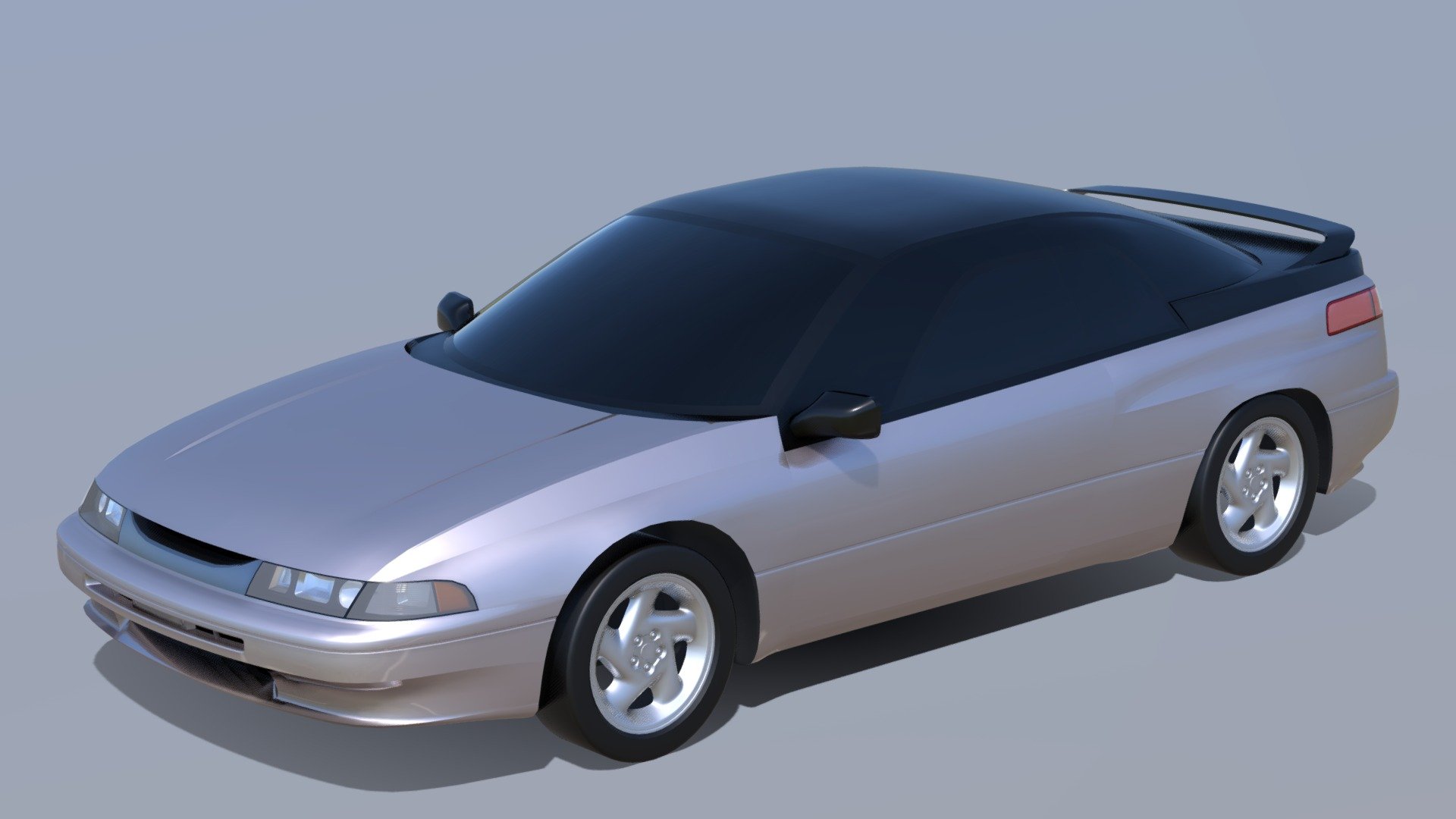
The 1991 Subaru SVX represents a pivotal moment in automotive history when a manufacturer known for utilitarian, all-wheel-drive wagons attempted to redefine the luxury grand touring segment. Designed by Giorgetto Giugiaro, the SVX introduced radical "window-within-a-window" styling and a sophisticated flat-six engine, cementing its status as a cult classic.
The Bold Arrival: Launching the Subaru SVX in 1991
When the Subaru SVX (Subaru Vehicle X) debuted for the 1992 model year (with production beginning in 1991), it was a shock to the automotive establishment. Up until that point, Subaru was largely perceived as a niche manufacturer of rugged, somewhat quirky economy cars and farm-ready wagons. The SVX was a deliberate attempt to shatter that image and move the brand upmarket, competing directly with established giants like the Nissan 300ZX, Mitsubishi 3000GT, and the Toyota Supra.
The launch was centered around the "Alcyone" nameplate in Japan, named after the brightest star in the Pleiades cluster—the same cluster that forms the Subaru logo. In North America, it was simply the SVX. It wasn't just a new car; it was a technological showcase. Subaru invested heavily in a new 3.3-liter flat-six engine and a highly advanced all-wheel-drive system that was years ahead of most competitors. However, the launch was also a gamble. With a price tag exceeding $24,000 in 1992 (roughly $54,000 in 2026 inflation-adjusted terms), it was nearly double the price of a standard Subaru Legacy of the era, putting it in a bracket where brand prestige was as important as performance.
Architectural Marvel: The "Window-within-a-Window" Design
The most striking feature of the SVX remains its "aircraft canopy" glazing. Subaru commissioned Italdesign, headed by the legendary Giorgetto Giugiaro, to create a shape that was both futuristic and aerodynamically efficient. Giugiaro’s vision resulted in a drag coefficient ($C_d$) of just 0.29, an impressive feat for the early 90s that remains competitive even by 2026 standards.
The "window-within-a-window" design, also seen on exotic machinery like the Lamborghini Countach and the DeLorean DMC-12, served both aesthetic and functional purposes. Structurally, it allowed for thinner A-pillars and a more expansive glass area, providing the driver with near-panoramic visibility. From a performance standpoint, it allowed the windows to be rolled down without creating the massive turbulence and wind buffeting typically associated with large-aperture side glass. This design gave the SVX a silhouette unlike anything else on the road, emphasizing its role as a "Grand Tourer" designed for high-speed, long-distance comfort rather than a raw, twitchy sports car.
Technical Specifications and Engineering Philosophy
At the heart of the SVX was the EG33 engine, a 3.3-liter horizontally opposed (boxer) six-cylinder. This engine was essentially an evolution of the four-cylinder EJ22 found in the Legacy, but with two additional cylinders and a host of refinements. It featured dual overhead cams (DOHC) and four valves per cylinder, producing a respectable 230 horsepower and 228 lb-ft of torque.
The EG33 Flat-Six Powerplant
The EG33 was a masterpiece of smooth power delivery. Because of the boxer configuration, the engine was inherently balanced, canceling out secondary vibrations without the need for heavy balance shafts. This allowed the SVX to cruise at triple-digit speeds with a level of refinement that rivaled contemporary BMWs and Lexuses. The engine utilized a sequential multi-port fuel injection system and a variable induction system that adjusted the intake runners' length to optimize torque at low RPMs and horsepower at high RPMs.
The Drivetrain Dilemma: AWD and the Automatic Transmission
Perhaps the most controversial aspect of the SVX's engineering was the choice of transmission. Subaru exclusively equipped the SVX with a 4-speed 4EAT automatic transmission. At the time, Subaru did not have a manual gearbox capable of handling the EG33's torque while maintaining the refinement expected of a luxury GT.
While the lack of a manual gearbox alienated some enthusiasts, the all-wheel-drive (AWD) systems were world-class. Depending on the market and year, the SVX utilized one of two systems:
- ACT-4 (Active Torque Split): Mostly found in later or lower-trim models, this system used a multi-plate transfer clutch to vary torque between the front and rear axles.
- VTD (Variable Torque Distribution): Found in the higher-spec LSi models, this was a more sophisticated system using a planetary center differential and an electronically controlled hydraulic clutch. It provided a default 33/67 front-to-rear torque split, which could adjust to 50/50 as conditions dictated, giving the car a rear-biased, sporty feel.
| Specification | Details (1991-1997 Models) |
|---|---|
| Engine Type | 3.3L DOHC Flat-Six (EG33) |
| Horsepower | 230 hp @ 5,400 RPM |
| Torque | 228 lb-ft @ 4,400 RPM |
| Transmission | 4-Speed Automatic (4EAT) |
| AWD System | VTD or ACT-4 (Regional/Trim dependent) |
| Top Speed | ~143 mph (Governed) |
| 0-60 mph | ~7.3 Seconds |
| Curb Weight | 3,500 – 3,600 lbs |
Year-by-Year Evolution (1992–1997)
The SVX did not undergo a traditional "mid-cycle refresh" with major body changes, but it did see significant mechanical and trim adjustments throughout its six-year production run.
- 1992–1993: The early years focused on the high-end market. The SVX was available in "L" and "LSi" trims. The LSi came standard with leather, a sunroof, and the more advanced VTD all-wheel-drive system. These early models are often the most sought after by collectors for their pure "Giugiaro" vision.
- 1994–1995: Responding to slow sales caused by the high price tag, Subaru introduced a front-wheel-drive (FWD) version of the SVX in 1994. This model was lighter and cheaper, but it stripped the car of its core "all-weather" identity. By 1995, sales remained sluggish, and the FWD experiment was largely deemed a failure as it didn't align with the brand’s AWD-centric marketing.
- 1996: This was a transition year for emissions and safety. The SVX received OBD-II (On-Board Diagnostics) compliance, which changed some of the engine management components. Subaru also discontinued the FWD model, returning to an all-AWD lineup.
- 1997: The final year of production saw the SVX phased out. Subaru produced a limited "LSi" run, often identified by their distinctive paint colors and woodgrain interior accents. By the end of 1997, Subaru had sold only about 25,000 units globally, making it a rare sight on modern roads.
The SVX vs. Its 90s Contemporaries
To understand the SVX, one must compare it to the "Golden Era" of Japanese performance cars. While the Toyota Supra Turbo and Nissan 300ZX Twin Turbo were focused on raw acceleration and track prowess, the SVX was designed for the "Grand Tour." It was meant to be driven from Zurich to Monte Carlo—or Seattle to San Francisco—at high speed in total comfort.
The SVX lacked the aftermarket support of its rivals, largely because its ECU was difficult to tune and the automatic transmission was perceived as a bottleneck. However, in terms of foul-weather capability, the SVX was unmatched. While a Supra would struggle in a rainstorm or light snow, the SVX's AWD system and high-quality Bridgestone tires (standard at the time) made it a year-round supercar. Its interior was also significantly more spacious and airy than the cramped cockpits of the RX-7 or the 300ZX, thanks to that expansive glass canopy.
The Legacy: A Cult Icon in 2026
As of 2026, the Subaru SVX has matured into a respected classic. It is no longer viewed as a "failed experiment" by Subaru but as a bold statement of engineering capability. For collectors, the SVX offers a unique entry point into the vintage Japanese market.
Modern Reliability and Common Issues
Owning an SVX in 2026 requires a dedicated enthusiast. The 4EAT transmission remains the primary "weak point." The original units were prone to overheating, leading to premature failure of the internal clutches. Most surviving examples have been upgraded with external transmission coolers or have undergone the popular "5-speed manual swap" using gearboxes from contemporary WRXs or Legacys.
Parts availability for the body and glass is the greatest challenge. Because of the unique window design, replacement side glass or windshields can be prohibitively expensive and difficult to source. However, the EG33 engine itself is remarkably robust, often reaching 200,000 miles or more with regular timing belt and water pump service.
Value and Collectibility
The market for the SVX has seen a steady rise over the last decade. While they haven't reached the astronomical prices of the Supra or the R34 Skyline, clean, low-mileage LSi models now command a premium. The car appeals to those who value design history and technical eccentricity over sheer horsepower. It remains a conversation starter at every "Cars and Coffee" event, representing a time when Subaru dared to be different.
Troubleshooting and Owner Guidance
If you are considering purchasing or restoring a 1991–1997 Subaru SVX, several critical areas require verification:
- Transmission Fluid History: Check for a dark color or burnt smell. If the car does not have an auxiliary transmission cooler installed, it should be the first modification you make.
- Wheel Bearings: The SVX is heavy (approx. 3,600 lbs), and it is notorious for wearing out rear wheel bearings. Listen for a low-frequency hum that increases with speed.
- The Window Seals: Inspect the rubber seals around the "window-within-a-window." These are specialized parts; if they are cracked or leaking, they can cause interior water damage and are difficult to replace.
- ECU Caps: Like many 90s Japanese cars, the capacitors in the Engine Control Unit can leak over time. Proactive replacement of these capacitors can prevent sudden stalling or "no-start" conditions.
For more technical documentation, enthusiasts often refer to the original Subaru SVX Service Manuals or community-driven databases like the Subaru SVX World Network, which has archived nearly three decades of repair data.
Frequently Asked Questions
Can you manual swap a Subaru SVX?
Yes, manual swaps are the most common performance modification for the SVX. Most owners use a 5-speed manual from a Subaru Legacy or a 6-speed from a WRX STI. This requires a custom pedal box and minor modifications to the transmission tunnel, but it significantly improves the car's acceleration and driver engagement.
Why was the Subaru SVX so expensive at launch?
The price was driven by the high cost of the Italdesign collaboration, the bespoke EG33 engine, and the complex AWD systems. Additionally, the unique glass canopy was expensive to manufacture compared to standard automotive glass.
Is the Subaru SVX a reliable daily driver in 2026?
While the engine is reliable, the SVX is best suited as a weekend or collector car. The scarcity of body parts and specialized glass means that even a minor fender-bender could lead to the car being declared a total loss by insurance companies.
How many Subaru SVXs were made?
Total global production was approximately 24,379 units. Of those, about 14,257 were sold in the United States. This makes it significantly rarer than most of its 1990s Japanese contemporaries.
What is the "Alcyone" name?
In the Japanese domestic market (JDM), the car was called the Alcyone SVX. Alcyone is the brightest star in the Pleiades star cluster, which is represented by the six stars in the Subaru logo.
Final Recommendation: Should You Buy One?
The 1991 Subaru SVX is an exceptional choice for a collector who appreciates 90s "bubble era" Japanese engineering and avant-garde design. It is not the car for someone seeking a simple, low-maintenance commuter, nor is it the car for someone wanting to win drag races. Instead, the SVX is a rolling piece of art that offers a refined, high-speed touring experience.
If you find a well-maintained LSi model with a documented service history—ideally one that has already had its transmission cooling addressed—it represents one of the most unique and rewarding "undervalued" classics on the market today. Its legacy as Subaru's most ambitious project ensures it will remain a significant landmark in automotive history for decades to come.