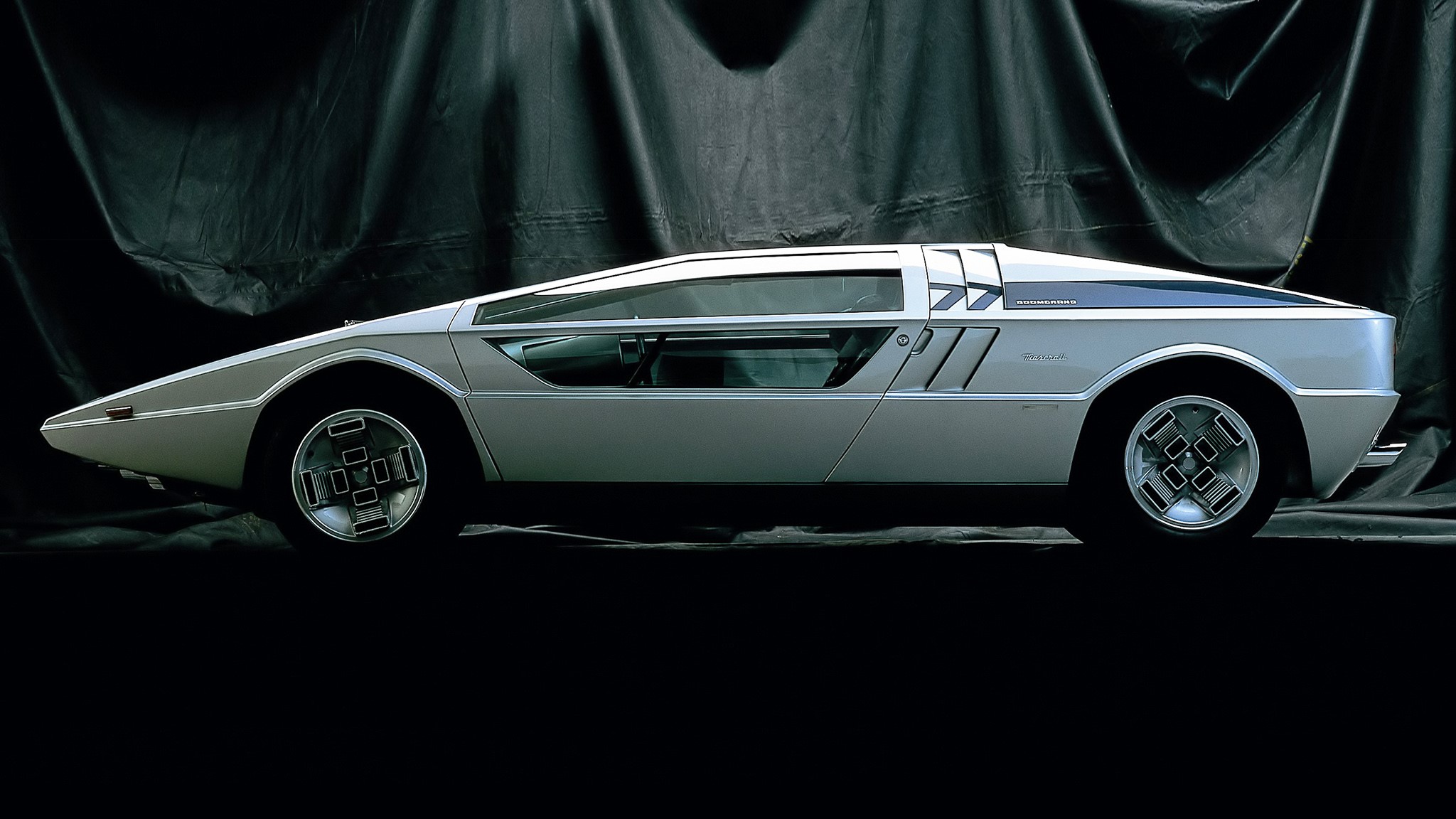
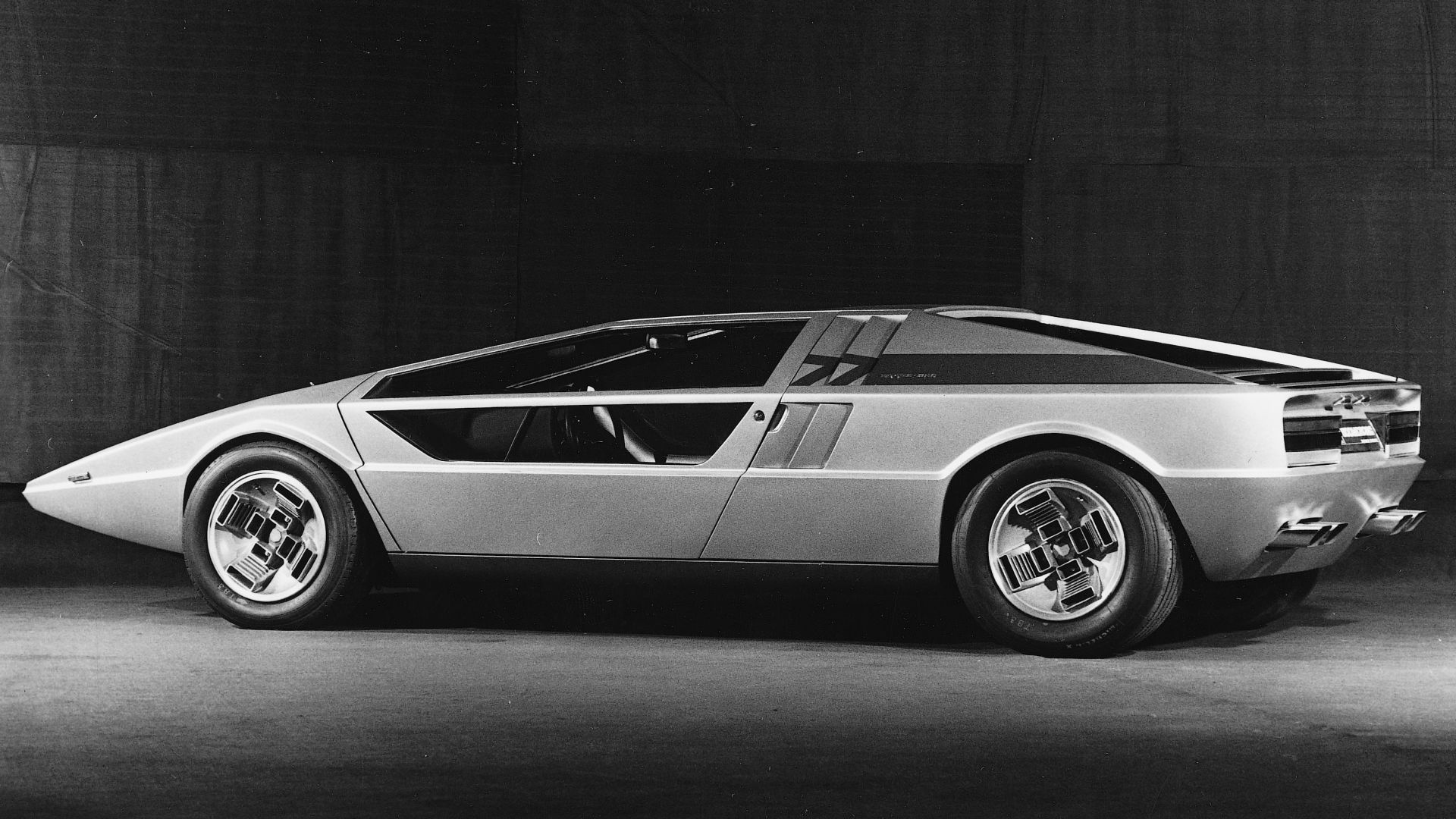
The 1972 Maserati Boomerang is a legendary concept car designed by Giorgetto Giugiaro of Italdesign. It revolutionized automotive styling with its extreme wedge silhouette, glass-heavy cabin, and radical interior layout featuring a steering wheel that enclosed the dashboard instruments. It remains an icon of 1970s "folded paper" design.
Origins and the Genesis of the Wedge Design Era
The early 1970s marked a radical departure in automotive design. The curvaceous, organic lines that dominated the 1950s and 1960s gave way to sharp angles, flat planes, and aggressive wedge profiles. At the forefront of this movement was Giorgetto Giugiaro, founder of Italdesign. Having previously penned masterpieces like the Maserati Ghibli, Giugiaro sought to push the envelope of aerodynamic and geometric styling even further.
The Boomerang made its debut as a non-running dummy model at the Turin Motor Show in November 1971, but it returned a few months later at the 1972 Geneva Motor Show as a fully functional, road-legal automobile. Built upon the chassis and mechanical underpinnings of the Maserati Bora, the Boomerang was not merely a stylistic exercise; it was a high-performance laboratory designed to explore the absolute limits of low-slung, wedge-shaped architecture.
Maserati, under the ownership of Citroën at the time, provided a potent mid-engine platform that allowed Giugiaro to execute his vision without the mechanical constraints of a front-engine layout. The project symbolized a period of fearless experimentation in European coachbuilding, where independent design houses competed fiercely to redefine the future of the supercar.
Exterior Styling, Aerodynamics, and Proportions
The defining characteristic of the 1972 Maserati Boomerang is its uncompromising wedge profile. Viewed from the side, the car forms an almost continuous diagonal line running from the razor-sharp tip of the front bumper up the heavily raked windshield, across the roofline, and down to the abrupt, Kamm-tail rear end.
With an overall height of just 990 millimeters (38.9 inches), the Boomerang possessed an ultra-low stance that emphasized speed even when standing still. The exterior panels were composed of hand-formed steel and aluminum, meticulously folded to create sharp creases and flat planes that caught light in dramatic ways.
Key exterior design elements included:
- The Glasshouse Canopy: A massive, steeply raked windshield integrated seamlessly with large side door windows that featured a split design, allowing the lower portion to slide downward.
- Integrated Lighting: Pop-up dual headlamps sat flush into the nose, maintaining the clean horizontal plane of the front fascia when retracted.
- Rear Treatment: A flat, vertical truncation housing wide, rectangular tail lamps derived from contemporary Citroën parts bins, reinforcing the corporate synergy of the era.
- The Paintwork: Originally finished in a striking metallic pale blue (known as French Blue), the color accented the geometric planes and minimized visual clutter.
Aerodynamically, the wedge shape was designed to generate downforce at speed, though its extreme rake and massive glass surface area created notable thermal challenges within the cabin. The greenhouse acted essentially as a solar greenhouse, requiring advanced ventilation solutions that influenced later mid-engine layout designs.
Revolutionary Interior Architecture and Ergonomics
While the exterior of the Maserati Boomerang captured public imagination, the interior revolutionized how drivers interacted with automotive controls. Giugiaro reimagined the cockpit entirely, centered around a stationary, circular console that housed the steering wheel and all primary instrumentation.
Rather than mounting the instrument cluster on the dashboard or behind a traditional steering wheel hub, the Boomerang integrated the gauges, warning lights, and toggle switches directly into the center of the steering wheel itself. The rim of the steering wheel rotated around this fixed central pod, a design choice intended to maximize visibility of the dials and create a futuristic, aircraft-like environment.
| Feature | Conventional 1970s Supercar | 1972 Maserati Boomerang |
|---|---|---|
| Steering Wheel Design | Three-spoke wheel with separate dash-mounted gauges | Fixed central instrument cluster with a rotating outer rim |
| Seating Position | Upright or slightly reclined bucket seats | Semi-prone, deeply integrated bucket seats aligned with floor pans |
| Glass-to-Body Ratio | Traditional greenhouse with thick A, B, and C pillars | Wraparound glass canopy with glazed door panels |
| Switchgear Layout | Column stalks and dashboard-mounted toggles | Centralized pod controls clustered directly around the driver |
The seating position was similarly radical. The driver and passenger reclined deeply into fixed-position seats, with the pedal box and steering column adjustable to accommodate different driver heights rather than moving the seat itself. This layout minimized weight and kept the center of gravity exceptionally low.
Powertrain, Chassis, and Performance Specifications
Beneath its avant-garde fiberglass and metal skin, the Maserati Boomerang shared its DNA with the production Maserati Bora. This ensured that the concept car was not just a static sculpture, but a functioning, high-performance machine capable of brisk road behavior.
The vehicle utilized a mid-mounted, longitudinally positioned 4.7-liter V8 engine equipped with four Weber carburetors. This powerplant produced an estimated 310 horsepower at 6,000 rpm, delivering power to the rear wheels via a five-speed manual transaxle.
Core Technical Specifications:
- Engine Type: 90-degree V8, naturally aspirated
- Displacement: 4,719 cc (4.7 liters)
- Valvetrain: Dual overhead camshafts per bank (DOHC)
- Power Output: 310 hp (metric) at 6,000 rpm
- Transmission: 5-speed ZF manual transaxle
- Chassis: Monocoque steel body with tubular subframes
- Suspension: Independent double wishbones with coil springs and anti-roll bars all around
- Brakes: Ventilated disc brakes on all four wheels, power-assisted
Performance estimates of the era placed the Boomerang's top speed near 300 km/h (186 mph), depending on the final drive ratio and aerodynamic drag coefficients. The handling benefited from the Bora’s mid-engine weight distribution, though the heavy V8 positioned behind the cockpit required respect on wet or uneven surfaces.
Provenance, Ownership History, and Restoration
Unlike many concept cars that met the crusher after their exhibition circuit ended, the Maserati Boomerang survived. Following its debuts in Turin and Geneva, the car was sold to a private owner in Spain in 1974. Over the next two decades, it passed through several collectors across Europe, occasionally participating in historic events and automotive exhibitions.
In the early 2000s, the car underwent a comprehensive, meticulous restoration led by experts who sourced original Maserati and Italdesign documentation to preserve its factory-correct specifications. Every effort was made to maintain the integrity of its unique interior mechanisms and fragile glass components.
The restored Boomerang re-emerged on the international concours circuit, capturing widespread acclaim. In 2015, the car was offered at a Bonhams auction in Chantilly, France, where it sold for €3.3 million ($3.7 million USD at the time). It continues to make rare appearances at prestigious motoring events, serving as a rolling monument to 1970s design audacity.
Frequently Asked Questions
Is the Maserati Boomerang street-legal?
Yes. Unlike the initial 1971 Turin show car which was a non-running wooden model, the 1972 Geneva show car was built on a fully operational Maserati Bora chassis. It is registered for road use and retains its original registration plates from Spain.
Who designed the Maserati Boomerang?
The exterior and interior were designed by Giorgetto Giugiaro during his tenure at Italdesign. Giugiaro is widely recognized as one of the most influential automotive designers of the 20th century, having also penned the Volkswagen Golf Mk1, BMW M1, and DeLorean DMC-12.
How many Maserati Boomerangs were built?
Only one functional prototype was ever built. While Italdesign constructed a styling model previously, the 1972 Geneva car remains a true one-off vehicle, making its valuation exceptionally high among collectors.
What engine powers the Boomerang?
It is powered by a 4.7-liter naturally aspirated V8 engine borrowed from the Maserati Bora, producing 310 horsepower and mated to a five-speed ZF manual transmission.
Why is the steering wheel design unusual?
Giugiaro wanted to experiment with ergonomics by placing all dashboard instrumentation inside a stationary central hub, allowing the outer steering wheel rim to rotate around the gauges without obstructing the driver's forward view.
Practical Recommendations for Automotive Enthusiasts
For those seeking to study or experience the legacy of the 1972 Maserati Boomerang, direct physical access is limited due to its single-prototype status and private ownership. However, enthusiasts can engage with its history through several avenues:
- Automotive Museums: Monitor announcements from major European and North American concours events (such as the Concorso d'Eleganza Villa d'Este or Pebble Beach), where the car is occasionally loaned for special Giugiaro retrospectives.
- Archival Study: Review Italdesign’s official historical archives and period motoring magazines from 1972 for firsthand driving impressions and technical cutaway drawings.
- Alternative Ownership: For collectors drawn to the mechanical underpinnings of the Boomerang, acquiring a production Maserati Bora (produced from 1971 to 1978) offers a similar V8 mid-engine driving experience at a fraction of a concept car's valuation.