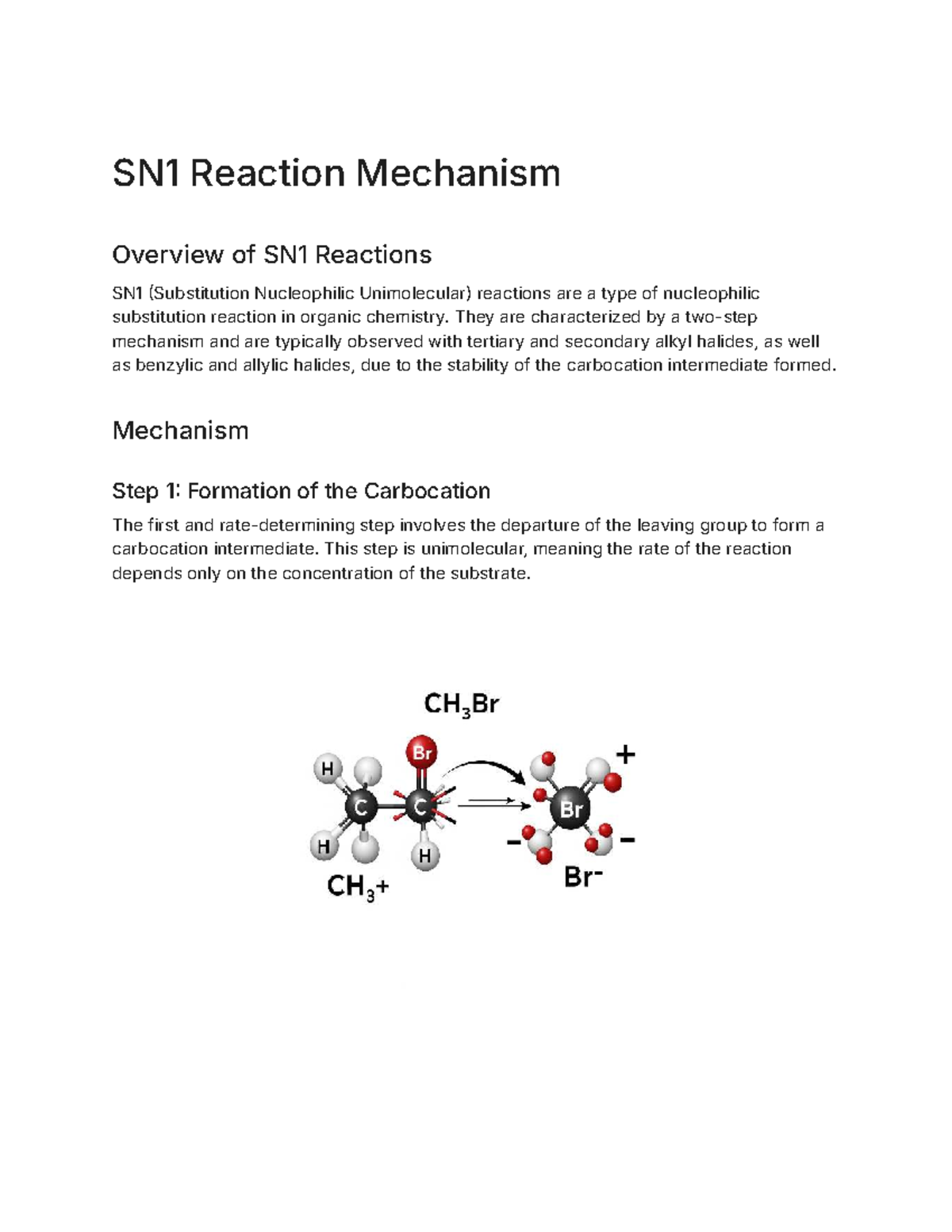
Choosing the right solvent for an $S_N1$ (Substitution Nucleophilic Unimolecular) reaction requires balancing carbocation stability, nucleophilicity, and the energetic demands of polar transition states. The single most decisive factor shaping $S_N1$ solvent choice is solvent polarity and protic character, because these properties directly facilitate the formation of the reaction's defining intermediate: a high-energy carbocation.
Understanding the Mechanistic Foundation of $S_N1$ Reactions
To understand why a particular solvent is selected for an $S_N1$ reaction, one must first master the two-step mechanism that defines it. Unlike $S_N2$ (Substitution Nucleophilic Bimolecular) mechanisms—which proceed in a single concerted step dependent on both the substrate and the nucleophile—$S_N1$ reactions are stepwise and unimolecular in the rate-determining step.
- Step 1 (Rate-Determining): R-X --> R(+) + X(-) (Slow, facilitated by polar protic solvents)
- Step 2 (Fast): R(+) + Nu(-) --> R-Nu (Fast nucleophilic attack)
In the first and rate-determining step, the carbon-leaving group bond cleaves heterolytically. This generates a positively charged carbocation intermediate and a leaving group anion. Because creating charge separation from a neutral molecule requires a significant energetic investment, the reaction rate depends almost entirely on how effectively the surrounding solvent can lower this activation energy.
Consequently, $S_N1$ reactions thrive under conditions that stabilize charge separation, shield ions from immediate recombination, and solvate the developing transition state. Selecting an inappropriate solvent can completely halt the reaction, force an elimination pathway (such as E1), or cause the reaction to shift entirely to an $S_N2$ mechanism if a strong nucleophile and a primary or secondary substrate are involved.
Polar Protic Solvents: The Gold Standard for $S_N1$
Polar protic solvents possess molecules with hydrogen atoms bound to electronegativity-driven atoms like oxygen or nitrogen (e.g., $-\text{OH}$ or $-\text{NH}$ bonds). These solvents are uniquely suited for $S_N1$ reactions due to their ability to engage in strong hydrogen bonding and provide high dielectric constants.
Solvation of Leaving Groups and Carbocations
When a leaving group departs during the rate-determining step of an $S_N1$ reaction, it carries away a negative charge. Polar protic solvents stabilize this newly formed anion through hydrogen bonding. The partially positive hydrogen atoms of the solvent cluster around the anion, dispersing its charge and preventing it from attacking the carbocation immediately.
Simultaneously, these solvents stabilize the developing carbocation and the transition state leading up to it. By lowering the energy of the transition state, the solvent effectively reduces the activation energy ($\Delta G^\ddagger$), accelerating the overall rate of ionization.
Common Examples in Laboratory and Industrial Settings
- Water ($\text{H}_2\text{O}$): The most polar protic solvent available. It possesses a very high dielectric constant and exceptional hydrogen-bonding capacity. It is frequently used in solvolysis reactions where water acts as both the solvent and the nucleophile.
- Methanol ($\text{CH}_3\text{OH}$) and Ethanol ($\text{CH}_3\text{CH}_2\text{OH}$): Lower alcohols that balance high polarity with moderate volatility, making them easy to remove during workup procedures. They frequently participate as nucleophiles in alcoholysis.
- Acetic Acid ($\text{CH}_3\text{COOH}$): A weaker protic solvent often utilized when milder acidic conditions are required, though its lower dielectric constant compared to water makes ionization slower.
Dielectric Constant and Solvation Energy
The dielectric constant ($\epsilon$) of a solvent is a quantitative measure of its ability to reduce the electrostatic force between charged particles. In the context of $S_N1$ reactions, a high dielectric constant is vital for separating ions.
- High Dielectric Constant ($\epsilon$)
- Reduces electrostatic attraction between Carbocation (+) and Anion (-)
- Lowers activation energy for ionization
- Prevents tight ion-pair collapse
When the leaving group departs, it initially forms an intimate ion pair with the carbocation. If the solvent cannot quickly separate these ions, they will simply recombine to form the starting material. Solvents with high dielectric constants weaken the Coulombic attraction between the carbocation and the leaving group, allowing them to drift apart and leaving the carbocation vulnerable to attack by a nucleophile.
| Solvent | Dielectric Constant ($\epsilon$ at 25°C) | Protic / Aprotic | Relative $S_N1$ Rate Impact |
|---|---|---|---|
| Water ($\text{H}_2\text{O}$) | 80.4 | Protic | Extremely Fast (Maximum Ionization) |
| Methanol ($\text{CH}_3\text{OH}$) | 32.7 | Protic | Fast |
| Ethanol ($\text{CH}_3\text{CH}_2\text{OH}$) | 24.5 | Protic | Moderate-Fast |
| Acetone ($\text{CH}_3\text{COCH}_3$) | 20.7 | Polar Aprotic | Slow / Unfavorable |
| Diethyl Ether ($\text{CH}_3\text{CH}_2\text{OCH}_2\text{CH}_3$) | 4.3 | Nonpolar Aprotic | Extremely Slow / Ineffective |
The Role of Solvolysis: When the Solvent is the Nucleophile
In many classic $S_N1$ procedures, the solvent plays a dual role: it acts as the reaction medium to stabilize the ionic transition states and functions directly as the nucleophile in the second step. This specific scenario is known as solvolysis.
When a tertiary alkyl halide is dissolved in a mixture of water and ethanol, water and ethanol molecules surround the substrate. Once the leaving group departs and creates a tertiary carbocation, an abundant solvent molecule captures the carbocation, yielding an alcohol or an ether product, respectively.
Because the solvent is present in massive molar excess compared to any added reagents, competition from external nucleophiles is virtually nonexistent. Consequently, controlling the composition of solvent mixtures—such as varying aqueous-organic ratios—allows chemists to fine-tune reaction kinetics and product distributions in synthetic pathways.
Avoiding Mechanistic Pitfalls: Why Polar Aprotic Solvents Fail in $S_N1$
While polar aprotic solvents (such as acetone, dimethylformamide [DMF], and dimethyl sulfoxide [DMSO]) have high dielectric constants, they lack acidic hydrogen atoms and do not participate in hydrogen bonding. This distinction has profound implications for reaction pathways.
Polar aprotic solvents are exceptional media for $S_N2$ reactions because they leave anions relatively unsolvated and highly reactive. However, they are generally poor choices for dedicated $S_N1$ processes. Without protic hydrogen bonding to stabilize leaving group anions and solvate the transition state effectively, the ionization of the substrate requires significantly more energy.
Furthermore, if a strong nucleophile is present alongside a polar aprotic solvent, the reaction mechanism will inevitably divert away from $S_N1$ and proceed via the bimolecular $S_N2$ pathway (provided the substrate is not sterically hindered like a tertiary carbon). Therefore, misidentifying solvent requirements can completely alter the chemical outcome of a synthesis.
Practical Guidelines and Troubleshooting Solvent Selection
When designing or troubleshooting an $S_N1$ reaction in a laboratory or industrial setting, chemists must weigh several operational and chemical constraints beyond raw reaction kinetics.
1. Substrate Reactivity Matching
Tertiary and benzylic substrates form stable carbocations rapidly and can tolerate slightly less polar solvent systems if solubility demands it. Conversely, secondary substrates require highly polar protic environments to encourage ionization, as they form less stable carbocations that are prone to rearrangement.
2. Solubility of Reactants
A solvent must dissolve the organic substrate for the reaction to proceed at a practical rate. If a tertiary alkyl halide is insoluble in pure water, chemists use binary solvent mixtures—such as aqueous ethanol or aqueous acetone—to maintain solubility while preserving enough protic character to facilitate ionization.
3. Safety, Toxicity, and Workup Constraints
- Volatility: Solvents like methanol and ethanol are easy to rotary-evaporate during product isolation.
- Toxicity: Chlorinated solvents or benzene derivatives were historically common but are minimized in modern protocols due to strict environmental and health regulations.
- Inucluence of Trace Impurities: Acidic or basic impurities in industrial-grade solvents can catalyze unintended side reactions, such as E1 eliminations or rearrangements. High-purity, analytical-grade solvents are mandatory for reproducible results.
Frequently Asked Questions
Why are polar protic solvents required for $S_N1$ reactions?
Polar protic solvents are required because they possess hydrogen atoms capable of strong hydrogen bonding. These bonds stabilize the developing negative charge on the leaving group as it departs, and they lower the activation energy required to form the high-energy carbocation intermediate in the rate-determining step.
Can an $S_N1$ reaction occur in a nonpolar solvent?
No. Nonpolar solvents lack the dielectric strength and solvation capabilities required to separate ions. In a nonpolar solvent like hexane or toluene, the carbocation and the leaving group would remain tightly bound as an ion pair, preventing nucleophilic attack and effectively halting the reaction.
What is solvolysis in the context of $S_N1$?
Solvolysis is a specific type of substitution reaction where the solvent itself acts as the nucleophile. Because the solvent is present in massive molar excess, it reacts with the intermediate carbocation after ionization, resulting in an alcohol, ether, or similar solvent-derived product.
How does solvent choice affect the stereochemical outcome of $S_N1$?
$S_N1$ reactions theoretically yield a racemic mixture due to planar carbocation geometry. However, polar protic solvents can form a tight solvent cage around one face of the carbocation during the ionization phase. This leads to partial retention of configuration alongside predominant inversion, depending on the solvent's viscosity and coordination strength.
Why do polar aprotic solvents favor $S_N2$ instead of $S_N1$?
Polar aprotic solvents possess high dielectric constants to dissolve salts but lack acidic hydrogens, meaning they do not effectively solvate anions. This leaves anions unencumbered and highly reactive as strong nucleophiles, which drives second-order bimolecular ($S_N2$) kinetics rather than unimolecular ionization.
Conclusion and Next Actions
Selecting the correct solvent for an $S_N1$ reaction ultimately depends on maximizing carbocation stability and promoting clean ionization through polar protic media. When planning a synthesis, verify your substrate's capacity to form a stable carbocation, select a solvent with an appropriate dielectric constant and hydrogen-bonding profile, and adjust aqueous-organic ratios to balance reactant solubility with reaction rate requirements.