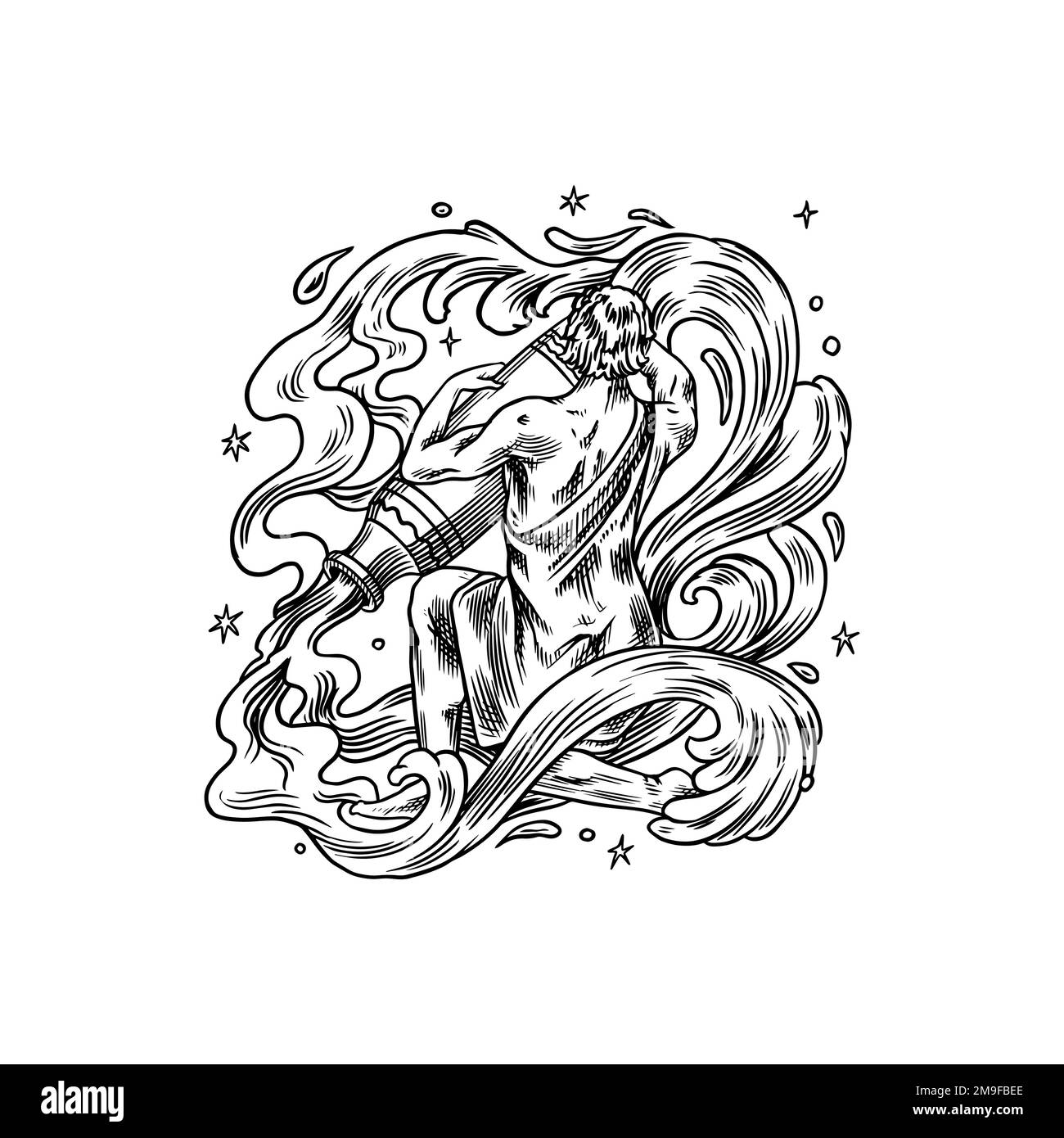
The Aquarius symbol, represented by two parallel zigzag lines, functions in modern astrology as the glyph for the eleventh sign of the zodiac. It symbolizes the diffusion of cosmic energy, reflecting the sign’s association with electricity, humanitarianism, and the intellectual flow of collective consciousness, rather than depicting a literal water-bearer pouring liquid from a vessel.
Historical Context and Iconographic Evolution
In the broader history of celestial study, the constellation Aquarius has been identified as the "Water Bearer" since the Babylonian era. The name is derived from the Latin aquarius, meaning "water-carrier" or "cup-carrier." Early Mesopotamian depictions linked the constellation to the god Ea, who was often shown pouring water from an overflowing vase.
However, in modern astrology, the visual representation is strictly defined by the iconic parallel zigzags. This shift from figurative iconography (a man holding a jug) to abstract symbolism (the lines) reflects a transition in astrological practice toward shorthand and standardized glyphs. In the mid-twentieth century and into the twenty-first, the focus moved away from the literal imagery of the water-bearer toward the function of the sign—specifically, the transmission of ideas and the connectivity of social networks. The zigzag lines are interpreted by modern practitioners as electrical waves, a nod to the sign's modern planetary ruler, Uranus, which governs sudden shifts, innovation, and technological advancement.
Anatomical and Elemental Associations
Aquarius is traditionally categorized as an Air sign. In the Western zodiacal system, the four elements (Fire, Earth, Air, Water) denote the temperament and core psychological focus of the signs. Air signs, which include Gemini, Libra, and Aquarius, are primarily concerned with the intellect, communication, social dynamics, and abstract concepts.
The Aquarius symbol serves as a marker for the sign’s specific anatomical and energetic resonance within the human body. In medical astrology—a branch historically used to correlate zodiac signs with physical systems—Aquarius governs:
- The Circulatory System: Often associated with the flow of blood, aligning with the "flow" of the water-bearer’s vessel.
- The Calves and Ankles: These areas are assigned to Aquarius in the traditional "Zodiac Man" template, where the signs map onto the body from Aries (head) to Pisces (feet).
- The Nervous System: Because of the modern association with Uranus and electricity, practitioners often link the Aquarian influence to the conductivity of the nerves, paralleling the zigzag glyph's resemblance to lightning or energy pulses.
The Role of Modern Planetary Rulers
To understand the Aquarius symbol in a contemporary context, one must distinguish between its classical and modern planetary rulers. Before the discovery of the outer planets, Aquarius was governed by Saturn, the planet of structure, restriction, and discipline. The shift to Uranus as the modern ruler has profoundly impacted how the symbol is interpreted today.
| Planet | Governing Influence | Impact on Aquarian Symbolism |
|---|---|---|
| Saturn | Limitation, Tradition, Time | Provides the foundation and the "walls" for the water to flow. |
| Uranus | Innovation, Rebellion, Electricity | Transforms the water into energy waves and modern connectivity. |
In 2026, the interpretation of Aquarius relies heavily on this duality. While the symbol remains a constant, the way it is read in a birth chart or a predictive transit depends on whether the astrologer is applying traditional Hellenistic techniques or modern psychological/evolutionary astrology.
Technical Implementation in Astrological Charts
For the student or practitioner of astrology, the Aquarius symbol is not merely a logo but a precise location in the celestial coordinate system. The zodiac is a band of 360 degrees divided into twelve 30-degree segments, known as signs. Aquarius occupies the 300° to 330° segment of the ecliptic.
When calculating or analyzing an individual's "Aquarius placement," the symbol is applied to specific components of a chart:
- Sun Sign: The position of the Sun at the moment of birth, typically falling between January 20 and February 18.
- Ascendant (Rising Sign): The sign crossing the eastern horizon at birth, which dictates the chart’s house system and the structural "angle" from which the individual interacts with the world.
- Planetary Placements: If a planet—such as Mercury or Venus—is located within the 30-degree span of the Aquarius segment, that planet is said to be "in Aquarius."
The presence of the symbol in a digital or paper chart indicates that the qualities of the sign—innovation, detachment, and social reform—are expressed through the medium of that specific planet. For example, Venus in Aquarius suggests a preference for unconventional relationships or friendships-first romantic connections.
Common Misinterpretations and Technical Errors
A frequent error in amateur astrology is the conflation of the Aquarius symbol with water-based elements. Because the sign is named "The Water Bearer," novices often mistake it for a Water sign. This is a primary point of friction for learners. The water being poured is a metaphor for the dissemination of knowledge or spirit into the material world, not a representation of emotional fluidity, which is the domain of Water signs like Cancer, Scorpio, and Pisces.
Another common point of confusion is the relationship between the symbol and the "Age of Aquarius." The "Age" is an astronomical phenomenon related to the precession of the equinoxes, where the vernal equinox point shifts backward through the constellations. This is distinct from the tropical zodiac sign used in standard horoscopic astrology. In 2026, the confusion persists; the symbol's presence in popular culture often references the concept of a New Age of humanity rather than the technical placement of the Sun in a birth chart.
The Symbol in Contemporary Cultural Practice
In 2026, the use of the Aquarius symbol has transcended specialized astrological texts and entered the realm of digital semiotics. It is frequently employed in social media, jewelry, and branding to denote "non-conformity" or "tech-forward" thinking.
From a professional astrological standpoint, however, the symbol remains a precise identifier of fixed-modality air energy. Its "fixed" nature means that, unlike the mutable signs (Gemini, Virgo, Sagittarius, Pisces) which are characterized by adaptability, Aquarius is characterized by persistence and the solidification of ideals. The two lines of the symbol represent the consistency of this intellectual energy, emphasizing a stability of thought and a relentless pursuit of humanitarian goals.
Frequently Asked Questions
Why are there two lines in the Aquarius symbol instead of one? The two lines represent the dual nature of the flow—often interpreted as the division between the ethereal/intellectual realm and the material/humanitarian application of that knowledge. The waves symbolize the movement of energy rather than static containment.
Is the Aquarius symbol related to the Greek god Poseidon? No. While Poseidon is associated with the sea and water, the Aquarius sign is distinct from maritime or oceanic symbolism. The water in the Aquarius mythos is atmospheric or symbolic of wisdom being poured onto the Earth, not the physical ocean.
Does the symbol change depending on the house it occupies? The visual glyph of the symbol remains identical, but its expression changes based on the house it resides in within a birth chart. If the Aquarius symbol is at the cusp of the 10th house, the individual may express Aquarian innovation within their career; if in the 4th house, it may manifest in their private home life.
Why is Aquarius considered an "Air" sign if the name implies water? The naming is a relic of ancient celestial cartography that identified the constellation's shape with a man holding a water jar. However, the elemental assignment was codified later based on the sign's dry, intellectual, and communicative properties, which align with the characteristics of the element of Air.
How does the 2026 positioning of planets affect the Aquarius symbol? In 2026, the movement of outer planets through the zodiac continues to activate the Aquarius segment. When planets transit the area marked by the Aquarius symbol, they are thought to bring themes of technological disruption and societal restructuring to the forefront of collective experience, adhering to the traditional and modern meanings associated with the sign.
Next Steps for Practitioners
For those looking to deepen their understanding of the Aquarius symbol, the most effective path involves mapping it against the other signs in your own birth chart. By identifying which house contains the Aquarius symbol, you can pinpoint the specific area of your life—whether career, relationship, or personal identity—where you are most likely to prioritize intellectual freedom and unconventional problem-solving. Use a verified ephemeris or a trusted, date-accurate astrology software to locate the exact degree of the sign in your chart to understand how it interacts with other planetary aspects. Ensure that your foundational knowledge is based on the distinction between the tropical zodiac signs and the physical, precessional constellations to avoid the most common technical errors in modern interpretation.